|
PLEASE UPDATE YOUR BOOKMARKS TO LIVINLAVIDALOWCARB.COM/BLOG
Six Months Of Lifting Weights And I'm Finally Getting The Hang Of It
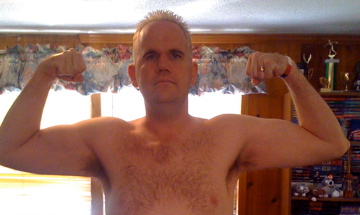 The results of my weight lifting have been pretty awesome The results of my weight lifting have been pretty awesomeGrowing up with an older brother who played football in high school was pretty intimidating. I didn't care a bit in the world about growing muscles, participating in athletics, or doing anything physically active. It just wasn't my cup of tea at the time and I had no problem playing alto saxophone in the marching band, pushing myself academically in preparation for college, and anything else that would keep me from EVER lifting a single weight in my life. Of course, this was incredibly stupid on my part because I had no idea that building up my muscles would aid in fat and calorie burning which might have kept me from becoming a 410-pound morbidly obese slob of a man as an adult. Thankfully I was able to find a diet plan that would enable me to shed that weight at the age of 32 and now I am in the midst of a journey to actively make my body stronger, leaner, and more powerful than it has ever been. BETTER LATE THAN NEVER! It was in December 2007 when I started my resistance training program in earnest for the first time in my entire life and I was dead serious about it this time. I've dibble dabbled with lifting weights before but didn't know what the heck I was doing, so I hired a personal trainer at my local gym to help me with proper form, effective repetitions, and the weekly accountability and motivation I needed to do this right. After just one month, I was seeing some incredible results already and in three months it was that much more pronounced. I had no doubt in my mind that the muscle growth and tone would take place, but it's nice to see it in real life on ME! What a feeling it is to actually be strong enough to carry in all the groceries at one time without straining at all. Or lifting the couch up for my wife Christine when she vacuums. Or even slamming the ball down with force during my Tuesday night volleyball games. I'm a different man now than I was before--and I like it! In my previous update after three months, I was complaining about the consistent pain I was experiencing after every single workout. It was rather excruciating in the first few months and I really did want to stop doing it (especially with the double whammy of seeing my weight go up by 30 pounds and STAY up since I began lifting weights). But I'm not a quitter and I didn't want to pay the penalty to get out of my contract with my personal trainer who I have enjoyed working with. And so I pressed on. 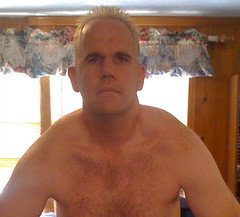  It's a great feeling when you see muscle development It's a great feeling when you see muscle developmentNow it's been a half-year for me lifting weights and I wanted to update you on how it's going. The delayed onset muscle soreness (DOMS) I was having is still there, but not nearly as severe as it was. My trainer especially likes working my abdominal muscles each time and I feel those for 2-3 days after working out. My shoulders, biceps, and quadriceps get a little sore as well, but I can handle it now very well. To me, it's a sign that the muscle was adequately exhausted which will result in quality muscle growth. After six months, I think I'm finally getting the hang of it. I certainly have a lot more to learn about lifting weights, but I have just enough knowledge now to make me dangerous. The muscles that have started to appear on my body are bigger and more defined than I ever thought possible. No, I'm no Arnold Schwarzenegger or Mr. Olympia, but I'd say the changes are pretty remarkable for someone in his mid-30s who has NEVER ever lifted weights in his entire life. It may sound a little egotistical to say this, but I'm pretty proud of myself for doing something like this for myself. Let's take a look at my progress since I started in December 2007. Here are some before and after photos in the six months I have been training about twice a week (one 30-minute session with my trainer and one self-guided 30-minute workout): 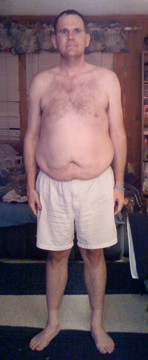  My neck has DEFINITELY gotten bigger because my collared button-up shirts are getting tight around the top button when I put on a tie. The muscle growth in my upper body has been pretty extraordinary. The same thing about the tightness in my clothes is happening in my shoulders and upper arms as the muscle growth continues to progress well in those specific areas. 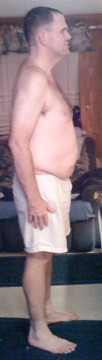  Here you can see where I've put on the extra weight in my stomach, but you can also see the muscles in the neck, shoulders, and arms that weren't there before. When we figure out what's happening with my weight and get it back down again, then I can't wait for even more definition to start showing up in my upper body, including my chest and abs.   The back side view again shows the muscles I have grown in the neck, shoulders, triceps and forearm that weren't there before. My trainer works my arms, shoulders and back regularly, so it's no wonder those are the areas I'm seeing results. As of right now, I weigh 264 pounds--up 29 pounds since I started my resistance training six months ago. Sure, some of that weight is muscle, but my personal trainer estimates the actual muscle weight I have put on is around 5-7 pounds. The rest is fat and that is so not cool. Again, I'm working on that with a low-carb doctor and will be going back for more tests next week to see if we can see why this is happening. It could be totally unrelated to my diet or I may need to tweak a few things with my possible reactive hypoglycemia strategy to make it work for me. For those of you who are wondering, no I'm not taking the creatine anymore. I did it for six weeks at the beginning of my resistance training regimen and have been completely off of it since the beginning of February. Any remnants of that stuff should be out of my system by now, so it's still a mystery why I have been unable to take the weight off that has come on me. If we figure it out, then you'll be the first to know about it. If you are thinking about adding some resistance training to your healthy lifestyle, then DO IT! I cannot say enough positive things about what lifting weights can and will do for your health. And don't worry about "bulking up" as it takes a lot of aggressive heavy lifting to make that happen. Hire a personal trainer, read a book like Slow Burn by Fred Hahn or The New Rules of Lifting for Women by Cassandra Forsythe, and even join a gym if you'd like. Of course, you don't really NEED any of those things to grow your muscles if you just lift your own body weight at home. But I've found the accountability that comes from getting dead serious about doing this is worth every penny you spend to get there. NEVER GIVE UP!!! Labels: creatine, gym, health, healthy, Jimmy Moore, muscle, personal trainer, resistance training, update, water weight, weight lifting, weights
When You're Low-Carbing Perfectly And Producing No Weight Loss--What Gives?
I've been guilty of it and now I realize it was just plain wrong. Here's the scenario: somebody sends me an e-mail and says, "Jimmy, I'm doing everything exactly as I am supposed to on my low-carb lifestyle and I'm just not losing weight." Okay, the first inclination that most of us, myself included, have is to suggest that person seriously evaluate what they are eating to look for hidden carbs and sugars, reminding them to follow their chosen low-carb plan exactly as the author prescribes, and then to determine if they are doing anything differently since the scale stopped moving downward. This should do the trick. It certainly sounds like good advice, right? Well, maybe not. Certainly, there are people who allow some old habits to slip back into their routine again and they experience the dreaded "carb creep" that has haunted many an unsuspecting low-carber as they live this lifestyle over the long-term. It's usually easily remedied simply by bringing your carbohydrate intake back down again to a level where you can still maintain or lose weight. I went through this myself a couple of years ago and it happens. But you get right back on plan again and all is well. So, let's say you are low-carbing perfectly and yet you are producing no weight loss. Aside from the occasional weight loss stall that can hit anyone at anytime, I have told people that the absence of weight loss while livin' la vida low-carb should make you very suspicious. You just never know what's going on inside your body that could be related to your weight refusing to go down or, worse yet, going up despite being on a low-carb diet. Even when you have that steadfast resolve to make better choices for your health, this can easily befall you. And I should know. It's exactly what's been going on with me this year and I'm baffled as to why it is happening. As my regular readers are already aware, I started lifting weights for the first time in my life beginning in December 2007 and was excited about getting stronger and firming up areas of my body that were still plagued by loose skin from my 180-pound weight loss. A trainer friend of mine suggested I start taking creatine to supplement my resistance training in the first couple of months to help get me going. He warned me that I'd gain some weight taking it, but that the weight would come back down again after I come off of it. After loading up for a few days on the creatine, I religiously took that stuff daily for about six weeks. When I started working with my personal trainer in mid-December, my weight was 235 pounds. Six weeks later, I weighed 260 pounds--A 25-POUND INCREASE! Holy cow! My trainer friend sure wasn't kidding when he said I'd gain weight on creatine. It was at this point that I decided to come off of the creatine in early February since that weight gain was sorta freakin' me out a bit. I fully expected the weight to come back down some (but not all since I was building up some good muscles especially in my upper body). But it didn't happen and it hasn't happened. In fact, although my diet didn't really change from what I was doing before I started lifting weights (except for maybe a little more protein since I was trying to grow muscle mass), I have been hovering around 265 pounds for nearly four months in a row. It has been so disconcerting to me that I went to see a low-carb doctor earlier this month about it to see what was going on. What was I doing wrong, if anything, and how can we get the weight to come back down again? I was adding muscle to my body, yes, but my waist has also increased by a few inches. What gives? Of course, when I started sharing about this recent weight gain at my forum and at my menus blog, the typical responses started pouring in from people trying to offer their own guidance about what I should do: you're eating too much food, your calories are way too high, you consume too many low-carb "products," you aren't eating often enough, you don't exercise enough, yadda yadda yadda! I know everyone means well and I sincerely appreciate their suggestions for my diet. But I wasn't convinced I was doing anything at all wrong with my low-carb lifestyle and I still don't. Nevertheless, I'm stuck. That's why I went to see this low-carb doctor. Perhaps he could pinpoint exactly what's going on with my weight. He ran a series of tests on me, examined my dietary choices, looked at the supplements I am taking, and asked me about any changes I have made since the weight gain took place. I told him about the weight lifting and adding more protein to my diet. I also switched brands of fish oil since then as well as adding cinnamon to my daily vitamins. His proposal for me was to put me back on a very strict Induction diet for two weeks and to cut out all of my supplements as a temporary measure of seeing if they are the reason for my inability to lose these 30 pounds. Additionally, I reduced my diet soda consumption voluntarily to make sure that wasn't a culprit as well. The two-week Induction period began on May 7th and ends today. Wanna know the grand total of the amount of weight loss I've experienced since cutting out all the low-carb "Frankenfoods" (which have never been a MAJOR part of my diet, just some chocolate and the occasional treat), eating strictly low-carb Induction for the past two weeks, and never wavering or cheating at all during that time? Zip, zero, nada! That's right--NOTHING! And, in case you are wondering what I ate these past two weeks, see for yourself: May 7, 2008May 8, 2008May 9, 2008May 10, 2008May 11, 2008May 12, 2008May 13, 2008May 14, 2008May 15, 2008May 16, 2008May 17, 2008May 18, 2008May 19, 2008My diet could not have been more perfect following strict Atkins Induction. I did it even more strict this time around than I did in 2004 when I lost my weight the first time. I checked my ketosis levels using Ketostix every single day and I was DEFINITELY excreting ketone bodies. My carbohydrate intake remained at or below 20g daily and I basically did everything exactly right. I didn't even have any one bite of my low-carb chocolates during this time which was a BIG sacrifice for me. The net result of this effort was NO weight loss. COME ON!!! It's at this point that most people would be ready to just throw their hands up and give up on this stupid low-carb diet thing. I mean, you follow it like you are supposed to and this is the reward you get for that dedication?! AAACK! But I'm not looking at it that way. The way I see it, even if for some odd reason the weight NEVER comes back down again (I know it will, but let's just pretend it won't), the low-carb way of eating is so incredibly healthy that I wouldn't dare think of eating any other way. Remember, even if the scale isn't moving, your healthy is still improving. I'll be sharing some exciting numbers with you about my health soon that will both shock and inspire you as you continue down this journey to better health the low-carb way. Even my low-carb doctor was amazed at my numbers, but he said I am exactly where I need to be to keep my risk factors for cardiovascular disease at bay. That's a sweet sound to hear especially in light of my weight concerns! :) So what now? Beginning this afternoon at 6pm, I will begin something that I swore I'd never do again--the intermittent fast. If for some reason I am consuming too many calories even on my low-carb lifestyle as some have proposed, then this should do the trick. The last time I did it, I lost 4 1/2 pounds in a week although I hated it. But if we can get those few stubborn pounds to start moving again, then it'll be worth it. I'm ready to figure out what's going on and I'm certainly doing everything I can in my diet to make that happen. My doctor says there may even be a non-diet related reason for my weight gain which intrigued me. Yes, some of the weight is indeed muscle as my biceps, triceps, shoulders, neck, chest and legs are all noticeably bigger now five months after beginning my weight lifting, the fact my stomach has gotten bigger is the greatest concern. There may be an underlying internal issue going on that could be the culprit in my abdominal weight gain. Even before my low-carb lifestyle began in 2004, I have had trace amounts of blood in my urine during routine physical exams. I've been to see a urologist before, they've performed an IVP (shooting dye through me) as well as a very expensive 30-second cystoscopy test only to be told there is nothing wrong with me, and to take an antibiotic. After I take the antibodies, the blood goes away for about six months and then it comes back. When I go back to the urologist, they want to do another IVP and cystocopy followed by antibiotics again. UGH! Obviously, something is going on, but heretofore nobody can tell me what it is. That blood in my urine may indeed be the reason why my weight is increasing. I'm aware of two other prominent low-carbers who have been through similar strange and unexpected weight gains over the past couple of years. I won't share their names because of privacy concerns, but one gained about 50 pounds and ended up eating just chicken and pickles for a year trying to get the weight back down again. It turns out, there was a cyst pressing up against the pancreas causing constant insulin to be released. And we know what that does! Since the cyst has been removed, the weight has come back down again in short order. The other person had another strange issue with the development of a fibroid in the stomach. Although the body was normal elsewhere, this person's belly was protruding out. When the doctors found the fibroid, this person was relieved that nothing was seriously wrong. Of course, the naysayers pointed to this well-known low-carber and claimed that they can't seem to follow their own advice. You get that when you put yourself out there, so you learn to ignore it. This person now faces a pretty major surgery to remove the fibroid and is putting it off until the end of the year. And that's the other issue with all that's going on with my weight right now. I've become more self-conscious about how I look again. Are people looking at me judging that I must be letting myself go again since I've gained weight? Do people nervously say to my face that they're happy to see I'm still keeping the weight off after all these years while simultaneously thinking, "Oh boy, here he goes gaining it all back again! I knew it would happen eventually!" These psychological games are virtually impossible to ignore, although I'm trying very hard to do just that--IGNORE THEM! It just adds another layer to this developing story. What exactly is happening to me right now, I don't know. I wish I did so I could help others going through similar circumstances. We're getting closer to knowing than we did before and that's a good thing. Rest assured you will know when I know and I covet your thoughts and prayers as we try to figure this all out. I'm not worried at all because I know I have a plan of action that will put me in position to lose the weight I've put on since December. I am very pleased that my weight has NOT increased since February. I've been right around 265 for the past three months although my muscles continue to get bigger and bigger. So, in essence, I have been losing some weight while gaining the muscle, but it has been offset. That's encouraging and I wouldn't mind seeing my muscles continue to grow in size as long as my weight remains where it is. A 6'3" man with big muscles could easily weigh 265 pounds, right? :D Let this be a gentle reminder that low-carb living is always a work in progress and we should assume anything about anyone who is following this lifestyle. There are just too many underlying issues at work to make judgments about someone who is not losing weight while following low-carb. Yes, some are preventable...but others like me are not. This has opened my eyes to a new level of appreciation and compassion for anyone who is struggling with their weight and health and concerned about what to do. You are NOT alone. THANK YOU again to everyone who has offered advice and support during this time and I will report back to you my progress on my intermittent fasting experiment for the next two weeks. It certainly can't be worse than what I've experienced the past two weeks on strict Atkins Induction. You can see what I'm eating at my menus blog and provide your continued feedback. I will likely add back in some low-carb chocolate again on the days I'm not fasting and staying low-carb the rest of the time. Let's see what happens! Labels: Atkins, creatine, diet, doctor, Induction, intermittent fasting, low-carb, menu, weight gain, weight lifting
Three Months Of Resistance Training Down, A Lifetime To Go!
 Lifting weights for the first time in my life has been hard Lifting weights for the first time in my life has been hardI've been getting a lot of e-mails lately from so many of you asking about my progress with my resistance training program I started in mid-December 2007, so I will endeavor to update you today after 15 weeks of working with a personal trainer and on my own to build muscle and tone up areas of my body where the remnants of my former 410-pound self still haunt me. You'll recall from my one-month weight lifting update in January 2008 that I was already seeing some measurable results from the work I have invested. Right now I meet with my own personal trainer at the gym once a week for a 30-minute session and then various other days my weight lifting is self-guided. It's been good for accountability to report to a personal trainer I have to look at week in and week out because it forces me to stay serious about this and resist the temptation to slack off. I'm gonna be dead honest with you about this experience--I HATE IT! My body has never been this sore in my entire life. I thought it was only gonna be a temporary pain, but I'm experiencing some sort of delayed onset muscle soreness (DOMS) and other chronic muscle pain after EVERY SINGLE TIME I workout. There are some days following my intense workouts that I absolutely cannot move. Last week was a prime example and you can read about how debilitating my workout was in this post from my menus blog. OUCH is the operative word! But as the old saying goes, "No pain, no gain." And I'm doing my best to put on a happy face in the midst of the pain. It's not just muscle soreness either. I've been having intense headaches that feel like migraines (and I NEVER got headaches before!) and my weight has increased by about 30 pounds and sustained there for over a month. I can deal with the headaches, but the weight gain is freaking me out a little bit. This was one of the reasons I was apprehensive about lifting weights during my weight loss in 2004. I had always heard that when you build muscle, you will gain weight and it's a good thing. And I wholeheartedly agree with that notion because you absolutely want to have muscle on your body so you can burn more fat and calories on a regular basis. That's why I took the plunge and decided to embark on this journey a few months ago because I knew it would be worth it to me. And I can't argue with the results I've seen so far. Check out these comparison pictures from when I started in December 2007 and the ones of myself I took today: 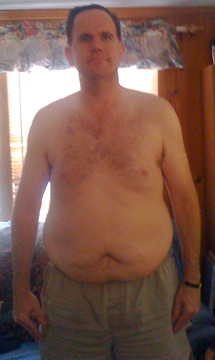 The first thing you'll notice from this front view comparison is my neck, shoulders and arms are noticeably bigger. I've been working those three areas of my upper body very hard for the past three months or so and that investment is paying off. Before I began my resistance training, I was basically bony all across my upper body as you can see in that picture on the left. But there is real definition kicking in now and the "loose skin" in my arms and neck from my weight loss is beginning to stretch out with muscle. WOO HOO! 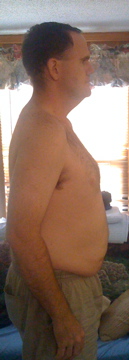 With the side view comparison, first take a look at my arms. You'll notice my elbow is kinda pointy in the left picture and then is rounded out with muscle in the one in the right. And my bicep and forearm are much larger than before. My wife Christine noted that my chest has grown too and now matches my stomach. Hopefully the chest will continue to puff out as I bench press and my waist will shrink (although the "loose skin" in my belly ain't going anywhere anytime soon). 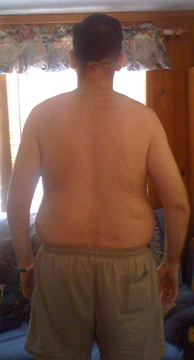 Finally, looking from the back side, my triceps, neck and shoulders are more muscular than they were before. That was to be expected. But I couldn't help but notice that my hips are getting smaller. This is real progress and I can't wait to see what the difference will be in another three months when I update my 6-month progress. But the weight gain remains. As of today, my weight is 259 and I'm not happy about that. Sure, you can attribute some of that gain to the new muscle on my body and I LOVE that. But what's up with gaining 30 pounds in three months after lifting weights? Check out my menus and you'll see I've been eating VERY good since beginning this regimen and have even seen my calorie and overall food intake shrink in recent days. I'm not doing anything that different from before except maybe a little bit extra protein to supplement my workouts. I did take the supplement creatine when I first started my weight lifting to try to give myself a bit of a boost with the workouts since I'd NEVER lifted weights in my life. I stopped taking it after a couple of months of the training since my weight started predictably going up to see if my weight would come down a bit. It hasn't yet, but I'm noticeably larger now in my arms, neck, shoulders, chest and legs from all the resistance training. This is the best thing I've done for my health since I lost my weight in 2004, though. For that, I am extremely happy. Let me be clear--I'm not worried about this to the point that I feel like there is no way to turn this situation around. I've already mapped out a course of action if my weight does not start coming down soon and that includes going to see a doctor to find out if there is something metabolically going on with me that is totally unrelated to my resistance training. It seems too coincidental for it not to be related in some way, but I'll know with certainty if I can get checked out. That may happen within the next month or so. In the meantime, I'm closely monitoring my weight on a daily basis as I always do and I'm feeling fabulous (other than the muscle soreness!). My strength has increased dramatically which has made other parts of life (like lifting boxes, carrying groceries, and even my golf game) more pleasurable than they were before. I'm no Heman yet, but with continued effort for the rest of my life I WILL be! :) THANKS to everyone who has encouraged me as I began this new weight lifting routine and I hope my experience will be just what you need to get started on your own program real soon. I HIGHLY suggest you check out Fred Hahn's Slow Burn plan because it is helping a whole lotta people with busy schedules squeeze in a solid workout that is changing their lives forever. Whatever you do, don't let those demons inside your head tell you this is impossible. It may be hard--VERY HARD!--but it is NOT impossible. YOU CAN DO IT!!! Labels: exercise, Jimmy Moore, personal trainer, resistance training, sore, weight gain, weight lifting, weights
Hahn: Long-Term Aerobic Training Causes Premature Aging And Damage To The Heart
 Fred Hahn is making a "Slow Burn" believer out of me1. When you start talking about living a healthy lifestyle, generally the conversation begins with your diet and the kind of foods you put inside your body. While that is certainly the logical first step when it comes to losing weight and improving your health, most people tend to neglect another important factor in the weight and health equation: exercise. Ah yes, the dreaded “e” word! Fred Hahn is making a "Slow Burn" believer out of me1. When you start talking about living a healthy lifestyle, generally the conversation begins with your diet and the kind of foods you put inside your body. While that is certainly the logical first step when it comes to losing weight and improving your health, most people tend to neglect another important factor in the weight and health equation: exercise. Ah yes, the dreaded “e” word!
But what if everything you think you know about exercise is just plain bogus? Have we been duped into thinking we need to spend hours running on a treadmill when actually that might cause your body more harm than good? YIKES!
Well, my special guest here today at the “Livin’ La Vida Low-Carb” blog knows a thing or two about this subject, so we’ll ask him what he thinks. He is professional exercise trainer Fred Hahn, owner of Serious Strength, Inc. and co-author of a fabulous book with Drs. Michael & Mary Dan Eades called The Slow Burn Fitness Revolution.
Welcome Fred! Tell us a little bit about why you got started working in the world of fitness and health and how you stumbled upon this whole “Slow Burn” concept to begin with.Jimmy let me say first off that it’s an honor and a pleasure to be interviewed by you. Thank you for giving me the opportunity. Your web blog is first rate. I started working in the fitness field in the 1980’s as a personal trainer at the New York Health and Racquet Club when it first opened. I worked there on and off for a few years interspersed with college studies and carpentry work. In 1993 I became certified as a personal trainer by the American Council on Exercise. At that time I was working as a physical therapy aide (not a physical therapist) at the newly built Hospital for Joint Diseases Sports Medicine Center. I administered much of the strength training and conditioning programs for the patients there. While there I also worked as a personal trainer at the original Equinox Fitness Club in NYC. When I was hired by HJD, I was fascinated by how little the therapists did to strengthen the patients. Most of what the patients were asked to do was treadmill walking, bike riding, slip-slide boards, BAPS balance training, etc. These modalities did little to strengthen the patients’ muscles. The sparse amount of strength training they did advocate was very low in intensity and thus nearly useless. I wanted and needed to change this. A funny story: One typical day, a dancer, who was recovering from knee ligament surgery, was surrounded by a posse of therapists who were scratching their heads as to why the woman could not stand and balance on her injured leg very well. She’d try and collapse - try again and falter. They had spent weeks on her rehab program placing her on the underwater treadmill, giving her BAPS balance drills, TENS units, heat, ice, ultrasound, etc. (This was a common scenario by the way.) As they mused, mumbled and murmured over her malady, one therapist (the novice in the group) shot forth a possible answer. “Maybe she’s just weak?” she humbly heralded. Although they were surrounded by $50K worth of strength equipment, back to the BAPS board she went. Sad indeed. So I started to use the strength training knowledge I had (which was mostly Nautilus high intensity strength training principles) to focus on strengthening and less on the passive modalities. The therapists seemed pleased that the patients were responding better and faster under my instruction. But I swiftly realized that the faster paced Nautilus reps (2 seconds to lift the weight, 4 to lower) irritated many of the clients’ orthopedic issues. I remembered reading about slow reps in a strength and health magazine article from the 60’s that a friend sent to me which I initially ignored. I decided to revisit the idea of slow training and began reading about it in various venues and decided to give it a try with the patients at HJD. To make a long story short, the pain and irritation they had with the faster rep speed all but disappeared and the patients responded faster and better to the slow method. It was quite remarkable. In the beginning, the PT’s would often silently watch me put a person through a fairly intense Slow Burn strength workout looking sort of bewildered. But they recognized that what I was doing was working incredibly well so they left me alone. The only thing that bothered them was when the patients would say “Can I have Fred instead?” upon being assigned to a PT. One more funny story: One day a PT pulled me aside after putting a senior woman through an intense (for her) set of Slow Burn leg presses and said “What are you trying to do – make that old woman as strong as Arnold Schwarzenegger?” I paused for a second and answered “Yes, yes I am.” It is very odd to me that with senior health care costs skyrocketing, something as simple as strength training is hardly ever prescribed. We let our respected and beloved elders grow feeble and waste away for no reason whatsoever. Back to the story. Unbeknownst to me, many of the patients loved how they felt so much that they were telling the head orthopedic surgeon about it. One day as I was training someone, the doctor appeared in front of the glass window and gestured to me to come hither. It seemed like I was in trouble or something. I went outside of the clinic and he said “What are you doing with the patients?” “Making them strong,” I responded. “Yes you are!” he replied and then asked me to train him at his gym in his apartment complex. He was so pleased with the results that he and I decided to open a physical therapy clinic together which I ran for 3 years. We focused on slow speed strength training as the primary form of orthopedic rehab therapy and used passive modalities as a secondary measure. Patients loved it. We trained their entire body – not just their injured limb in less time than it took to train just their injured limb conventionally. There’s a lot more to this story but that is how I got started with slow training. 2. Your philosophy regarding building muscles and increasing strength is indeed one of the most revolutionary methods I have ever heard about. You claim that in just 30 minutes a week anyone can achieve amazing results by implementing the strategies you outline in your “Slow Burn” method. This runs directly counter to the conventional wisdom that you need to spend hours upon hours in the gym pumping iron, doing abdominal crunches, and getting in lots of reps to help sculpt your body the way you would like it to look. Come on, are you serious? Just 30 minutes a week is all it takes? What’s the catch, Fred?There’s really no catch Jimmy except perhaps the degree of effort. A lot of people want their exercise programs to be fun, enjoyable and easy. These types of activities are what I refer to as ‘pastime activities’ – not formal exercise since ideally, exercise is supposed to create a positive physical adaptation. Pastime activities rarely do so. Easy efforts when exercising simply cannot cause the kind of positive adaptation people so desperately want and need. This is not my opinion, it is fact. Slow Burn training is challenging and takes a lot of concentration and focus. But so does anything that provides exceptional benefits. Truth be told, it’s not really my philosophy – what I advocate is rooted in exercise science. It’s just not very flashy or sexy nor does it make the industry billions of dollars as do so many exercise fads and gadgets that don’t work. Research indicates that two, twenty minute strength training sessions a week provide all of the benefits strength training can bestow. Further, the benefits that you get from two, twenty minute strength training sessions are everything you need to become and stay healthy and strong and this includes the heart. This is a very freeing and exciting reality that people desperately need to know about. The experts who tell you that you need to do weights at least 3 times a week, aerobics almost everyday and stretching everyday in order to be fit and healthy are innocently ignorant of the facts. 3. I recently started lifting weights for the first time in my life beginning in December 2007. I hired a personal trainer to work with me so I can learn the proper form and technique for working the various muscle groups on my body. As a newbie to this kind of thing, I can tell you how utterly clueless I am about what I’m doing and am relying heavily on my trainer to show me the ropes so to speak. After one month, my results have been okay.
I know I’m not alone in this feeling and it’s something that scares away a lot of people from even trying to implement a resistance training program into their own life. Am I being counterproductive to the “Slow Burn” program by having a personal trainer help me in a more traditional manner? Or is there any benefit to being trained by someone who may not be familiar with the “Slow Burn” concepts?Good for you Jimmy for starting! Strength training is by far the single best exercise modality a person can engage in to better his or her entire body. Here’s the down and dirty truth – many different types of strength training programs will work. Having said that, other strength training programs may not work as well or be as safe as or efficient as Slow Burn. For example, Pilates is a form of resistance training - nothing more, nothing less. But the kind of resistance used is springs on a reformer or body weight on the floor and very often this is an inefficient and less effective way to strengthen muscles. (And NO – Pilates cannot make muscles long and lean like a dancers. This is a little white lie Pilates practitioners tell their clients.) The real question is this - what is your safety and time worth to you? A trainer who is worth his salt can easily read my book and be able to implement a Slow Burn workout. As for people who can’t afford a personal trainer, my book The Slow Burn Fitness Revolution and Slow Burn Workout DVD provide what anyone needs to implement a Slow Burn program. In fact, I’ll be creating more DVD’s and online programs for using Slow Burn with many other exercise devices. 4. My understanding of the “Slow Burn” strategy is this: lifting as much as you can possibly stand in a slow and deliberate manner so you force your muscles to work as hard as they can to produce maximum strength gains in a shorter period of time. I gotta tell you, this sounds intimidating to someone who has only just begun lifting for the first time. Reassure me and anyone else who may be skeptical of the “Slow Burn” plan that this is much better than the moderate weight, high repetition that is commonplace among most personal trainers. What are the benefits of doing it your way compared with typical resistance training?Whoa there Jimmy - the way you’re saying it DOES make it sound intimidating, but this isn’t exactly what Slow Burn is. Typical resistance training programs usually have the trainee tossing and dropping the weight which causes unnecessary stresses on the joints and connective tissues – even with a light weight. By moving slowly with the correct weight, you minimize momentum and maximize muscular tension when performing the exercises. This decreases the forces and reduces the risk of injury. If anything, people should fear conventional training! With Slow Burn you’re essentially asking your muscles to do all of the work all of the time. This constant muscular tension without the sudden impact forces allows a trainee to remain injury free and produces a very strong and enduring body. Slow Burn is about building yourself up without beating yourself up. I often refer to Slow Burn as the ‘Tai Chi of weight lifting.’ We train every sort of person from 7 year old kids to people in their mid eighties. They all do the program without any problems. 5. I can tell you from personal experience during these first few weeks of beginning my weight training that I have had some pretty intense muscle aches and pains that have literally wiped me out for days. Some mornings I could barely roll out of bed because my biceps were so sore from the rigorous training from the day before (and the day before and the day before that!). What can be done to prevent that from happening? Is it better to sit out a day or two from even working other muscle groups when other muscles on your body hurt that much after a workout like that? Does the “Slow Burn” method provide any relief from such excruciating pain?What can you do about this Jimmy? Switch to Slow Burn! (Shameless aren’t I?). One of the benefits of Slow Burn is that the type of post exercise pain (delayed onset muscle soreness) you experience is almost non existent. This is not to say you don’t feel sore and tired a day or two later from a Slow Burn workout – you do. But the feeling is very different – sort of like the difference between a deep massage and a kick boxing class. The feeling is milder, gentler, more like you did something great for your body than hurt yourself as you describe. The workout itself is far more exhilarating than exasperating and, man, do you ever sleep well after a Slow Burn session! And one very important thing to know is this – you receive the physiological benefits from exercise while you rest, not while you exercise. Research indicates that the human body typically requires a couple of days of rest and recovery before productively exercise happens again. Some people might require 3-4 days of recovery between strength training sessions. It depends on age, how active you are outside of your strength training, and a few other things that a good instructor should know. Arthur Jones, the inventor of Nautilus is credited with saying “We’re trying to discover how little exercise you need, not how much you can withstand.” 6. One excellent benefit of the “Slow Burn” technique is that it helps to change the body metabolically in addition to the increases in strength and muscles. In other words, there are cardiovascular benefits that come from training this way that makes walking on the treadmill, using the Stairmaster, riding a stationary bike, or stepping on an elliptical machine obsolete. Convince me and anyone else who still feels cardio exercise is important to our health why we should give it all up in favor of the “Slow Burn” program instead. Are all of us simply running ourselves ragged increasing our heart rate and sweatin’ like a dog for nothing?Strength training is cardiovascular Jimmy – it’s simply a different road to Rome. You stimulate the heart and lungs very powerfully by strength training properly. As for running yourself ragged and sweating doing aerobics, if your doing it because you think you have to in order to keep your heart healthy and/or to lose fat you’re pretty much wasting your time. Most of the aerobic training programs that people do cause them more long-term harm than good. The orthopedic issues are a no-brainer – everyone knows that aerobics can cause a host of orthopedic maladies (in fact the aerobics boom of the 70’s, started by Dr. Kenneth Cooper, was the reason sports rehab became a huge money-making industry!). But what people don’t know (and pay for later) is the accelerated aging that comes with performing continuous long term aerobic activity. Steady state aerobic activity damages hormonal tone by using up resources at an accelerated rate. ‘A sun that burns twice as hot burns half as long.’ Aerobics to better your body is a sham. What people also don’t realize is that aerobics do not strengthen the heart and lungs. In fact, chronic long term aerobic activity can damages the heart. (I go over this in great detail in my book.) The few benefits one receives from aerobics are mainly muscular in nature. Strength training provides you all of the same benefits that aerobics does and much more all without the damage – if you strength train properly. I challenge anyone to tell me what aerobics can do for a person health-wise that properly performed strength training cannot that a physician considers important upon a thorough physical exam. Even Dr. Cooper, the father of aerobics, now advocates strength training as the focus of an adult person’s exercise program. Jimmy, I could go on and on for pages and pages, on this issue. A good book to read on this issue is Making Waves by Roger Lewin, the story of Irving Dardik, MD. 7. The thing that attracted me to your book is the fact that Drs. Mike & Mary Dan Eades from Protein Power fame co-wrote it with you which means a very solid message of livin’ la vida low-carb is a major part of your plan. Discuss why carbohydrates are not a necessary for energy on a strength-building program like “Slow Burn” and share where the body gets its energy to perform the physical tasks you require as part of your program. How does dietary fat and to a lesser degree protein become the primary fuel source for the “Slow Burn” workouts? Speaking of protein, how much of it do you need to consume before and after your workouts?Well, the answer to that can be a book in and of itself! Here’s how it works – dietary carbohydrates are not necessary because of a process called gluconeogenesis. As any good low-carber knows, this is the synthesis of protein to glucose from non carbohydrate sources, like meat, fish, eggs, and other protein sources. Sufficient fat is necessary for the best utilization of protein so I suggest fattier grass-fed meats over lean cuts of meat. Saturated fat is good for you, not bad as many would have us believe. The amount of protein you need differs depending on your size. To gain muscle size and strength, eat about a gram of protein for every pound of lean body weight over the course of a day. This might be a smidge too much but you’re better off eating a touch more protein than a too little. A 150 pound lean man should eat 150 grams of protein per day. For a man lean is 15% body fat or less, for a woman 20% or less. Stay on the low carb/Slow Burn training course and the body will, slowly but surely, shift from being a sugar burner to a fat burner and unwanted body fat will fly off of you faster than you can say Jackie Robinson (or Dr. Michael and Mary Dan Eades). At the same time, you’ll spare or even build muscle mass to boot. Veggies are the go-to choice for carbs as well as some seasonal fruits. I suggest a good meal 30 minutes after your Slow Burn session. What’s a good post-exercise meal? A juicy bacon cheeseburger (no bun) with lettuce, tomatoes, onion, and avocado, or steak and eggs with sliced tomatoes. Eating low-carb the possibilities are endless – and tasty! 8. Is it important to supplement your “Slow Burn” plan with any specific vitamins or other minerals and nutrients so that you maximize your body’s ability to repair itself and get stronger? If so, then what would you recommend? What do you think about the use of creatine for someone new to weight lifting?If you’re eating low-carb, meaning plenty of protein, you’re getting all the creatine you need. I’ve experimented with creatine and it has done absolutely nothing for me since creatine is found in ample amounts in fish and meats and I eat ample amounts of fish and meats. Creatine supplements are expensive (less so now) and can cause bloating and loose bowels. As for dietary supplements, I bow to the Eades on this issue and I personally follow their recommendations especially the krill oil for omega 3’s. But if you don’t supplement and eat healthfully, you’ll get great results from Slow Burn. 9. My favorite part of your book is in the back where you provide a pictorial demonstration along with preparation instructions for doing a variety of exercises whether you have access to a gym or not. It helps to have a visual demonstration when you are going it alone, but there’s always some nagging doubt that creeps into the back of your mind about whether you are doing it right or not.
What do you suggest to someone who needs some reassurance that they are following the “Slow Burn” methods properly? Can a traditional personal trainer provide any assistance with this or will a specialized personal trainer educated in the “Slow Burn” techniques be required to help? How can people find an approved “Slow Burn” trainer in their area?Well just like talking to the Eades directly as opposed to reading their book, it’s better to have a qualified instructor well versed in Slow Burn for best results. On my web site there are some affiliates listed in the Friends and Partners page. But my book is pretty thorough (I like to think) and I also answer ALL emails personally. I even have an at home DVD workout where you follow along with me doing the exercises. My website also has a free online discussion board where people share ideas and help others learn. But just to warn folks - my message board can get a touch huffy at times. I monitor it frequently and if things get to messy, I clean it up pretty quick. Most of the people there are real good at sharing and helping. I get dozens, even hundreds of emails from people telling me how much they love the book and DVD and how easy it is to follow, not to mention the great results they are getting. 10. THANK YOU for being with us today, Fred. It’s always inspiring to hear from real health and fitness experts who actually know what they are talking about because they live by the very principles they espouse. I’m excited about my own journey to get bigger and stronger this year, especially in my upper body, and can’t wait to see the results I have been longing for ever since I lost 180 pounds in 2004.
One last question for you: is the “Slow Burn” technique permissible for virtually anyone, including the morbidly obese, the elderly, and even children? Are there any modifications that need to be done to the program to tailor it to these various groups of people?In sum Jimmy, Slow Burn is safe and effective for anyone, seniors and juniors alike. In fact, I have a new book coming out this year on strength training and low-carbing for children. My mission is to get teachers, parents, doctors, coaches and caregivers to understand the tremendous benefits strength training has on kids, especially obese kids. Strength training in combination with a low-carb diet would virtually eliminate adolescent obesity and type II diabetes. I hope people can have an open mind and embrace science over convention on this issue. It’s one thing to dupe adults – it’s entirely another matter to do so to children. Unfortunately, even some of the most prominent and well meaning advocates of curing adolescent obesity like Oprah and President Bill Clinton are innocently ignorant of the real cause and cure for this growing problem. I urge everyone to make strength training a part of their lives. It will improve so many health parameters and de-age you in ways no other exercise program can. Lastly, may I say thank you Jimmy for the praise of my work and for the opportunity to be featured by your first rate blog. Keep up the great work! THANKS again, Fred, for an awesome interview! I am going to commit to implementing slow burn techniques into my own workout routine and can't wait to see the results. To learn more about Fred Hahn's "Slow Burn" techniques, visit his web site SeriousStrength.com, his "Slow Burn" blog, and pick up a copy of his The Slow Burn Fitness Revolution book co-written by Drs. Michael and Mary Dan Eades. Labels: fitness, Fred Hahn, health, interview, low-carb, resistance training, Slow Burn, weight lifting
'Livin' La Vida Low-Carb Show' Episode 106: Part 2 Of My Chat With 'The Biggest Loser' Bill Germanakos
 "Got Milk?" ad with "The Biggest Loser" Bill Germanakos "Got Milk?" ad with "The Biggest Loser" Bill GermanakosAfter sharing with you Part 1 of my interview with "The Biggest Loser" 4 winner Bill Germanakos on my podcast show on Monday, it's time to hear Part 2 and the conclusion of that interview during Episode 106 of "The Livin' La Vida Low-Carb Show with Jimmy Moore" today. Fans of the hit NBC-TV reality weight loss series "The Biggest Loser" are given a small glimpse behind-the-scenes of what makes this one of the most popular and inspiring shows on television these days. Click on the "LISTEN NOW" link below or download it to your iPod to hear today's podcast:  "The Livin' La Vida Low-Carb Show with Jimmy Moore" Episode 106 [17:43m]: LISTEN NOW | DownloadBill Germanakos was quite candid during Part 2 of my interview with him about how he feels about livin' la vida low-carb. I was grinning from ear to ear when I heard him talking about keeping his carbohydrate intake to 20 percent of his total calories (WOO HOO!) and avoiding "anything white," including bread, pasta, and sugar. This was quite refreshing to hear and not surprising since every previous winner of "The Biggest Loser" has implemented some form of carbohydrate restriction to their diet. In Part 2 of my interview with Bill Germanakos, he also talks about what kind of sweetener he uses instead of sugar (and it just might surprise you!), the enormous benefits of resistance training and cardiovascular exercise in his weight loss success, the inherent dangers of drinking regular soda (and our host Jimmy confesses to Bill how much sugary soda he used to drink!), as well as Bill's potential plans for the future to continue inspiring and educating the masses about getting healthy. It's time for you to be your own "biggest loser" right now by: 1. Listening at the official web site2. Calling (818) 688-2763 to listen via Podlinez3. Subscribing to the RSS feed 4. Going to iTunes-- Click here to subscribe! Now that you've heard from Bill Germanakos in Episode 106 of "The Livin' La Vida Low-Carb Show with Jimmy Moore," I'm curious to hear your reaction. Do you like his chances for keeping the weight off long-term by continuing down the low-carb path he has chosen for himself? Are you intrigued by the fact that the nutritionists and trainers on the show taught him about the inherent dangers of consuming too many carbs on weight and health? Talk about it in the show notes section of Episode 106 and express yourself. Like I shared in my previous podcast post, I am in the midst of bringing you more interviews with the contestants from Season 4 of "The Biggest Loser," including Bill's brother and the at-home $100,000 winner Jim Germanakos as well as his fellow Black Team members Hollie Self and Isabeau Miller, Red Team members David Griffin, Lezlye Donahue, and "B" Andretti, as well as Blue Team members Neil Tejwani, Nicole Michalik, Ryan Rodriguez, Kae Whang, and the oldest contestant ever--62-year old Jerry Lisenby. I've been working diligently for over a month trying to secure these interviews and will share them with you soon and very soon. :) Don't forget to check out the outstanding web sites created by Bill Germanakos located at HalfTheManTwiceTheMan.com and BiggestLoserTwins.com to keep up with what is happening with the Season 4 winner of "The Biggest Loser." You can even book Bill and Jim Germanakos to come speak in your area and buy some cool merchandise from the brothers, including that CD with Sinatra favorites sung by Jim. You can listen to FREE clips from the CD, too. THANKS for your support of "The Livin' La Vida Low-Carb Show with Jimmy Moore" and listen again on Monday as we bring you another motivating and inspiring message of hope in your healthy low-carb lifestyle. SEE YA THEN! ;) Labels: biggest loser, Bill Germanakos, exercise, health, interview, low-carb, podcast, resistance training, soda, The Livin' La Vida Low-Carb Show, web site, weight lifting, weight loss
Jitomir: Don't Be Afraid To Make A 'Commitment To Living A Healthy Lifestyle'
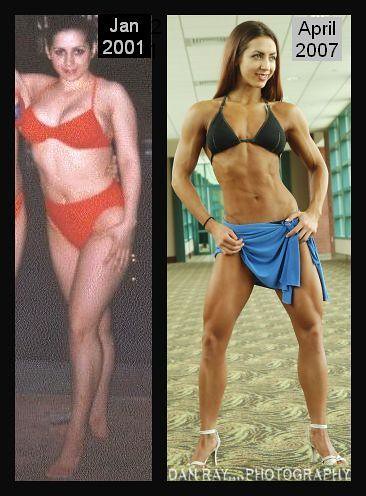 From a tumultuous childhood, Jean Jitomir now living a dream From a tumultuous childhood, Jean Jitomir now living a dreamThink back in your life to a time when you were not in the most ideal situation for living healthy. That time could be RIGHT NOW for many of you, but for Jean Jitomir that was in her childhood when circumstances out of her control put her in a position that would later motivate her to do something meaningful not just in her own life, but in the lives of others. Today, I want to share Jean's story with you because hers is one of transformation and rising up to new challenges in the face of certain failure. None of the past really matters to her now because she knows she is light years away from where she used to be thanks to her own hard work ethic and undying spirit to excel at everything she does. As you can see from those before and after photos at the top of this post, Jean has changed her life and health through her diet and regular resistance training routine. Since I am new to weight lifting and in the midst of making this a regular part of my healthy lifestyle, I decided to interview Jean Jitomir from the "Built Nutrition" blog to learn more about how she incorporated bodybuilding into her life and to dispel some of the myths about women lifting weights. You won't agree with everything she says (especially regarding diet), but it's hard to ignore the final results. ENJOY! 1. I'm pleased to welcome to the "Livin' La Vida Low-Carb" blog today a woman who knows what she's talking about when it comes to getting into shape. Not only can she talk about it, but she LIVES it herself. I'm describing for you registered dietitian, exercise nutrition doctoral candidate, and national light weight bodybuilding competitor Jean Jitomir. As you can see from her pictures at the top of this blog post, she has sculpted and built her body into one bad mamma jamma! Welcome Jean!
Lifting weights has traditionally been a "man" thing, but you have proven that stereotype is just not true. What got you interested in resistance training to begin with? Were you ever worried about "bulking up" too much and losing your femininity?First of all, thanks a lot for the warm welcome and opportunity to do this interview! The very first experience I had with weight lifting was with my dad’s 25-pound dumbbells as a 15 year old. I could do military presses, which is for shoulders. I had some really jacked shoulders, for a girl of 15 anyway. I lifted a little once I got into track in high school when the team converted my math teacher/coach’s classroom to a weight room. The weights were concealed by upright gym mats during class time. When it was time for practice, the desks got pushed aside and we’d bench our little hearts out. The serious lifting and working out began in my sophomore year of college, however. I have never been concerned about losing my femininity because I simply don’t take physique-enhancing drugs! Read my Times New Roman “you will not get big and freaky from lifting the heaviest weights you possibly can!” Rinse. Repeat. Women who look unnaturally muscular are doing something illegal to get that way. There is absolutely nothing you can do to look like that otherwise, trust me, I have only gained about one pound of real muscle mass in a good year; its gets less every year (I’m pretty close to maxing out my genetic capabilities). I’m a woman who is trying to gain as much muscle as possible and I’m still 30 pounds lighter than I was as the overweight version of myself. Sometimes people think I look big and muscular in pictures, but are shocked to meet someone who is 5’2” and a size 0. Getting lean is a wonderful illusion that makes you look “bigger”; this applies to both men and women. 2. You came from a very modest upbringing where the household income for five people was just $20,000 annually. And yet I found it very interesting to hear your perspective on what those limited resources meant regarding your family's diet. The typical poor American household nowadays would use their financial status as an excuse for stocking up on cheap high-carb, sugary junk foods (what you like to call "craptacular" food) and yet that wasn't what you and your family feasted on. Instead, you ate what you describe as "a hearty chunk o' meat" with spring water.
In essence, you were consuming a zero-carb diet for survival. What do you say to those people who use the excuse that their lack of money forces them to buy unhealthy foods? Share how people can avoid the high-carb crap and make better choices even with only modest means.I think there is a distinction to be made between living off the land and home-raised livestock as a member of the rural-poor and the experience of living in America as an suburban or urban poor person. We also had carbs in our diet in the form of vegetables, milk, and rice, usually. It’s just that the focus of most of our meals was certainly a chunk of organic, free-range, grass-fed beef—-an item that is quite pricey in any supermarket! That said, eating healthfully is possible on a budget; it just requires planning. For instance, there are a number of very inexpensive protein sources. For example, frozen non-breaded chicken tenders, eggs, beans (from dry or canned!), frozen edamame, tofu, ground turkey, milk, cottage cheese, and powdered whey or soy protein. One of my favorite, under-known protein products is Fearn Soya Granules. These defatted bits of goodness all almost pure protein and fiber and ring in at about $2-3 for a large container! They are high in antioxidants and can be cooked like hot cereal or added to boost the protein content of a bean chili or, to some extent, a baked product. Soya granules can be found in many health food stores and online. Another fun high-protein, high-fiber ingredient is partially de-fatted peanut flour. Many manufacturers add these to bars to get a super-peanuty flavor. You can buy this flour online and make low-fat peanut-flavored shakes that are off the charts! Furthermore, many vegetables and fruits are cheap year round including bagged spinach, other dark green (mustard, collard, kale), broccoli, green peppers, carrots, zucchini, and apples. Furthermore, purchasing local foods in season at the farmer’s market may help to cut costs. When all else fails, frozen vegetables are very high in nutrition (sometimes even better than fresh) because they are frozen at their peak ripeness and preserved. Frozen vegetables taste great and are usually substantially cheaper than fresh, not to mention convenient! The best source of grains are the uncracked, unprocessed kernels and there is really nothing cheaper! Some, like quinoa and bulgur, have moderate amounts of protein and cook within 15-20 minutes! 3. Just like you, I had to endure the pain of divorce as a child. It's a very confusing time in the life of a child because you feel like your entire world is collapsing all around you and it's YOUR fault. This stress can lead to some erratic behavior which can change an otherwise good kid into one who's looking for trouble. How were you able to overcome this inevitability and get back on the path you are traveling down today?I think I had two good parents who were acting VERY stupidly and selfishly due to their own stress. Despite that, they were both showed love in their own ways; this is what ultimately saves anyone. Also, the influence of dedicated mentors and teachers cannot be overlooked! If it were not for my school nurse, who listened to endless hours of frustration, and my coach/teacher who made me work to meet his clear and reasonable expectations, I don’t know where I would be today. The credit for my current and future success is owed, in part, to selfless individuals who supported me during the worst time of my life. 4. Tell us about your experience when you were subjected to a series of physical tests as a freshman in high school and you performed horribly. Was that what lit a fire within you perhaps for the first time to get your body into shape? What role did you mother play in motivating and inspiring you in this newfound journey to better health and fitness?I think most of us can remember the dreaded timed-mile! In NY state, as in most other placed in the country, throughout elementary, middle, and high school students are required to perform yearly tests of the mile, pull-ups, and body fat. I performed terribly on these tests every year and was always embarrassed to cross the finish line last in the mile, not be able to do half a pull-up, and be told by my gym teacher that I was over-fat in front of everyone (those are the teachers I could have lived without! ;) As an overweight freshman in high school, my math teacher described how he would start a “cross-country” team, a sport where you would run 2 miles a day, minimum! I informed him that he was “crazy” to believe anyone would sign up for that. During that year, I literally could not catch a couple of kids I was babysitting as they ran up the road and I knew I had to do something to be in better shape. I started “running,” which consisted of about 50 feet of jogging to a “goal.” Right before I reached that mini-goal, I would add another, until I really needed to take a walking break. The following Fall, I went out for cross-country and did the 5K (about 3.1 miles) in roughly 30 minutes on average; the next year I brought my time down to about 23-34 minutes. I was never a stellar runner, but I lost about 15-20 pounds and became fit and healthy! 5. Recalling my own undergraduate college experience at the University of Tennessee, it was extremely difficult to eat healthy in between two full-time jobs and a full load of classes each semester. The stress of all that as well as the added pressures that most people go through during that time in their lives caused my weight to suffer.
You can certainly relate to this from your first year at Cornell University. You went through some trying circumstances that caused you to put on 30 pounds and fall into a deep pit of depression. What happened during that summer that followed to get your mind and body back in sync again? Why did you decide to ultimately change your major to nutrition and dietetics?After a very bad second semester at college, I returned home to find myself unhappy and 30 pounds heavier—-I brought up the curve on the Freshman 15! I ran into one of my high school friends who got even more athletic in college; I started going to the gym with her—-it’s so useful to have a partner in fitness! I also became a girl scout camp counselor, which involves a lot of chasing after 10 year olds. I lost about 20 pounds that summer and maintained that loss throughout college. I started as a plant science major in undergrad, which didn’t thrill me because, hey, plants don’t do much. I had already taken a whole bunch of chemistry, biology, and math--I didn’t want to start from scratch in a new major. I chose Nutritional Sciences initially because I thought it was interesting enough and I could graduate on time. The department required me to pursue dietetics because they wanted me to prove myself in the more rigorous track than general nutrition. I got high grades in dietetics and finished the degree on time. My mother has always been a huge source of motivation and inspiration for me. She grew up fatherless, exceedingly poor, and dropped out of high school to give birth to my older sister. Two divorces later, she was on welfare with three kids. However, she went on to finish community college at the top of her program and was accepted to Cornell University to finish her bachelor’s. After that, she attended Cornell Law School. She went from being a high school drop-out to an Ivy League lawyer in less than 10 years. She demonstrated that even if society looks down on you, anything is possible when you are sharp, motivated, and believe in yourself! 6. You never expected to actually compete in bodybuilding, but it sorta fell in your lap. You bought a book by Arnold Schwarzenegger to help you learn how to begin lifting weights and you grew to love it. How did you get past the initial soreness that I'm just now discovering happens when you begin a resistance training regimen? How long was it before you saw the results you were looking for? What was it like competing against other women in a bench press competition for the first time?Soreness will recede as you become a more experienced lifter. That sensation goes away, for the most part, after several months! Also, soreness is not an indicator of “how good you hit your muscles"--research does not support this notion, though you probably will experience delayed onset muscle soreness (DOMS) within 24-48 hours after your workouts when starting a weight-lifting program. Slowly work through it, be consistent, and I promise it will get better! I still haven’t seen the results I’m looking for—-that’s just how it goes. I just strive to be better all the time. If you become content with where you are, then you stop working hard. I don’t want that. Though I will say, it took about 3-4 years of consistent lifting before I looked visibly more muscular than an average woman, so it’s a long process to gain muscle mass naturally. Furthermore, most women simply don’t have the genetics to gain a whole lot of muscle mass—-I am certainly born with a decent amount of potential, which I have realized through consistent, hard work! That said, resistance and cardiovascular training are both important to fitness and anyone will improve and be closer to his or her potential through the same efforts; the end result will be different for different individuals, however. I was so scared to do my first bench-press competition! My heart was racing and I was afraid to weigh-in and nervous about missing my lifts. I still was able to win that small contest and many other, though I’m still nervous every time! 7. Obviously, your early success in those competitions gave you confidence to try even more of them in the future. In September 2005, you competed in your first bodybuilding competition--AND WON! You won your class and the overall title to go to the national competition. CONGRATULATIONS! Although you were not as muscular and big as the other women at that level, tell us why you were less concerned about winning and more interested in how far you've come from your humble upbringing.It’s so hard, especially in physique competition, to keep your progress in perspective. When you are being compared to other equally motivated, talented, or possibly chemically-enhanced individuals, priorities often become blurred. That’s why there needs to be a motivator that is larger than the contest at hand. For me, I am rewarded by an e-mail by someone who was benefited by information on my blog or motivated by my story. I am also flattered by the great health and nutrition questions I receive from inquiring minds. I currently have a Certified Strength and Conditioning Specialist and practicing Medical Doctor who are good enough to guest-blog on my site, so even if your training or health question is out of my scope of practice, I may be able to find a good answer and get it posted! 8. Today, you are at Baylor University studying to receive a PhD in Exercise, Nutrition, and Preventive Health. As a registered dietitian, you are able to tweak your menus to coincide with your next bodybuilding competition. I'm curious, have you discovered anything extraordinary about what kind of diet maximizes your ability to compete on the highest levels? Do you believe in the theory subscribed to by so many in the fitness industry that you need to "carb up" to fuel your workouts? Why or why not?Athletes need carbs. Period! Carbs are the primary source to fuel any intense workout and you will injure yourself if you train or compete at a high level and do not take in adequate amounts! I have seen and met with several triathletes in particular who have made the mistake of taking their carbs too low and suffer from poor performance and over-training. Many sedentary or carb-sensitive individuals, however, will benefit from a diet that is a low to moderate in overall carbohydrate. If your daily activity is low, you do not need a lot of carbs to fuel your expenditure. Furthermore, numerous studies conducted in my own lab at Baylor and by Dr. Donald Layman et al (early 2000s) provide strong evidence that a weight loss diets that is fairly high in protein, low-moderate in carbs, and moderate in fat is beneficial for weight loss and retaining muscle mass during a period of energy restriction, especially in overweight women ages 35-60 or so. If you workout intensely, carbs after your workout are a must; the insulin response is a signal for muscle-building after a workout and is also essential for recovery. Please refer to my blog for specific posts on this topic! 9. If the United States continues down our current path, then obesity and related diseases will eventually become the norm (if it isn't already) and the concept of health will be lost forever. With such ridiculous statements as "fat is bad" and "sugar is healthy," there's little wonder why Americans are so confused and baffled about what they need to do to eat better. What do you think can be done to get people more interested in living a healthy lifestyle both through diet and exercise?I think that food processing is a huge industry with a lot of advertising money and political control. Our previous recommendations have not been influenced by optimal health outcomes and the result is manifest in reduced quality of life and increased healthcare costs. The motivation issue is paramount. It’s an important area of research and thought—-what will inspire the American people to pass up the bargain buffet and opt for smaller portions of whole food and regular exercise? If I knew the answer to that, I could just post in on my blog and retire! Generally speaking, Walter Willett (Harvard) is a good nutrition expert to look to for advice in term of healthy living and eating. Based on the research of Willett and colleagues, the principal advice is moderate portions of whole food equals good; processed food, especially in large portions is bad. Whole: Vegetables (not in a can!), nuts (controlled portions!), fish, fruits (not sweetened in a can!), beans/lentils, lean meat and fish (less than 5 grams fat per 3oz serving, exception is fatty fish), whole grains: brown rice, old-fashioned oats, quinoa; lean dairy in moderation Processed: everything else, especially 1) grains that have been smashed, kneaded, heated, chop-up, and wrapped in air-tight plastic; 2) high-fat meats that have been treated with God-only knows what and are not hospitable to microorganisms of any kind; and 3) most “foods” that come in cans, wrappers, and boxes. These are foods that really were never intended to go in the human body! 10. Jean, thank you so much for being here with us today at my blog. You are an important voice in the health debate and I am encouraged to know there are people like you out there espousing common sense and proven experience in regards to fitness and health. And you look absolutely fantastic! What an inspiration to all of us who hope to follow in your footsteps getting our bodies in the best shape of our lives. Is there anything else you'd like to share with that person who thinks lifting weights and eating a healthy diet is useless?I know it’s very hard to start and stick with it. In my own young life, I have already started twice! Almost everyone feels unsure about exercising or going into the gym for the first time; it’s normal. But it’s also very important to find what helps you work past those feelings and be consistent about exercising regularly and eating a diet that will help you maintain a healthy weight and reach your goals. My mom is a good example. For years, she tried to lose weight for cosmetic reasons. Even considering all she had accomplished, she could not get her weight under control using vanity as her source of inspiration. Then about two years ago, she was diagnosed with serious hypertension and Type 2 Diabetes; she was told she would die early if she did not lose a certain amount of weight. A serious health risk motivated her to lose 40 pounds and improve her health. Hopefully, the wake-up call doesn’t have to be that severe for the majority people who have not already made a commitment to living a healthy lifestyle. Find a way to stick with a regular exercise plan and a diet consisting mostly of natural, whole foods; the rewards will be evident within a month or two and serve as an internal source of inspiration! Please visit Jean Jitomir's "Built Nutrition" blog for more from this diet and fitness expert. Labels: blog, Built Nutrition, health, healthy, interview, Jean Jitomir, muscle, weight lifting, weight loss
Resistance Training Update: My One-Month Weight Lifting Progress Report
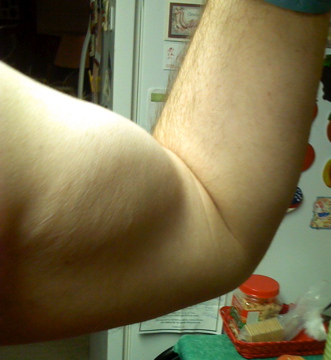 In just a few short weeks, I'm already seeing muscle formation In just a few short weeks, I'm already seeing muscle formationIt was one month ago that I began for the first time in my life to get serious about resistance training to try to build my upper body strength. When I was losing weight in 2004, my exercise routine was exclusively dedicated to cardiovascular workouts on the treadmill or elliptical machine. While I still love my cardio and built considerable muscles in my legs because of it, my arms, shoulders, chest and abs really needed some serious help. That's why I hired a personal trainer back in December to guide me into unchartered territory for me--weight lifting and bodybuilding. I'll be the first to tell you how utterly clueless I am when it comes to this area of fitness. And I'm sure there are many of you who wouldn't know where to start or what to do to begin doing this, too. Yet it is something that can definitely enhance your body's ability to burn fat while giving you the added strength and energy you so desperately want. One thing that got me to add this next chapter in my healthy lifestyle journey was watching The Biggest Loser during Season 4. Watching those obese contestants not just running on the treadmill, but also doing some pretty remarkable exercises with weights while they were STILL fat lit a fire inside of me that I needed to get going with a plan to get strong, too. It's been four years since I began livin' la vida low-carb and it's high time I get to building some muscles above my waistline. That is the path I decided to travel down beginning in mid-December and it has been an experience like none other so far. Even when I lost 180 pounds in 2004, that wasn't nearly as difficult as this has been for me. My brother Kevin was the football player in high school and I played alto saxophone in the marching band. He was athletic and I was...not. But here I am at the age of 36 years old lifting dumbbells and using exercise equipment that I've never even seen before to make my body even better. It has been exhilarating, exhausting, and exasperating all at the same time. But in a masochist kind of way, I'm lovin' every minute of the pain and agony because I can already see that I'm getting stronger and one step closer to my goal of feeling good about myself without a shirt on. I was a bit concerned on day one of my training when I told the manager I lost triple-digits following the Atkins low-carb diet. He gave me that scrunched up face showing his disgust at my dietary choice and went on to lecture me about how your body needs carbs to fuel your workouts. I guess he didn't realize he was talking to someone who has studied this subject extensively for the past four years. You should have seen his face when I explained that I ate a high-fat, low-carb diet and the dietary fat is what fuels my workouts. You would have thought I was an alien from outer space the way he looked at me and the bewilderment on his face was priceless. I offered to help educate him further about this subject by letting him borrow my copy of Gary Taubes' Good Calories, Bad Calories and surprisingly he read it! After hemming and hawing about a few things he disagreed with during the first few days of reading Taubes' book, the manager finally got it when he got to the end of the book and said "well, you should find what works for you and do that." That's my motto, buddy, and welcome to the spirit of enlightenment! It was a beautiful moment to hear him say that because he changed his tune virtually overnight. So what about my training? My workouts have been a bit erratic during the first month because I've been so incredibly sore after each workout. I don't mean the slap-a-little-Icy-Hot-cream-on-it kinda sore, but rather the make-you-feel-paralyzed-til-you-can't-move-a-muscle kind. It's been pretty rough waking up in the morning and barely able to move my arms because my personal trainer worked them so hard on the previous day. The same thing goes for my shoulders and my chest. So far, my abs, calves, and legs have endured the wrath of resistance training. I'm trying to get in the gym to lift weights on a regular (daily) basis rotating from muscle group to muscle group, but I'm not ready for that yet. It'll come soon enough and the progress I have made in such a short amount of time astounds me. I can't believe that is MY bicep at the top of this blog post. My wife Christine is already impressed by how much bigger my arms have gotten and I told her she ain't seen nothin' yet! By the end of 2008, those arms that still have the remnants of loose skin on them from when I weighed 410 pounds four years ago will be as solid as a rock! It's coming! The only things I am doing different in my diet now that I am lifting weight is I have increased my protein intake and I added creatine supplements. The added protein is coming from some extra protein shakes and bars to aide my growing muscles. And the creatine gives me that extra boost in my muscles to continue growing and growing. I'm still eating a low-carb diet, taking my daily vitamins and fish oil, and keeping a positive attitude about this. I'll admit this has been a difficult road, but I'm not planning on giving up by any stretch of the imagination. I'm in this for the long haul not just for 2008, but well beyond that as I transform my body into something it has never been--lean, strong, and looking absolutely amazing! It seems like this dream is so far away, but I'm encouraged by the progress to date that dream will indeed become a reality soon enough. Let me say a special THANK YOU to everyone who has e-mailed me encouragement in my new resistance training schedule. Because I am so new to this, it has been rewarding to hear from those of you who have gone through the pain and agony of weight lifting in the early days and now look fantastic. In fact, I've got a few interviews coming up with some truly remarkable fitness role models that I know you will enjoy hearing from about how they got the body they've always wanted. Stay tuned for that! As for me, I'll keep truckin' along with my trainer building up my muscles even bigger and bigger to become that hunkie man I've always wanted to be. It's an unbelievable road I have started down and there's no turning back now. By the way, my weight has increased a few pounds during this, but I'm not worried about it. I KNOW it is muscle weight and I haven't cheated at all since beginning this. I've been keeping a food journal since day one of my resistance training and am thinking about creating a blog specifically for sharing what I have been eating. Actually, I do think this would be an interesting blog since I started during the Christmas holidays when everyone says it is impossible to eat low-carb. WRONG! I did and you can, too. Lemme know what you think about the idea of posting my daily food and exercise journal online. As always, I welcome your feedback and comments anytime at livinlowcarbman@charter.net or by leaving your remarks in the comments section below. 1-15-08 UPDATE: One observant reader was concerned about something he saw in the background of that picture of my bicep at the top of my blog post. I was wondering if anyone was gonna notice it. Jimmy,
Better be careful of all the critics out there because the picture on your latest post shows your muscle formation on your arm--but it also shows a pack of opened WHITE CRACKERS in the background!!!!!!! OH NO!!!!!! LOL! Just thought I would be the first to bring this up.Yep, you are the first, but I'm sure you're not the only one. Actually, I purposely put that there next to my cashews to see if anyone would notice. No, they're not mine, but they are Christine's. She sometimes gets an unsettled stomach and eats some whole wheat Saltine crackers. Plus, she can get away with more carbs than I can, so an occasional cracker or two ain't gonna hurt her. GREAT EYE out there and I appreciate you keeping me accountable. ;) Labels: health, Jimmy Moore, low-carb, muscle, resistance training, trainer, weight lifting, workout
Getting Serious At Last About Resistance Training
Four years after losing 180 pounds, it's time to tone upThe year 2004 was a turning point in my life. Starting the year weighing in at a robust 410 pounds, I had a steep hill to climb to get my life back. But the great thing was I had a proven plan in place that merely needed to be implemented and executed. And the rest they say is history! It's no secret that the Atkins diet worked and worked AMAZINGLY well on me unlike any other diet I had ever been on. The low-carb lifestyle is so easy to follow and much more pleasurable than the same old tired low-fat, low-calorie diets we've always been told is "healthy" that I can't understand why anyone would want to eat any other way. Unless you are a glutton for punishment, it doesn't make sense to NOT be livin' la vida low-carb. But that's just me. However, I do want to share one major regret that I have about my weight loss experience four years ago. As awesome an accomplishment that it was (and I'll never deny the positive impact it made on my life for the better) and as good as I have felt ever since taking the weight off, I wish I had been taught how to do resistance training and gotten comfortable with it as part of my workout routine. In my book about my weight loss experience, I wrote a chapter called "Exercise Is Not A Dirty Word" and it's true. As much as people moan and complain about not having time to exercise, lacking any energy to commit to a regular routine, and any number of other useless excuses that are bantered about by the usual suspects, the fact is there is no excuse good enough for NOT taking care of your physical body. After all, God only gives you one, so you need to do what you can with what you've got. For me when I was losing weight, that meant cardiovascular exercise galore. As much as I HATED the treadmill when I first started and was gasping for air after 15 minutes at 3mph, today I can easily go 30-45 minutes on an elliptical machine at 8-9mph with 12 resistance and get a good workout. I'll admit that in 2007 I have been a little slack with my regular cardio primarily because my free YMCA gym membership I used to get with my old job expired and I never renewed or joined elsewhere. I still play volleyball on Tuesday nights at my church for a good FREE two-hour workout, but that was pretty much it for exercise during the week for most of this year. I didn't think much of it, though, since I'm only maintaining my weight now and not actually losing anymore. Thoughts that I didn't really need a lot of exercise anymore made their way into my cranium. Boy was I wrong! Although my weight has remained pretty steady over the past few months, I've noticed it start to slowly do the creepy crawly thing. Anyone who has lost a significant amount of weight and tried to keep it off for any length of time knows what I'm talking about. You wake up, step on the scale, and you're up a pound. Next morning, same routine, up another pound with no real changes in your diet. Hey, it happens. You don't panic. But then those pounds sorta hang around and don't really go away. Again, it happens and you just keep doing what you know got you to where you are now. I liken it to being in a weight loss stall which I had one that lasted for TEN STRAIGHT WEEKS during my weight loss in 2004. Instead, this is a weight maintenance stall and it can be a bit more complicated. However, the same principle stands--keep working the plan and eventually you'll break out of it and return to your pre-stall weight. It's happened several times since I started maintenance in 2005. I know all that in my head, but sometimes you can't help but let yourself get disappointed by how you look without a shirt on. IT'S EMBARRASSING! Those pictures of me without a shirt on at the top of this blog post were taken of me tonight and quite frankly I'm ashamed to look like that. Yes, it's a whole lot better than when I weighed 410 pounds, but I wanna look ripped and toned--not droopy and have the appearance of being "fat" (although I know that's not fat, it sure looks like it to the naked eye!). I want to look as good as I feel! See for yourself how bad it is up close and personal: 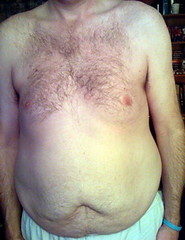  So I'm marking today, December 13, 2007 down as the official beginning date of the next chapter in my health and fitness life. This is the day I began in earnest what I resolved to do on January 1st this year--GET SERIOUS ABOUT RESISTANCE TRAINING! Quite frankly, the "good intentions" part of me REALLY wanted to do it all year, but I've just dragged my feet. Life and all the intricacies that come with it have gotten in the way because I've allowed it to. We MAKE time for what we think is most important and apparently on a subconscious level I didn't see this as something I needed to do like I did losing weight in 2004. That fire that burned within me during my weight loss didn't even flicker a little spark in regards to weight training. Several months ago, though, I signed up with a personal trainer for two hours worth of sessions to kickstart me into lifting weights and having assistance with something that is completely foreign to me. I can do cardio 'til the cows come home, but with lifting weights I'm totally clueless about how to even start. That's why I needed help. But I drug my feet some more and only called him about doing those sessions a couple of weeks ago. A few weeks back, I joined a local gym called Peak Fitness and I REALLY like it a lot. The people who work there are super-friendly and they don't judge you for how you look. It's sorta in between the high-brow nature of a place like Gold's Gym where you have to look like Ahhhnold to be respected and those local gyms that only have a few select pieces of equipment and that's about it. I've been impressed by the availability of virtually any machine I need every single time I've gone there day or night--and they're open 24 hours a day! Sweet! Midnight workout, anyone? :D But tonight I felt an inkling within me that the time was right for me to make that commitment to do something about my upper body strength. While my legs are arguably the most physically attractive part of my body because of all the cardio I have done (the definition in my thighs and calves is very noticeable and I've taken great pride in that), my arms, chest and abs are pitiful looking. Well, you know that for yourself now that you've seen my pictures. What did I do to seal the deal on that commitment? I hired a personal trainer. Watching professional trainers like Bob Harper and Jillian Michaels working those courageous contestants on "The Biggest Loser" as hard as they do, I've always wanted to have a trainer to do that for me, too. I literally motivated myself to do the cardio in 2004 that was an integral part of my 180-pound weight loss success, but I've needed somebody to get me going with weight lifting and getting into a regular routine. And that's what I'll be doing from now on over at least the next 12 months. I'm signed up to work twice a week for 30-minute sessions with a certified personal trainer and may increase that if I feel I need more personal attention. I especially like the trainer they started me out with tonight. He looks absolutely amazing with guns that I'd love to have and I told him I'd like to get to where he is physically by this time next year. Without flinching a bit and with a smile on his face, he assured me he could help get me to that goal if I put forth the effort. You know me, I'm up for a good challenge. And this is it. That New Year's resolution I wanted to start in January 2007 is about 11 1/2 months late, but I'm doing it now...better late than never! My body still aches from top to bottom after my first session even now hours after my first training session, but as John Cougar Mellencamp used to sing, it "hurts so good!" I'm ready to do this and am as excited about getting stronger in my upper body as I was losing weight in 2004. I'll be popping in with my progress from time to time and posting pictures when I start to see differences happening. I just want to be stronger and look good without a shirt on. That's been a real dream of mine ever since I kissed 400 pounds goodbye and I believe it can still happen with the right effort. My trainer said he could tell I was pretty healthy and did lots of cardio because my breathing was good during the workout. Now we need to add some muscle to that endurance and get Jimmy Moore looking the way he needs to be.  Could I possibly look like this in the near future? Could I possibly look like this in the near future?Of course, I do have all that loose skin that's just been hanging around for the past four years as a badge of honor for how far I've come. But maybe some of it will now tighten up through this process. If there's a way, then I'm confident my trainer will help me get there. Wish me well in this next endeavor that will complement my permanent and healthy low-carb lifestyle change. And if you've been putting off starting a fitness routine--cardiovascular and/or resistance training--then don't wait until the new year to get started. Start RIGHT NOW and get ready to transform your weight and health forever. YOU CAN DO THIS and I'll be right here working hard to do the same. Hey, does anybody have any Sportscreme, my muscles are KILLING me?! :) Labels: health, Jimmy Moore, muscle, Peak Fitness, resistance training, trainer, training, weight lifting, weight loss
|


