What's In A Twinkie? You Don't Wanna Know!

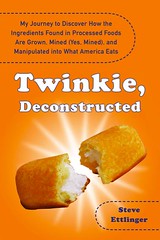

Ever wonder what they put in a Twinkie? Just ask Steve Ettlinger!
1. What a sweet low-carb treat we have for the readers of the "Livin' La Vida Low-Carb" blog today--it's Steve Ettlinger! Who? Steve is the author of a provocative new Hudson Street Press book that I think you're gonna love entitled Twinkie, Deconstructed: My Journey to Discover How the Ingredients Found in Processed Foods Are Grown, Mined (Yes, Mined), and Manipulated Into What America Eats
--yes, we're talking about high-carb junk food like Twinkies, but it's not what you think. Steve, tell us a little bit about yourself and how and why you got into writing books on the subject of food and nutrition.I've had a hand in forty books and written six, but three of my favorites concern food. I love ating, have worked as an assistant chef, and while living in France, came to appreciate good, fresh, well-prepared food like never before. Since I began writing or producing books in 1988, I have always concentrated on the popular reference angle.
I wondered for years why no one covered things like polysorbate 60 the same way we cover wine or cheese, and thought about doing something for a few years. Finally, my kids asked me, "Daddy, where does polysorbate 60 come from?" and I knew I had to get moving on this book. Choosing the Twinkie as an example was great, because the Twinkie ingredient list, which is the table of contents of Twinkie, Deconstructed,
is just the right length for a book and covers a wide range of ingredients. 2. I have to tell you, Steve, the title and cover art of your book certainly captures your attention right away which you hope will get people hooked just long enough to hear the message you have to share. I did the same with my book and blog calling them "Livin' La Vida Low-Carb." Have you heard about anyone who accidentally "found" you looking for Twinkies and became convinced they'd never eat one again?
No. Most people who eat them expect Twinkies to be processed food. I think many are surprised at how much of our food comes from petroleum or rocks, though.
3. Can you believe the ingredients people are stuffing their faces with nowadays without a care in the world what most of those words they can't even pronounce really are?! It's really a sad state of affairs we find ourselves in nutritionally when much of what is consumed by the average American is not just garbage, but a bad nightmare food science project where the public serves as the guinea pigs for this junk! When did our culture move away from eating real whole foods and start relying on these highly-processed concoctions made in a food lab somewhere filled with God knows what as the main source of nourishment?
I tell people who are aghast at what's in processed food that if they want healthy food, they should eat their fruits and vegetables. I have tended toward the Mediterranean diet for years, and I stay basically low-fat and low-carb. I do enjoy many welcome digressions to eat sauces, desserts, and beer. I try to eat fresh oranges for breakfast instead of orange juice, etc.
But living in New York City, I can eat all kinds of neat, healthy food--sushi for snacks, fruit from street vendors--nearly any time and any place I want. And Twinkies are sold by most corner grocery stores, too, just in case I need one--for research purposes only, of course!
A lot of people think that I must be coming out with some diatribe against Twinkies, and in fact, they are not what you would want to be eating if you are seriously dieting. However, because they are so clearly a dessert treat I just don't bother with getting up on my soapbox and yelling anything bad about them. That would fall kind of flat, considering that no one ever claimed that Twinkies are good for you.
My angle is that this is truly amazing stuff they use, and all processed foods use. I just think it is fascinating to realize and to think about. And then I go eat my fruits and vegetables!
4. It's bad enough having weight and health-damaging ingredients like trans fats, white flour, sugar, high fructose corn syrup, and the like showing up in just about everything these days, but there are other substances and chemicals finding their way into a good number of popular food items like Twinkies, too. Tell us about a few of the biggest culprits and why they are detrimental to our weight and health.
I can see by your question that you need to read my book in order to see that I am not a nutritionist or weight loss advisor, so I'll just answer the ones that I know about and let you deal with the rest.
5. I am planning on reading your book very soon because it reminds me of several others that have come out in recent years. For example, Eric Schlosser's amazing book about the fast food industry called Fast Food Nation
. It seems you did what Schlosser did in his book by examining the food line all the way to the source of the actual ingredients that make up processed foods made in the United States. What was the most shocking discovery you unearthed in your investigation and have you personally altered your eating habits as a result of what you learned from writing this book?I was totally shocked that we eat five kinds of rocks just about any time we eat anything baked! The simple product found on kitchen shelves everywhere, baking powder, is made from three. I was able to actually visit the mines where two of the rocks come from -- phosphate and trona, which is almost pure sodium carbonate.
The other one is limestone. Two other rocks are common--salt, of course, and calcium sulfate, which is essentially food-grade plaster and has been used in bread and tofu making for thousands of years. None of these are dangerous to us but they sure are surprising. I was also amazed to learn that enrichment vitamins are mostly from China.
6. There are some rather repulsive methods used when food companies start processing foods and what you describe as ingredients that are "closely linked to rocks and petroleumthan any of the four food groups" to get the proper consistency for making popular junk foods like Twinkies look like we know them to be. Would you mind sharing some of the major steps that go into the processing of these innocent-looking snack cakes?
Much of this process if discussed at length in my book. But I will say this--that we crack natural gas into methane and ethane in order to make sorbic acid, one of the safest food additives around, still totally blows me away. Sorbic acid is actually a food, a close cousin of olive oil.
7. I'm curious, what does Hostess, the company that manufactures Twinkies, think about Steve Ettlinger exposing their dirty little secret about their cherished American icon? Have they threatened to sue you or do even they realize you are merely sharing the truth?
I seriously doubt they consider this a "dirty little secret," in that their ingredients are listed on every package they sell! I also doubt that typical Twinkie consumers care about this kind of thing. As far as any threats go, please read the foreword in the book. All I'm doing is writing about ingredients used by most processed foods and many pharmaceuticals.
8. Your book is similar to one I reviewed at my blog recently by Michael Pollan entitled The Omnivore's Dilemma. Were you inspired by Pollan's outstanding investigative journalism?
While I have long admired and enjoyed Michael Pollan's work, his book came out after I finished mine (major publishing houses like Penguin have very long lead times in order to sell the book and distribute it to bookstores around the world), The Omnivore's Dilemma did not play a role in my book.
9. How did you seek to distinguish your work from Pollan's?
Because my book was written before his came out, I did not have to "seek to distinguish" my work from his. This said, we overlap quite a bit: check out his page 17, where he pretty much asks someone to try to figure out where Twinkies' ingredients come from! Surely readers who liked his book will be interested in mine, but his writing is much better. :)
10. THANK YOU, Steve Ettlinger, for joining me for an eye-opening look at the current state of affairs we find ourselves in bowing to the mad scientists in the food industry. So where do we go from here? Based on your newfound "expert" status with the release of your new book, how can Americans like myself and my readers who are deeply concerned about the issue of weight and health take what you have shared and help bring about the necessary changes that absolutely need to happen if issues like obesity, diabetes, heart disease, and metabolic syndrome are ever going to be adequately addressed? Do you think we will see those changes happen anytime soon? Why or why not?
My newfound "expert" position allows me to entertain people with stories about where these ingredients are from and how they are made. Every person I spoke with--engineers, scientists, etc.--does their best to make things that we can eat or chemicals that we can use to make things that we eat. None of the people I spoke with would be proper spokespeople for what is good nutrition.
You can learn more about Steve Ettlinger's Twinkie, Deconstructed
by visiting TwinkieDeconstructed.com.Labels: book, dessert, diet, health, ingredients, interview, junk food, processed foods, Steve Ettlinger, Twinkie Deconstructed
posted by Jimmy Moore at
3/12/2007 09:14:00 PM
1 Comments


