A Collection Of Low-Carb News To Kick Off 2008

It's the dawn of a new year, but low-carb hasn't slowed a bit!
Waving goodbye to the end of another year simply means it's time to say hello to a new beginning as the calendar year turns over yet again. While 2007 was indeed a year to remember, I'm so looking forward to 2008 and all that awaits people who are contemplating, in the midst of, or head over heels about the amazingly healthy low-carb lifestyle.
Good things are happening all the time and it is always a pleasure to share with you the very latest in the wonderful world of livin' la vida low-carb. My commitment to you is to keep doing this in the new year so you'll always stay ahead of the game. In fact, I'm happy to share with you a collection of positive low-carb news right now to help kick off your 2008 the right way. HAPPY NEW YEAR EVERYONE!!!
BREAST CANCER MADE WORSE BY HIGH INSULIN LEVELS
I've shared with you many times over the past few years how researchers are beginning to see an unmistakable connection between the prevalence and growth of cancer tied to the existence of high levels of insulin in the body. Most notably was this Time magazine article on German researchers using a high-fat, low-carb diet to combat cancer in the most dire of patients with astounding results.
Now researchers out of Yale University have found that women with high levels of insulin in their body are likely to develop breast cancer. Although the lead researcher Dr. Melinda Irwin recommends "exercise and eating a diet rich in fruits and vegetables and low in fat," what they need more than anything is a sugar-free, low-carb diet rich in healthy amounts of fat, including saturated fat, to combat and prevent this disease.
The problem I have always had with generalized recommendations from people like Dr. Irwin who say we should "eat a diet rich in fruits and vegetables with a low-fat diet" is that it is not backed up by the latest published research and in my opinion is simply a copout for providing guidance about which foods are better. Not all vegetables are good for you (potatoes and other starchy ones especially) and neither are all fruits (bananas alone have 29g carbohydrate in them!).
It's nice to see the research is finally showing the detrimental role that insulin is doing to our health brought on by a high-carb diet, but it's high time we start matching up our dietary recommendations to adequately take on these health challenges properly. Share your comments and concerns with Dr. Melinda Irwin about her study by e-mailing her at melinda.irwin@yale.edu.
IS THERE REALLY ANOTHER NEW ATKINS DIET BOOK?
You may have already heard about this new book, but in case you haven't it is not a misprint. There's a brand new Atkins diet book called The All-New Atkins Advantage: The 12-Week Low-Carb Program to Lose Weight, Achieve Peak Fitness and Health, and Maximize Your Willpower to Reach Life Goals that released on December 26, 2007 and is being marketed as an updated version of the low-carb diet made popular by the late great Dr. Robert C. Atkins.
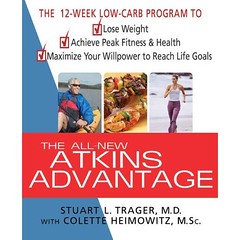
This Atkins book co-written by Dr. Stuart Trager and Collette Heimowitz
I've been reading through this "new" Atkins diet book and the overriding message that I am seeing is that there are different levels of carbohydrate tolerance for each individual and this book will help guide you regardless of the amount of carbs your body will permit you to eat. There are menus for varying levels of carbohydrate intake from 20g a day to 80g a day, so you never have to guess about what to eat.
Dr. Trager is a fitness expert who uses his experiences in Ironman competitions and implementing a low-carbohydrate nutritional approach to help others reach their weight loss goals. I've blogged about him previously in this blog post and he devotes a major portion of the book on specific exercises you can do to go along with your Atkins diet.
As for Collette Heimowitz, I've interviewed her at my blog before talking about the continuing role of Atkins Nutritionals, Inc. in the realm of diet, health, and nutrition. She has been a long-time supporter of livin' la vida low-carb sharing with others all the research and data supporting low-carb living.
I will likely be sharing a book review of The All-New Atkins Advantage as well as some possible giveaways real soon, so keep reading the blog for those updates! This looks to be a good book for anyone needing a little bit of extra hand-holding as you begin the low-carb lifestyle.
CAL-CARB CLICKER TO BE FEATURED ON QVC
A few weeks ago, my wife Christine and I shared with you some great low-carb gift ideas to share with people who are livin' la vida low-carb on special occasions like birthdays, Christmas, and other such events involving presents. One of those products I told you about was something called the Cal-Carb Clicker which allows you to keep track of your calories, carbohydrates, and water intake all in one device that's super-easy to use.
Well, this little gadget is gonna hit the big time on New Year's Eve as the clock strikes midnight to head into 2008 because it will be featured for the first time ever on the QVC television shopping network. If you are up late watching the ball drop in Times Square, then be sure to switch over to QVC to watch Sandy Martucci, one of the two sisters who invented this gizmo, talk about it sometime between midnight and 2 a.m. This thing is expected to blow the doors off of QVC and it's exciting that one of the things it measures is carbohydrate intake. AMAZING!!!
If the Cal-Carb Clicker does as well as QVC expects selling at around $12, then they will keep offering it as part of their regular programming. This is excellent news because more and more people are discovering the importance of carb control and this tool will help them keep better track of it. And that's a VERY good thing! :)
ARIZONA STATE RESEARCHERS RIP LOW-CARB DIETS
As much as all the evidence keeps pointing to low-carb as being one of the healthiest ways you could possibly eat, I have come to the conclusion that there will ALWAYS be somebody out there who thinks the sky is green. When it comes to the alleged healthiness of a high-carb diet, this guys takes the cake (both figuratively AND literally!).
Joining in on the lunacy are researchers from Arizona State University who put out this damning press release against low-carb diets recently that claims (among many things) ketosis from a low-carb ketogenic diet will kill you, your bones will dry up and crumble like a cookie, and your LDL cholesterol will go up so high your arteries will explode! Okay, maybe it wasn't filled with that much hyperbole, but it might as well have since all of those flimsy excuses are the same ones we've heard over and over again for years.
What do they recommend instead? Eating a more "moderate" level of around 120g of carbohydrates daily as a STARTING POINT and much more than that if you even dare try to exercise a little. They say your body needs carbs but we know better don't we? It's called gluconeogenesis and is a very natural part of human physiology and metabolism.
These pompous, self-proclaimed researchers--Carol Johnston and Pamela Swan--need to get off their high horse every once in a while to start living in the real world like the rest of us rather than the fantasy land of higher academia! I'm sure they'd LOVE to hear from YOU, so feel free to e-mail them at carol.johnston@asu.edu and PSwan@asu.edu.
NUTRITION DATA GIVES LOW-CARB DISCERNMENT ADVICE
If you haven't been to the "Nutrition Data" blog yet, then you are doing yourself a huge disservice because they offer some really fantastic information about diet, health, and nutrition. And they also are quite the fans of livin' la vida low-carb, too. In this recent post about dietary dogma against low-carb diets, an excellent response was provided by Monica Reinagel for people confused about how to discern the good information from the bad as it relates to low-carb studies that seem to contradict themselves (as will frequently happen when the zealots release their biased research while genuine studies show the truth).
I especially liked Monica's four tips about what to do for living healthy:
1. Do what works...If a low-carb diet is the only way for you to do it, then the possible risks are probably justified.
2. Consider your health history. If you are diabetic or have metabolic syndrome and have weight to lose, a lower-carb diet may be a better choice.
3. Monitor your risk factors. Regardless of which dietary dogma you ascribe to, have your cholesterol, triglycerides, and inflammation markers (CRP) tested on an annual or bi-annual basis.
4. Don't over-simplify...A diet rich in low-glycemic carbs like vegetables and legumes is not going to have the same negative effects as a diet high in high-glycemic carbs like rice cakes and white bread.
See what I mean...don't you LOVE it when you find someone of like mind? In 2008, make it a point to visit The ND Blog early and often! And let Monica hear from you about what you think of her site by e-mailing her at feedback@nutritiondata.com.
Speaking of this fabulous web site, I just had to share with you about a recent poll conducted by NutritionData.com that simply asked the question, "What motivates you to eat healthier?" Wanna know what the surprising results were depending on what part of the United States you live in? Check this out:
One-third of Americans want to look good (33.3%) and just under a third want to feel better. But the results of the poll showed that Americans have different motivations for eating healthier based on where they live.
- Americans living in the Heartland States want to change their diets to lower their risk of diseases like heart disease, diabetes and cancer
- People living on the East Coast of the U.S. eat healthier in the hopes that they will live longer
- People in the South and on the West Coast try to eat better in order to lose weight and/or look good
- Americans on the West Coast change their diets for the better so that they will have more energy
What do you think about this? Is it true based on where YOU live? This should be a lively discussion in the comments section. :D
A USER-FRIENDLY WEB SITE EXPLAINING LOW-CARB DIETS
Have you been looking for a page on the Internet that would accurately describe what the low-carb lifestyle is REALLY all about, explain in simple terms what makes this way of eating so effective, and put it in language we can all understand? Well, look no further than "Why Low-Carb Diets Work" by author Adam Khan. He did a yeoman's job of breaking it down in digestible chunks for virtually anyone to grasp the basic concepts of livin' la vida low-carb. Whether you are a low-carb expert or a novice, this one's WELL worth the read!
NEW STUDY CONFIRMS LOW-CARB FOR EPILEPSY TREATMENT
I've blogged about the use of a very low-carb ketogenic diet for seizure control in people with epilepsy and other neurological diseases before. In fact, I highlighted a web site called "Atkins For Seizures" that is a grassroots attempt to educate people who suffer from epilepsy about this potential dietary cure for their disease Now there's a study scientifically backing up this treatment method.
Lead researcher Dr. Kelvin Yamada, professor of Neurology at the St. Louis, MO-based Washington University School of Medicine, and his team of researchers found that the key to helping people with epilepsy the release of leptin brought about as a result of a ketogenic low-carb diet. The science is a bit complicated to follow, but the bottom line is livin' la vida low-carb was shown to help reduce the occurrence of seizures in laboratory rats.
This study was published in the December 20, 2007 issue of Journal of Clinical Investigation. You can e-mail Dr. Kelvin Yamada about his study at yamadak@wustl.edu.
LAURA DOLSON HELPS WITH "BABY STEPS" TOWARDS LOW-CARB
One of the greatest low-carb resources on the Internet is the About.com Low-Carb Diets page from Laura Dolson. She works tirelessly to provide accurate, informative, and professional information regarding anything and everything that has to do with the low-carb lifestyle. I wanna be like Laura when I grow up! :)
Recently, Laura shared a post entitled "Seven Steps to Greater Carb Control" that is essential reading for anyone who thinks livin' la vida low-carb is an impossibility for them. It's amazing how making some very minor changes in your current habits can reap huge rewards in both your weight and health management. I know from talking to Laura that health is a HUGE part of everything she does, so take some advice from someone who has been there and cares.
DIABETES HEALTH MAGAZINE PUBLISHES LOW-CARB SUCCESS
Now that the American Diabetes Association (ADA) has given the green light to low-carb for diabetics, it will be very interesting to see how many amazing stories of blood sugar control that start happening for people who will try this for perhaps the first time as a means for treating their diabetes. While the ADA is focused on the weight loss aspect of livin' la vida low-carb, it's what will happen as insulin production slows for Type 2 diabetics that will be the really fun thing to watch for.
But even before that has happened, there's a fantastic column in Diabetes Health magazine written by Riva Greenberg from the "Diabetes Stories" blog. She simply shared from her experiences following Dr. Richard Bernstein's plan for controlling her Type 1 diabetes.
Here's a quick excerpt, but be sure to read the whole column:
"I essentially eliminated refined carbs, such as white bread, white potatoes, rice, pasta, sweets, muffins, and starchy veggies. The result? My sugars indeed dropped. They were consistently lower, and my insulin doses dropped. Maybe best of all, I was no longer chasing high blood sugars - you know, the ones that come from refined carbs, where you just can't seem to knock them down all day. My Lantus dose went from 20 to 12.5 units, and my pre-meal Humalog was all but cut in half. The results were so dramatic and made my life so much easier that I never went back to my old ways."
Riva's story is merely the first in a long line of successes that are to come now the the ADA has given recognition and credence to the healthy low-carb lifestyle. If you have an amazing story you'd like to share about how low-carb has helped you control your diabetes, then please feel free to send it to me anytime at livinlowcarbman@charter.net. It's important for the ADA and other health entities like them to know that real people are getting healthy eating this way. THANKS for sharing!
DR. RICHARD FEINMAN'S SATURATED FAT COLUMN AT DLIFE
I had the privilege of interviewing one of the most brilliant low-carb researchers in the world today in June 2006--Dr. Richard Feinman from the Brooklyn, NY-based SUNY Downstate. He told me in that interview that he believed the ADA was close to coming out in support of livin' la vida low-carb and 18 months later he was right!
As a strong advocate of the metabolic science behind low-carb living, we have seen Dr. Feinman challenge the status quo and now he's at it again on the popular diabetes and health web site called dLife.
In a guest column called "What if Saturated Fat is Not the Problem?" he shares about some of the latest research behind saturated fat to reveal it's not the public health menace we've all been led to believe. He notes this study from University of Connecticut researcher Dr. Jeff Volek that found a diet low in saturated fat actually increases saturated fat in the blood compared to a diet high in saturated fat. Counterintuitive? You betcha, but that's what the data shows.
Here's a taste of classic Feinman at his best:
"Carbohydrate, through its effect on insulin, is the key player. Insulin not only sweeps up glucose from the blood but it also plays air traffic controller, making the call as to whether that glucose is turned into fat or is used for energy. Most importantly, insulin determines what happens to dietary fat — whether it gets stored or oxidized for fuel. In fact, insulin has so much control over how dietary fat is metabolized that when levels of fat are measured in the blood, they are not strongly associated with a person's diet. In other words, one person who has a high intake of saturated fat may turn out to have a similar ratio of saturated to unsaturated fat in the blood as someone who consumes very little saturated fat."
There's plenty more nuggets of truth to chew on in Dr. Feinman's column, so read the entire thing, print it out, and give it to your doctor and anyone else whose health you care about. This is a subject that we've only just begun to scratch the surface on and will be at the center of debate in the months and years to come.
3800 CALORIES A DAY FOR A MONTH AND NO WEIGHT GAIN?
We often hear from all those so-called "experts" who tell us we need to create a calorie deficit in order to manage our weight. But those of us who consume a high-fat, low-carb diet with no regard for calories have always believed that theory was bogus--but we didn't really have any way to back it up other than our own personal experiences.
Allow me to introduce you to a Wisconsin man named Jeff. Over the course of 30 days during the entire month of December, he has conducted an experiment on his own body a la what Morgan Spurlock did in his Super Size Me movie. Jeff attempted to eat as many calories as he possibly could on his 169-pound frame to prove you can maintain your weight as long as you keep your carbohydrates reduced.
Check out his daily log of calories consumed and a list of the foods he ate to average a whopping 3822 calories for thirty days in a row! His high day was on Day 5 when he hit 4620 calories and his low day was on Day 30 when he only got to 2998--three-fourths of which was FAT! WOW! You go Jeff!!!
Conventional wisdom regarding calories would say that Jeff should have gained close to 14 pounds on this diet of his. But guess what? He didn't gain 14 pounds. He didn't even gain 10 pounds or even 5 pounds. The shocking result--HE MAINTAINED HIS WEIGHT!!! Incredible! I'd love to interview Jeff about his little experiment if someone who knows him will have him e-mail me. THANKS!
DR. WALTER WILLETT ACKNOWLEDGES LOW-CARB DIETS
A friend of mine pointed me to a rather fascinating interview with Dr. Walter Willett, a nutrition expert from the Harvard School of Public Health. While I've both praised and been critical of Dr. Willett at my blog, I'm pleased to share this interview conducted by PBS and their "Frontline" program with you because it has some good information from this leading American health expert on a variety of subjects.
Yes, he still subscribes to the Ancel Keys theory regarding fat causing obesity among other things, there are moments during the interview that Dr. Willett comes to the defense of fat consumption and livin' la vida low-carb. Here are some of my favorite parts:
"The reality is that during this campaign for fat-free and reduced-fat products, actual fat consumption did go down, but Americans got much fatter during this period of time. Now of course lots of things were going on at the same period in time, but I think it's highly likely this focus only on fat calories to the neglect of carbohydrate calories has contributed to this epidemic of obesity."
**********
"The evidence that we accrued really suggested not only that the type of advice that people were getting was not useful, but it actually could be dangerous, because some people were eliminating the very healthy types of fat that actually reduce heart disease rates."
**********
"The thinking in nutrition about carbohydrates really had broken them down into two classes: sugars and so-called complex carbohydrates, which are mostly starches. The idea has been pushed that all forms of so-called complex carbohydrates are really the poster child of nutrients, and we should be eating them in large amounts. That's what the pyramid tells us to do. But in fact, these kinds of starches -- white bread, white rice, potatoes -- are starches that are very rapidly converted to glucose, really pure sugar, and almost instantly absorbed into the bloodstream. And these are the kinds of carbohydrates that we really should be minimizing in our diets."
**********
"Actually, careful studies have shown, demonstrated that you get a bigger rise in blood sugar after eating potatoes, a baked potato, say, than you do from eating pure table sugar. Really."
**********
"First of all, when the blood sugar goes skyrocketing up, the body wants to bring it back down. So our pancreas pumps out a big blast of insulin, and as a result, the blood sugar comes crashing down rapidly. In fact, in many people, after three and four hours, it overshoots and actually become a little hypoglycemic, and that rapid crashing down of blood glucose and insulin stimulates hunger. That would be no problem, except that it's often all too easy to go in the refrigerator or find a snack, and if we do that frequently throughout the day, that can add up to too many calories over weeks and months and years, and contribute to obesity.
Second, these high rises in blood glucose and insulin have a bad metabolic effect on the blood cholesterol fractions. Specifically the HDL, the good cholesterol, is driven down, and triglycerides, another type of fat in the blood that leads to heart attacks, goes up.
Third, after many years of demand for high amounts of insulin, the pancreas tends to give out. And at that point in time, we've got type 2 diabetes."
**********
"Interestingly, in traditional Asian societies, people were very lean, very active, and therefore had low insulin resistance. They could eat large amounts of rice, even white rice, in the diet and have low heart attack rates and have low rates of type 2 diabetes. But if you take that same person, and they [now] may be living in Beijing and driving a car and watching a television, and they put on a few pounds, they're going to have much more insulin resistance. So if you take that same diet, high in carbohydrate and white rice, they will have a much worse metabolic response and much higher rates of type 2 diabetes."
**********
"If you're overweight and living in the United States, and you go to a hospital and see a dietician, almost for sure, you're going to be put on a low-fat, high-carbohydrate diet."
**********
"Dr. Atkins was saying as much as 30 years ago, that if we reduce our carbohydrate intake to quite low levels, that will make it easier to control our caloric intake and thus promote weight loss. As it turns out, there is a strong element of truth in that. A number of studies in the last year have looked in a very careful way, comparing low-fat, high-carbohydrate diets with reduced-carbohydrate diets, and in general people have done better on the reduced-carbohydrate diets in terms of their weight."
This was one incredible interview and I hope you take the time to read it all for yourself! While Dr. Willett is certainly no low-carb champion, he at least understands the mechanism behind why it works for those of us who choose it to manage our weight and health. This is something more health experts should get in the habit of doing.
Got some low-carb news you wanna share with me? I'm always happy to hear from my readers, so don't hesitate to e-mail me anytime at livinlowcarbman@charter.net.
Labels: 2008, ADA, Atkins, breast cancer, Cal-Carb Clicker, calories, diabetes, Diabetes Health, dLife, epilepsy, insulin, low-carb, new year, news, research, Richard Feinman, study, Walter Willett
posted by Jimmy Moore at
12/31/2007 08:17:00 AM
4 Comments