Dealing With Possible Reactive Hypoglycemia--One Month Later
I wanted to give you a quick one-month update on my progress dealing with a possible case of reactive hypoglycemia (although my symptoms don't match the definition of this condition found on Wikipedia). This seems like an incredibly odd subject to be talking about as someone who has been faithfully livin' la vida low-carb for the greater part of the past 4 1/2 years. How can a low-carber be dealing with something like this when a low-carb diet is supposed to be one of the best diets for stabilizing blood sugar levels and, more importantly, reducing insulin levels?
As you know, I've been speaking with noted New York City low-carb doctor Dr. Keith Berkowitz who has been the only low-carb expert I've ever heard even talk about this phenomenon. His theory about reactive hypoglycemia for long-term low-carbers who have lost a lot of weight (like me!) seems to be valid on the surface (I'll be conducting a follow-up podcast interview in mid-July with Dr. Berkowitz to answer a TON of questions that you have submitted for him to answer). But something very odd has been happening with my blood sugar levels and that even includes after I've consumed a VERY high-carb meal.
You'll recall last month I did an experiment where I splurged out on some pizza to test what would happen to my blood sugar since eating a "normal" low-carb meal produced a significant DROP in my blood sugar. I couldn't believe it was possible for your blood sugar to go DOWN after a meal, so I forced the issue by consuming more carbs in one sitting than I had done since I started livin' la vida low-carb in January 2004.
The result? My fasting blood sugar of 91 actually DROPPED to 90 when I checked it one hour after eating (WOW!) all those slices of pizza, it finally rose to 100 by the second hour, and was back down to 98 by the third hour after this extremely high-carb meal. It was quite an illuminating self-experiment that had me scratching my head about what the heck was going on. I have been spending a lot of time over the past month trying to figure this out and I'm still perplexed about it.
On the advice of Dr. Berkowitz, I implemented several strategies for dealing with this as well as the coinciding slight weight gain that seemed to happen at the same time I started resistance training beginning in December, including eating lots of small meals about every couple of hours (see my menus blog), getting adequate quality sleep, continuing with my exercise routine including my weight training, and trying to lower the stress in my life by taking more breaks from my work. When I started this I weighed 274 pounds and today I weighed 262.
Although it has been moderately successful with bringing my weight down, I can see the numbers starting to stall out again as of late and I can't help but go back to what is happening with my blood sugars again. Could this have something to do with my weight being elevated? Did the creatine I took in the first six weeks of my weight training impact my blood sugar levels and get 'em all messed up? The honest answer is I don't know.
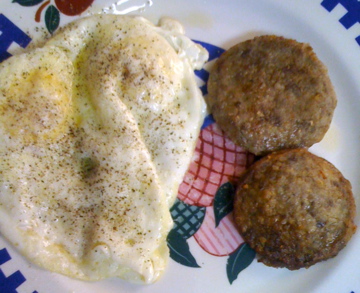
Since I have been doing this new routine for about a month now, I decided this morning to check my fasting blood sugar level and then several more times in the hour following a typical low-carb breakfast meal of eggs and sausage. This was a little larger meal than what I've been eating as part of my new "small" meals strategy, but not that much bigger. When I checked my blood sugar at 8:00am, the reading was 93 which is exactly where it should be after a night of fasting. So far, so good.
At 8:15am, I had that delicious egg and sausage meal that took me about five minutes to consume. At 8:20am, just after finishing my meal, I checked my blood sugar again and it had already dropped seven points to 86. Curious about this sudden drop, I then checked my blood sugar level again fifteen minutes later at 8:35am and it had jumped UP to 102. Hmmmm, now this was interesting. That made me want to see what would happen in fifteen more minutes at 8:50am and my blood sugar was back down to 92 again. For kicks, I measured it two more times at 15-minute intervals at 9:05am and 9:20am and my blood sugar was 89 and 92 respectively. I stopped measuring because it was almost time to eat again.
So what am I to make of all of this? Had I only checked my blood sugar after one hour as is typical, then I would have seen virtually NO change in my blood sugar. But doing this today in 15-minute increments was quite educational. It seems my blood sugar reaction is happening faster than normal which could be a good thing or a bad thing. Perhaps my body has become super-efficient at processing the foods I consume so there is no major impact on my blood sugar. Granted, my meal was virtually ZERO carbs, so the reaction should have been minimal.
Next week I'll be going back to see my low-carb doctor to have a blood glucose tolerance test run. They will be checking not just my blood sugars, but also my insulin levels after drinking a big glass of sugar water. This will be the tell-tale sign of what is happening to me and I'm curious about the insulin. Will it be off the charts which could explain why my blood sugar DROPS after a high-carb meal? If so, then what can be done to control this insulin release since I'm already livin' la vida low-carb. You will be the first to know these results as soon as I get them back and analyzed. We will figure this out together because this could help so many people.
I'll also be having a few more tests run just to check on them as possible culprits in this. My thyroid is fine based on the previous tests that were run at my last visit. So it's not that. The human body is a complex machine and sometimes it just takes time working through all the tests to come up with the answer. We are all different and there are any number of reasons that can explain what is happening. I just want to know THE reason. Is that too much to ask? :)
The good thing is I'm not in any pain because of what is happening. Other than the added weight, my quality of life is pretty normal. I'm still very active playing volleyball, lifting weights, shooting basketball with the middle school-aged girl across the street, mowing the grass, etc. Life continues on despite all of this. And that's my attitude about it right now--just keep on keepin' on and not worry about it. Worry produces cortisol which is a nasty stress hormone that can cause problems similar to insulin. It too could be an issue, so I'm gonna have it measured as well.
THANK YOU to everyone who has been following my story with this blood sugar thing with great interest and concern. I appreciate your comments and e-mails in support for me as I go through this. What I've found is I'm not the only one dealing with this and that's comforting in and of itself. In a way, I'm glad this is happening to me because I get to see what it's like to struggle somewhat. And I'll be danged if I let this thing beat me up and defeat me. I'm stronger than it is and I WILL prevail over it through the strength of the Lord and by the wisdom of the doctors who are overseeing my progress.
Let me encourage you to NEVER GIVE UP in your pursuit of health because it is the best thing you could ever do for yourself. When I weighed 410 pounds and was on a one-way ticket to the graveyard just a little over four years ago, I didn't feel like I'd ever find the hope to become that man I was intended to be. But today I stand before you a changed man and proud to say by the grace of God I am better off than I was back then.
While I may be having some tough times right now, I KNOW this situation is NOT impossible. There is an answer and I'm gonna keep searching for it until I find it. There's no going back to unhealthy eating ever again no matter how hard it gets. That's what my brother Kevin chose to do with his life and now he has less than a year left to live. It was his personal choice just as we all have that decision to make for ourselves. You can NEVER go wrong choosing to do something positive for your health.
MAKE THAT HAPPEN today and you'll reap the benefits of it for many years to come. Keep at it and whatever you do--NEVER GIVE UP!!! YOU are worth it and the best is yet to come. Make us all proud by doing the things you have to do to shed the pounds and improve your health. YOU CAN DO IT!!!
7-2-08 UPDATE: Last night I received a telephone call from a nutritionist who used to work with the Atkins Center back when Dr. Atkins was still around. She wanted to know how she could help me with this hypoglycemia issue I seem to be dealing with. I told her what was happening even after a low-carb meal and she brought up something I hadn't really thought much about before, but it makes sense. She said that perhaps my body is converting most of the protein I am eating (and I do eat a rather moderate amount of protein) into sugar/carbs through gluconeogenesis which is producing an insulin response.
So, despite the fact I am eating low-carb meals, the protein makeup of those meals could, in essence, be tantamount to eating carbohydrates. That sounds so messed up on surface value, but apparently my body must be extra sensitive to the protein I am consuming if it is doing this. I don't know for sure if that's what is happening, but it's the best theory I've heard yet.
So next week I am getting a glucose tolerance test (GTT) run and several people have said I need to eat upwards of 150g carbs daily in the few days leading up to test. I'd never heard of this, but apparently it was pretty well-known so you don't skew with results that you are looking for. I asked my low-carb doctor about this and here was his response:
Maybe...maybe not. It depends upon the question that we want to answer.
If you want to compare your results to what is thought to be the "normal response," then yes, carb eating would be good.
However, if you want to figure out what is happening to you after eating a low-carb meal (to look into this low blood glucose issue when eating low-carb), then no extra carb eating is needed.
We can start the test after you eat a low-carb breakfast. I also want to check the insulin at each time point to assess the pancreas response.
Don't I want to know what's happening after a low-carb meal or is it more beneficial to do a standard GTT? I'm open to your input about this. If I'm gonna do the standard, then I need to start eating a few more carbs beginning on Friday leading up to the Monday morning test.
As you know, I've been speaking with noted New York City low-carb doctor Dr. Keith Berkowitz who has been the only low-carb expert I've ever heard even talk about this phenomenon. His theory about reactive hypoglycemia for long-term low-carbers who have lost a lot of weight (like me!) seems to be valid on the surface (I'll be conducting a follow-up podcast interview in mid-July with Dr. Berkowitz to answer a TON of questions that you have submitted for him to answer). But something very odd has been happening with my blood sugar levels and that even includes after I've consumed a VERY high-carb meal.
You'll recall last month I did an experiment where I splurged out on some pizza to test what would happen to my blood sugar since eating a "normal" low-carb meal produced a significant DROP in my blood sugar. I couldn't believe it was possible for your blood sugar to go DOWN after a meal, so I forced the issue by consuming more carbs in one sitting than I had done since I started livin' la vida low-carb in January 2004.
The result? My fasting blood sugar of 91 actually DROPPED to 90 when I checked it one hour after eating (WOW!) all those slices of pizza, it finally rose to 100 by the second hour, and was back down to 98 by the third hour after this extremely high-carb meal. It was quite an illuminating self-experiment that had me scratching my head about what the heck was going on. I have been spending a lot of time over the past month trying to figure this out and I'm still perplexed about it.
On the advice of Dr. Berkowitz, I implemented several strategies for dealing with this as well as the coinciding slight weight gain that seemed to happen at the same time I started resistance training beginning in December, including eating lots of small meals about every couple of hours (see my menus blog), getting adequate quality sleep, continuing with my exercise routine including my weight training, and trying to lower the stress in my life by taking more breaks from my work. When I started this I weighed 274 pounds and today I weighed 262.
Although it has been moderately successful with bringing my weight down, I can see the numbers starting to stall out again as of late and I can't help but go back to what is happening with my blood sugars again. Could this have something to do with my weight being elevated? Did the creatine I took in the first six weeks of my weight training impact my blood sugar levels and get 'em all messed up? The honest answer is I don't know.
Since I have been doing this new routine for about a month now, I decided this morning to check my fasting blood sugar level and then several more times in the hour following a typical low-carb breakfast meal of eggs and sausage. This was a little larger meal than what I've been eating as part of my new "small" meals strategy, but not that much bigger. When I checked my blood sugar at 8:00am, the reading was 93 which is exactly where it should be after a night of fasting. So far, so good.
At 8:15am, I had that delicious egg and sausage meal that took me about five minutes to consume. At 8:20am, just after finishing my meal, I checked my blood sugar again and it had already dropped seven points to 86. Curious about this sudden drop, I then checked my blood sugar level again fifteen minutes later at 8:35am and it had jumped UP to 102. Hmmmm, now this was interesting. That made me want to see what would happen in fifteen more minutes at 8:50am and my blood sugar was back down to 92 again. For kicks, I measured it two more times at 15-minute intervals at 9:05am and 9:20am and my blood sugar was 89 and 92 respectively. I stopped measuring because it was almost time to eat again.
So what am I to make of all of this? Had I only checked my blood sugar after one hour as is typical, then I would have seen virtually NO change in my blood sugar. But doing this today in 15-minute increments was quite educational. It seems my blood sugar reaction is happening faster than normal which could be a good thing or a bad thing. Perhaps my body has become super-efficient at processing the foods I consume so there is no major impact on my blood sugar. Granted, my meal was virtually ZERO carbs, so the reaction should have been minimal.
Next week I'll be going back to see my low-carb doctor to have a blood glucose tolerance test run. They will be checking not just my blood sugars, but also my insulin levels after drinking a big glass of sugar water. This will be the tell-tale sign of what is happening to me and I'm curious about the insulin. Will it be off the charts which could explain why my blood sugar DROPS after a high-carb meal? If so, then what can be done to control this insulin release since I'm already livin' la vida low-carb. You will be the first to know these results as soon as I get them back and analyzed. We will figure this out together because this could help so many people.
I'll also be having a few more tests run just to check on them as possible culprits in this. My thyroid is fine based on the previous tests that were run at my last visit. So it's not that. The human body is a complex machine and sometimes it just takes time working through all the tests to come up with the answer. We are all different and there are any number of reasons that can explain what is happening. I just want to know THE reason. Is that too much to ask? :)
The good thing is I'm not in any pain because of what is happening. Other than the added weight, my quality of life is pretty normal. I'm still very active playing volleyball, lifting weights, shooting basketball with the middle school-aged girl across the street, mowing the grass, etc. Life continues on despite all of this. And that's my attitude about it right now--just keep on keepin' on and not worry about it. Worry produces cortisol which is a nasty stress hormone that can cause problems similar to insulin. It too could be an issue, so I'm gonna have it measured as well.
THANK YOU to everyone who has been following my story with this blood sugar thing with great interest and concern. I appreciate your comments and e-mails in support for me as I go through this. What I've found is I'm not the only one dealing with this and that's comforting in and of itself. In a way, I'm glad this is happening to me because I get to see what it's like to struggle somewhat. And I'll be danged if I let this thing beat me up and defeat me. I'm stronger than it is and I WILL prevail over it through the strength of the Lord and by the wisdom of the doctors who are overseeing my progress.
Let me encourage you to NEVER GIVE UP in your pursuit of health because it is the best thing you could ever do for yourself. When I weighed 410 pounds and was on a one-way ticket to the graveyard just a little over four years ago, I didn't feel like I'd ever find the hope to become that man I was intended to be. But today I stand before you a changed man and proud to say by the grace of God I am better off than I was back then.
While I may be having some tough times right now, I KNOW this situation is NOT impossible. There is an answer and I'm gonna keep searching for it until I find it. There's no going back to unhealthy eating ever again no matter how hard it gets. That's what my brother Kevin chose to do with his life and now he has less than a year left to live. It was his personal choice just as we all have that decision to make for ourselves. You can NEVER go wrong choosing to do something positive for your health.
MAKE THAT HAPPEN today and you'll reap the benefits of it for many years to come. Keep at it and whatever you do--NEVER GIVE UP!!! YOU are worth it and the best is yet to come. Make us all proud by doing the things you have to do to shed the pounds and improve your health. YOU CAN DO IT!!!
7-2-08 UPDATE: Last night I received a telephone call from a nutritionist who used to work with the Atkins Center back when Dr. Atkins was still around. She wanted to know how she could help me with this hypoglycemia issue I seem to be dealing with. I told her what was happening even after a low-carb meal and she brought up something I hadn't really thought much about before, but it makes sense. She said that perhaps my body is converting most of the protein I am eating (and I do eat a rather moderate amount of protein) into sugar/carbs through gluconeogenesis which is producing an insulin response.
So, despite the fact I am eating low-carb meals, the protein makeup of those meals could, in essence, be tantamount to eating carbohydrates. That sounds so messed up on surface value, but apparently my body must be extra sensitive to the protein I am consuming if it is doing this. I don't know for sure if that's what is happening, but it's the best theory I've heard yet.
So next week I am getting a glucose tolerance test (GTT) run and several people have said I need to eat upwards of 150g carbs daily in the few days leading up to test. I'd never heard of this, but apparently it was pretty well-known so you don't skew with results that you are looking for. I asked my low-carb doctor about this and here was his response:
Maybe...maybe not. It depends upon the question that we want to answer.
If you want to compare your results to what is thought to be the "normal response," then yes, carb eating would be good.
However, if you want to figure out what is happening to you after eating a low-carb meal (to look into this low blood glucose issue when eating low-carb), then no extra carb eating is needed.
We can start the test after you eat a low-carb breakfast. I also want to check the insulin at each time point to assess the pancreas response.
Don't I want to know what's happening after a low-carb meal or is it more beneficial to do a standard GTT? I'm open to your input about this. If I'm gonna do the standard, then I need to start eating a few more carbs beginning on Friday leading up to the Monday morning test.
Labels: blood sugar, health, Jimmy Moore, Keith Berkowitz, low-carb, reactive hypoglycemia, weight loss
posted by Jimmy Moore at
6/30/2008 09:14:00 PM
47 Comments