|
PLEASE UPDATE YOUR BOOKMARKS TO LIVINLAVIDALOWCARB.COM/BLOG
'Livin' La Vida Low-Carb Show' Episode 144: Dr. Keith Berkowitz And His Low-Carb Hypoglycemia Theory
 Dr. Keith Berkowitz reveals his low-carb hypoglycemia theory Last week I shared with you about a bewildering blood sugar issue happening with me right now. My blood sugars actually DROPPED after a meal rather than the typical rise and then gradual drop that happens in most people. This jogged my memory about a guest blog post I shared about a year ago about this very issue. In Episode 144 of "The Livin' La Vida Low-Carb Show with Jimmy Moore," we hear from the man behind the hypoglycemia theory associated with long-term low-carb weight loss success stories named Dr. Keith Berkowitz from the Manhattan-based Center For Balanced Health. Dr. Berkowitz worked with the late great Dr. Robert C. Atkins and inherited many of his patients who lost significant amounts of weight. Now he's seeing those patients dealing with hypoglycemia and is implementing strategies for dealing with this. Click on the "LISTEN NOW" link below or download it to your iPod to hear Episode 144:  "The Livin' La Vida Low-Carb Show with Jimmy Moore" Episode 144 [21:18m]: LISTEN NOW | DownloadEver since I blogged about my crazy blood sugar issues, people have been wanting to know more about this perplexing phenomenon. Dr. Berkowitz has been mulling this observational theory about reactive hypoglycemia around in his mind for a while now and is actively seeking a researcher to look into this for the sake of those low-carb dieters who have lost a lot of weight and then it just stops. This is something so many of us can relate to in our low-carb lifestyle. Dr. Berkowitz identifies what this condition is, why reactive hypoglycemia happens even when you eat low-carb, and what you can do to overcome this. This isn't just some quack theory because I'm living it right now. Practical, easy-to-implement strategies in response to hypoglycemia are shared by Dr. Berkowitz in today's podcast and I can personally attest that they WORK! Since I've added many of the suggestions he recommends people with this do, I have lost over 10 pounds in the first week. I don't expect this torrid pace to continue, but it is very encouraging so far. See my menus blog to see EXACTLY what I'm eating, how often, and the composition of the foods. Never miss anything for your low-carb lifestyle anytime by: 1. Listening at the official web site2. Calling (818) 688-2763 to listen via Podlinez3. Subscribing to the RSS feed 4. Going to iTunes-- Click here to subscribe! What's your reaction to what Dr. Keith Berkowitz shared in today's podcast? Have you experienced a hypoglycemic reaction to eating low-carb and feel "stuck" in your weight loss? Share your experiences with this in the show notes section of Episode 144. I appreciate Dr. Berkowitz sharing his time and expertise with us in today's podcast about this critical issue. If you are concerned about possibly having this condition, then you need to get a glucose tolerance test as soon as possible. This could be the answer you've been looking for. Tune in again next week as I share an eye-opening two-part interview with Dr. James E. Carlson, the author of a fabulous new book called Genocide!: How Your Doctor's Dietary Ignorance Will Kill You. If you support the high-fat, low-carb nutritional approach to weight loss and health, then you are gonna fall head over heels for Dr. Carlson! Let's just say he's not very fond of the current dietary recommendations of a high-carb, low-fat diet. DON'T MISS the next edition of "The Livin' La Vida Low-Carb Show with Jimmy Moore."Labels: blood sugar, hypoglycemia, interview, Jimmy Moore, Keith Berkowitz, low-carb, podcast, success, The Livin' La Vida Low-Carb Show, weight loss
'Livin' La Vida Low-Carb Show' Episode 143: Low-Carb Lifestyle Living Large In Sweden
  Low-carb activist Per Wikholm gives an update from Sweden There seems to be so much pessimism about the low-carb lifestyle in the United States that it can sometimes make you wonder if anyone in the world actually understands the science behind this way of eating for weight and health management. Unfortunately, the "low-fat diet religion" continues to rule the church of nutrition with a vice-grip that absolutely refuses to let go. But there is hope happening right now within the country of Sweden on behalf of the high-fat, low-fat dietary approach. In Episode 143 of "The Livin' La Vida Low-Carb Show with Jimmy Moore," we catch up with one of the leading voices on behalf of livin' la vida low-carb in Sweden named Per Wikholm. He is a molecular biologist who stays abreast of the latest happenings in the world of low-carb living in his home country and is a strong proponent of educating the people there about the benefits of the healthy low-carb lifestyle. There's so much positive happening over there right now with low-carb diets that it should encourage you that GREAT things are to come here in America soon, too! Click on the "LISTEN NOW" link below or download it to your iPod to hear Episode 143: "The Livin' La Vida Low-Carb Show with Jimmy Moore" Episode 143 [21:18m]: LISTEN NOW | DownloadYou'll recall I interviewed Dr. Annika Dahlqvist from Sweden on my podcast show back in January 2008 when she was vindicated by the government there following a charge by two duh-duh-dietitians there who claimed she was harming her diabetic and obese patients by putting them on a low-carb diet. The ruling was that low-carb is "in accordance with science" and "well tried." In other words, livin' la vida low-carb is based on FACTS from the latest research studies and it WORKS in the patients who have tried it. AWESOME! Per Wikholm gets us all up-to-date on the things that have happened in Sweden regarding the high-fat, low-carb diet, or what they call LCHF, including this 44-month study by Jörgen Vesti Nielsen comparing low-carb with low-fat diets for diabetics published in Nutrition & Metabolism, the reaction to this study from Dr. Dahlqvist, the revelation that the government leaders in charge of the new dietary guidelines are linked to the food industry (GASP--what a surprise! NOT!), and the real changes that are happening in the food purchasing habits of the Swedish people that reveal the LCHF message is sticking. You will be beaming with pride that this way of eating is not just surviving in Sweden, but thriving and on its way to producing BIG CHANGES in that country. If this can happen there, then I have all the confidence in the world we can make it happen in America as well! Stay on the cutting edge of low-carb living news anytime by: 1. Listening at the official web site2. Calling (818) 688-2763 to listen via Podlinez3. Subscribing to the RSS feed 4. Going to iTunes-- Click here to subscribe! Do you have any reaction to the things that are happening in Sweden right now as reported by Per Wikholm in today's podcast? I'd love to know what you think in the show notes section of Episode 143. You can also call our convenient new comment line at (206) 202-6516 and share your response. If you live in the country of Sweden and wish to respond or share your added insights, then please do. We'd LOVE to hear from you! And a VERY special thanks to Per Wikholm for his willingness to come on the podcast show to share about the exciting news from Sweden. He did a fabulous job and I appreciate him for sharing. Read this op-ed column he wrote in response to the government leaders in charge of Swedish dietary recommendations who are deeply entrenched in the food industry. We need people just like Per in the United States who can call a spade a spade and challenge these hypocritical leaders dictating public health mandates. Coming up on Thursday's podcast, I will be bringing you that interview I promised last week with Atkins protégé Dr. Keith Berkowitz from the Center For Balanced Health about the hypoglycemia phenomena that is happening with me right now as he discusses his theory about why long-term low-carb success stories deal with reactive hypoglycemia. Dr. Berkowitz shares why this happens in people who have lost large amounts of weight on low-carb and what you can do to overcome it. His insights have been invaluable in my own battle against this over the past week and I think you'll enjoy it too on the next "Livin' La Vida Low-Carb Show with Jimmy Moore." DON'T MISS IT!!! Labels: Annika Dahlqvist, Atkins, high-fat, hypoglycemia, interview, Keith Berkowitz, low-carb, Per Wikholm, podcast, research, Sweden, The Livin' La Vida Low-Carb Show
What Exactly Is Happening With My Bewildering Blood Sugar Levels
Ever since I blogged about my recent struggle to lose 30 pounds that have refused to budge since I put them on in the first couple of months of my resistance training which began in December 2007, the comments, e-mails, and overall good wishes that so many of you have shared with me have come pouring in and I sincerely appreciate everyone's advice and positive reinforcement for me through this frustrating time. I realize I am not alone in this and that is what drives me to want to get to the bottom of the issue to help others who have a similar predicament. While there are likely several issues going on right now that might be the culprit in my case, I kinda stumbled onto something accidentally yesterday that was quite odd to say the least. For perhaps the first time in the more than four years I've been livin' la vida low-carb, I may have figured out something that has happened to my body somewhere along the way that goes against everything you've ever heard about the physiological mechanism of blood sugars. This totally freaked me out because I've never experienced anything like this before. Out of pure curiosity, I decided to go to my local Walgreen's and purchase a blood glucose monitor on Tuesday along with all the lancets and testing strips to check my blood sugar levels. I couldn't believe the monitor was like $15, but the test strips cost $55 for a box of 50! WOW, paying over a dollar a pop for a tiny little test strip was a bit pricey, but Christine and I have considered buying this thing for a long time just to see where we are with our blood sugars. No, we're not diabetic or even pre-diabetic and don't really NEED to check this, but I was just very, very interested in seeing something for myself--what happens to my blood sugar AFTER I eat? We've all talked about one of the major benefits of livin' la vida low-carb is stabilized blood sugars and keeping it from spiking so high after a meal. It makes sense, we believe it is true, now let's see. And so I did. After a full night of fasting, I attempted to test my blood sugar levels yesterday morning. I say "attempted" because I had trouble using the lancet to provide me with enough blood for the testing strips. After reading the instructions about poking yourself in the forearm since it's not supposed to hurt as much there, I cocked that baby back on the "3" setting and let 'er rip! OUCH! Shoot, they didn't say it was gonna be like a shotgun coming out with that little pointy needle! That bad boy left a pretty big bruise on me today: 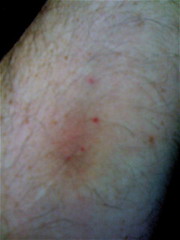 Then, when I attempted to put the blood into the test strip for my reading, apparently there wasn't enough blood for the test and the monitor shut off automatically. AAAACCK! I turned it back on again and the stupid thing showed "Er3" which I assumed was some sort of error message. Dangit, that mistake cost me over a buck and I pulled out another expensive test strip to try again. After trying to produce blood (out of a turnip!) from my forearm three more times with no success, I reluctantly went to my fingers. UGH! I type with these things all day long, so the thought of pricking the tips of my fingers was not very delightful at all. I have SO much respect for diabetics who do this EVERY SINGLE DAY! Oh my gosh, more power to ya and I bow down in your honor. I used my index finger the first time and it produced a painful, yet productive flow of a drop of blood for the monitor this time around. On subsequent readings, I alternated to my ring finger, a few times on my thumb (more bruises!) until finally figuring out the side of my middle finger works the most pain-free of them all. I feel like I'm gonna leak if I drink something with all these holes in my fingers! :) Okay, so I finally get my first reading after a full 15 hours of fasting--107 mg/dL. It seemed a little high after no food for such a long period of time, but I was pleased with it being well within "normal" range. I took my fish oil supplements and vitamins prior to this test, so I'm wondering if they might have impacted my blood sugars a bit. Even still, I wasn't at all concerned about my reading. It was right where it needed to be. So Christine and I decided to eat a pretty large meal for lunch which you can see at my menus blog for May 27, 2008. Although it was a low-carb meal, there was still plenty of carbs from spinach, eggs, Ranch dressing, dried cranberries, cheese, mashed cauliflower, and the protein that gets synthesized into carbs in the body (remember gluconeogenesis?). So you would expect that my blood sugar would go up even slightly, right? Well, not exactly. When I tested my blood one hour after this meal, I was in for a BIG SHOCK! Hold on to your hats with this people, but it literally stunned me--my blood sugar levels DROPPED 26 points down to 81 AFTER my meal. What the? How did? Is it possible? HUH?!?! Now, wait a minute. I thought your blood sugar was supposed to go UP after eating a meal? I ate all these carbs, so wouldn't my blood sugar go up under normal circumstances? Strange, huh? Oh, but it gets even better. Three hours after eating, I decided to check my blood sugars again (man, my fingers REALLY hurt with all this testing!) and it had risen back up to 94 again, but still well below my fasting blood glucose of 107. Although it was on the rise again, my blood sugar was still kinda low and made me hesitant about eating something else lest it drops again. I know it sounds funny to say that, but what else am I to think about this bewildering blood sugar predicament? You'll see from my menus blog yesterday that I ate a slice of homemade key lime cheesecake in the afternoon followed by a Stallone chocolate protein pudding prior to my Tuesday night volleyball games at church. This fueled me up for the 150-minute cardio workout I received and kept me satiated throughout all my games. When I got home, I was curious to see where my blood sugars were three hours after the last time I ate (the protein pudding). The readout? I was at 91. Weird doesn't even begin to describe this. I have to tell you during my lunch meal on Tuesday, I experienced a rather excruciating splitting headache from temple to temple across my forehead. I don't usually get headaches, but this one was a doozy. I took three Aleve when I got home and it went away within an hour, but I can't help but think it may have something to do with my blood sugar DROPPING while I was eating my meal. Counterintuitive? You bet it is! Yes, I realize my blood sugar numbers are fabulous and that people with very serious hypoglycemia have their blood sugars drop dangerously below 60 with all kinds of negative side effects, including headaches, the shakes, sweating, numbness in the extremities, thirst, hunger, heart palpitations, and worse. I would NEVER want to have to go through that myself and I know many of you have. But does your blood sugar ever go DOWN after eating? Everything I've ever heard and read about blood sugars is that they go UP following a meal and then come back down again over the next few hours. In fact, that's exactly what Christine's did when we measured her blood sugars at the same time as mine. She started at 83 after a full night of fasting and then hers jumped up to 127 one hour after eating lunch before falling again down below 100 a few hours later. That's a normal blood sugar response. So what the heck happened to mine then? Being the ever-inquisitive investigative reporter-type that I am, I couldn't resist the chance to experiment today and you're gonna think I've lost my marbles when you hear what I did. Because of the way my blood sugars responded to that low-carb meal for lunch yesterday, I wondered what would happen if I consumed an especially high-carb meal today for lunch. Some of you suggested I hearken back to my controversial "planned splurge" idea again to see if that will get the scale moving downward again, and so I did--I went to Pizza Inn and had their buffet! 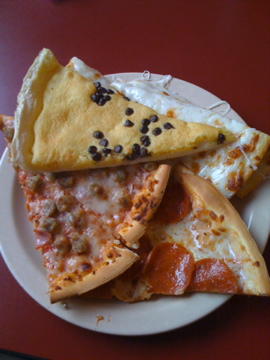 It was weird going to a pizza place for the first time in about three years (the last time was my infamous 30 slices of pizza splurge when I was visiting my dad in Tennessee) and I was preparing to hate it. Actually, it wasn't too bad. I was hungry, the food was pretty tasty, and I ended up eating about 15 slices in all. I fully expected my body to react to all these carbs (which undoubtedly numbered well over 300 grams!) by being lethargic, bloated, and miserable. And I also predicted my blood sugar would JUMP way up. Before we headed off for the pizza feast, I tested my fasting blood sugar this morning and it was 91 (lower than yesterday's reading of 107, but I didn't take my vitamins and fish oil prior to today's measurement). Would eating a very high-carb meal make any difference at all in the way my blood sugars react to it today? I wanted to know and see it with my own eyes. I ate and ate slices of garlic cheese pizza, pepperoni pizza, bacon cheeseburger pizza, sausage pizza, and even chocolate chip pizza. I ain't gonna lie, it was good! But I wouldn't want to eat like that everyday. As has happened in the past when I ate a bunch of carbs, I usually feel miserable the rest of the day regretting my transgressions. That's what I was expecting today along with a spike in my blood sugars. Did it happen? The answer is no to both. I feel great right now over five hours after eating all that pizza and interestingly my weight is only a couple of pounds up from what it was this morning when I weighed. That's curious since my weight has been known to fluctuate as much as 8-12 pounds after a big meal like that. But even more remarkable is what happened with my blood sugar just one hour after eating all those starchy and sugary pizza slices. I should have expected this. My reading was 90--that's right, my blood sugar dropped a point from my fasting level one hour after my meal. I had to see my two-hour reading and it FINALLY rose above my fasting level to 100 and then my three-hour reading started coming down again to 98. What's going on here? Am I producing excessive insulin which is keeping my blood sugars very low even after a meal? Is this what they call "reactive hypoglycemia" at work here? If so, how did I get it and what can I do to overcome it? Thankfully I have a whole host of low-carb experts at my disposal to discuss this phenomena and I suspect a lot more of us low-carbers are dealing with this issue than we would like to admit. Is this part and parcel of eating this way over the long-term and is there anything necessarily wrong with this happening? What can we do to counteract it if it is something that needs to be addressed? I have set up a podcast interview with a doctor who used to work with the late Dr. Robert C. Atkins later this week to talk about his theory about the onset of hypoglycemia for those who continue livin' la vida low-carb after a significant weight loss. It's a thought-provoking mental exercise that perhaps needs to be researched for the sake of all of us who have made this our chosen lifelong nutritional program. I'll be sharing that interview with you sometime in the month of June at "The Livin' La Vida Low-Carb Show with Jimmy Moore. In the meantime, I'm finished eating pizza for a LONG time and back to the healthy low-carb lifestyle again. If all of this doesn't have at least SOMETHING to do with my recent inability to get rid of those 30 pounds I've put on since beginning weight training, then I don't know what else is happening. It seems too coincidentally odd that all this is happening simultaneous to the weight gain, so I'm pursuing this further with my doctor to see if it will shed some light on my situation. You'll be the first to know when I hear ANYTHING about this, so THANK YOU again for all of your encouragement, advice, and support through this. I appreciate the friendships I have seen in action over the past few months as you all remind me of the great community we have surrounding the low-carb lifestyle. We're just real people living our lives and trying to figure out what works best for weight and health management. We KNOW it's livin' la vida low-carb which is why we LOVE it! :) Please feel free to share your thoughts and experiences about these blood sugar fluctuations. I'm sure I'm not the only one who has seen this happening while following a low-carb nutritional approach. Thoughts anyone? 5-28-08 UPDATE: I just took another measurement of my blood sugar six hours after my meal (no, I'm still not hungry after all those pizza slices!) and it was 90--back to my fasting baseline again. Hmmmmm... Labels: blood, blood glucose, blood sugar, diabetes, hypoglycemia, insulin, insulin resistance, Jimmy Moore, lancet, low-carb, pizza, Pizza Inn, planned splurge, strips, test
Could An Intermittent Fast Help Hypoglycemia?
After I recently blogged about hypoglycemia as a possible side effect of livin' la vida low-carb, one of my readers had an interesting circumstance in her life that she wanted to know if anyone else has had experience with. Here's what she wrote to me in an e-mail: "I became hypoglycemic at 21 and had no idea what was suddenly wrong with me except that eating French fries fixed the symptoms. I was diagnosed and advised by doctors who didn't believe in hypoglycemia and simply told me to eat sweets and glucose tablets.
So after hugely gaining weight (glucose tablets led to me eating 6 meals a day to combat the worsening symptoms), I worked out over the years how to deal with it by trial and error. One thing that I have never heard any other hypoglycemic mention is that I discovered I can 'train' myself for a fast (for example, for 8 hours, if circumstances demand I will need to skip lunch that day) by fasting the day before.
On the first day I will be useless and shaky for the last few hours (I am luckily not too hypoglycemic and have never fainted), but on the second day I can function normally for much longer and don't need to eat until around the time when I gave in on the first day.
I would be interested to know if anyone else has tried this, and whether there are medical implications that would make it worth investigating how and why it is possible."I don't have any specific experience doing this, but it sorta sounds like the intermittent fasting plan that I tried last year for weight loss. Has anyone use this kind of strategy for controlling hypoglycemia? My reader and I'm sure many others who are reading the blog would like to know. Labels: glucose tablets, health, hypoglycemia, intermittent fasting, low-carb
Is Hypoglycemia A Hidden Low-Carb Side Effect?
One of the things I enjoy doing at my blog is providing information that people can apply to their daily lives that will help them solve an issue they are having while livin' la vida low-carb. Whether it's about weight loss, health, fitness, or whatever, I think you the reader can be best served with practical and scientifically-sound ways to live this lifestyle over the long-term as so many of us are. Today I have a very special guest editorial from Dr. Keith Berkowitz, who is the medical director for The Center For Balanced Health. I was talking to him on the telephone recently about his fantastic new high-fiber NexGen muffins when the subject of blood sugar came up. He said that the issue of hyperglycemia, or high blood sugar which is a precursor to diabetes, has been given almost a monopoly of attention from the medical community while an even more dangerous condition has gotten completely overlooked and ignored. It's the condition known as hypoglycemia. Dr. Berkowitz went on to explain some of the symptoms of hypoglycemia, or low blood sugar, and how it could be the reason why your weight loss suddenly stops while livin' la vida low-carb. Also, if your energy is sapped and you begin feeling tired for no apparent reason at all, it's time to get a glucose tolerance test to see what your A1C levels are, he said. I was so spellbound by the discussion of this issue that I asked Dr. Berkowitz to write a column for my blog so that all of us can be better informed of the warning signs that we may be suffering from hypoglycemia and how to treat it. Special THANKS to Dr. Berkowitz for sharing his wisdom on this issue with us today and I welcome your feedback to what he has to share. ENJOY! The Forgotten Blood Sugar Disorder: Hypoglycemiaby Dr. Keith Berkowitz, M.D. Medical Director for The Center For Balanced HealthAccording to the American Diabetes Association, 21 million Americans have diabetes and another 54 million American are at risk with pre-diabetes or elevated blood glucose. Because of this, our attention has been concentrated on treating high blood glucose while largely ignoring other blood sugar disorders. Poor eating habits, the addition of unhealthy ingredients, increased stress and poor sleeping habits has led to the increased incidence of this underappreciated blood sugar disorder: hypoglycemia. Hypoglycemia has been traditionally defined as a low blood glucose level (serum levels less than 70 mg/dl either taken fasting, randomly or after a glucose challenge). Unfortunately, most individuals I see in my practice do not present with these results but instead present with normal blood glucose levels, the ability to lose some weight but not the last 10 to 20 pounds or unexplained low energy levels. One reason for this is that most individuals only have fasting blood glucose or an HgbA1c taken by their health professional. An HgbA1c level represents the average amount of glucose in the blood over a three month period. A level of 4.0% is equal to an average blood glucose level of 60 mg/dl while a level of 5.0% is equal to a blood glucose level of 90 mg/dl. HgbA1c levels between 4.8% and 5.9% are considered normal. Levels below 4.8% are usually consistent with hypoglycemia. Individuals with hypoglycemia can often have symptoms that include: headaches, increased irritability, difficulty concentrating, palpitations, light-headedness, fatigue, anxiety, excessive sweating or urination, leg cramps, dizziness and clamminess. Other symptoms can be related to eating. Patients I see with this diagnosis often feel more tired after meals, feel “sick” when they either miss a meal or if a meal is delayed. So, if you have significantly reduced calories or carbohydrates, are you still unable to lose weight? Are you unable to lose that last 20 pounds no matter what you try? Eating a low carbohydrate diet but still hungry and/or tired after meals? I just may have a solution for you. Traditionally treatment for hypoglycemia has been to give sugar. Unfortunately, this treatment only provides temporary relief and in very sensitive individuals causes an even greater reaction thirty minutes to two hours later. Although, a strict low carbohydrate diet is helpful, it does not always solve the problem by itself. In my practice, Center for Balanced Health, I see individuals with such pronounced hypoglycemia that their blood sugar drops almost immediately after a glucose challenge. It’s the equivalent of filling an automobile with gas only to find that the gas tank has a very large leak. At the Center for Balanced Health, we help patients manage their hypoglycemia by telling them to: - Eat five to six small meals a day about every three hours. Think of yourself as a fuel-efficient automobile. You want constant flow of energy (glucose) throughout the day. - Avoid meals that are too small or too large especially at night. Meals that are too small will not provide enough energy to get you through the day. Meals that are too large place a larger burden on your metabolic system to process these nutrients and thus can trigger a hypoglycemic reaction. - DON'T skip meals especially breakfast. Breakfast is the most important meal of the day because it sets the tone. - Balanced eating. Always have some protein and fat at each meal or snack. Avoid and limit foods high in sugar or other refined carbohydrates especially on a empty stomach. Still utilize a controlled carbohydrate approach and get your carbohydrates from foods high in fiber (dark green leafy vegetables, non starchy vegetables, avocado, high fiber low carbohydrate crackers as examples) - Get a good night’s sleep. Good sleep helps replenish your system so that your body works more efficiently. - Use of a fiber supplement (make sure you take with enough water) or eating a high fiber food (without refined carbohydrates or sugar) before meals or snacks can help slow the absorption of carbohydrates and thus prevent rapid declines in blood sugar. - Exercise regularly. Strength training can improve glucose metabolism - Avoid alcohol, caffeine, tobacco use - Avoid the use of stimulants If you suspect hypoglycemia, the best diagnostic test is a glucose tolerance test with insulin levels and an HgbA1c. I usually do this test in my office because a glucose challenge can sometimes precipitate symptoms of low blood sugar. Labels: A1C, blood glucose, blood sugar, Center For Balanced Health, diabetes, hypoglycemia, Keith Berkowitz, test
Forsythe: When Low-Carb Becomes 'A Way Of Life,' Mainstream Acceptance Will Come
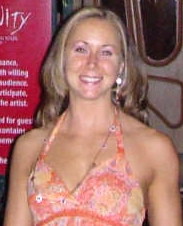 Up-and-coming low-carb researcher Cassandra Forsythe You know, I'm spoiling you this week by publishing TWO interviews in the past few days. If you missed my interview with Dr. Gil and Regina Wilshire earlier this week, then you will want to go back and check it out. It was REALLY encouraging hearing these fantastic leaders in the low-carb community sharing their passion for livin' la vida low-carb. Today, I have another special treat to share with you. That beautiful woman you see at the top of this post is a young lady named Cassandra Forsythe from the Department of Kineseology at the University of Connecticut. You may not know who she is yet, but Cassandra is one of the rising research superstars who will thrust low-carb to the next level in the science lab in the decades to come. Get to know the future Dr. Cassandra Forsythe today in my exclusive interview with her as she shares what she is doing in her pursuit of a PhD and what she wants to do with her education after she graduates. Cassandra is EXACTLY the kind of people we need working behind-the-scenes on college campuses from coast to coast in the United States constantly looking to science for nutritional answers, not more of the same propaganda we hear from the so-called health "experts." ENJOY my interview with her and feel free to post your comments about it at the end of this post. I sure am glad Cassandra is fighting for the truth the old-fashioned way--empirical, science-based knowledge that comes from long-term research studies. 1. I'm pleased to welcome to the "Livin' La Vida Low-Carb" blog today a PhD student in nutrition and metabolism at the University of Connecticut named Cassandra Forsythe who works directly with one of the most influential members of the low-carb research community, Dr. Jeff Volek. Thanks for joining us today soon-to-be Dr. Forsythe (that does have a nice ring to it)! You have a very personal reason for livin' la vida low-carb that frankly has nothing with being overweight or obese. Tell my readers about your carbohydrate health horror story. Thank you Jimmy for inviting me to your blog. I'm very happy to share my story with your readers. For me, instead of being one of the many individuals who are carb insensitive (meaning that due years of carbohydrate-overexposure, their pancreas does not produce the insulin needed to clear the carbs from their bloodstream OR their tissues are unresponsive to insulin that is released). I'm someone that is TOO carb sensitive! Whenever I eat carbs, especially high glycemic carbs I become immediately hyperglycemic (aka high blood sugars) and then quickly hypoglycemic (aka low blood sugars). When I was tested in the hospital recently, after an oral glucose tolerance test, my blood sugar level went down as low as 30 mg/dl after only 2 1/2 hours! This reaction is known as reactive hypoglycemia, and I noticed Connie Bennett spoke about it recently on your blog. Now, doctors tell people with hypoglycemia to eat quickly digesting carbohydrates(like glucose tablets) immediately to help them get out of the blood sugar lows(these are the same doctors that tell diabetics to eat a low-fat diet, mind you). But, what this really results in is just another bout of reactive hypoglycemia! It was the sugars that put me there in the first place! So, I ignore the "wisdom" of these doctors and have learned to prevent hypoglycemic by staying away from carbohydrates and sugars. A low-carb lifestyle has been my saving grace. Now I focus my diet on protein, fats, and green vegetables. Before I discovered that I didn't have to eat carbs with every meal, or even carbs at all, I was always hungry, shaky and irritable due to the fact that my blood sugar levels were always on a rollercoaster ride. Now, my concentration levels, satiety and overall mood are so much better because I maintain euglycemia. 2. Despite all the attention on weight loss that the low-carb lifestyle receives (and rightfully so since it does perform that function well), it really is about controlling disease, isn't it? Whether it's hypoglycemia, metabolic syndrome, diabetes, cancer, or a myriad of other known illnesses associated with too much carb consumption, the most amazing part of livin' la vida low-carb is about naturally bringing these health ailments under control without the use of drugs or invasive surgical procedures of any kind, right?You're absolutely correct Jimmy. Proper food choices have the ability to make meaningful changes in anyone's body. It's amazing that drug companies have such a huge impact on our society when their products have so many uncomfortable side effects and are not even half as effective as changing one's eating habits around for the better. However, we all know that the reason drugs are so popular is because people have never been expected to take their health into their own hands. Instead of being responsible for their actions, they've been taught that they can reach for a pill whenever their health goes downhill. It's sad, really. 3. While I'm sure it is thrilling to be on the cutting edge of nutritional science as it relates to low-carb, no doubt the day-to-day activities of your studies may not be all that exciting to the average person. What is a typical day in the life of Cassandra Forsythe?Well, right now, I've been taking some time away from the research because I'm studying for my PhD exams. My supervisor Jeff Volek is letting me focus on passing those before I'm expected to return to the lab for the day-to-day research. Normally, though, a day in the life of Cassandra Forsythe is very exciting; but it's also one that requires a lot of self-motivation and passion for research. You see, as a researcher, no one is expecting me to clock in and clock out at some specific time. Instead, my day is built around the schedules of the research subjects we have participating in our studies, the classes I have to take for my degree, the readings I have to do to stay on top of the investigations done by other low-carb scientists, and the writing we have to do in order to communicate our findings to the world. Overall, my day doesn't just go from 7am to 5pm with a coffee break, lunch break and afternoon tea; rather, it's goes all day long and doesn't take breaks on the weekends. Now, that doesn't mean I have no social life or no escape from work, but it does mean that I spend less time watching TV, and more time getting in things that are important (such as working out). Also, our team of students at the lab is one of the best and we work very well together to accomplish some amazing research. It's all about team effort, because doing our jobs alone would not be possible. 4. Zeroing in on your primary fields of interest as it relates to livin' la vida low-carb, what are the major studies you are working on looking to discover? Without getting into the deep details of any ongoing study for obvious reasons, are you seeing any surprising trends among the data your team has compiled so far that could be damning for the low-fat diet in 2007 and beyond? When do you expect some of this research to be made public?The major questions we're looking to provide solid answers for is the effectiveness of a very-low-carbohydrate diet for the treatment of Metabolic Syndrome (the clustering of health disorders that predispose people to diabetes and cardiovascular disease) compared to a low-fat diet. We're also trying to determine what are the best types of fat to consume while following a very-low-carbohydrate diet. With respect to surprising data from our team, yes there are some very exciting results that we've discovered. This data will be published very soon and what it's going to show the world is that the beneficial effects of a low-carb diet extend further than just weight loss and improvements in blood triglycerides and cholesterol. A very-low-carb diet actually significantly improves the quality of our plasma membranes which results in better cell signaling, improved insulin sensitivity and decreased inflammation. These results are in comparison to a low-fat diet, and will cause advocates of a low-fat diet for treatment of Metabolic Syndrome to think twice about their recommendations. 5. Oh, that will be VERY exciting indeed, Cassandra! One specific field of interest in your research surrounds the much-vilified macronutrient known as fat. Society has grown accustomed to equating a low-fat diet with a healthy one while simultaneously considering any diet that is high in fat and low in carbohydrates as unhealthy. But there are differences in fat quality that the average Joe and Jane off the street do not differentiate or really understand for that matter. Can you share the basic difference between the various kinds of fat and which ones are actually good and even essential for you to consume?We all think of fat as just the white stuff you cut off your steak or the grease you drain out of the pan after you cook any type of meat. We also refer to certain fats as being saturated or unsaturated with the former being bad for you and the latter being good. What we don't understand though is that all foods that contain fat or any kind are a mixture of all different types of fatty acids. These fatty acids are basically long chains of carbons, oxygens and hydrogens that differ in the amount of bonds that are found between each carbon. Saturated fatty acids have single bonds between each carbon and are straight chains. Monounsaturated fatty acids have one double bond somewhere in the chain and are kinked as a result. Polyunsaturated fatty acids have two or more double bonds in the chain and a very kinked. There are also trans fatty acids, which are a type of polyunsaturated fatty acid, but instead of being kinked, their configuration makes them straight. Overall, straight chains of carbons are supposed to be the bad chains because in cell membranes they can lie closely side-by-side and cause the membrane to be very rigid. The unsaturated chains can't lie close together in membranes and as a result, cause the membrane to be more fluid and flexible. Also, in nutrition studies, researchers have found that foods that contain a high proportion of saturated fatty acids in them (remember, no food is 100% any type of fatty acid, instead, they are a MIXTURE of different types), cause increases in blood cholesterol and risk of disease. However, this research is very outdated and failed to look at what type of cholesterol was increased. Saturated fatty acids increase both the good and the bad cholesterol, so really their effects are not all that terrible. Also, in the majority of research, the effects of fatty acids were evaluated in the context of a high-carb diet. There may be a different effect of fatty acids depending on the amount and type of carbohydrate is consumed in conjunction. Our research here at UConn has given us evidence that saturated fats may not be as bad as once thought, and their effects are dictated more by the hormonal effects of carbohydrate in the diet. In summary, the only type of fatty acids you need to avoid completely in your diet are trans fatty acids. These types of fats are those found in deep fried and hydrogenated fat foods and are typically found in conjunction with carbs. However, some low-carb foods, like deep-fried chicken wings or dressings with hydrogenated oils should be avoided for their potential to contribute trans fatty acids. Foods with saturated fat, like dairy, and some meats, are not bad and don't need to be eliminated from a low-carb diet. 6. While it is universally known that trans fats are indeed bad news for the body as you just indicated, the same cannot necessarily be said for all saturated fats which have been severely maligned and misunderstood by low-fat zealots spreading ignorance about this vital ingredient in a healthy diet. You briefly hit on this in my last question, but what kind of saturated fats should people be eating and why? Do you have any studies in the works that will compare how the quality of fat consumed really does make a difference?Like I was saying above, there hasn't been enough research with saturated fatty acids to deem them as evil or not. What I mean is that no one has isolated saturated fatty acids from carbohydrates to see if they have the same effect on health markers as when the level of carbohydrate (an in turn, glucose and insulin in the body) are high. So, what I know right now about individual saturated fatty acids is just what I've read in studies that have included carbohydrate in the diet. Just based on this information, I can't really say what saturated fatty acids should be included and which should not because these recommendations would not apply to people following a low-carb lifestyle. However, with that said, the topic of my upcoming PhD dissertation project is to determine whether or not saturated fatty acids should be excluded from a low-carb diet. With the help of Dr. Volek and my fellow lab mates, I'm going to conduct a study that will look at a low-carb diet rich in saturated fatty acids with one that is rich in unsaturated fatty acids and see what happens to all risk factors for disease such as inflammatory markers, cell membrane composition, insulin sensitivity and blood cholesterol levels. Hopefully the results of this research will result in more investigations that will look at specific types of saturated fatty acids and how they effect health. 7. Your research experience combined with your writing talents (which are on full display at your remarkable blog located at CassandraForsythe.com) come in very handy with your contributions to some major health publications like Men's Health. You are helping to educate the public about why they should consider livin' la vida low-carb as their way to manage their weight and health. Where do you see low-carb living as a cultural phenomenon going in a year, five years, and even ten years from now? Will people ever really find out what "low-carb" means rather than what the media and the so-called health "experts" want them to believe about it (i.e. just eating bacon, eggs, and cheese all day)?Right now I think that low-carb is unfortunately still viewed as a bit of a "fad" (even though we know that it's not that at all). However, there are several prolific people in our low-carb circle that are making huge strides for the benefits of following a low-carb lifestyle. For example, as you know, Adam Campbell, the Men's Health sports and nutrition editor, has become a loud voice for low-carb. Through the magazine, he has the opportunity to reach out to thousands of people and tell them the truth behind carbs and the benefits of keeping carbs low. He wrote an amazing piece a few months back called "The Cure for Diabetes" that even made the ADA turn their heads! We've then got the brains in the Nutrition and Metabolism Society fighting the good fight for low-carb and providing all the science to back up everything that is stated. So, in my opinion, with all this power behind low-carb science, I think in five years, low-carb is going to become less of a "fad" and more of a way of life. Then, in ten years, our nutrition-governing bodies will finally accept low-carb as a way to treat certain health conditions like diabetes and certain forms of heart disease. (and I'm looking forward to being a part of that acceptance!) 8. What role do you plan on playing in the low-carb scientific realm after your work at the University of Connecticut is finished? Is this what you want to do for the rest of your life?After I'm done my degree here at UConn, I do plan on continuing researching low-carb. Ideally, I'd like to continue working with Jeff Volek. Dr. Volek is a brilliant person and has been an amazing mentor to me. He and I think very much the same and have many common interests. He's also a very hard worker and someone that gets the job done right every time. I've been fortunate to grow under his supervision. Once I'm officially a doctor, I will make it my top priority to either continue working at UConn or start a line of research on low-carb in a lab at another University with Dr. Volek as a co-investigator. As far as topics are concerned, I'm still interested in the quality of fat on a low-carb diet, meaning, since low-carb is going to become a way of life for many people, I want to help them understand what types of fat they should focus on so that they maximize their health benefits. So, this means continued research along the lines of my PhD dissertation project. 9. You are currently serving as the student representative for the International Society of Sports Nutrition (ISSN). What a platform for sharing the message of livin' la vida low-carb in an arena that may not know how well this way of eating functions for people who are active. Are there any specific areas of interest for you in terms of fitness that light your fire for telling people about low-carb?Yes, the ISSN is an awesome organization and I was so thrilled when I was voted at the new student representative. Since I've been involved with the ISSN, I've shared much of our research at UConn with people attending the various regional and international scientific meetings. Last year, I presented partial data from our low-carb and exercise study and it was very well received by the audience. With regards to fitness and low-carb, I'm very passionate about informing people that if you're a physically active individual, you DO NOT have to follow a high-carb diet! It is very possible and extremely effective to follow a low-carb diet, even if you're someone who is a long-distance endurance athlete or even someone who lifts heavy weights. Ultimately, just because you're an athlete, does not automatically mean you have to eat oodles of carbs just to be successful. Here at UConn, we're in the process of completing a study with low-carb and weight training and have not seen any negative effects on performance from following a low-carb lifestyle. In fact, the results are even better when people who are insensitive to carbs switch to low-carb and add exercise. However, this doesn't mean that every athlete should not eat carbs, or has to follow a low-carb diet. It just means that a low-carb diet is a good option for athletes and should be considered as an alternative to a typical carbo-loaded diet without any negative consequences. 10. WOW, what an honor it was to have you with us today, Cassandra...er, I mean the future Dr. Forsythe! I have a feeling we will be hearing a lot more from Dr. Cassandra Forsythe for many years to come and frankly I'm glad to have you working in the trenches bringing this fabulous research on low-carb to the forefront. Do you have anything encouraging and uplifting to share with any of my readers who may feel livin' la vida low-carb just isn't worth it to them anymore?Yes, I do. The benefits of a low-carb lifestyle for those who need it are so powerful that we're only just beginning to understand all of it's effects. These benefits positively effect things in your body that you can not see, but positively effect everything about your health. These things include changes in the way your genes are expressed to changes in the health of your cell membranes. Although you can't see these things, they're changing the quality of your life for the better. Living a low carb life isn't about cutting out things in your diet that you think taste good (i.e. cookies and cake), it's about changing the way you eat so that every aspect of your body is healthy, wealthy and full of energy. Are you as inspired by this young lady as I am? If so, then please share your feedback with her by clicking on the comments link below or you can e-mail her directly at Cassandra.Forsythe@uconn.edu. Let her know how much you appreciate her work and encourage her to keep the fire burning deep within her to share the truth about livin' la vida low-carb for many years to come. We are all so very proud of you, Cassandra! YOU GO GIRL! Labels: carbs, Cassandra Forsythe, diet, disease, fat, health, hypoglycemia, inspiration, interview, Jeff Volek, low-carb, low-fat, obesity, research, saturated fat, science, study, UConn
25 Signs You May Suffer From Hypoglycemia
 The energetic, beautiful, and talented Connie Bennett! Back by popular demand is bestselling author Connie Bennett from the SUGAR SHOCK! blog guest blogging with more information about the subject of hypoglycemia which you may find quite the eye-opener, especially if you or a loved one suffers from any of these nasty symptoms. Remember to leave your comments for Connie and she will respond right here at my blog. ENJOY! Dear readers of the "Livin' La Vida Low-Carb" blog,
It's Connie Bennett again. As you may recall, I'm one of Jimmy's many blogging buddies. I'm also a former sugar addict, holistic health counselor and author of the new book SUGAR SHOCK! from Berkley Books (part of the Penguin Group). Anyhow, Jimmy is being kind enough to allow me to guest blog over here as I continue my worldwide SUGAR SHOCK! Blog Tour.
Today, I'm here to talk to you about reactive hypoglycemia, which is a condition that not enough doctors recognize or accept. In my previous post, I mentioned a few symptoms you could get. What you may find mind-boggling is that if you have hypoglycemia (also called low blood sugar), you could have as many as 125 ailments! (To understand more about this condition and how it's often misdiagnosed, read this excerpt from my book SUGAR SHOCK!)
In fact, hypoglycemia has been called the “Great Imitator” because its strange, startling symptoms can mimic a frightening array of diseases and conditions. For instance, people with reactive hypoglycemia have been misdiagnosed as having bipolar disorder, schizophrenia, neurosis, migraines, Parkinson’s syndrome, paroxysmal tachycardia (rapid heartbeat), rheumatoid arthritis, mental retardation, alcoholism, hyperactive disorder, and even senility.
Isn't that scary? You may have reactive hypoglycemia, but your doctor diagnoses the wrong disease or condition! (By the way, in SUGAR SHOCK!, I share some scary stories about people getting misdiagnosed.)
So, here are 25 symptoms which signify you may have hypoglycemia:
1. Cravings for sweets
2. Mental confusion
3. Mood swings
4. Unexplained fatigue and exhaustion
5. Weak spells
6. Cold sweats
7. Depression
8. Headaches
9. Heart palpitations
10. Digestive disturbances
11. Forgetfulness
12. Insomnia
13. Anxiety
14. Obesity
15. Internal trembling
16. Crying spells
17. Lack of sex drive (females)
18. Impotence (males)
19. Allergies
20. Blurred vision
21. Night terrors and nightmares
22. Muscle pains
23. Allergies
24. Itching and crawling sensations on the skin
25. Internal trembling
I’m not a doctor, but if you have a number of the health woes cited above, I’d highly recommend that you see a physician to learn if you have hypoglycemia or another blood sugar condition. (The five-hour Glucose Tolerance Test, while unpleasant, may be able to give you some answers.)
Bear in mind, though, often, if you kick sugar (or at least drastically cut back on your consumption of sweets and refined carbs), you may be able to cut out (or curtail) these ailments. (I'm not promising anything, but isn’t it worth a try to find out?)
Incidentally, that’s what happened to me: I quit eating sugar and quickie carbs on doctor's orders in 1998, and all 44 of my symptoms completely vanished! So, I invite you to do some self-exploration.
- Do you have any of the symptoms I mentioned above? Which ones?
- Do you have any other baffling ailments? Think about any and all health problems that you have such as headaches, mood swings, getting too tired or wired, difficulty focusing, etc.
I’m eager to hear back from you and maybe help steer you in the right direction. Don’t be bashful. Tell us about your strange symptoms.
Connie Bennett, C.H.H.C.,
Author, SUGAR SHOCK! (Berkley Books)
www.SugarShockBlog.comLabels: blog, book, Connie Bennett, hypoglycemia, Jimmy Moore, SUGAR SHOCK, symptoms
Connie Bennett Guest Blogs On Hypoglycemia
What a sweet sugar-free and delicious treat I have for you in this post because my fellow low-carb blogging and sugar-shunning friend Connie Bennett from the SUGAR SHOCK! blog is currently on her worldwide blog book tour in promotion of her dynamic bestselling debut book release SUGAR SHOCK!: How Sweets And Simple Carbs Can Derail Your Life--And How You Can Get Back On Track!  Connie has a special message just for YOU about the sometimes confusing and misunderstood health condition known as hypoglycemia. Special THANKS to Connie for sharing this invaluable information with my readers and I urge you to pick up a copy or two of this very important book. Here's the personalized message Connie has just for YOU: Greetings, readers of Livin' La Vida Low-Carb,
It's my pleasure to be a guest here on my colleague/blogging buddy Jimmy Moore's Livin' La Vida Low-Carb blog. My name is Connie Bennett, and I'm an experienced journalist and the author of SUGAR SHOCK! (Berkley Books), which was recently released and is now for sale at bookstores everywhere and online retailers like Amazon, BarnesAndNoble.com, WalMart.com and Powells.com.
My "adoration" of--or should I say overwhelmingly unhealthy attachment to--carbs dates back to 1998...actually, even before then. You see, I'm a former sugar addict with a torrent of tales about how I used to embarrass myself mightly because of all those "culprit carbs" that I so avidly over-consumed. In fact, I now even jokingly refer to myself as an "Ex-Sugar Shrew!" (See how I playfully poke fun of myself in this cartoon.)
In retrospect, the worst part of my sugar habit was that I was besieged by a host of baffling, seemingly unrelated ailments--horrible headaches, severe PMS, a mind-numbing "brain fog," embarrassing forgetfulness, out-of-the-blue dizziness, unsettling depression, scary heart palpitations, and even more! It wasn't until my doctor diagnosed me with reactive hypoglycemia and bluntly stated, "Connie, quit all sugar and simple carbs" that I reluctantly walked away from these nutrient-lacking foods. Now, my goal is to spread the sour scoop about sweets and to help you break free.
By the way, perhaps, the name of my book (SUGAR SHOCK!) rings a bell, because Jimmy was one of a number of people who was kind enough to endorse it. He was joined by many top health experts, bestselling authors, and famous personalities, including the renowned Dr. Mehmet Oz, co-author of the huge bestseller, YOU: On A Diet. Not only that, but Jimmy gave a wonderful thumbs-up review, too. (Thanks again, Jimmy.)
So, I'm here today and tomorrow to draw your attention to the pervasiveness of hypoglycemia, a hugely misunderstood and often maligned condition by members of the medical establishment. (You can read an eye-opening excerpt from my book SUGAR SHOCK! by clicking here.)
I'd like to invite you to do what I call "Sugary Soul Searching" to begin to examine whether or not your weight issues may be related to symptoms of hypoglycemia:
- Do you think your weight problem is connectd to your sugar habit and your humongous sugar cravings?
- Are you besieged by a whole host of perplexing symptoms such as the ones I've mentioned above?
- Do you find that you'd rather eat those low-quality carbs than relish veggies and other high-caliber carbs?
- Do you skimp on better foods just to make room for those nutrient-lacking candies?
I look forward to hearing back from you. Feel free to ask me questions, too.
Connie Bennett
Author, SUGAR SHOCK! (Berkley Books)
www.SugarShockBlog.comPlease share your questions and feedback for Connie in the comments section below. She will be monitoring my blog and providing responses for YOU. She's the expert, so ask away everyone! Labels: blog, book, Connie Bennett, hypoglycemia, Livin' La Vida Low-Carb, low-carb, sugar, SUGAR SHOCK
|


