What Exactly Is Happening With My Bewildering Blood Sugar Levels
Ever since I blogged about my recent struggle to lose 30 pounds that have refused to budge since I put them on in the first couple of months of my resistance training which began in December 2007, the comments, e-mails, and overall good wishes that so many of you have shared with me have come pouring in and I sincerely appreciate everyone's advice and positive reinforcement for me through this frustrating time. I realize I am not alone in this and that is what drives me to want to get to the bottom of the issue to help others who have a similar predicament.
While there are likely several issues going on right now that might be the culprit in my case, I kinda stumbled onto something accidentally yesterday that was quite odd to say the least. For perhaps the first time in the more than four years I've been livin' la vida low-carb, I may have figured out something that has happened to my body somewhere along the way that goes against everything you've ever heard about the physiological mechanism of blood sugars. This totally freaked me out because I've never experienced anything like this before.
Out of pure curiosity, I decided to go to my local Walgreen's and purchase a blood glucose monitor on Tuesday along with all the lancets and testing strips to check my blood sugar levels. I couldn't believe the monitor was like $15, but the test strips cost $55 for a box of 50! WOW, paying over a dollar a pop for a tiny little test strip was a bit pricey, but Christine and I have considered buying this thing for a long time just to see where we are with our blood sugars.
No, we're not diabetic or even pre-diabetic and don't really NEED to check this, but I was just very, very interested in seeing something for myself--what happens to my blood sugar AFTER I eat? We've all talked about one of the major benefits of livin' la vida low-carb is stabilized blood sugars and keeping it from spiking so high after a meal. It makes sense, we believe it is true, now let's see. And so I did.
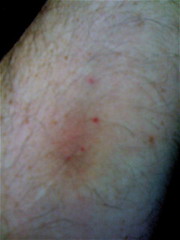
After a full night of fasting, I attempted to test my blood sugar levels yesterday morning. I say "attempted" because I had trouble using the lancet to provide me with enough blood for the testing strips. After reading the instructions about poking yourself in the forearm since it's not supposed to hurt as much there, I cocked that baby back on the "3" setting and let 'er rip! OUCH! Shoot, they didn't say it was gonna be like a shotgun coming out with that little pointy needle! That bad boy left a pretty big bruise on me today:
Then, when I attempted to put the blood into the test strip for my reading, apparently there wasn't enough blood for the test and the monitor shut off automatically. AAAACCK! I turned it back on again and the stupid thing showed "Er3" which I assumed was some sort of error message. Dangit, that mistake cost me over a buck and I pulled out another expensive test strip to try again.
After trying to produce blood (out of a turnip!) from my forearm three more times with no success, I reluctantly went to my fingers. UGH! I type with these things all day long, so the thought of pricking the tips of my fingers was not very delightful at all. I have SO much respect for diabetics who do this EVERY SINGLE DAY! Oh my gosh, more power to ya and I bow down in your honor. I used my index finger the first time and it produced a painful, yet productive flow of a drop of blood for the monitor this time around. On subsequent readings, I alternated to my ring finger, a few times on my thumb (more bruises!) until finally figuring out the side of my middle finger works the most pain-free of them all. I feel like I'm gonna leak if I drink something with all these holes in my fingers! :)
Okay, so I finally get my first reading after a full 15 hours of fasting--107 mg/dL. It seemed a little high after no food for such a long period of time, but I was pleased with it being well within "normal" range. I took my fish oil supplements and vitamins prior to this test, so I'm wondering if they might have impacted my blood sugars a bit. Even still, I wasn't at all concerned about my reading. It was right where it needed to be.
So Christine and I decided to eat a pretty large meal for lunch which you can see at my menus blog for May 27, 2008. Although it was a low-carb meal, there was still plenty of carbs from spinach, eggs, Ranch dressing, dried cranberries, cheese, mashed cauliflower, and the protein that gets synthesized into carbs in the body (remember gluconeogenesis?). So you would expect that my blood sugar would go up even slightly, right?
Well, not exactly.
When I tested my blood one hour after this meal, I was in for a BIG SHOCK! Hold on to your hats with this people, but it literally stunned me--my blood sugar levels DROPPED 26 points down to 81 AFTER my meal. What the? How did? Is it possible? HUH?!?! Now, wait a minute. I thought your blood sugar was supposed to go UP after eating a meal? I ate all these carbs, so wouldn't my blood sugar go up under normal circumstances? Strange, huh?
Oh, but it gets even better. Three hours after eating, I decided to check my blood sugars again (man, my fingers REALLY hurt with all this testing!) and it had risen back up to 94 again, but still well below my fasting blood glucose of 107. Although it was on the rise again, my blood sugar was still kinda low and made me hesitant about eating something else lest it drops again. I know it sounds funny to say that, but what else am I to think about this bewildering blood sugar predicament?
You'll see from my menus blog yesterday that I ate a slice of homemade key lime cheesecake in the afternoon followed by a Stallone chocolate protein pudding prior to my Tuesday night volleyball games at church. This fueled me up for the 150-minute cardio workout I received and kept me satiated throughout all my games. When I got home, I was curious to see where my blood sugars were three hours after the last time I ate (the protein pudding). The readout? I was at 91. Weird doesn't even begin to describe this.
I have to tell you during my lunch meal on Tuesday, I experienced a rather excruciating splitting headache from temple to temple across my forehead. I don't usually get headaches, but this one was a doozy. I took three Aleve when I got home and it went away within an hour, but I can't help but think it may have something to do with my blood sugar DROPPING while I was eating my meal. Counterintuitive? You bet it is!
Yes, I realize my blood sugar numbers are fabulous and that people with very serious hypoglycemia have their blood sugars drop dangerously below 60 with all kinds of negative side effects, including headaches, the shakes, sweating, numbness in the extremities, thirst, hunger, heart palpitations, and worse. I would NEVER want to have to go through that myself and I know many of you have.
But does your blood sugar ever go DOWN after eating? Everything I've ever heard and read about blood sugars is that they go UP following a meal and then come back down again over the next few hours. In fact, that's exactly what Christine's did when we measured her blood sugars at the same time as mine. She started at 83 after a full night of fasting and then hers jumped up to 127 one hour after eating lunch before falling again down below 100 a few hours later. That's a normal blood sugar response. So what the heck happened to mine then?
Being the ever-inquisitive investigative reporter-type that I am, I couldn't resist the chance to experiment today and you're gonna think I've lost my marbles when you hear what I did. Because of the way my blood sugars responded to that low-carb meal for lunch yesterday, I wondered what would happen if I consumed an especially high-carb meal today for lunch. Some of you suggested I hearken back to my controversial "planned splurge" idea again to see if that will get the scale moving downward again, and so I did--I went to Pizza Inn and had their buffet!
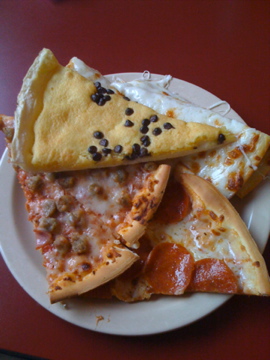
It was weird going to a pizza place for the first time in about three years (the last time was my infamous 30 slices of pizza splurge when I was visiting my dad in Tennessee) and I was preparing to hate it. Actually, it wasn't too bad. I was hungry, the food was pretty tasty, and I ended up eating about 15 slices in all. I fully expected my body to react to all these carbs (which undoubtedly numbered well over 300 grams!) by being lethargic, bloated, and miserable. And I also predicted my blood sugar would JUMP way up.
Before we headed off for the pizza feast, I tested my fasting blood sugar this morning and it was 91 (lower than yesterday's reading of 107, but I didn't take my vitamins and fish oil prior to today's measurement). Would eating a very high-carb meal make any difference at all in the way my blood sugars react to it today? I wanted to know and see it with my own eyes.
I ate and ate slices of garlic cheese pizza, pepperoni pizza, bacon cheeseburger pizza, sausage pizza, and even chocolate chip pizza. I ain't gonna lie, it was good! But I wouldn't want to eat like that everyday. As has happened in the past when I ate a bunch of carbs, I usually feel miserable the rest of the day regretting my transgressions. That's what I was expecting today along with a spike in my blood sugars. Did it happen?
The answer is no to both. I feel great right now over five hours after eating all that pizza and interestingly my weight is only a couple of pounds up from what it was this morning when I weighed. That's curious since my weight has been known to fluctuate as much as 8-12 pounds after a big meal like that. But even more remarkable is what happened with my blood sugar just one hour after eating all those starchy and sugary pizza slices. I should have expected this.
My reading was 90--that's right, my blood sugar dropped a point from my fasting level one hour after my meal. I had to see my two-hour reading and it FINALLY rose above my fasting level to 100 and then my three-hour reading started coming down again to 98. What's going on here? Am I producing excessive insulin which is keeping my blood sugars very low even after a meal? Is this what they call "reactive hypoglycemia" at work here? If so, how did I get it and what can I do to overcome it?
Thankfully I have a whole host of low-carb experts at my disposal to discuss this phenomena and I suspect a lot more of us low-carbers are dealing with this issue than we would like to admit. Is this part and parcel of eating this way over the long-term and is there anything necessarily wrong with this happening? What can we do to counteract it if it is something that needs to be addressed?
I have set up a podcast interview with a doctor who used to work with the late Dr. Robert C. Atkins later this week to talk about his theory about the onset of hypoglycemia for those who continue livin' la vida low-carb after a significant weight loss. It's a thought-provoking mental exercise that perhaps needs to be researched for the sake of all of us who have made this our chosen lifelong nutritional program. I'll be sharing that interview with you sometime in the month of June at "The Livin' La Vida Low-Carb Show with Jimmy Moore.
In the meantime, I'm finished eating pizza for a LONG time and back to the healthy low-carb lifestyle again. If all of this doesn't have at least SOMETHING to do with my recent inability to get rid of those 30 pounds I've put on since beginning weight training, then I don't know what else is happening. It seems too coincidentally odd that all this is happening simultaneous to the weight gain, so I'm pursuing this further with my doctor to see if it will shed some light on my situation.
You'll be the first to know when I hear ANYTHING about this, so THANK YOU again for all of your encouragement, advice, and support through this. I appreciate the friendships I have seen in action over the past few months as you all remind me of the great community we have surrounding the low-carb lifestyle. We're just real people living our lives and trying to figure out what works best for weight and health management. We KNOW it's livin' la vida low-carb which is why we LOVE it! :)
Please feel free to share your thoughts and experiences about these blood sugar fluctuations. I'm sure I'm not the only one who has seen this happening while following a low-carb nutritional approach. Thoughts anyone?
5-28-08 UPDATE: I just took another measurement of my blood sugar six hours after my meal (no, I'm still not hungry after all those pizza slices!) and it was 90--back to my fasting baseline again. Hmmmmm...
While there are likely several issues going on right now that might be the culprit in my case, I kinda stumbled onto something accidentally yesterday that was quite odd to say the least. For perhaps the first time in the more than four years I've been livin' la vida low-carb, I may have figured out something that has happened to my body somewhere along the way that goes against everything you've ever heard about the physiological mechanism of blood sugars. This totally freaked me out because I've never experienced anything like this before.
Out of pure curiosity, I decided to go to my local Walgreen's and purchase a blood glucose monitor on Tuesday along with all the lancets and testing strips to check my blood sugar levels. I couldn't believe the monitor was like $15, but the test strips cost $55 for a box of 50! WOW, paying over a dollar a pop for a tiny little test strip was a bit pricey, but Christine and I have considered buying this thing for a long time just to see where we are with our blood sugars.
No, we're not diabetic or even pre-diabetic and don't really NEED to check this, but I was just very, very interested in seeing something for myself--what happens to my blood sugar AFTER I eat? We've all talked about one of the major benefits of livin' la vida low-carb is stabilized blood sugars and keeping it from spiking so high after a meal. It makes sense, we believe it is true, now let's see. And so I did.
After a full night of fasting, I attempted to test my blood sugar levels yesterday morning. I say "attempted" because I had trouble using the lancet to provide me with enough blood for the testing strips. After reading the instructions about poking yourself in the forearm since it's not supposed to hurt as much there, I cocked that baby back on the "3" setting and let 'er rip! OUCH! Shoot, they didn't say it was gonna be like a shotgun coming out with that little pointy needle! That bad boy left a pretty big bruise on me today:
Then, when I attempted to put the blood into the test strip for my reading, apparently there wasn't enough blood for the test and the monitor shut off automatically. AAAACCK! I turned it back on again and the stupid thing showed "Er3" which I assumed was some sort of error message. Dangit, that mistake cost me over a buck and I pulled out another expensive test strip to try again.
After trying to produce blood (out of a turnip!) from my forearm three more times with no success, I reluctantly went to my fingers. UGH! I type with these things all day long, so the thought of pricking the tips of my fingers was not very delightful at all. I have SO much respect for diabetics who do this EVERY SINGLE DAY! Oh my gosh, more power to ya and I bow down in your honor. I used my index finger the first time and it produced a painful, yet productive flow of a drop of blood for the monitor this time around. On subsequent readings, I alternated to my ring finger, a few times on my thumb (more bruises!) until finally figuring out the side of my middle finger works the most pain-free of them all. I feel like I'm gonna leak if I drink something with all these holes in my fingers! :)
Okay, so I finally get my first reading after a full 15 hours of fasting--107 mg/dL. It seemed a little high after no food for such a long period of time, but I was pleased with it being well within "normal" range. I took my fish oil supplements and vitamins prior to this test, so I'm wondering if they might have impacted my blood sugars a bit. Even still, I wasn't at all concerned about my reading. It was right where it needed to be.
So Christine and I decided to eat a pretty large meal for lunch which you can see at my menus blog for May 27, 2008. Although it was a low-carb meal, there was still plenty of carbs from spinach, eggs, Ranch dressing, dried cranberries, cheese, mashed cauliflower, and the protein that gets synthesized into carbs in the body (remember gluconeogenesis?). So you would expect that my blood sugar would go up even slightly, right?
Well, not exactly.
When I tested my blood one hour after this meal, I was in for a BIG SHOCK! Hold on to your hats with this people, but it literally stunned me--my blood sugar levels DROPPED 26 points down to 81 AFTER my meal. What the? How did? Is it possible? HUH?!?! Now, wait a minute. I thought your blood sugar was supposed to go UP after eating a meal? I ate all these carbs, so wouldn't my blood sugar go up under normal circumstances? Strange, huh?
Oh, but it gets even better. Three hours after eating, I decided to check my blood sugars again (man, my fingers REALLY hurt with all this testing!) and it had risen back up to 94 again, but still well below my fasting blood glucose of 107. Although it was on the rise again, my blood sugar was still kinda low and made me hesitant about eating something else lest it drops again. I know it sounds funny to say that, but what else am I to think about this bewildering blood sugar predicament?
You'll see from my menus blog yesterday that I ate a slice of homemade key lime cheesecake in the afternoon followed by a Stallone chocolate protein pudding prior to my Tuesday night volleyball games at church. This fueled me up for the 150-minute cardio workout I received and kept me satiated throughout all my games. When I got home, I was curious to see where my blood sugars were three hours after the last time I ate (the protein pudding). The readout? I was at 91. Weird doesn't even begin to describe this.
I have to tell you during my lunch meal on Tuesday, I experienced a rather excruciating splitting headache from temple to temple across my forehead. I don't usually get headaches, but this one was a doozy. I took three Aleve when I got home and it went away within an hour, but I can't help but think it may have something to do with my blood sugar DROPPING while I was eating my meal. Counterintuitive? You bet it is!
Yes, I realize my blood sugar numbers are fabulous and that people with very serious hypoglycemia have their blood sugars drop dangerously below 60 with all kinds of negative side effects, including headaches, the shakes, sweating, numbness in the extremities, thirst, hunger, heart palpitations, and worse. I would NEVER want to have to go through that myself and I know many of you have.
But does your blood sugar ever go DOWN after eating? Everything I've ever heard and read about blood sugars is that they go UP following a meal and then come back down again over the next few hours. In fact, that's exactly what Christine's did when we measured her blood sugars at the same time as mine. She started at 83 after a full night of fasting and then hers jumped up to 127 one hour after eating lunch before falling again down below 100 a few hours later. That's a normal blood sugar response. So what the heck happened to mine then?
Being the ever-inquisitive investigative reporter-type that I am, I couldn't resist the chance to experiment today and you're gonna think I've lost my marbles when you hear what I did. Because of the way my blood sugars responded to that low-carb meal for lunch yesterday, I wondered what would happen if I consumed an especially high-carb meal today for lunch. Some of you suggested I hearken back to my controversial "planned splurge" idea again to see if that will get the scale moving downward again, and so I did--I went to Pizza Inn and had their buffet!
It was weird going to a pizza place for the first time in about three years (the last time was my infamous 30 slices of pizza splurge when I was visiting my dad in Tennessee) and I was preparing to hate it. Actually, it wasn't too bad. I was hungry, the food was pretty tasty, and I ended up eating about 15 slices in all. I fully expected my body to react to all these carbs (which undoubtedly numbered well over 300 grams!) by being lethargic, bloated, and miserable. And I also predicted my blood sugar would JUMP way up.
Before we headed off for the pizza feast, I tested my fasting blood sugar this morning and it was 91 (lower than yesterday's reading of 107, but I didn't take my vitamins and fish oil prior to today's measurement). Would eating a very high-carb meal make any difference at all in the way my blood sugars react to it today? I wanted to know and see it with my own eyes.
I ate and ate slices of garlic cheese pizza, pepperoni pizza, bacon cheeseburger pizza, sausage pizza, and even chocolate chip pizza. I ain't gonna lie, it was good! But I wouldn't want to eat like that everyday. As has happened in the past when I ate a bunch of carbs, I usually feel miserable the rest of the day regretting my transgressions. That's what I was expecting today along with a spike in my blood sugars. Did it happen?
The answer is no to both. I feel great right now over five hours after eating all that pizza and interestingly my weight is only a couple of pounds up from what it was this morning when I weighed. That's curious since my weight has been known to fluctuate as much as 8-12 pounds after a big meal like that. But even more remarkable is what happened with my blood sugar just one hour after eating all those starchy and sugary pizza slices. I should have expected this.
My reading was 90--that's right, my blood sugar dropped a point from my fasting level one hour after my meal. I had to see my two-hour reading and it FINALLY rose above my fasting level to 100 and then my three-hour reading started coming down again to 98. What's going on here? Am I producing excessive insulin which is keeping my blood sugars very low even after a meal? Is this what they call "reactive hypoglycemia" at work here? If so, how did I get it and what can I do to overcome it?
Thankfully I have a whole host of low-carb experts at my disposal to discuss this phenomena and I suspect a lot more of us low-carbers are dealing with this issue than we would like to admit. Is this part and parcel of eating this way over the long-term and is there anything necessarily wrong with this happening? What can we do to counteract it if it is something that needs to be addressed?
I have set up a podcast interview with a doctor who used to work with the late Dr. Robert C. Atkins later this week to talk about his theory about the onset of hypoglycemia for those who continue livin' la vida low-carb after a significant weight loss. It's a thought-provoking mental exercise that perhaps needs to be researched for the sake of all of us who have made this our chosen lifelong nutritional program. I'll be sharing that interview with you sometime in the month of June at "The Livin' La Vida Low-Carb Show with Jimmy Moore.
In the meantime, I'm finished eating pizza for a LONG time and back to the healthy low-carb lifestyle again. If all of this doesn't have at least SOMETHING to do with my recent inability to get rid of those 30 pounds I've put on since beginning weight training, then I don't know what else is happening. It seems too coincidentally odd that all this is happening simultaneous to the weight gain, so I'm pursuing this further with my doctor to see if it will shed some light on my situation.
You'll be the first to know when I hear ANYTHING about this, so THANK YOU again for all of your encouragement, advice, and support through this. I appreciate the friendships I have seen in action over the past few months as you all remind me of the great community we have surrounding the low-carb lifestyle. We're just real people living our lives and trying to figure out what works best for weight and health management. We KNOW it's livin' la vida low-carb which is why we LOVE it! :)
Please feel free to share your thoughts and experiences about these blood sugar fluctuations. I'm sure I'm not the only one who has seen this happening while following a low-carb nutritional approach. Thoughts anyone?
5-28-08 UPDATE: I just took another measurement of my blood sugar six hours after my meal (no, I'm still not hungry after all those pizza slices!) and it was 90--back to my fasting baseline again. Hmmmmm...
Labels: blood, blood glucose, blood sugar, diabetes, hypoglycemia, insulin, insulin resistance, Jimmy Moore, lancet, low-carb, pizza, Pizza Inn, planned splurge, strips, test
posted by Jimmy Moore at
5/28/2008 02:32:00 PM
48 Comments