|
PLEASE UPDATE YOUR BOOKMARKS TO LIVINLAVIDALOWCARB.COM/BLOG
Post-Low-Carb Meal 5-Hour Glucose Tolerance Test Produces Rather Odd Results
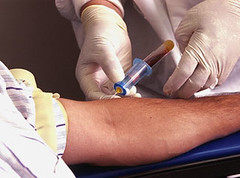 My arm had so much blood sucked out of it for these tests My arm had so much blood sucked out of it for these testsI just returned late on Thursday from my 3-hour trip up I-85 North to Durham, North Carolina to spend some time with the Triangle (and Beyond) Low-Carb Meetup group there as well as seeing a great low-carb doctor from Duke University named Dr. Eric Westman to conduct some tests and talk about my recent blood sugar woes and pesky 30-pound weight gain in 2008 that won't come back down again no matter what I do. It was a good time away although I missed blogging and updating you about the healthy low-carb lifestyle. And I'll be leaving again on Tuesday to go see my brother Kevin in Pensacola, Florida for at least a week where I will have ZERO Internet access besides my iPhone (and, no offense, but I ain't up for blogging on that thing with the hunt and peck typing!), so I'll be trying to squeeze in as many posts as I can before then. It's gonna stay busy for me the next couple of months. But so many of you have been wondering about how my visit with Dr. Westman went that I wanted to make sure I provided an update, especially with the results from my five-hour glucose tolerance test (GTT) following a low-carb meal which was conducted on Monday. If you thought my home testing of my blood sugars was interesting enough, just wait until I tell you what happened during the GTT. Unbelievably crazy! I'll share more about that in a moment. First, let's look at the bazillion other tests Dr. Westman ran for me to see if there are other culprits going on with my health. A few of these I requested done because Dr. Keith Berkowitz (who I will be sharing a special two-part follow-up podcast interview with the first week in August about this answering your questions), who espouses the "reactive hypoglycemia" theory for long-term low-carbers, suggested I have them run. Here were the results: Vitamin B-12--529 (normal) Cortisol--8.9 (surprisingly normal) Homocysteine--6.7 (normal) 25-Hydroxyvitamin D3--42 (normal) HbA1c--5.0 (a little low, but normal) LDL particle number--1453 (borderline high) Small LDL particle number--30 (low is less than 600!) By all accounts of these tests, I'm one extremely healthy guy! My thyroid function was all fine and so was my liver function. So it's good we can rule those out as culprits. I was quite frankly shocked to see my cortisol levels in the good range considering all the stress I've experienced lately, but this just confirms my body handles it all very well apparently. The A1c number was also encouraging since it is so spectacular and out of the diabetic range completely (although Dr. Berkowitz thinks it is a little low--a sign of the reactive hypglycemia according to him). My LDL and total cholesterol are higher than normal as I've previously blogged, but look at the particle number of the dangerous "small" LDL--a measly little 30! That's just 0.02 percent of my total LDL particle number...in other words, quite negligible and protective considering over 95 percent of my LDL particle size is the large, fluffy kind. :D I'm not at all worried about my lipid profile with my HDL at 65 and triglycerides at 77. That's an HDL/triglycerides ratio I'd put up against anybody else's every day of the week. Alright, so what the heck is going on with my blood sugars? And, more importantly, what is happening with my insulin levels when my blood sugar drops even after a low-carb meal? Inquiring minds, myself included, sincerely want to know. Here are the results of my GTT after eating a low-carb breakfast consisting of eggs and cheese with a chicken breast from Chick-Fil-A: TIME--GLUCOSE--INSULIN FASTING--87--4.4 30 MIN--89--13.7 1 HOUR--78--11.1 2 HOUR--78--9.0 3 HOUR--89--5.1 4 HOUR--87--5.0 5 HOUR--89--4.7 Fascinating test, huh? And it's just about what I expected was happening. My fasting glucose and insulin levels are perfect, but within a half hour of eating even a low-carb meal I'm seeing a TRIPLING in my insulin levels to keep my blood sugars in check. This would be a typical response if my insulin then came back down again within the first hour or two, but it doesn't. As you can see, the insulin sustains at that higher level for two hours lingering at 13.7 then slowly dropping to 11.1 and then hitting 9.0 before dropping back down significantly in the third hour to get closer to baseline. During this time of elevated insulin, my blood sugar falls below fasting down about 10 points before rising back to where it started once the insulin comes down again. A normal response would show blood sugars going up quickly and then falling quickly, but not for Jimmy Moore. Lucky me, eh? So what am I to make of this and what plan of action does Dr. Westman and his colleagues suggest I implement to limit this insulin response so that maybe I can get my recent weight gain to come back down again? I wish I could tell you it's a pretty cut and dry "do this and all will be well" solution, but it's not. The reality is I need to tweak this slowly by only changing one thing at a time. That one thing for me will include eating LESS protein than I have been and watching my specific portions of protein and overall intake just to see if it makes a difference. Yes, I know cutting portions and even counting calories is almost taboo to talk about within low-carb circles and I'm not interested in that debate right now because I'm not fully convinced of it. Only time will tell. I haven't once counted calories or measured out my portion sizes in the past four and a half years of livin' la vida low-carb, so this is a tough sell for me. But I'm certainly game for doing something different to get my weight to come back down again, especially that little bit that has come back to my midsection. Interestingly, Dr. Westman suggested I cut back on the amount of protein I have been consuming because it is possible that my body through gluconeogenesis is converting much of the dietary protein I have been consuming into glucose/sugar/carbs which COULD be the reason why I haven't been able to get my weight back down again. And this theory certainly has some merit since I consciously increased my protein intake when I started lifting weights for the first time in December 2007 shortly before my weight gain. Sure, I also took creatine in the first six weeks and that may have had some impact on the weight gain. But consuming more protein-based foods in an effort to help with my muscle growth could have sabotaged my weight maintenance efforts somewhat. Although I have experienced quite an increase in the amount of muscle on my body after six months of training, it's not implausible that upwards of half of that weight gain is indeed muscle mass. The rest of the 15 or so pounds of weight I have put on over this period of time may be the result of excess glucose from protein. Beginning yesterday, I started adding in more fat and deliberately trying to eat less total protein (not as a percentage, but overall) to see if it makes a difference. One way I'm doing this is to make sure any protein source I am eating is offset by an addition of more fat. For example, if I'm eating a chicken breast that is basically all protein and little fat, I'll slather it in butter and add cheese on top. Cheese in the form of brie or other fatty ones as a meal will also be a way to increase my fat while decreasing my protein. Cooking eggs in butter and adding cheese also will help with this. Nuts, coconut oil, heavy cream, and other high-fat foods will become more and more prevalent in my low-carb menus. Since I already eat most of those foods anyway, this shouldn't be difficult to implement. Simply cutting back on protein could be as simple as eating half a steak or only one burger patty or chicken breast. Making sure I contribute fat and fiber to my meals will keep that ratio of fat to protein at the 3-1 ratio I am hoping to attain. Carbs, of course, will remain reduced to basically non-starchy, green leafy veggies. What do you think about all of this? I'd love to know what you think about the results of my GTT. I'm also frightened to think what would happen if I did a traditional GTT with a glass of sugar water--EEEK! My insulin would go even MORE berserk! Your thoughts as always are welcomed. :) Labels: blood glucose, blood sugar, doctor, Eric Westman, fat, gluconeogenesis, glucose tolerance test, health, insulin, Jimmy Moore, low-carb, protein, tests
Dealing With Possible Reactive Hypoglycemia--One Month Later
I wanted to give you a quick one-month update on my progress dealing with a possible case of reactive hypoglycemia (although my symptoms don't match the definition of this condition found on Wikipedia). This seems like an incredibly odd subject to be talking about as someone who has been faithfully livin' la vida low-carb for the greater part of the past 4 1/2 years. How can a low-carber be dealing with something like this when a low-carb diet is supposed to be one of the best diets for stabilizing blood sugar levels and, more importantly, reducing insulin levels? As you know, I've been speaking with noted New York City low-carb doctor Dr. Keith Berkowitz who has been the only low-carb expert I've ever heard even talk about this phenomenon. His theory about reactive hypoglycemia for long-term low-carbers who have lost a lot of weight (like me!) seems to be valid on the surface (I'll be conducting a follow-up podcast interview in mid-July with Dr. Berkowitz to answer a TON of questions that you have submitted for him to answer). But something very odd has been happening with my blood sugar levels and that even includes after I've consumed a VERY high-carb meal. You'll recall last month I did an experiment where I splurged out on some pizza to test what would happen to my blood sugar since eating a "normal" low-carb meal produced a significant DROP in my blood sugar. I couldn't believe it was possible for your blood sugar to go DOWN after a meal, so I forced the issue by consuming more carbs in one sitting than I had done since I started livin' la vida low-carb in January 2004. The result? My fasting blood sugar of 91 actually DROPPED to 90 when I checked it one hour after eating (WOW!) all those slices of pizza, it finally rose to 100 by the second hour, and was back down to 98 by the third hour after this extremely high-carb meal. It was quite an illuminating self-experiment that had me scratching my head about what the heck was going on. I have been spending a lot of time over the past month trying to figure this out and I'm still perplexed about it. On the advice of Dr. Berkowitz, I implemented several strategies for dealing with this as well as the coinciding slight weight gain that seemed to happen at the same time I started resistance training beginning in December, including eating lots of small meals about every couple of hours (see my menus blog), getting adequate quality sleep, continuing with my exercise routine including my weight training, and trying to lower the stress in my life by taking more breaks from my work. When I started this I weighed 274 pounds and today I weighed 262. Although it has been moderately successful with bringing my weight down, I can see the numbers starting to stall out again as of late and I can't help but go back to what is happening with my blood sugars again. Could this have something to do with my weight being elevated? Did the creatine I took in the first six weeks of my weight training impact my blood sugar levels and get 'em all messed up? The honest answer is I don't know.  Since I have been doing this new routine for about a month now, I decided this morning to check my fasting blood sugar level and then several more times in the hour following a typical low-carb breakfast meal of eggs and sausage. This was a little larger meal than what I've been eating as part of my new "small" meals strategy, but not that much bigger. When I checked my blood sugar at 8:00am, the reading was 93 which is exactly where it should be after a night of fasting. So far, so good. At 8:15am, I had that delicious egg and sausage meal that took me about five minutes to consume. At 8:20am, just after finishing my meal, I checked my blood sugar again and it had already dropped seven points to 86. Curious about this sudden drop, I then checked my blood sugar level again fifteen minutes later at 8:35am and it had jumped UP to 102. Hmmmm, now this was interesting. That made me want to see what would happen in fifteen more minutes at 8:50am and my blood sugar was back down to 92 again. For kicks, I measured it two more times at 15-minute intervals at 9:05am and 9:20am and my blood sugar was 89 and 92 respectively. I stopped measuring because it was almost time to eat again. So what am I to make of all of this? Had I only checked my blood sugar after one hour as is typical, then I would have seen virtually NO change in my blood sugar. But doing this today in 15-minute increments was quite educational. It seems my blood sugar reaction is happening faster than normal which could be a good thing or a bad thing. Perhaps my body has become super-efficient at processing the foods I consume so there is no major impact on my blood sugar. Granted, my meal was virtually ZERO carbs, so the reaction should have been minimal. Next week I'll be going back to see my low-carb doctor to have a blood glucose tolerance test run. They will be checking not just my blood sugars, but also my insulin levels after drinking a big glass of sugar water. This will be the tell-tale sign of what is happening to me and I'm curious about the insulin. Will it be off the charts which could explain why my blood sugar DROPS after a high-carb meal? If so, then what can be done to control this insulin release since I'm already livin' la vida low-carb. You will be the first to know these results as soon as I get them back and analyzed. We will figure this out together because this could help so many people. I'll also be having a few more tests run just to check on them as possible culprits in this. My thyroid is fine based on the previous tests that were run at my last visit. So it's not that. The human body is a complex machine and sometimes it just takes time working through all the tests to come up with the answer. We are all different and there are any number of reasons that can explain what is happening. I just want to know THE reason. Is that too much to ask? :) The good thing is I'm not in any pain because of what is happening. Other than the added weight, my quality of life is pretty normal. I'm still very active playing volleyball, lifting weights, shooting basketball with the middle school-aged girl across the street, mowing the grass, etc. Life continues on despite all of this. And that's my attitude about it right now--just keep on keepin' on and not worry about it. Worry produces cortisol which is a nasty stress hormone that can cause problems similar to insulin. It too could be an issue, so I'm gonna have it measured as well. THANK YOU to everyone who has been following my story with this blood sugar thing with great interest and concern. I appreciate your comments and e-mails in support for me as I go through this. What I've found is I'm not the only one dealing with this and that's comforting in and of itself. In a way, I'm glad this is happening to me because I get to see what it's like to struggle somewhat. And I'll be danged if I let this thing beat me up and defeat me. I'm stronger than it is and I WILL prevail over it through the strength of the Lord and by the wisdom of the doctors who are overseeing my progress. Let me encourage you to NEVER GIVE UP in your pursuit of health because it is the best thing you could ever do for yourself. When I weighed 410 pounds and was on a one-way ticket to the graveyard just a little over four years ago, I didn't feel like I'd ever find the hope to become that man I was intended to be. But today I stand before you a changed man and proud to say by the grace of God I am better off than I was back then. While I may be having some tough times right now, I KNOW this situation is NOT impossible. There is an answer and I'm gonna keep searching for it until I find it. There's no going back to unhealthy eating ever again no matter how hard it gets. That's what my brother Kevin chose to do with his life and now he has less than a year left to live. It was his personal choice just as we all have that decision to make for ourselves. You can NEVER go wrong choosing to do something positive for your health. MAKE THAT HAPPEN today and you'll reap the benefits of it for many years to come. Keep at it and whatever you do--NEVER GIVE UP!!! YOU are worth it and the best is yet to come. Make us all proud by doing the things you have to do to shed the pounds and improve your health. YOU CAN DO IT!!! 7-2-08 UPDATE: Last night I received a telephone call from a nutritionist who used to work with the Atkins Center back when Dr. Atkins was still around. She wanted to know how she could help me with this hypoglycemia issue I seem to be dealing with. I told her what was happening even after a low-carb meal and she brought up something I hadn't really thought much about before, but it makes sense. She said that perhaps my body is converting most of the protein I am eating (and I do eat a rather moderate amount of protein) into sugar/carbs through gluconeogenesis which is producing an insulin response. So, despite the fact I am eating low-carb meals, the protein makeup of those meals could, in essence, be tantamount to eating carbohydrates. That sounds so messed up on surface value, but apparently my body must be extra sensitive to the protein I am consuming if it is doing this. I don't know for sure if that's what is happening, but it's the best theory I've heard yet. So next week I am getting a glucose tolerance test (GTT) run and several people have said I need to eat upwards of 150g carbs daily in the few days leading up to test. I'd never heard of this, but apparently it was pretty well-known so you don't skew with results that you are looking for. I asked my low-carb doctor about this and here was his response: Maybe...maybe not. It depends upon the question that we want to answer.
If you want to compare your results to what is thought to be the "normal response," then yes, carb eating would be good.
However, if you want to figure out what is happening to you after eating a low-carb meal (to look into this low blood glucose issue when eating low-carb), then no extra carb eating is needed.
We can start the test after you eat a low-carb breakfast. I also want to check the insulin at each time point to assess the pancreas response.Don't I want to know what's happening after a low-carb meal or is it more beneficial to do a standard GTT? I'm open to your input about this. If I'm gonna do the standard, then I need to start eating a few more carbs beginning on Friday leading up to the Monday morning test. Labels: blood sugar, health, Jimmy Moore, Keith Berkowitz, low-carb, reactive hypoglycemia, weight loss
'Livin' La Vida Low-Carb Show' Episode 144: Dr. Keith Berkowitz And His Low-Carb Hypoglycemia Theory
 Dr. Keith Berkowitz reveals his low-carb hypoglycemia theory Dr. Keith Berkowitz reveals his low-carb hypoglycemia theoryLast week I shared with you about a bewildering blood sugar issue happening with me right now. My blood sugars actually DROPPED after a meal rather than the typical rise and then gradual drop that happens in most people. This jogged my memory about a guest blog post I shared about a year ago about this very issue. In Episode 144 of "The Livin' La Vida Low-Carb Show with Jimmy Moore," we hear from the man behind the hypoglycemia theory associated with long-term low-carb weight loss success stories named Dr. Keith Berkowitz from the Manhattan-based Center For Balanced Health. Dr. Berkowitz worked with the late great Dr. Robert C. Atkins and inherited many of his patients who lost significant amounts of weight. Now he's seeing those patients dealing with hypoglycemia and is implementing strategies for dealing with this. Click on the "LISTEN NOW" link below or download it to your iPod to hear Episode 144:  "The Livin' La Vida Low-Carb Show with Jimmy Moore" Episode 144 [21:18m]: LISTEN NOW | DownloadEver since I blogged about my crazy blood sugar issues, people have been wanting to know more about this perplexing phenomenon. Dr. Berkowitz has been mulling this observational theory about reactive hypoglycemia around in his mind for a while now and is actively seeking a researcher to look into this for the sake of those low-carb dieters who have lost a lot of weight and then it just stops. This is something so many of us can relate to in our low-carb lifestyle. Dr. Berkowitz identifies what this condition is, why reactive hypoglycemia happens even when you eat low-carb, and what you can do to overcome this. This isn't just some quack theory because I'm living it right now. Practical, easy-to-implement strategies in response to hypoglycemia are shared by Dr. Berkowitz in today's podcast and I can personally attest that they WORK! Since I've added many of the suggestions he recommends people with this do, I have lost over 10 pounds in the first week. I don't expect this torrid pace to continue, but it is very encouraging so far. See my menus blog to see EXACTLY what I'm eating, how often, and the composition of the foods. Never miss anything for your low-carb lifestyle anytime by: 1. Listening at the official web site2. Calling (818) 688-2763 to listen via Podlinez3. Subscribing to the RSS feed 4. Going to iTunes-- Click here to subscribe! What's your reaction to what Dr. Keith Berkowitz shared in today's podcast? Have you experienced a hypoglycemic reaction to eating low-carb and feel "stuck" in your weight loss? Share your experiences with this in the show notes section of Episode 144. I appreciate Dr. Berkowitz sharing his time and expertise with us in today's podcast about this critical issue. If you are concerned about possibly having this condition, then you need to get a glucose tolerance test as soon as possible. This could be the answer you've been looking for. Tune in again next week as I share an eye-opening two-part interview with Dr. James E. Carlson, the author of a fabulous new book called Genocide!: How Your Doctor's Dietary Ignorance Will Kill You. If you support the high-fat, low-carb nutritional approach to weight loss and health, then you are gonna fall head over heels for Dr. Carlson! Let's just say he's not very fond of the current dietary recommendations of a high-carb, low-fat diet. DON'T MISS the next edition of "The Livin' La Vida Low-Carb Show with Jimmy Moore."Labels: blood sugar, hypoglycemia, interview, Jimmy Moore, Keith Berkowitz, low-carb, podcast, success, The Livin' La Vida Low-Carb Show, weight loss
What Exactly Is Happening With My Bewildering Blood Sugar Levels
Ever since I blogged about my recent struggle to lose 30 pounds that have refused to budge since I put them on in the first couple of months of my resistance training which began in December 2007, the comments, e-mails, and overall good wishes that so many of you have shared with me have come pouring in and I sincerely appreciate everyone's advice and positive reinforcement for me through this frustrating time. I realize I am not alone in this and that is what drives me to want to get to the bottom of the issue to help others who have a similar predicament. While there are likely several issues going on right now that might be the culprit in my case, I kinda stumbled onto something accidentally yesterday that was quite odd to say the least. For perhaps the first time in the more than four years I've been livin' la vida low-carb, I may have figured out something that has happened to my body somewhere along the way that goes against everything you've ever heard about the physiological mechanism of blood sugars. This totally freaked me out because I've never experienced anything like this before. Out of pure curiosity, I decided to go to my local Walgreen's and purchase a blood glucose monitor on Tuesday along with all the lancets and testing strips to check my blood sugar levels. I couldn't believe the monitor was like $15, but the test strips cost $55 for a box of 50! WOW, paying over a dollar a pop for a tiny little test strip was a bit pricey, but Christine and I have considered buying this thing for a long time just to see where we are with our blood sugars. No, we're not diabetic or even pre-diabetic and don't really NEED to check this, but I was just very, very interested in seeing something for myself--what happens to my blood sugar AFTER I eat? We've all talked about one of the major benefits of livin' la vida low-carb is stabilized blood sugars and keeping it from spiking so high after a meal. It makes sense, we believe it is true, now let's see. And so I did. After a full night of fasting, I attempted to test my blood sugar levels yesterday morning. I say "attempted" because I had trouble using the lancet to provide me with enough blood for the testing strips. After reading the instructions about poking yourself in the forearm since it's not supposed to hurt as much there, I cocked that baby back on the "3" setting and let 'er rip! OUCH! Shoot, they didn't say it was gonna be like a shotgun coming out with that little pointy needle! That bad boy left a pretty big bruise on me today: 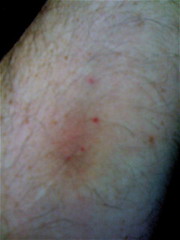 Then, when I attempted to put the blood into the test strip for my reading, apparently there wasn't enough blood for the test and the monitor shut off automatically. AAAACCK! I turned it back on again and the stupid thing showed "Er3" which I assumed was some sort of error message. Dangit, that mistake cost me over a buck and I pulled out another expensive test strip to try again. After trying to produce blood (out of a turnip!) from my forearm three more times with no success, I reluctantly went to my fingers. UGH! I type with these things all day long, so the thought of pricking the tips of my fingers was not very delightful at all. I have SO much respect for diabetics who do this EVERY SINGLE DAY! Oh my gosh, more power to ya and I bow down in your honor. I used my index finger the first time and it produced a painful, yet productive flow of a drop of blood for the monitor this time around. On subsequent readings, I alternated to my ring finger, a few times on my thumb (more bruises!) until finally figuring out the side of my middle finger works the most pain-free of them all. I feel like I'm gonna leak if I drink something with all these holes in my fingers! :) Okay, so I finally get my first reading after a full 15 hours of fasting--107 mg/dL. It seemed a little high after no food for such a long period of time, but I was pleased with it being well within "normal" range. I took my fish oil supplements and vitamins prior to this test, so I'm wondering if they might have impacted my blood sugars a bit. Even still, I wasn't at all concerned about my reading. It was right where it needed to be. So Christine and I decided to eat a pretty large meal for lunch which you can see at my menus blog for May 27, 2008. Although it was a low-carb meal, there was still plenty of carbs from spinach, eggs, Ranch dressing, dried cranberries, cheese, mashed cauliflower, and the protein that gets synthesized into carbs in the body (remember gluconeogenesis?). So you would expect that my blood sugar would go up even slightly, right? Well, not exactly. When I tested my blood one hour after this meal, I was in for a BIG SHOCK! Hold on to your hats with this people, but it literally stunned me--my blood sugar levels DROPPED 26 points down to 81 AFTER my meal. What the? How did? Is it possible? HUH?!?! Now, wait a minute. I thought your blood sugar was supposed to go UP after eating a meal? I ate all these carbs, so wouldn't my blood sugar go up under normal circumstances? Strange, huh? Oh, but it gets even better. Three hours after eating, I decided to check my blood sugars again (man, my fingers REALLY hurt with all this testing!) and it had risen back up to 94 again, but still well below my fasting blood glucose of 107. Although it was on the rise again, my blood sugar was still kinda low and made me hesitant about eating something else lest it drops again. I know it sounds funny to say that, but what else am I to think about this bewildering blood sugar predicament? You'll see from my menus blog yesterday that I ate a slice of homemade key lime cheesecake in the afternoon followed by a Stallone chocolate protein pudding prior to my Tuesday night volleyball games at church. This fueled me up for the 150-minute cardio workout I received and kept me satiated throughout all my games. When I got home, I was curious to see where my blood sugars were three hours after the last time I ate (the protein pudding). The readout? I was at 91. Weird doesn't even begin to describe this. I have to tell you during my lunch meal on Tuesday, I experienced a rather excruciating splitting headache from temple to temple across my forehead. I don't usually get headaches, but this one was a doozy. I took three Aleve when I got home and it went away within an hour, but I can't help but think it may have something to do with my blood sugar DROPPING while I was eating my meal. Counterintuitive? You bet it is! Yes, I realize my blood sugar numbers are fabulous and that people with very serious hypoglycemia have their blood sugars drop dangerously below 60 with all kinds of negative side effects, including headaches, the shakes, sweating, numbness in the extremities, thirst, hunger, heart palpitations, and worse. I would NEVER want to have to go through that myself and I know many of you have. But does your blood sugar ever go DOWN after eating? Everything I've ever heard and read about blood sugars is that they go UP following a meal and then come back down again over the next few hours. In fact, that's exactly what Christine's did when we measured her blood sugars at the same time as mine. She started at 83 after a full night of fasting and then hers jumped up to 127 one hour after eating lunch before falling again down below 100 a few hours later. That's a normal blood sugar response. So what the heck happened to mine then? Being the ever-inquisitive investigative reporter-type that I am, I couldn't resist the chance to experiment today and you're gonna think I've lost my marbles when you hear what I did. Because of the way my blood sugars responded to that low-carb meal for lunch yesterday, I wondered what would happen if I consumed an especially high-carb meal today for lunch. Some of you suggested I hearken back to my controversial "planned splurge" idea again to see if that will get the scale moving downward again, and so I did--I went to Pizza Inn and had their buffet! 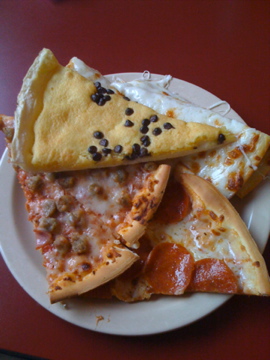 It was weird going to a pizza place for the first time in about three years (the last time was my infamous 30 slices of pizza splurge when I was visiting my dad in Tennessee) and I was preparing to hate it. Actually, it wasn't too bad. I was hungry, the food was pretty tasty, and I ended up eating about 15 slices in all. I fully expected my body to react to all these carbs (which undoubtedly numbered well over 300 grams!) by being lethargic, bloated, and miserable. And I also predicted my blood sugar would JUMP way up. Before we headed off for the pizza feast, I tested my fasting blood sugar this morning and it was 91 (lower than yesterday's reading of 107, but I didn't take my vitamins and fish oil prior to today's measurement). Would eating a very high-carb meal make any difference at all in the way my blood sugars react to it today? I wanted to know and see it with my own eyes. I ate and ate slices of garlic cheese pizza, pepperoni pizza, bacon cheeseburger pizza, sausage pizza, and even chocolate chip pizza. I ain't gonna lie, it was good! But I wouldn't want to eat like that everyday. As has happened in the past when I ate a bunch of carbs, I usually feel miserable the rest of the day regretting my transgressions. That's what I was expecting today along with a spike in my blood sugars. Did it happen? The answer is no to both. I feel great right now over five hours after eating all that pizza and interestingly my weight is only a couple of pounds up from what it was this morning when I weighed. That's curious since my weight has been known to fluctuate as much as 8-12 pounds after a big meal like that. But even more remarkable is what happened with my blood sugar just one hour after eating all those starchy and sugary pizza slices. I should have expected this. My reading was 90--that's right, my blood sugar dropped a point from my fasting level one hour after my meal. I had to see my two-hour reading and it FINALLY rose above my fasting level to 100 and then my three-hour reading started coming down again to 98. What's going on here? Am I producing excessive insulin which is keeping my blood sugars very low even after a meal? Is this what they call "reactive hypoglycemia" at work here? If so, how did I get it and what can I do to overcome it? Thankfully I have a whole host of low-carb experts at my disposal to discuss this phenomena and I suspect a lot more of us low-carbers are dealing with this issue than we would like to admit. Is this part and parcel of eating this way over the long-term and is there anything necessarily wrong with this happening? What can we do to counteract it if it is something that needs to be addressed? I have set up a podcast interview with a doctor who used to work with the late Dr. Robert C. Atkins later this week to talk about his theory about the onset of hypoglycemia for those who continue livin' la vida low-carb after a significant weight loss. It's a thought-provoking mental exercise that perhaps needs to be researched for the sake of all of us who have made this our chosen lifelong nutritional program. I'll be sharing that interview with you sometime in the month of June at "The Livin' La Vida Low-Carb Show with Jimmy Moore. In the meantime, I'm finished eating pizza for a LONG time and back to the healthy low-carb lifestyle again. If all of this doesn't have at least SOMETHING to do with my recent inability to get rid of those 30 pounds I've put on since beginning weight training, then I don't know what else is happening. It seems too coincidentally odd that all this is happening simultaneous to the weight gain, so I'm pursuing this further with my doctor to see if it will shed some light on my situation. You'll be the first to know when I hear ANYTHING about this, so THANK YOU again for all of your encouragement, advice, and support through this. I appreciate the friendships I have seen in action over the past few months as you all remind me of the great community we have surrounding the low-carb lifestyle. We're just real people living our lives and trying to figure out what works best for weight and health management. We KNOW it's livin' la vida low-carb which is why we LOVE it! :) Please feel free to share your thoughts and experiences about these blood sugar fluctuations. I'm sure I'm not the only one who has seen this happening while following a low-carb nutritional approach. Thoughts anyone? 5-28-08 UPDATE: I just took another measurement of my blood sugar six hours after my meal (no, I'm still not hungry after all those pizza slices!) and it was 90--back to my fasting baseline again. Hmmmmm... Labels: blood, blood glucose, blood sugar, diabetes, hypoglycemia, insulin, insulin resistance, Jimmy Moore, lancet, low-carb, pizza, Pizza Inn, planned splurge, strips, test
Video: Understanding Why Carbohydrate Restriction Is Needed For Diabetes Control
 Mary Vernon leads the charge for low-carb diets for diabetics Mary Vernon leads the charge for low-carb diets for diabeticsI have lots to share with you that I heard and saw at the ASBP/Nutrition & Metabolism conference in Phoenix, AZ I attended earlier this month. It was an amazing experience being around the superstars of the low-carb scientific world and hearing the very latest research that unequivocally supports livin' la vida low-carb. Anyone who tells you there isn't any real evidence that low-carb is a viable nutritional approach has chosen to ignore the literature. It's there! As I previously noted, I met an extraordinary couple while in Phoenix who head a television production company called Atlanta Teleproductions. Richard and Melanie Vogan have over three decades of filming experience each that was put to good use with all these amazing low-carb researchers in one place. Anyone who was attending that meeting would have seen Richard behind the camera taking video footage of Melanie interviewing everybody they could during those few short days. They were kept quite busy moving their equipment from location to location. Although the original plan was to try to piece together a documentary of sorts with all these experts, Richard and Melanie now believe the videos they shot are much too important to chop up and remove key elements. For the sake of the integrity of the answers that were provided and to expose the positive message to a wide online audience, they are posting the interviews commissioned by the Nutrition & Metabolism Society individually in an exclusive Internet series. "The interviews that we got are so incredible we realized they should not be edited," Melanie explained to Livin' La Vida Low-Carb. "We now have lots of content and the possibility of lots more. As much as I would love to do a documentary, for now this is the most viable option."And that's why they created a new web site called DiabetesNewsStand.com which is "dedicated to the education and prevention of the diabetes epidemic." How is gonna do that? By sharing amazing videos online with the most knowledgeable and successful doctors and diabetes experts in the world today. It's am ambitious project that certainly warrants the support of anyone who cares about taming the exploding diabetes epidemic with real, innovative solutions to the problem--not more of the same failed treatments centered around prescribing more and more medications and insulin. Regular "V-Issues" will be presented on this new web site to share from the researchers, physicians, authors, nutritionists, and advocates of healthy living for people suffering from diabetes. As they are posted, I will highlight each of them here at my "Livin' La Vida Low-Carb" blog so you'll be made aware. First up is this interview with Dr. Mary C. Vernon, who discusses insulin resistance, the role of insulin in the body, blood sugar abnormalities, traditional vs. dietary measures for controlling diabetes, and so much more. As you will quickly notice, Dr. Vernon is arguably the most articulate and ardent supporter of a low-carbohydrate dietary approach for controlling diabetes in the world today. Her enthusiastic and impassioned plea for people to take notice of livin' la vida low-carb is difficult to ignore. Of course, my regular readers are already very familiar with Dr. Mary Vernon who I nominated for "Diabetes Educator Of The Year" last year (hint, hint for those of you who haven't entered by blogiversary contest yet), was featured on dLife, has appeared on my podcast show and in an interview at my blog, and was the subject of a highly-publicized Men's Health magazine column by Adam Campbell on the low-carb "cure" for diabetes. This diabetes doc from Lawrence, Kansas is the real deal and she's making a difference in the lives of her patients who embrace the concepts she talks about with them individually as well as in the book she co-wrote with Jackie Eberstein entitled Dr. Atkins' Diabetes Revolution. Kudos to Richard and Melanie Vogan for starting off their new "V-Issues" series with a bang by presenting this fabulous interview with Dr. Mary C. Vernon to the online world. You'll be seeing a lot more of these in the coming months, so be sure to check DiabetesNewsStand.com for even more outstanding interviews and comments from the biggest names in low-carb living! If you would like to support this effort to share even more videos from low-carb experts in the future, then e-mail Melanie at melanie@diabetesnewsstand.com or call her in her Atlanta office at 770-777-1265. After spending some quality time with Richard and Melanie, I can tell you they are as committed to the cause of sharing the truth about livin' la vida low-carb as I am. Whatever you can donate to this cause I know will be used for the greater good of promoting low-carb to those who need to hear it the most. Labels: blood sugar, diabetes, health, insulin, insulin resistance, Mary Vernon
New 2008 ADA Recommendations Partially Acknowledge Low-Carb Diets
  Has the American Diabetes Association endorsed the Atkins diet? Has the American Diabetes Association endorsed the Atkins diet?We've heard a growing undercurrent of rumblings over the past month or so that the all-powerful American Diabetes Association (ADA) is FINALLY beginning to consider giving credence to low-carb diets as a means for diabetics to control their health. Much anticipation has been steadily building among supporters of livin' la vida low-carb that perhaps maybe, just maybe, a major breakthrough could be happening within one of the most influential health institutions in the United States upon the release of their new dietary recommendations scheduled for Friday, December 28, 2007. Well, the answer is a sorta yes and a little bit of no, too, as we learn in this Atlanta Journal-Constitution column. As Veronica Atkins, widow of the late great Dr. Robert C. Atkins, told me in my interview with her this year, the ADA still "has their head in the sand" about low-carb living! First to the good news. After years of failing to even acknowledge that low-carb diets like Atkins were an option for people with diabetes to consider, the ADA released their 2008 Clinical Practice Recommendations used by diabetes health providers in helping their patients adequately treat their disease and stated that low-carb diets are now indeed a strategic method for producing weight loss. This comes after years of pushing a monopolistic high-carb, low-fat diet as the ONLY nutritional approach for diabetics to follow in order to control their weight and health despite the fact that carbohydrates have been known to raise blood sugar levels and spike insulin production--two things you try to avoid when treating diabetes. Now, as I suggested earlier this year, low-carb diets will be promoted alongside low-fat ones to give people a choice about which one will work best for them. The one-size-fits-all mode of thinking within the ADA is now history and now diabetics who have not yet been exposed to the joy of the low-carb lifestyle could very well find this way of eating suits them perfectly. This is pretty huge news not just for diabetics, but for anyone who needed to know that low-carb is not the dangerous "fad" diet that it has been made out to be! While the preponderance of the evidence from the research community has continued to pour in over the past few years in support of controlled-carbohydrate diets (we'll examine some of it in just a moment), it's a major announcement that a group like the ADA would step outside the conventional wisdom of the day and make these kinds of changes within the language of their recommendations--much to the chagrin of the other self-appointed dietary gods telling us how to eat for our health. Don't you know the powers that be over at the American Medical Association (AMA), American Heart Association (AHA), Food & Drug Administration (FDA), and the U.S. Department of Agriculture (USDA) have got to be beside themselves today because the ADA has basically chopped off the legs on their crumbling low-fat diet scheme that has lasted untouched for the past three decades? If a health organization like the ADA gives ANY credence to livin' la vida low-carb, then it forces the hand of those other groups to follow suit in like manner. If the AMA, AHA, FDA, and USDA do not fall into line with these same recommendations themselves, then the American people will begin to question exactly who is lying to them. As long as they were all on the same page touting the same old low-fat mantra, then everything was hunky dory and the bamboozle could continue. But obesity has gotten worse, Type 2 diabetes is way out of control, and preventable disease is all around us despite the heavy promotion of the great and mighty low-fat diet. I want to publicly applaud the ADA for being the first to break ranks with the establishment and realizing that the health of diabetics is much more important than preserving a failing dietary philosophy that has been a decisive abomination for the vast majority of people who have tried it. The time is ripe as we enter a new year for another alternative to be given an opportunity and low-carb fits the bill perfectly. But... As much as I'd like to be overjoyed by the ADA's decision to add low-carb diets to their recommendations for diabetics, I cannot. Why? Because rather than looking at all the studies that have come out, especially in the past year or so, showing the vast improvements in insulin control, A1c levels, blood sugar stabilization, lipid profile, and other key health indicators with a low-carb diet, the ADA has made this change based solely on weight loss over the short term. They have taken the very small handful of studies showing low-carb is as effective as low-fat for shedding pounds over a one-year span like this one published in JAMA out of Stanford University in March 2007. And because some people can stick with a low-carb diet better than they can a low-fat one (AMEN!), the ADA says diabetics should pick the one that suits them best to bring about the same weight loss result. Sounds logical, right? Not exactly because they still don't acknowledge an important part of livin' la vida low-carb--the health improvements that happen exclusive of weight loss. Wanna see some of these studies for yourself? Check them out: - Atkins produces weight loss and improves glucose tolerance- Low-carb controls Type 2 diabetes without weight loss or insulin- Ketogenic diet produced significant improvements in HgbA1c levels- Low-carb stabilizes blood sugars and reduces medications- Lower insulin levels from low-carb reduces acneThis doesn't even count all the research that shows how unhealthy eating the traditional high-carb, low-fat diet can be for your health. Here are just a few examples of this: - High-carb, low-fat diet ineffective against high insulin levels- High-carb diet raises insulin levels, blood pressure- High-carb diet leads to age-related macular degeneration- High-carb diet lowers HDL, increases triglycerides- High-carb diet leads to the development of Type 2 diabetes- High-carb, low-fat diet produces negligible weight lossThere's plenty more research I could present in favor of low-carb diets for improving health as well as how high-carb, low-fat diets can be detrimental to your health. But it's out there for anyone willing to open their eyes and see it. Livin' la vida low-carb is about so much more than just weight loss. It is indeed the healthiest way to eat which is my primary reason for supporting it today. Yes, I lost 180 pounds on the Atkins diet and it has done a wonderful job of helping me maintain that triple-digit weight loss for the past four years. But more than that, my health did a complete turnaround and I shudder to think what it would look like today had I not started on the low-carb lifestyle. Heart attack, stroke, Type 2 diabetes, or even death was probably in the cards for me and low-carb REVERSED that trend completely. I'm healthy and that's all that matters! And for people who already have diabetes, livin' la vida low-carb gives them a chance to not only shed a few pounds but to find a diet that would allow them to control their blood sugars and insulin levels naturally with little to no use of diabetes drugs or insulin. Why would you want to continue taking drugs and insulin when you could quite possibly eliminate them from your life by eating a low-carb diet? Why indeed!  Albright supports low-carb for weight loss, not health Albright supports low-carb for weight loss, not healthDr. Ann Albright, president of Health Care & Education at the ADA and a Type 1 diabetic herself, said they now realize that people need "realistic ways to lose weight" and livin' la vida low-carb is certainly part of that equation. "The evidence is clear that both low-carbohydrate and low-fat calorie restricted diets result in similar weight loss at one year. We’re not endorsing either of these weight-loss plans over any other method of losing weight," she said in a statement. "What we want health care providers to know is that it’s important for patients to choose a plan that works for them, and that the health care team support their patients’ weight loss efforts and provide appropriate monitoring of patients’ health."All I can say is WELL IT'S ABOUT TIME! This is precisely the message I've been sharing with people for nearly three years since I've been blogging and I'm glad the ADA understands that individualization of a diet program that works is what low-carb supporters want. We're not trying to eradicate the low-fat diet if that way of eating is helping someone bring their weight and health under control. On the contrary, we've been supportive of people finding what works for them and then doing it. If that means a low-carb diet, then so be it. There shouldn't be any judgment placed on those of us who choose to eat this way. Irresponsible comments about low-carb describing it as a "dangerous" diet that can "kill you" needs to stop because that is simply hyperbolized conjecture in a civilized discussion of proper nutrition. This open dialog begun by the ADA today needs to trickle down not just to the health care providers, but also to government officials in charge of health policy, journalists who wield influence through the use of their public platform, and all the so-called health "experts" who have been railing against livin' la vida low-carb for years. Of course, Dr. Albright continues the scaremongering hyperbole that has run rampant about low-carb living by warning any diabetics who use a low-carb diet about their cholesterol going up. Um, hello, I'd be willing to bet that people who follow an organized low-carb plan like the Atkins diet will see their triglycerides fall below 100 and their HDL "good" cholesterol rise to above 50. It's the tell-tale sign that someone is on a low-carb diet and studies have shown these are better markers for cardiovascular health than LDL and total cholesterol. She also adds that since "high protein diets may also worsen kidney problems," anyone with kidney disease should talk to their doctor about watching their protein intake. Again, what's this all about? How many people actually have a kidney issue, Dr. Albright, hmmmm? Obviously anyone making ANY dietary changes should talk to their doctor first to make sure there are underlying problems they need to be aware of. And that includes going on a low-fat diet. Are we worried about people who produce high levels of insulin going on a high-carb, low-fat diet in the same manner that we show concern over people with kidney issues going on a low-carb diet? Not hardly. And yet I would argue there's more concern over the former than there is the latter, so let's keep our priorities straight, shall we? Additionally, a low-carb diet need not be high in protein as is often claimed by those who oppose this way of eating. In fact, my own diet is very heavy in fat, even saturated fat, with nearly 65-70 percent of my calorie consumption coming from this macronutrient. Protein has been around 20-25 percent up until the past few weeks when I began resistance training and upped it to around 30-35 percent. Carbs are kept to a minimum around single digits. Like clockwork, Dr. Albright also cautions about weight loss being sustainable by stating that "what is most important for health is keeping the weight off long-term." ABSOLUTELY, Dr. Albright, I couldn't agree with you more which is why I have chosen to continue with my low-carb diet for the past four years and counting to improve my health. It's the best thing I could have ever done for my weight and health and I'll never regret it! Stuck in the sound bytes that seem to pervade most health leaders these days, Dr. Albright makes sure we don't forsake the need for getting proper exercise while eating a low-calorie diet. "We also want to continue to emphasize the importance of regular physical activity, both to aid weight loss from calorie-restricted diets, and also for the positive health gains associated with exercise that are independent of weight loss," she exclaimed.True enough, exercise is important, but there should be more specific instructions provided for what this means. What kind of physical activity, how vigorous should the workouts be, how often should you do it, how long does it need to be in order to produce results, and what ratio of cardio/resistance training is necessary? None of these are addressed by the ADA or most other health organizations when they put out these recommendations. They just assume people inherently KNOW what to do. It's like the silly notion that we always hear from the "experts" to just eat a healthy diet and exercise. WHAT THE HECK DOES THAT MEAN?! People need to be educated with specifics about what constitutes a healthy diet and what kind of exercise is beneficial for various aspects of weight and health management. Obviously anything is better than nothing, but people need to be guided about what to do. To see the ADA's 2008 Clinical Practice Recommendations for yourself, it will be published on the Diabetes.org web site in January 2008 (or you can pay to see them right now at Diabetes Care). You can also request a copy by e-mailing the ADA at AskADA@diabetes.org or by calling 1-800-DIABETES (1-800-342-2383). Regardless, let them hear from you about what you think of their new recommendations for diabetics. And feel free to share your reaction to their focus on weight loss rather than health with livin' la vida low-carb. Are they still missing the boat? Leave it to low-carb diabetes expert Dr. Mary C. Vernon to put this news from the ADA in the proper perspective at her blog today for people who are advocates of low-carb. "Carbohydrate restriction and the resulting control of insulin secretion is much more than weight loss," she wrote. "It’s not the weight-it’s the metabolic state your body is in, that generates disease or well-being. I suppose we'll have to wait another 5-10 years before the ADA catches up with the rest of the science."Maybe not, Dr. Vernon, if enough of us voice our sincere concerns and opinions to the ADA, our representatives at both the state and federal level, our doctors, and in letters to the editor at our local newspapers. We have a unified voice with a message backed up by the data, but the question remains whether we will choose to use it or not. Our silence has long been interpreted that we accept what we've been told is true. Is that the message you want to be making? Labels: ADA, Ann Albright, Atkins, blood sugar, diabetes, diet, dietary guidelines, insulin, low-carb, recommendations, weight loss
Diabetes Health Leaders Finally Realizing Low-Carb Diet Has Merit
When I asked Dr. Richard D. Feinman, professor of biochemistry at SUNY Downstate Medical Center in Brooklyn, New York and renowned low-carb researcher, about when he thought diabetes health leaders--including the American Diabetes Association (ADA)--would start realizing livin' la vida low-carb has merit during my interview with him in June 2006, his answer was hopeful. "With diabetes, carbohydrate restriction has been a traditional treatment and because the underlying physiology is obvious and accepted. Since low carbohydrates stabilize glucose and insulin excursions, we can expect progress pretty soon. Even the ADA is probably trying to back into carbohydrate restriction with a minimum of losing face."Well, it's about to happen and none too soon. According to my friend and fellow low-carb blogger Laura Dolson from the About Low-Carb Diets web site, there are "potential changes in ADA recommendations" to be announced in January 2008. It seems they are FINALLY listened to those of us who advocate carbohydrate restriction and are are going to abandon their high-carb recommendations. So much for people like Hope Warshaw dictating what diabetes policy looks like in the United States and it's about time. Coming in January 2008, the ADA is expected to publish new dietary guidelines for people suffering with diabetes where livin' la vida low-carb will be acknowledged and promoted as one way to improve the symptoms of this awful disease. A talking head from the ADA states "there is growing recognition that a variety of diets including low carbohydrate diets, can achieve weight loss [and] improve postprandial blood glucose." We'll definitely be looking forward to the new ADA dietary guidelines coming in the January 2008 issue of Diabetes Care and report to you any positive changes they are expected to make. Stay tuned! In the meantime, the paradigm shift is also happening in the grassroots among those who are passionate about helping people with diabetes. Take Jackie Eberstein, co-author of Atkins Diabetes Revolution and who worked directly with the late great Dr. Robert C. Atkins for three decades, for example. In celebration of National Diabetes Month in November, she wrote an outstanding positive message on carb control for diabetics. Her overall message is one of prevention--knowing the warning signs BEFORE you are diagnosed with diabetes, changing your lifestyle to put yourself in a better position to avoid it, and take the subject of diabetes health as serious as your heart health. Essentially, diabetes has become a rampant disease of modern society because of our poor dietary habits and over 1 in 5 have no idea they have it (a dangerous place to be in considering carbohydrates--poison for diabetics--are the primary macronutrient in most American households). Untreated diabetes leaves a haunting trail of obvious symptoms: "Once the disease has progressed common symptoms such as extreme thirst, extreme hunger, frequent urination, unexplained weight loss, unusual fatigue, blurred vision and the slow healing of cuts and bruises makes the diagnosis easier," Eberstein explained. "But by the time these symptoms are apparent, blood sugar levels have been elevated for a long time causing silent damage to every cell in the body."These are merely precursors to the even worse damage that can happen to your body, including cancer and Alzheimer's disease--something neurologist Dr. Larry McCleary describes in his book The Brain Trust Program as "Type 3 diabetes." Eberstein expresses her concern that the ADA has traditionally recommended a low-fat, low-calorie diet that includes too many carbohydrates for a diabetic causing them to rely on upwards of 3-6 medications to keep their disease moderately controlled. She is deeply disturbed by the potential and known side effects of these drugs while the ADA has turned a blind eye to the negative impact extra sugars and refined flour have had on this. I know she will be anxious to see the new changes in the ADA recommendations come January. Be sure to check out all the diabetes risk factors that Eberstein notes for people with Type 2 diabetes in her column. It very well could save your life or the life of your loved one. Another exciting development regarding the embracing of the low-carb message for diabetics comes from the top diabetes blogger online today--Amy Tenderich from Diabetes Mine. Although I was less than impressed by her lack of even a single acknowledgment of livin' la vida low-carb for people with diabetes in her 2007 book release Know Your Numbers, Outlive Your Diabetes, I was blown away to see Tenderich was willing to at least hear what actual low-carbers have to say about what they eat to control their diabetes with the low-carb lifestyle when she requested recipes from the members of my new "Livin' La Vida Low-Carb Discussion" forum. She was so moved by my readers that she reprinted the column "Low-Carb Favorites, from the Devotees" at MyDiabetesCentral.com. THANKS Amy and I'm happy to see your openness to new ideas that go against everything you've ever known to be true in the past. That takes courage and strength beyond the scope of modern journalism to do and I applaud you for it. But Tenderich didn't stop there. Check out her recent guest post at Diet-Blog where she lists "10 Ways to Treat Diabetes With Diet." She particularly points out that diabetics need to watch their carbs to control their A1c levels, be aware of the carb content in the foods they eat, avoid "carb-heavy choices," watch out for corn syrup on nutritional labels, not equate sugar-free with carb-free, and the best one of them all--CURB THE CARBS (go straight to #7 for this one!). Sure, she still sticks with the low-fat mantra that has been what she's known for years, but at least Tenderich is moving in the right direction. Her conclusion regarding past ADA recommendations is spot on: "There’s a lot of controversy over the ADA's food pyramid for people with diabetes, because they recommend more breads, grains, and starches (carb-heavy foods) than anything else," Tenderich stated. "We have to side with the patients-in-the-know: keep the carbs low for better control of blood sugar."And that, my low-carb friends, is what I call progress in this effort to bring legitimacy and practicality to the world of diabetes health. This is merely the beginning of a major change in health policy that could very well cascade into the general dietary recommendations at some point in the future. First things first, though. Let's get diabetics eating this way and vastly improving their health and then the turnaround will speak for itself. Labels: ADA, Amy Tenderich, blood sugar, diabetes, Diabetes Mine, dietary guidelines, health, Jackie Eberstein, Laura Dolson, recommendations, Richard Feinman
Study: Andipose Gene Stimulation Makes You Skinny And Lowers Blood Sugar, Insulin
 Dr. Jonathan Graff says "skinny gene" needs to be turned on in obese Dr. Jonathan Graff says "skinny gene" needs to be turned on in obeseThe head of the British Medical Association caught a lot of flack last month for suggesting overweight and obese people should stop looking for another pill to pop to do something about their weight problem. But his concerns have fallen on deaf ears from every obesity researcher in the world still trying to find the next great anti-obesity drug! This Globe & Mail column highlights a new study on a gene researchers have found in the body that allegedly makes you skinny and reverses high blood sugar and insulin levels in the body. They are working feverishly on developing a prescription medication to stimulate this gene. Lead researcher Dr. Jonathan Graff, associate professor of Molecular Biology at the University of Texas Southwestern Medical Center, and his fellow researchers observed the adipose (Adp) gene in obese mice, fruit flies, and worms over a 5-year period and found that less stimulation of this gene existed which led to fat formation and insulin resistance leading to Type 2 diabetes. At the same time, when more stimulation of the Adp gene was present in the mice, flies, and worms, they were thinner and healthier. This study was published in the September 5, 2007 issue of the scientific journal Cell Metabolism. Dr. Graff said this proves anyone has the potential to be lean and healthy once this gene is properly regulated in the body. "There's a 'skinny gene' out there, and when it's reduced in function, animals become fat," he explained. "It works in fat cells and not by changing appetite, and could account for what I would call this epidemic of obesity and diabetes."Because human beings also have the Adp gene, Dr. Graff says further research will be needed to look into a possible new pharmaceutical treatment for obesity, diabetes, and other weight-related diseases. "What we want to do now is to get a medicine to rev this thing up, to help you be skinny, to get your blood sugar down, to get your insulin down," he stated.Bringing an oral medication to the market could take a decade. I just have one thing to say about: OH BROTHER, NOT AGAIN! You know, I see a regular trend happening here. Researchers find something in a study related to being fat, they justify continuing their research by claiming it can be turned into a drug for treating obesity, and then they keep pursuing it so the financial underwriting will continue. Is there no end to this hysteria? Don't get me wrong, studying the culprits behind obesity and disease is wonderful, but the focus has all too often been on creating the next so-called "magic pill" for treating weight loss. Nevermind those outstanding researchers who are promoting natural and healthy dietary changes for reducing weight and improving health like livin' la vida low-carb (we even saw the researchers in this study published in Cell Metabolism last month regarding the TOR gene and the Atkins diet trying to push for a drug intervention--UGH!). But there's no money in natural nutritional remedies, so those research studies are generally swept under the rug, ignored, and research dollars mysteriously shrivel up and disappear. Why? The cold hard reality is that obesity and disease have become BIG BUSINESS as Dr. William Davis so poignantly noted in my recent interview with him about heart healthcare. Dr. Graff maintains the reduced Adp gene function, which was discovered a half century ago in obese fruit flies, just needs to be turned on and up in fat people. "It's a volume control," he contended. "We can just keep making you skinnier by turning the volume of this up."Um, with all due respect, Dr. Graff, I disagree that the overwhelming cases of obesity that exist in modern time is necessarily tied to the Adp gene. Instead, it's about what happens in the body metabolically when overconsumption of carbohydrate is combined with fat and protein to pack on the pounds and cause insulin resistance. Instead of working on a pill which may or may not work even after years of testing, how about looking at and embracing the studies that HAVE come out about controlling metabolic syndrome with a naturally healthy diet? It's livin' la vida low-carb in case you missed it! The low-carb lifestyle has a proven track record for reducing body fat, lowering triglycerides, raising HDL "good" cholesterol, improving blood sugars, and so many other health markers. Let's urge people to implore this kind of natural anti-obesity strategy rather than constantly looking for that next great miracle pill. Who in the research community has the guts to stand up and declare this truth? You can e-mail Dr. Jonathan Graff about his study at jon.graff@utsouthwestern.edu. Labels: adipose, Adp, blood sugar, diabetes, drug, fat, gene, insulin, Jonathan Graff, mice, obesity, study, Texas Southwestern Medical Center
Is Hypoglycemia A Hidden Low-Carb Side Effect?
One of the things I enjoy doing at my blog is providing information that people can apply to their daily lives that will help them solve an issue they are having while livin' la vida low-carb. Whether it's about weight loss, health, fitness, or whatever, I think you the reader can be best served with practical and scientifically-sound ways to live this lifestyle over the long-term as so many of us are. Today I have a very special guest editorial from Dr. Keith Berkowitz, who is the medical director for The Center For Balanced Health. I was talking to him on the telephone recently about his fantastic new high-fiber NexGen muffins when the subject of blood sugar came up. He said that the issue of hyperglycemia, or high blood sugar which is a precursor to diabetes, has been given almost a monopoly of attention from the medical community while an even more dangerous condition has gotten completely overlooked and ignored. It's the condition known as hypoglycemia. Dr. Berkowitz went on to explain some of the symptoms of hypoglycemia, or low blood sugar, and how it could be the reason why your weight loss suddenly stops while livin' la vida low-carb. Also, if your energy is sapped and you begin feeling tired for no apparent reason at all, it's time to get a glucose tolerance test to see what your A1C levels are, he said. I was so spellbound by the discussion of this issue that I asked Dr. Berkowitz to write a column for my blog so that all of us can be better informed of the warning signs that we may be suffering from hypoglycemia and how to treat it. Special THANKS to Dr. Berkowitz for sharing his wisdom on this issue with us today and I welcome your feedback to what he has to share. ENJOY! The Forgotten Blood Sugar Disorder: Hypoglycemiaby Dr. Keith Berkowitz, M.D. Medical Director for The Center For Balanced HealthAccording to the American Diabetes Association, 21 million Americans have diabetes and another 54 million American are at risk with pre-diabetes or elevated blood glucose. Because of this, our attention has been concentrated on treating high blood glucose while largely ignoring other blood sugar disorders. Poor eating habits, the addition of unhealthy ingredients, increased stress and poor sleeping habits has led to the increased incidence of this underappreciated blood sugar disorder: hypoglycemia. Hypoglycemia has been traditionally defined as a low blood glucose level (serum levels less than 70 mg/dl either taken fasting, randomly or after a glucose challenge). Unfortunately, most individuals I see in my practice do not present with these results but instead present with normal blood glucose levels, the ability to lose some weight but not the last 10 to 20 pounds or unexplained low energy levels. One reason for this is that most individuals only have fasting blood glucose or an HgbA1c taken by their health professional. An HgbA1c level represents the average amount of glucose in the blood over a three month period. A level of 4.0% is equal to an average blood glucose level of 60 mg/dl while a level of 5.0% is equal to a blood glucose level of 90 mg/dl. HgbA1c levels between 4.8% and 5.9% are considered normal. Levels below 4.8% are usually consistent with hypoglycemia. Individuals with hypoglycemia can often have symptoms that include: headaches, increased irritability, difficulty concentrating, palpitations, light-headedness, fatigue, anxiety, excessive sweating or urination, leg cramps, dizziness and clamminess. Other symptoms can be related to eating. Patients I see with this diagnosis often feel more tired after meals, feel “sick” when they either miss a meal or if a meal is delayed. So, if you have significantly reduced calories or carbohydrates, are you still unable to lose weight? Are you unable to lose that last 20 pounds no matter what you try? Eating a low carbohydrate diet but still hungry and/or tired after meals? I just may have a solution for you. Traditionally treatment for hypoglycemia has been to give sugar. Unfortunately, this treatment only provides temporary relief and in very sensitive individuals causes an even greater reaction thirty minutes to two hours later. Although, a strict low carbohydrate diet is helpful, it does not always solve the problem by itself. In my practice, Center for Balanced Health, I see individuals with such pronounced hypoglycemia that their blood sugar drops almost immediately after a glucose challenge. It’s the equivalent of filling an automobile with gas only to find that the gas tank has a very large leak. At the Center for Balanced Health, we help patients manage their hypoglycemia by telling them to: - Eat five to six small meals a day about every three hours. Think of yourself as a fuel-efficient automobile. You want constant flow of energy (glucose) throughout the day. - Avoid meals that are too small or too large especially at night. Meals that are too small will not provide enough energy to get you through the day. Meals that are too large place a larger burden on your metabolic system to process these nutrients and thus can trigger a hypoglycemic reaction. - DON'T skip meals especially breakfast. Breakfast is the most important meal of the day because it sets the tone. - Balanced eating. Always have some protein and fat at each meal or snack. Avoid and limit foods high in sugar or other refined carbohydrates especially on a empty stomach. Still utilize a controlled carbohydrate approach and get your carbohydrates from foods high in fiber (dark green leafy vegetables, non starchy vegetables, avocado, high fiber low carbohydrate crackers as examples) - Get a good night’s sleep. Good sleep helps replenish your system so that your body works more efficiently. - Use of a fiber supplement (make sure you take with enough water) or eating a high fiber food (without refined carbohydrates or sugar) before meals or snacks can help slow the absorption of carbohydrates and thus prevent rapid declines in blood sugar. - Exercise regularly. Strength training can improve glucose metabolism - Avoid alcohol, caffeine, tobacco use - Avoid the use of stimulants If you suspect hypoglycemia, the best diagnostic test is a glucose tolerance test with insulin levels and an HgbA1c. I usually do this test in my office because a glucose challenge can sometimes precipitate symptoms of low blood sugar. Labels: A1C, blood glucose, blood sugar, Center For Balanced Health, diabetes, hypoglycemia, Keith Berkowitz, test
Bernstein: No Other Diet Works To Control Blood Sugars In Diabetics As Well As Low-Carb
 Dr. Richard K. Bernstein has beaten his diabetes with a low-carb diet Dr. Richard K. Bernstein has beaten his diabetes with a low-carb dietI've interviewed a lot of people here at my blog, but there has been one interview I have been wanting to do for a very long time--Dr. Richard Bernstein, M.D., F.A.C.E., F.A.C.N., C.W.S., FACCWS (did I leave out any letters in the alphabet? *wink*). You've seen him on dLife on CNBC debating the so-called experts who say to just eat a low-fat diet and take your diabetes medications and insulin while Dr. Bernstein just keeps on smiling and living his life just as normal as a non-diabetic for the past 61 years and counting. In fact, I so highly regard the work Dr. Bernstein is doing on behalf of diabetics that I named him one of my Top 10 Movers & Shakers of 2006 and he deserves the accolodes as much as anyone else in the low-carb community. I recently highlighted the fantastic work he is continuing to do in pursuit of giving people living with diabetes hope for a better future in this blog post and was absolutely thrilled when he agreed to be interviewed by me for my blog. Whether you have diabetes or not, we could all learn a lot from this man. Absorb what he has to say, let it permeate your thoughts, percolate a while, and then share the good news with a diabetic loved one in your life to let them know that livin' la vida low-carb could very well be their answer to a long and healthy life with diabetes. Let Dr. Bernstein encourage you today. 1. What an honor and a privilege to welcome the one and only Dr. Richard K. Bernstein to the "Livin' La Vida Low-Carb" blog today. Dr. Bernstein is THE authority on the positive impact of low-carb diets on diabetes today and is living proof this way of eating works since he uses it to control his Type 1 diabetes. Thank you for joining me for this interview today since many of my readers are big fans of the work you are doing on behalf of diabetics.
You once described yourself as "an ordinary diabetic" before you found the low-carb solution to your diabetes. What changed about your life when you went from the recommended diabetic diet to your current low-carb dietary approach?When I was on the ADA high-carb diet, it was impossible to approach normal blood sugars on a steady basis, no matter how I juggled multiple insulin doses. Once I cut my carb intake to the minimum necessary for consuming a reasonable amount of vegetables, my blood sugars leveled off. 2. Normalized blood sugar levels is the ultimate goal of everyone who has been afflicted with Type 1 or Type 2 diabetes. How were you as a diabetic able to control this disease that threatened to take your life at an early age for so many years and do you believe there is a better all-natural way to stabilize blood sugar than a proper diet plan like low-carb?I don't know what you mean by an "all natural way" to stabilize blood sugar. A low-carb diet works. I know of no other approach that can remotely work. I have seen naturopathic physicians who were diabetics. I've seen diabetics on vegetarian and vegan diets and none of these people were able to remotely control their blood sugars until they abandoned their prior practices and embarked upon a low carbohydrate diet. I have seen some vegans and vegetarians who refused to consider a low carb diet and of course, they never attained anything approaching normal blood sugars. 3. Your discovery of the answer to the diabetes dilemma over three decades ago and your inability to convince the medical community of what you stumbled upon led you to go to medical school at the age of 45 to become a doctor. What barriers did you encounter when you were just a "layperson" and how were those barriers overcome once you became a part of the health establishment?Becoming "part of the health establishment" only permitted me to get published. It did not change the minds of most of the physicians who were uninterested in normalizing blood sugars. To this day, professional diabetes associations are advocating elevated blood sugars for diabetics. Even many drug manufacturers and makers of devices are focused on profit rather than the well being of the patient. I can say that I accomplished one thing, however. After battling the ADA from 1969 until the early 1980's on behalf of blood sugar self-monitoring, they finally caved in to a variety of outside pressures and approved self‑monitoring for those diabetics who use insulin. It is still, however, impossible to get Medicare to pay for enough blood sugar test strips for type 2 diabetics who do not routinely inject insulin. 4. Today you practice medicine in the state of New York helping literally hundreds of patients annually find the low-carb solution to their diabetes and obesity. Dr. Mary C. Vernon in Kansas is another prominent medical doctor treating diabetes patients with a low-carb diet, but you don't hear about many others. How many Dr. Bernsteins and Dr. Vernons are there using this treatment option for their diabetic patients across the country and do you see this field of medicine expanding in the coming years to accomodate the rising rates of diabetes?The intensive treatment of diabetes is not a profit-making venture. It is, therefore, very unlikely that many physicians will pursue the intensive training and meal planning that I do with my patients. It should be possible, however, for large group practices and insurance based medical practices such as Kaiser Permanente, to train patients in groups and to have meal planning and medication planning put in the hands of paramedical personnel such as nurse educators. This would be far more financially practical than the kind of medicine that I perform. I have, from time time, encountered physicians that actually did use my book as a guide and are achieving good results. For the most part, they have large practices and supervise non-physician personnel in the administration of the methods that I disclose in my books.   Dr. Bernstein recently revised and updated his classic diabetes book5. Your book Dr. Bernstein's Diabetes Solution: The Complete Guide to Achieving Normal Blood Sugars became an instant bestseller in the late 1990's and has become like a virtual health Bible for people living with diabetes. How has the release of that book as well as The Diabetes Diet book made and impact on our culture? Dr. Bernstein recently revised and updated his classic diabetes book5. Your book Dr. Bernstein's Diabetes Solution: The Complete Guide to Achieving Normal Blood Sugars became an instant bestseller in the late 1990's and has become like a virtual health Bible for people living with diabetes. How has the release of that book as well as The Diabetes Diet book made and impact on our culture? If you look at the reader reviews on Amazon.com and Amazon.co.uk, you will see the effects that these books have had on many of the readers who have put them into practice. Over the years I have read several thousand such reviews on both of these sites. I, therefore, have a rough idea of the effects that these books have upon diabetic patients and their families. I have no way of gauging "the impact on our culture". Since the grand total sales of my books over the years is less than 400,000 copies, I haven't even touched 3% of the diabetic population in the U.S.A. alone. One thing that has occurred, however, is the formation of the Nutrition and Metabolism Society which now has a web site that publishes studies of low carbohydrate vs. low fat diets. Furthermore, the number of such studies have burgeoned in the past few years. Has my work had an increase in such studies? I have no idea but it would be nice if I could get a little bit of the credit. 6. I'm sure many would be happy to give you that credit you deserve, Dr. Bernstein. You recently released a revised and updated version of your Diabetes Solution book commemorating one decade since it first came out. What changes did you make to the original book and is there any specific new information about diabetes that may have come out even since the publication of this update?The third edition of my book that came out in March 2007 was probably up‑to-the minute in terms of new developments as of February 2007. To my knowledge, there have been no significant discoveries in diabetes care since publication. Probably the single most important thing that I discuss in the book is the use of Symlin to treat overeating in diabetics and the use of Byetta to treat overeating in non-diabetics. There are, of course, hundreds of changes in the book and discussion of many, many new products, new medications and so on. The basic approach to normalizing blood sugar, however, is essentially the same as before with a smattering of more advanced methodology. 7. Why does the American Diabetes Association (ADA) continually ignore the low-carb solution to diabetes? Dr. Richard Feinman from SUNY Downstate in Brooklyn, New York told me last year in an interview that he believes they are "backing into supporting low-carb," but it certainly doesn't look imminent. What are your thoughts about this?Although there have been one or two papers presented at ADA meetings demonstrating the value of low carbohydrate vs. low fat diets, I see no evidence that the ADA has any intention of backing off on their guidelines. There is, however, a lot of pressure from other professional organizations to lower Alc targets. The ADA tends to follow the mob very slowly so when other organizations lower their Alc target by 1%, the ADA might lower theirs by 1%. I'm sure, however, that they realize that anything approaching normal blood sugars is utterly impossible with their dietary recommendations. I, therefore, expect they will never recommend normal blood sugars during my lifetime (Hgb Alc = 4.2 - 4.6%). 8. You assert that popular low-carb programs such as Atkins and South Beach are great only for short-term weight loss, but fail to provide people following these plans with a permanent way to keep the weight off for good. I went on the Atkins diet in 2004 and lost 180 pounds in one year. Since then, I have been able to keep the weight off by following the basic principles of the Maintenance phase of the diet. How does your program provide long-term support for improvements in both weight and health and where do you see those other plans falling short?I read the Atkins' diet and found that it usually works initially, but when he backs off and permits the re-institution of high carbohydrate foods, such as bread, he is just reigniting the addiction to carbohydrates that has spawned the epidemic of obesity and diabetes. In my experience, any diet that permits carbohydrates other than vegetables and perhaps a few bran products is doomed to failure. 9. You have an outstanding online resource for diabetics (Diabetes-Book.com) looking for more information about the low-carb lifestyle and how it can help them with their disease. The posted testimonials are quite encouraging and compelling. Are there any specific testimonials that stick out in your mind over the years since you started helping diabetics that you will never forget?I have seen so many testimonials that they've become a blur in my mind. I was, however, greatly impressed by the testimonials on Amazon.co.uk. It appears that the people in the United Kingdom are either better educated and therefore, more capable of writing impassioned prose or are just more capable of expressing their feelings. One could probably write a book based upon the stories that some of the readers posted on this site. 10. Again, I cannot thank you enough for coming on my blog today and sharing your wealth of wisdom with me and my readers. I remember seeing you at the Nutritional & Metabolic Aspects of Carbohydrate Restriction conference in Brooklyn, New York in January 2006 and most of the researchers there were confounded by not just your knowledge about low-carb living as it relates to diabetes, but also your experience living with this disease with relative ease for many years. Do you have any words of wisdom and encouragement to pass along to the diabetics who are reading this right now?Jimmy, I could sum it up with one expression that strongly contradicts conventional medical wisdom: "Diabetics are entitled to the same blood sugars as non-diabetics." Thanks for inviting me to your blog. As always, YOUR comments are welcome! What did you think of my interview with the great Dr. Bernstein? Do you have any pesonal stories to tell about how his work has helped you manage YOUR diabetes? Please share by clicking on the comment link below. Labels: A1C, ADA, blood sugar, diabetes, Diabetes Solution, diabetic, diet, low-carb, Richard Bernstein
|


