PLEASE UPDATE YOUR BOOKMARKS TO LIVINLAVIDALOWCARB.COM/BLOG
Saturday, July 12, 2008
Post-Low-Carb Meal 5-Hour Glucose Tolerance Test Produces Rather Odd Results
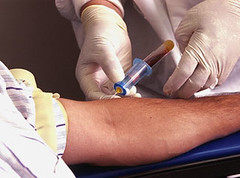
My arm had so much blood sucked out of it for these tests
I just returned late on Thursday from my 3-hour trip up I-85 North to Durham, North Carolina to spend some time with the Triangle (and Beyond) Low-Carb Meetup group there as well as seeing a great low-carb doctor from Duke University named Dr. Eric Westman to conduct some tests and talk about my recent blood sugar woes and pesky 30-pound weight gain in 2008 that won't come back down again no matter what I do. It was a good time away although I missed blogging and updating you about the healthy low-carb lifestyle. And I'll be leaving again on Tuesday to go see my brother Kevin in Pensacola, Florida for at least a week where I will have ZERO Internet access besides my iPhone (and, no offense, but I ain't up for blogging on that thing with the hunt and peck typing!), so I'll be trying to squeeze in as many posts as I can before then. It's gonna stay busy for me the next couple of months.
But so many of you have been wondering about how my visit with Dr. Westman went that I wanted to make sure I provided an update, especially with the results from my five-hour glucose tolerance test (GTT) following a low-carb meal which was conducted on Monday. If you thought my home testing of my blood sugars was interesting enough, just wait until I tell you what happened during the GTT. Unbelievably crazy! I'll share more about that in a moment.
First, let's look at the bazillion other tests Dr. Westman ran for me to see if there are other culprits going on with my health. A few of these I requested done because Dr. Keith Berkowitz (who I will be sharing a special two-part follow-up podcast interview with the first week in August about this answering your questions), who espouses the "reactive hypoglycemia" theory for long-term low-carbers, suggested I have them run.
Here were the results:
Vitamin B-12--529 (normal) Cortisol--8.9 (surprisingly normal) Homocysteine--6.7 (normal) 25-Hydroxyvitamin D3--42 (normal) HbA1c--5.0 (a little low, but normal) LDL particle number--1453 (borderline high) Small LDL particle number--30 (low is less than 600!)
By all accounts of these tests, I'm one extremely healthy guy! My thyroid function was all fine and so was my liver function. So it's good we can rule those out as culprits. I was quite frankly shocked to see my cortisol levels in the good range considering all the stress I've experienced lately, but this just confirms my body handles it all very well apparently. The A1c number was also encouraging since it is so spectacular and out of the diabetic range completely (although Dr. Berkowitz thinks it is a little low--a sign of the reactive hypglycemia according to him).
My LDL and total cholesterol are higher than normal as I've previously blogged, but look at the particle number of the dangerous "small" LDL--a measly little 30! That's just 0.02 percent of my total LDL particle number...in other words, quite negligible and protective considering over 95 percent of my LDL particle size is the large, fluffy kind. :D I'm not at all worried about my lipid profile with my HDL at 65 and triglycerides at 77. That's an HDL/triglycerides ratio I'd put up against anybody else's every day of the week.
Alright, so what the heck is going on with my blood sugars? And, more importantly, what is happening with my insulin levels when my blood sugar drops even after a low-carb meal? Inquiring minds, myself included, sincerely want to know. Here are the results of my GTT after eating a low-carb breakfast consisting of eggs and cheese with a chicken breast from Chick-Fil-A:
Fascinating test, huh? And it's just about what I expected was happening. My fasting glucose and insulin levels are perfect, but within a half hour of eating even a low-carb meal I'm seeing a TRIPLING in my insulin levels to keep my blood sugars in check. This would be a typical response if my insulin then came back down again within the first hour or two, but it doesn't.
As you can see, the insulin sustains at that higher level for two hours lingering at 13.7 then slowly dropping to 11.1 and then hitting 9.0 before dropping back down significantly in the third hour to get closer to baseline. During this time of elevated insulin, my blood sugar falls below fasting down about 10 points before rising back to where it started once the insulin comes down again. A normal response would show blood sugars going up quickly and then falling quickly, but not for Jimmy Moore. Lucky me, eh?
So what am I to make of this and what plan of action does Dr. Westman and his colleagues suggest I implement to limit this insulin response so that maybe I can get my recent weight gain to come back down again? I wish I could tell you it's a pretty cut and dry "do this and all will be well" solution, but it's not. The reality is I need to tweak this slowly by only changing one thing at a time. That one thing for me will include eating LESS protein than I have been and watching my specific portions of protein and overall intake just to see if it makes a difference.
Yes, I know cutting portions and even counting calories is almost taboo to talk about within low-carb circles and I'm not interested in that debate right now because I'm not fully convinced of it. Only time will tell. I haven't once counted calories or measured out my portion sizes in the past four and a half years of livin' la vida low-carb, so this is a tough sell for me. But I'm certainly game for doing something different to get my weight to come back down again, especially that little bit that has come back to my midsection.
Interestingly, Dr. Westman suggested I cut back on the amount of protein I have been consuming because it is possible that my body through gluconeogenesis is converting much of the dietary protein I have been consuming into glucose/sugar/carbs which COULD be the reason why I haven't been able to get my weight back down again. And this theory certainly has some merit since I consciously increased my protein intake when I started lifting weights for the first time in December 2007 shortly before my weight gain.
Sure, I also took creatine in the first six weeks and that may have had some impact on the weight gain. But consuming more protein-based foods in an effort to help with my muscle growth could have sabotaged my weight maintenance efforts somewhat. Although I have experienced quite an increase in the amount of muscle on my body after six months of training, it's not implausible that upwards of half of that weight gain is indeed muscle mass. The rest of the 15 or so pounds of weight I have put on over this period of time may be the result of excess glucose from protein.
Beginning yesterday, I started adding in more fat and deliberately trying to eat less total protein (not as a percentage, but overall) to see if it makes a difference. One way I'm doing this is to make sure any protein source I am eating is offset by an addition of more fat. For example, if I'm eating a chicken breast that is basically all protein and little fat, I'll slather it in butter and add cheese on top. Cheese in the form of brie or other fatty ones as a meal will also be a way to increase my fat while decreasing my protein. Cooking eggs in butter and adding cheese also will help with this. Nuts, coconut oil, heavy cream, and other high-fat foods will become more and more prevalent in my low-carb menus.
Since I already eat most of those foods anyway, this shouldn't be difficult to implement. Simply cutting back on protein could be as simple as eating half a steak or only one burger patty or chicken breast. Making sure I contribute fat and fiber to my meals will keep that ratio of fat to protein at the 3-1 ratio I am hoping to attain. Carbs, of course, will remain reduced to basically non-starchy, green leafy veggies.
What do you think about all of this? I'd love to know what you think about the results of my GTT. I'm also frightened to think what would happen if I did a traditional GTT with a glass of sugar water--EEEK! My insulin would go even MORE berserk! Your thoughts as always are welcomed. :)
Don't you know that your body needs carbs in order to function properly?! Come on, you idiot low-carb supporters, how can you tell people to cut down or even eliminate most of their dietary carbohydrate intake from things like healthy whole grain foods like brown rice and pasta and even fruits and vegetables? What kind of reasonable diet would suggest you remove whole categories of foods like this in order to lose weight and live a healthy lifestyle, hmmmm? Well? WELL?!?! How about it Mr. Livin' La Vida Low-Carb Man?!
Siiiiiiiiiiggggghhhhh. That, my friends, is just a typical day in the life of what I put up with in my e-mail box most of the time. People have become so incredibly misinformed about diet and health that they are content with merely repeating back the same old diatribes from those so-called health "experts." It really is a pity that more people can't learn to think for themselves by getting all the facts, analyzing them carefully with the intent on learning the truth, and then applying that knowledge to their own personal experience while sharing it with others. That's what I try to do here at my blog and all my other projects.
It certainly gives you more credibility if you constantly remain a student of health whether you are a doctor, dietitian, nurse, or even a low-carb blogger. I may not have a bunch of letters after my name (although I do have an M.A. in Public Policy...does that count?), I have worked hard to NEVER stop soaking in every bit of information that I can about health so I can share what I discover with you. Then, hopefully you can take that knowledge, apply what is relevant to your own life, share it with someone else, and continue to education further. We live in an age of information and ignorance is no longer a viable excuse--especially on the subject of diet and health.
In Episode 45 of "Livin' La Vida Low-Carb On YouTube," Christine and I wanted to share with the YouTube viewers about a word that is inextricably linked to low-carb dieting, but you really don't hear about it much outside the realm of low-carb research. The word is gluconeogenesis and I contend every single person who is on a carbohydrate-restricted or even a zero carb diet needs to know about this word. I've blogged about it and even did a podcast show on it, but this is much too important a concept for people to miss. Although gluconeogenesis (GNG) is rather complex from a metabolic standpoint looking at all the biochemistry that's involved. Check out this T-shirt from The Nutrition & Metabolism Society that illustrates all the pathways involved with GNG:
Order one of these "geeky" shirts TODAY by clicking here
Learn more about gluconeogenesis in today's video:
Since I uploaded this video to YouTube, there has been some confusion about what I shared in it about how the protein is converted into glucose. My friend Charles Washington, the zero-carb half-marathon runner who recently wrote a guest blog post said it seemed like I was saying that ALL protein gets converted to glucose. I certainly don't want to mislead anyone in that direction because it's not a one for one ratio of conversion. Dr. Eric Westman from Duke University says the studies he has seen say for every 2g of dietary protein consumed, one gram of it is converted to glucose/sugar/carbs. So it's about a 2-1 ratio of conversion which could cause SOME people problems who are especially carbohydrate sensitive (like me!).
This is what I was referring to when I said eating too much protein could POSSIBLY stall your weight loss if you are especially sensitive to carbohydrate whether through eating them or through gluconeogenesis. In looking at some of the reasons for my own struggle this year to get my weight back down despite doing all the right things, gluconeogenesis has come up as a possible culprit for my difficulty. Perhaps for me I need to be eating LESS protein than I currently am while increasing my fat and keeping my carbs to a minimum. This isn't a universal thing for everyone and could be genetic in nature. I'll be blogging more with an update about my weight and health situation very soon.
You guys are awesome for watching our "Livin' La Vida Low-Carb On YouTube" videos and we appreciate hearing your comments about them and suggestions for future topics at livinlowcarbman@charter.net. Don't miss our previous YouTube videos and be sure to subscribe to our YouTube videos if you like what you see. THANK YOU for all of your support and, as always, let us know how we can help you along in this journey to better health. Keep on livin' la vida low-carb! :D
Is Ketosis Necessary On A Low-Carb Diet? Let's Ask The Experts!
One of the most asked about aspects of livin' la vida low-carb has got to the issue of ketosis. There is so much misinformation about there about this very natural state that the body goes through when you are on a low-carb diet (primarily confusing it with a serious condition that diabetics must be careful of called ketoacidosis--NOT the same as ketosis). As such, there may be confusion that lingers out there among my readers who are just learning about this way of eating.
In this recent blog post where I provided some "quickie one-liner" responses to some e-mails, I made the following statement:
Being in ketosis is like being pregnant--you either are or you're not; regardless of what the Ketosticks show you, if you are eating less than 30g carbohydrates a day, then you ARE in ketosis.
One of my readers named Charles Fred decided to respond to my statement which he disagreed with and it gets to the very heart of this issue about ketosis. Here's what he wrote:
Your statement reflects today's informed opinion, but my article in work, Unified Physiology of the Metabolic Syndrome, has given me an unusual perspective which for the sake of brevity I'll state dogmatically.
Ketosis need not and should not be part of low-carb eating. Low-carb diets should never be labeled as ketogenic diets. Ketosis appears to be an Induction phase of low-carb eating, but in fact it is a last ditch response to inadequate glucose. As such it is either temporary or avoidable.
Low-carb eating is the evolution-derived diet of humans (unlike other primates). Humans are carnivores, hunters, because human evolution happened pre-fire and pre-agriculture when very few carbs were edible. For carnivores, gluconeogenesis in the liver supplies all necessary glucose.
But if someone abruptly switches from high carbs to very low carbs, gluconeogenesis will be inadequate to supply enough glucose - causing weakness, dizziness and ketosis.
Well if gluconeogenesis is supposed to be adequate, why does it fail? When you eat carbs they are stored as glucose (glycogen) in your glucose fuel tank - your liver. When you manufacture glucose from protein via gluconeogenesis it is stored in that same fuel tank, intermingled with those dietary carbs.
Enzymes, including gluconeogenic enzymes, are expressed only as needed. If your glucose storage is kept full by dietary carbs, expression of gluconeogenic enzymes is reduced. Eventually your gluconeogenic machinery becomes atrophied, inadequate to supply 100% of your glucose requirements.
So, contrary to usual practice, the proper way of switching from high-carb to low-carb is to gradually reduce dietary carbs over the course of about a month, inciting gradual rebuilding of gluconeogenic machinery. Then all those Induction woes which convince many that low-carb is not for them are avoided - as is ketosis.
Did you get all that? You'll recall I've explained gluconeogenesis before and it's a beautiful metabolic process that allows your body to make its own carbs (glucose) for the body's needs from the protein you consume through the liver. So, therefore, there isn't a real need for dietary carbohydrate at all.
But Mr. Fred believes eating too few carbohydrates to the point that your body is in a state of ketosis is harmful to your body and that a more gradual progression to lower and lower levels of carbohydrate is needed to keep the body from going through the "shock" of what many describe as the Induction flu. As someone who has gone through this experience and appreciated the benefits of making that "sudden" change, I could not disagree with him more.
What do the low-carb experts have to say, though? I decided to pose this theory put forth by Mr. Fred to several of America's most respected low-carb diet authorities and have them respond:
Not everyone who suddenly moves from a high-carb intake to Induction will get symptoms. Many make the transition very easily. My educated guess is that at least 50% make the transition easily. Others have only mild symptoms. A few have more severe symptoms that can be managed. I think the transition would be easier for more people if they read the book completely so they know what to expect and how to deal with symptoms.
After years in clinical practice I have only had a few patients that required a slow transition because of such severe symptoms. The Induction phase is important especially to those with a severe carb addiction. It is the fastest way to stabilize the blood sugar, control hunger and cravings and improve many diet related symptoms quickly. It is amazing how many people feel better once they are in ketosis by the 4th or 5th day.
Secondly, the mindset of the dieter is they want progress ASAP to stay motivated especially when having to give up some of their favorite foods. Induction provides that. By slowly lowering carbs many will give up too soon and miss the opportunity to find out how effective low-carb can be.
For people with severe health risks, rebalancing the body with a very low-carb intake can lead to rapid improvements in blood sugar, blood pressure, triglycerides and high insulin levels. Until insulin levels improve some of the other benefits of low-carb can't happen. I have seen many severely disordered insulin and blood sugar results that would take far too long to improve with even 60 or 70 grams of carbs.
Just as one diet does not fit all, one level of carb restriction does not fit all. We are all different. The level of carb intake needs to be the level that works for each person based on what we know about them. Dr. Atkins didn't always start in the Induction phase--some people didn't need it, yet many did and would not have been as successful without it.
Unfortunately, many are still stuck in the mindset that having ketones from fat burning is abnormal and undesirable. We know it is not. Dr. Veech, an NIH researcher, agrees that the negatives about dietary ketosis are misunderstood.
Humans are omnivores--able to survive as carnivore, but thrives as omnivore.
Gluconeogenesis isn't solely a metabolic process induced by carbohydrate restriction; it is a normal homeostatic process to maintain blood glucose, so even those consuming a high carbohydrate diet will utilize it as needed (usually when engaged in high levels of activity or during the period of sleep).
The idea that if you don't use it, you lose it, is an incomplete view--yes the enzymes will be made in lesser amounts if one doesn't rely on gluconeogenesis to fully supply glucose, but to claim "atrophy" sets in is a bit over the top.
Some people do find this approach to be a gentler way to restrict carbohydrate--slowly lowering their intake over a period of time; others do better just going "cold turkey" and reducing carbohydrate below 40g. Both reach the same endpoint--persistent state ketosis and utilization of gluconeogenesis. The idea that one will not induce ketosis (burning fat) doing the former is physiologically not possible--if your carbohydrate is below a particular threshold, you're going to make ketone bodies.
The result of reducing carbohydrate slowly isn't a lack of ketone bodies being produced, but less of them wasted, thus the less likelihood a person will register ketosis on Ketostix. Those who restrict carbohydrate below 40g initially make more ketone bodies than necessary, so they "spill" the excess in urine, saliva and sweat. But someone reducing carbohydrate slowly is also making ketones--just less likely to be spilling excess ketones.
With time the person who reduced carbohydrate below 40g and stays there will also begin to not see any measurable ketones on the Ketostix as they get more efficient at making ketones for energy. There is less wasted ketones, thus less to see on the sticks, as time passes. But, if one is keeping carbohydrate below 40g, they're burning fat for their primary energy source, which means they are making ketones whether they register on the sticks or not.
In most medical terminology, "osis" implies "the abnormal condition of"--like onychomycosis means "abnormal nail fungus," halitosis means "bad breath." Perhaps this is one reason why people unfamiliar with low carb approaches jump to the conclusion that "ketosis" is harmful. If you have no insulin in your body, as in Type 1 diabetes, a potentially life-threatening condition called diabetic "ketoacidosis" can occur. My Duke colleague Will Yancy published a paper looking at the pH in the blood of people on two diets (low-carb vs. low-fat) and did not find low blood pH ("acidosis"), but because the blood bicarbonate was lowered below the normal range we called it a "compensated metabolic acidosis." Another published study by Brehm showed the average level of blood ketones goes down over time.
In our clinic, some people always have ketones in the urine, others never do, other fluctuate back and forth. Dr. Atkins used the phrase "benign dietary ketosis" in his books. I have wondered if it would be better to say: "ketosis without acidosis" or "ketonuria" instead of "ketosis." "Ketonemia", which means "ketones in the blood" "ketonuria", which means "ketones in the urine."
I don't agree with Charles Fred's point of view. You can see why there might be confusion. If you said "if you are eating less than 20g of carb per day then you are burning fat, or in the fat burning zone, or the 'ketone zone'--apologies to Barry Sears and the Zone Diet--rather than "in ketosis," then this might be technically more correct.
This does not make a lot of sense to me. Ketone production and utilization and ultimately blood and urine levels vary along a continuum. So to suggest it is an absolute yes or no is not accurate. There is also a diurnal variation and many other factors that influence their metabolism other than diet (e.g., exercise). There is also a lot of individual variation in regards to the level of carbohydrate restriction required to see significant accumulation of ketones. So I don't see it as black and white.
Gluconeogenesis is more than adequate to supply obligatory glucose needs. How else would you explain the aboriginal hunting and fishing cultures (e.g., Inuit of the Arctic and First Nations groups in Canada) who survived for millennia with little if any identifiable dietary carbohydrate intake? I guess I'm not quite understanding the point of it all.
There is a continuum of ketosis. In fact, one of the features of ketone bodies is that, unlike other fuels, glucose and fatty acids, they can be present in plasma over a wide range of concentrations. What is true is that Ketostix measure ketonuria which may or may not give you an accurate view of plasma ketone bodies. If ketone bodies are used as fast as they are made, you may never see ketosis. Also, I personally think there may be more aspecs of normal ketone body metabolism than we know about now. There is the idea, for example that glial cells may supply ketones as fuel for neurons:
Ketone bodies make an important contribution to brain energy production and biosynthetic processes when glucose becomes scarce. Although it is generally assumed that the liver supplies the brain with ketone bodies, recent evidence shows that cultured astrocytes are also ketogenic cells. These findings support the notion that ketone bodies produced by astrocytes may be used in situ as substrates for neuronal metabolism, and raise the possibility that astrocyte ketogenesis is a neuroprotective pathway.
This theory from Mr. Fred seems to assume that ketosis is somehow foreign or not part of normal metabolism. It is true that it may take some time to adapt to it but there is no reason to assume that it is inherently undesirable. Human evolution probably had a lot of starvation. The function of ketone bodies is to keep gluconeogenesis from having to supply all necessary glucose because it can be a drain on body protein.
I don't think gluconeogenesis fails. There is just some period of adaptation. If there is evidence for Mr. Fred's theory, then I would be interested. Practically, it may feel better to adapt to low-carb slowly--I think it depends on how much carbs you start out with--but the idea you can be on very low-carb and not be in ketosis has to be tested. I personally doubt it but I don't know.
Ketone body production is under the control of many factors: glucose, insulin, fatty acids, level of oxidative metabolism, etc. I think there is also a time factor. Many people eat one meal a day, are quite happy with it and they may be in ketosis at some point during the day. So, it may be useful for some people to get into low-carb slowly but I don't react well when somebody tells me didactically the proper way to eat. "Proper" usually means the way they do it.
I don't agree with this man at all. Your body still produces ketones from all the extra dietary fat, and it gets better at doing that and using the ketones as time goes on. In our work at the University of Connecticut, with three months of following a weight loss ketogenic diet all subjects had a decline in urinary ketones over time even though they were eating the same foods and had the same caloric restriction.
What's happening is that the body is getting better at taking up the ketones--maybe ketone receptor unregulation. Also, they all still had ketones in their blood after three months and this was higher than baseline and much higher than those following a low-fat diet. Your body does not have enough metabolic machinery to produce enough of it's own glucose to support all organs (i.e. your heart).
Yes, it's true gluconeogenesis goes up, but most organs don't use it anyway. That's why blood glucose tends to drift up over time.
Now that the experts have weighed in on Charles Fred's hypothesis, why not share YOUR thoughts based on your own experience following a low-carb diet. Did you ease into livin' la vida low-carb and have excellent results doing it that way? Or did you do like most of us did, myself included, and go from a high-carb to a low-carb diet overnight? Did you see measurable results doing it that way despite having some temporary unpleasantness? Share your thoughts in the comments section below.
Special thanks to all the experts I quoted in this post for sharing their knowledge about this subject of ketosis. On behalf of me and my readers, THANKS SO MUCH! :)
"The Livin' La Vida Low-Carb Show with Jimmy Moore" Episode 13 [13:17m]: Play in Popup | Download
Four days, four podcast shows! Wheeeee! This has been quite a week for "The Livin' La Vida Low-Carb Show with Jimmy Moore" and I appreciate everyone who has listened to my podcasts each day. And the good news is we've got one more to go on Friday! WOO HOO!
Today's Episode 13 gets into the nitty gritty about gluconeogenesis, a scientific nutritional concept I've blogged about before here at my blog. But this is something that bears repeating often enough until it becomes a part of the regular lexicon of any discussion of the supposed necessity of carbohydrate intake. The science doesn't back this claim one bit.
If you have listened to the show and never left me feedback, then please go to the show notes section of today's episode and share your comments. You can even call my podcast voicemail at 206-203-4192. Be honest! I'd LOVE to know what you think about the show even if you hate it. Tell me what you think about it regardless. Can you do that for me? THANKS!
"The Livin' La Vida Low-Carb Show" can be accessed by:
THANK YOU for listening to Episode 13 of "The Livin' La Vida Low-Carb Show with Jimmy Moore" and I encourage you to come back one more time this week tomorrow for the fifth and final podcast of this special New Year's week of shows. We'll probably be expanding the show to two per week starting next week (on Mondays and Thursdays), so keep tuning in for more news and commentary about livin' la vida low-carb for your listening pleasure. :)
Layman: Low-Carb Diets Need Protein For Maximum Health Benefits
Dr. Layman's research focuses on the vital role of protein in the diet
Another one of America's best and brightest researchers in the field of low-carb research is nutrition professor Dr. Donald K. Layman. His work on the low-carbohydrate nutritional approach that you will hear about in my interview with him today is making a clear difference in the way people view diet and nutrition well into the future just as Dr. Eric Westman, Dr. Jeff Volek, and Dr. Richard Feinman already are as well, just to name a few.
Dr. Layman was kind enough to share a few moments with us today talking about his research on the low-carb approach as it relates to exercise and protein consumption. Prepare to be amazed by all the positive research that just keeps coming out about this miraculous way of eating.
1. Appearing at the "Livin' La Vida Low-Carb" blog today is yet another one of the behind-the-scenes people regarding the science behind low-carbohydrate diets. His name is Dr. Donald Layman from The University of Illinois at Urbana-Champaign. Dr. Layman, we are privileged and honored to have you with us today. Your studies into this incredible dietary approach that has helped so many people lose weight and get healthy is indeed fascinating. How and why did you become so interested in nutritional science?
My interest in nutrition has always focused on muscle development and physical activity. I have studied growth, sports nutrition and muscle wasting during starvation and malnutrition. It has been this work with skeletal muscle that got me interested in the optimum ratios of dietary protein and carbohydrates for life long health. Skeletal muscle needs protein to stay healthy.
2. It's probably not very glamorous doing studies about low-carb. Share with my readers just a little of what your daily work specifically entails.
I guess you’re correct that it’s not very glamorous, but I really enjoy the process of research. I enjoy the search for new ideas and I enjoy training students. My job description says that I spend 50% of my time on research and 50% on teaching.
I think what would surprise your readers is how long it takes to do good research. Even a relatively small study can take 3-4 years from initial concept and planning, through writing proposals for research funding, training research staff, conducting the experiments, frequently repeating experiments to prove reliability, evaluating data, preparing research papers and finally publishing the results. Good research takes a lot of time and often appears to move very slowly.
3. The primary focus of your research is on how changes in diet and exercise can help prevent the onset of health problems such as obesity, Type 2 diabetes, and metabolic syndrome, aka Syndrome X. Preventable disease is a growing problem not only in the United States but around the world now. Why do think people are so unwilling to make the necessary changes with what they eat and how much physical activity they get to keep themselves healthy? Who and/or what is to blame for these problems getting worse and worse?
I think there are lots of reasons people don’t (or can’t) change including time, knowledge, environment and motivation. The question about blame sounds too much like media hype. Why does someone have to be blamed?
As a society we now live longer healthier lives than any time in history. We have modern conveniences that save us time and effort and we have a wonderful food supply that provides us virtually any type of food at any time or during any season. Frankly, we are still learning how to handle our success.
We really do not know what diet is best for life spans that routinely reach into the 80’s and 90’s. But with that said, there is simply no question that we eat too much and exercise too little.
4. Your field of research has been focused on the role of exercise in preserving lean body mass, energy expenditure and maintaining weight. We often hear critics of the low-carb lifestyle talk about how you can't exercise on a low-carb program without "carb-loading." Is this true? If not, then please explain for us how the body functions and fuels itself during a workout for someone on a low-carb diet.
Carb-loading is definitely not required for exercise. Our muscles use two primary fuels, fats (or fatty acids) and carbs, specificially glucose. Think about exercise as a continuum from very low-intensity activity such as walking up to extreme- intensity exercise such as a world class 100-meter sprinter.
With very low-intensity walking the muscles should be using almost 100% fatty acids as the fuel, while the elite sprinter will be almost 100% glucose. Without carbs the sprinter will finish last, but without glucose the walker will simply burn more fats.
So for world class sprinters or marathon runners, carbs are an important fuel, but for the rest of us trying to maintain a healthy adult life, carbs do little more than prevent us from burning fats.
5. In fact, your research study published in the August 2005 issue of The Journal of Nutrition found that eating a low-carb/high-protein diet lead to increased fat-burning in the body as well as the creation of more muscle mass than those you observed on a low-protein, low-fat, high-carb diet. Although weight loss can still happen following a low-carb/high-protein nutritional approach, what are the health advantages of adding exercise to that routine?
I think the J. Nutrition paper was important because it demonstrated the interaction of dietary protein with exercise. The paper showed that the combination of a higher protein diet and exercise increased weight loss and targeted the weight loss to body fat while protecting lean tissues like muscles.
You’re right both diet groups lost weight and exercise helped both groups but there were differences in the amount of fat the was burned by each group.
For example, we had two groups that were diet-only treatment and two groups that were diet-plus-daily exercise. After 16 weeks of dieting, the group receiving the high-carb diet lost about 11 pounds of body fat, while the group consuming the low-carb, high-protein diet lost 13 pounds of body fat. The group that had the high-carb-diet-plus exercise lost 12 pound of body fat while the low-carb, high-protein diet plus exercise lost an amazing 19.5 pounds of fat!
So, the individuals eating a high-carb diet did 16 weeks of daily exercise and lost 1 pound of body fat more than just the diet effect, while the low-carb, high-protein subjects lost an additional 6.5 pounds of body fat doing the same exercise program. The higher protein diet maximizes the benefits of doing exercise.
6. A popular myth that floats around out there about livin' la vida low-carb is that your body hits a certain point during exercise when it stops burning fat for fuel and starts using lean muscle mass instead. Why do people believe they will lose muscle while on a low-carb diet and what really happens to muscle when people eat low-carb?
The answer to this question is a bit complex. This statement is derived from studies of long-term starvation. The body always needs some carbohydrates (glucose). The exact amount varies depending on specific conditions. During total starvation with no food being eaten, the body must rely on its own tissues to provide the essential mixture of fuels to sustain life.
The primary fuel is stored fat and fortunately (or unfortunately as the case may be) most of us could live at least 6 weeks without another meal. However, we also need a continuous supply of glucose. The body has a very small store of glycogen that can provide glucose for about 36 hours, then the body must make its glucose.
The body has three sources of glucose, one is the diet (but our person is starving), a second is glycogen (but this is all gone) and the third is a process called gluconeogenesis where the body makes glucose from amino acids. During starvation, the body must rely on body proteins for the amino acids. But under normal conditions, the body makes glucose from amino acids coming in from the diet.
This is one of the reasons that a low-carb diet must also be high-protein. The high-protein diet allows the body to make the necessary glucose from dietary amino acids and not rely on breaking down body proteins.
7. New research on protein and the effect it has on hunger has become the latest craze that food companies have attempted to take advantage of in the marketing of their foods over the past year. Your research looks closely at protein not just for satiety purposes, but also on the amino acids (especially leucine) it provides for other health benefits. What are some of theadditional reasons for eating more protein, how much should people be eating daily, and what are the best sources for protein that people can purchase?
Our research has shown that people lose more weight, they lose more body fat and less lean tissue, and they have more energy and feel less hungry when they consume protein. Specific mechanisms to explain each of these are not clear.
We think that the increase in the amino acid leucine along with the decrease in the levels of insulin produce the important changes in body composition. Mechanisms to explain the feelings of greater energy and reduced hunger are much more speculative.
The amount of protein that we use is approximately 110 to 130 grams each day with not less than 30 grams at each meal. We recommend use of dairy, meats and eggs as our primary sources of protein because they the right balance of amino acids and a high content of leucine.
8. Another one of those popular myths about people on a low-carb diet is that all of that meat they are eating will cause their kidneys to stop functioning and shut down. Why is this argument invalid and how can a low-protein diet be even more detrimental to someone's health?
That is simply not true. While special-interest groups continue to perpetuate this myth, the Food and Nutrition Board of the National Academies of Science reviewed this issue and they concluded that there was no evidence that diets high in protein harmed the kidney.
However, they did find that LOW protein diets resulted in reduced kidney function. So not only is the statement not true, the truth is exactly the opposite--low-protein diets are bad for your kidneys.
The origins of the myth is that individuals with advanced kidney failure need to reduce the work load on the kidneys which is done be reducing dietary intake of salts and protein. It is a totally different question to ask “what is the best way to treat a damaged kidney” versus “what is the best way to keep a healthy kidney healthy?”
We have now studied over 150 adults using high-protein, low-carb diets and we have never seen a single case of gout. Gout is not a problem with protein or amino acids, it is a metabolic problem associated with handling nucleotides which are the building blocks for DNA and RNA.
10. THANK YOU Dr. Layman for sharing your vast knowledge about the low-carb diet with me and my readers today. We are thankful to have someone like you bringing the real science behind low-carb to the forefront of our culture. Do you have any parting words you would like to share?
Never lose your passion for learning the truth.
We won't, Dr. Layman, we DEFINITELY won't! You can e-mail Dr. Donald K. Layman at dlayman@uiuc.edu.
10-27-06 UPDATE: One of my readers had a question about Dr. Layman's research.
What percentage of carbs, protein and fat did they eat? There are lots of studies coming out on low-carb diets but they never tell you how low the carbs are. This would be helpful information. Can you find out?
Well, I went back to Dr. Layman himself and here's what he said:
The carbs in our study diet were reduced but not super low. We required subjects to maintain diets with less than 170 total grams of carbs per day. Most of our subjects averaged about 140 total grams daily (including fiber). The type of carbs and the distribution throughout the day is as important as the absolute amount.
We use a ratio of carbs to protein in our teaching approach. At any meal or snack, the ratio of carbs to protein should be around 1 to 1. Since protein has such high satiety, this creates a self-limiting approach to carb intake.
THANK YOU for the question and hopefully Dr. Layman answered it for you to your satisfaction. Any other questions?