PLEASE UPDATE YOUR BOOKMARKS TO LIVINLAVIDALOWCARB.COM/BLOG
Saturday, July 12, 2008
Dude, You Should 'Ditch The Unhealthy Fad Diet' And 'Hit The Weight Room' Harder
I have always contended that people are much more assertive, aggressive, and in-your-face on the Internet than they would EVER be in the real world. Sure, there are a few exceptions to this, but for the most part it's true. And when you can post something anonymously without any way to trace where it came from, you can multiply that willingness to say ANYTHING by at least one-hundredfold!
People have their opinions and certainly don't mind sharing them regardless of the consequences. I learned a long time ago that you had better put on a thick layer of skin if you decide to start blogging for the whole world to see, especially when it comes to sharing your own personal diet and weight loss story. Everyone has their own theories about what works and I think it's great that the World Wide Web affords us the chance to hear all of these voices and decide for ourselves what is true or not.
But there is some sense of responsibility for decency and class when it comes to leaving a comment, especially when it is critical. There's nothing more cowardly in my opinion than to do what I like to call a "drive-by comment"--you come into a blog, post a flaming comment anonymously, and then run away. What good does that do? Just put your name and e-mail address on there at the end so that if people have questions about what you wrote they can reach you. How difficult would that be?
Well, I suppose they don't WANT to be contacted and that should make you suspicious of their remarks. Anyone willing to give a strong opinion should never be afraid to catch some heat back from the people who disagree. It's how public discourse should be handled and yet so many people like the following anonymous reader just don't get that.
Everyone is being very supportive of your weight loss, but dude you are still very very overweight and borderline obese. You lost a lot of weight, but 220 pounds is not a lean weight unless you're a bodybuilder or athlete. Jesus, you've still got a good 70 pounds of pure fat to lose in order to be considered "normal."
It's seriously not "loose" skin, it's just heaps of fat that you haven't lost yet because you basically starved your body with an improper diet while not doing enough exercise.
I guarantee your body would look worlds better had you hit the weight room and treadmill six days a week and not subscribed to a fad diet that goes against nature itself. Face the facts: You lost weight too quickly while NOT exercising enough. That is not loose skin, that is fat that is backed up by emaciated muscle mass.
Don't believe me if you want, but I know what I'm saying. Your got about 60% if the way to your goal and then you stopped, thinking 220 pounds was your ideal body weight, and you neglected your body composition of muscle: fat ratio. You have no muscle and tons of fat, that's why your body looks so bad. Sure, surgery can fix this, but dedication and a gym membership will fix it as well. And before you go on saying "Well, I do work out, I do have a gym membership, etc.", have you considered you just aren't working hard enough?
Again, congrats on the weight loss, but you need to stop making excuses and face your own issue: get more dedicated to exercise and ditch the unhealthy fad diet. The human body needs carbs to fuel all of our organs, which includes the skin (the largest organ) and brain.
Nice, huh? So, tell me how you REALLY feel. Ahhhhhhh, what do you say to something like that? While there was some truth in what was expressed, there was a whole lotta crap too. I chose not to respond in the comments and to highlight this one in this post today instead because it is indicative of the kind of vitriolic hatred people have not just for people on a low-carb nutritional approach, but also who are on a journey to better health and weight loss. Let's take a look at each part of this comment to separate the good from the bad from the ugly:
Everyone is being very supportive of your weight loss, but dude you are still very very overweight and borderline obese. You lost a lot of weight, but 220 pounds is not a lean weight unless you're a bodybuilder or athlete. Jesus, you've still got a good 70 pounds of pure fat to lose in order to be considered "normal."
By what standards am I "very overweight and borderline obese?" I presume you are referring to body mass index and that's not the entire story. Yes, I'm still a big guy, but everyone who meets me says I am much taller and large structured than they expected. I'm a big guy who used to be a REALLY big guy. I'd love to lose more weight and am working on getting there the best I can. According to you, I need to weigh 150 pounds as a 6'3" man--ummmm, call me crazy, but that's just nuts!
It's seriously not "loose" skin, it's just heaps of fat that you haven't lost yet because you basically starved your body with an improper diet while not doing enough exercise.
I'm the first to admit some of it is indeed body fat, but I could not disagree more than I've "starved" my body with some kind of "improper diet." Have you read the latest studies on a high-fat, low-carbohydrate diet? It's stunning and I highly recommend you read books like Good Calories Bad Calories by Gary Taubes to get the whole story before you show how ignorant you are describing this way of eating that way. And how do you know I'm not exercising enough? I did DAILY cardiovascular exercise the entire time I was losing 180 pounds in 2004. How much MORE could I possibly do?
I guarantee your body would look worlds better had you hit the weight room and treadmill six days a week and not subscribed to a fad diet that goes against nature itself. Face the facts: You lost weight too quickly while NOT exercising enough. That is not loose skin, that is fat that is backed up by emaciated muscle mass.
I'm the first to admit I regret that I didn't "hit the weight room" sooner as I noted in the final chapter of my first book. But I did upwards of 45-60 minutes (and sometimes more!) of treadmill or elliptical training every single day of the week during my weight loss. I was afraid of GAINING weight then, but I have since added a regular weight lifting routine with great success so far. What's so "fad" about eating a diet like our early hunter-gatherer ancestors did with healthy whole foods like beef, eggs, fish, nuts, and anything else they could find for nourishment? to me, eating tofu and bean sprouts and saying you love it "goes against nature itself." How did I lose too quickly and how can you possibly know that I wasn't exercising enough? There's a whole lotta assumin' going on out there.
Don't believe me if you want, but I know what I'm saying. Your got about 60% if the way to your goal and then you stopped, thinking 220 pounds was your ideal body weight, and you neglected your body composition of muscle: fat ratio. You have no muscle and tons of fat, that's why your body looks so bad. Sure, surgery can fix this, but dedication and a gym membership will fix it as well. And before you go on saying "Well, I do work out, I do have a gym membership, etc.", have you considered you just aren't working hard enough?
I will agree that I could have lost more weight than I did and I'm still on that journey to get my body weight down to around 200 pounds. That's what I'd like to be at. But I won't sacrifice my health to get there. Right now, I am as healthy as an ox despite your assertion to the contrary. Sure, my body composition could use some more muscle, but I'm working on that. In just the past six months, I've grown more muscle mass than I EVER have in my entire life. I'm proud of this and know it will continue henceforth. I'm not just a member of a gym, but I have a personal trainer guiding me each week about proper form and technique with my lifting. If I was a lazy slob who didn't stay committed to my workouts and exercise routine, then I could see you stating I wasn't "working hard enough." But quite frankly you don't have a clue what you are talking about.
Again, congrats on the weight loss, but you need to stop making excuses and face your own issue: get more dedicated to exercise and ditch the unhealthy fad diet. The human body needs carbs to fuel all of our organs, which includes the skin (the largest organ) and brain.
What a birdbrain! I've never made any excuses for the way I look. My pursuit has always been to become better and better as the years go by. Nobody is gonna argue that I looked better and was healthier at 410 pounds four plus years ago than I am right now. And I challenge anyone to tell me I'm not exercising enough for what my body needs to get stronger, more conditioned, and burn calories. Could I do a little more cardio than I do now? Sure, but the scientific evidence behind it is shaky at best. My focus is on the resistance training, but I get in several hours of cardio a week in the form of basketball, volleyball, and other recreational competitive sports events that are a part of my life. As for the "body need carbs" BS that keeps coming up over and over and over (did I mention "over"?) again and again, I simply point you to my latest YouTube video on gluconeogenesis.
Okay, I feel much better now. :D But one of my readers named Melinda who is NOT a low-carber and lost a significant amount of weight on a low-calorie diet saw this comment from the anonymous anti-loose-skin, anti-low-carb, anti-Jimmy-Moore person and decided to give her a piece of her mind about what she thought about it. You gotta LOVE this:
Alright this just peeves me off. I can't believe how people can come down on someone's success. Jimmy came ages from where he was and achieved something most people only dream about.
No matter what diet you use to achieve weight loss, you can end up with loose skin. It's just a matter of fact. I get tired of hearing people spout off about how working out harder at the gym can "take care" of the extra skin.
I've lost 175 pounds by calorie counting and exercise (no I did not follow the low-carb diet) and I am plagued with loose skin. I am 24 years old and NO I am not still overweight. If I lost any more weight, people would assume I was anorexic.
I am 5'5" tall and currently weigh 120 pounds. Slabs of skin are on my stomach, arms, legs, thighs...heck, even my breasts could use some serious help. Was it because I didn't "try" hard enough, or that I did something wrong? Um...no, it's not!
So stop bagging on people. I just get mad that other people can be such a**holes. Sorry Jimmy. Congrats on all your weight loss. You're amazing.
This is why I don't ever have to respond to negative blog comments like these that come my way. There are plenty of people like Melinda willing to tell 'em off for me. THANKS Melinda! Something tells me you'd probably tell that anonymous commenter a thing or two to his face if you had the chance. I appreciate your support and CONGRATULATIONS on your own weight loss success, too. :)
As for the anonymous commenter, I welcome your criticisms anytime. But how about coming out from behind your computer screen and sharing with us your name and contact information so an open discussion can ensue? Plus, if you have what you believe are the answers to obesity, then why not share them in a blog? I'd be happy to post about it at my blog so that others can see what you have to say. This isn't a competition about seeing who's diet or fitness routine is better. We're all on the same side trying to help people start to care about their health. These kind of needless "drive-by comment" attacks are totally unnecessary. SHOW YOURSELF and be proud of what you have to say.
Post-Low-Carb Meal 5-Hour Glucose Tolerance Test Produces Rather Odd Results
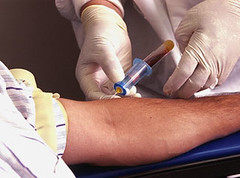
My arm had so much blood sucked out of it for these tests
I just returned late on Thursday from my 3-hour trip up I-85 North to Durham, North Carolina to spend some time with the Triangle (and Beyond) Low-Carb Meetup group there as well as seeing a great low-carb doctor from Duke University named Dr. Eric Westman to conduct some tests and talk about my recent blood sugar woes and pesky 30-pound weight gain in 2008 that won't come back down again no matter what I do. It was a good time away although I missed blogging and updating you about the healthy low-carb lifestyle. And I'll be leaving again on Tuesday to go see my brother Kevin in Pensacola, Florida for at least a week where I will have ZERO Internet access besides my iPhone (and, no offense, but I ain't up for blogging on that thing with the hunt and peck typing!), so I'll be trying to squeeze in as many posts as I can before then. It's gonna stay busy for me the next couple of months.
But so many of you have been wondering about how my visit with Dr. Westman went that I wanted to make sure I provided an update, especially with the results from my five-hour glucose tolerance test (GTT) following a low-carb meal which was conducted on Monday. If you thought my home testing of my blood sugars was interesting enough, just wait until I tell you what happened during the GTT. Unbelievably crazy! I'll share more about that in a moment.
First, let's look at the bazillion other tests Dr. Westman ran for me to see if there are other culprits going on with my health. A few of these I requested done because Dr. Keith Berkowitz (who I will be sharing a special two-part follow-up podcast interview with the first week in August about this answering your questions), who espouses the "reactive hypoglycemia" theory for long-term low-carbers, suggested I have them run.
Here were the results:
Vitamin B-12--529 (normal) Cortisol--8.9 (surprisingly normal) Homocysteine--6.7 (normal) 25-Hydroxyvitamin D3--42 (normal) HbA1c--5.0 (a little low, but normal) LDL particle number--1453 (borderline high) Small LDL particle number--30 (low is less than 600!)
By all accounts of these tests, I'm one extremely healthy guy! My thyroid function was all fine and so was my liver function. So it's good we can rule those out as culprits. I was quite frankly shocked to see my cortisol levels in the good range considering all the stress I've experienced lately, but this just confirms my body handles it all very well apparently. The A1c number was also encouraging since it is so spectacular and out of the diabetic range completely (although Dr. Berkowitz thinks it is a little low--a sign of the reactive hypglycemia according to him).
My LDL and total cholesterol are higher than normal as I've previously blogged, but look at the particle number of the dangerous "small" LDL--a measly little 30! That's just 0.02 percent of my total LDL particle number...in other words, quite negligible and protective considering over 95 percent of my LDL particle size is the large, fluffy kind. :D I'm not at all worried about my lipid profile with my HDL at 65 and triglycerides at 77. That's an HDL/triglycerides ratio I'd put up against anybody else's every day of the week.
Alright, so what the heck is going on with my blood sugars? And, more importantly, what is happening with my insulin levels when my blood sugar drops even after a low-carb meal? Inquiring minds, myself included, sincerely want to know. Here are the results of my GTT after eating a low-carb breakfast consisting of eggs and cheese with a chicken breast from Chick-Fil-A:
Fascinating test, huh? And it's just about what I expected was happening. My fasting glucose and insulin levels are perfect, but within a half hour of eating even a low-carb meal I'm seeing a TRIPLING in my insulin levels to keep my blood sugars in check. This would be a typical response if my insulin then came back down again within the first hour or two, but it doesn't.
As you can see, the insulin sustains at that higher level for two hours lingering at 13.7 then slowly dropping to 11.1 and then hitting 9.0 before dropping back down significantly in the third hour to get closer to baseline. During this time of elevated insulin, my blood sugar falls below fasting down about 10 points before rising back to where it started once the insulin comes down again. A normal response would show blood sugars going up quickly and then falling quickly, but not for Jimmy Moore. Lucky me, eh?
So what am I to make of this and what plan of action does Dr. Westman and his colleagues suggest I implement to limit this insulin response so that maybe I can get my recent weight gain to come back down again? I wish I could tell you it's a pretty cut and dry "do this and all will be well" solution, but it's not. The reality is I need to tweak this slowly by only changing one thing at a time. That one thing for me will include eating LESS protein than I have been and watching my specific portions of protein and overall intake just to see if it makes a difference.
Yes, I know cutting portions and even counting calories is almost taboo to talk about within low-carb circles and I'm not interested in that debate right now because I'm not fully convinced of it. Only time will tell. I haven't once counted calories or measured out my portion sizes in the past four and a half years of livin' la vida low-carb, so this is a tough sell for me. But I'm certainly game for doing something different to get my weight to come back down again, especially that little bit that has come back to my midsection.
Interestingly, Dr. Westman suggested I cut back on the amount of protein I have been consuming because it is possible that my body through gluconeogenesis is converting much of the dietary protein I have been consuming into glucose/sugar/carbs which COULD be the reason why I haven't been able to get my weight back down again. And this theory certainly has some merit since I consciously increased my protein intake when I started lifting weights for the first time in December 2007 shortly before my weight gain.
Sure, I also took creatine in the first six weeks and that may have had some impact on the weight gain. But consuming more protein-based foods in an effort to help with my muscle growth could have sabotaged my weight maintenance efforts somewhat. Although I have experienced quite an increase in the amount of muscle on my body after six months of training, it's not implausible that upwards of half of that weight gain is indeed muscle mass. The rest of the 15 or so pounds of weight I have put on over this period of time may be the result of excess glucose from protein.
Beginning yesterday, I started adding in more fat and deliberately trying to eat less total protein (not as a percentage, but overall) to see if it makes a difference. One way I'm doing this is to make sure any protein source I am eating is offset by an addition of more fat. For example, if I'm eating a chicken breast that is basically all protein and little fat, I'll slather it in butter and add cheese on top. Cheese in the form of brie or other fatty ones as a meal will also be a way to increase my fat while decreasing my protein. Cooking eggs in butter and adding cheese also will help with this. Nuts, coconut oil, heavy cream, and other high-fat foods will become more and more prevalent in my low-carb menus.
Since I already eat most of those foods anyway, this shouldn't be difficult to implement. Simply cutting back on protein could be as simple as eating half a steak or only one burger patty or chicken breast. Making sure I contribute fat and fiber to my meals will keep that ratio of fat to protein at the 3-1 ratio I am hoping to attain. Carbs, of course, will remain reduced to basically non-starchy, green leafy veggies.
What do you think about all of this? I'd love to know what you think about the results of my GTT. I'm also frightened to think what would happen if I did a traditional GTT with a glass of sugar water--EEEK! My insulin would go even MORE berserk! Your thoughts as always are welcomed. :)
Chris Rosenbloom, meet zero-carb runner Charles Washington!
We are surrounded by people who insist on repeating the same health mantras we've always heard over and over again until they're blue in the face. I'm sure they mean well with their conventional advice and had the right motives when they continued their education into the subject of diet and fitness. But somewhere along the line, many of these people who are placed on a pedestal and declared "experts" have lost their objectivity and ability to think logically about the advice they are sharing. Such is most definitely the case with those healthy journalists at major newspapers.
But today I wanted to bring in a special guest to respond to a rather ludicrous column that appeared in the Atlanta Journal-Constitution this week by Chris Rosenbloom, Ph.D., R.D. called "For runners: 'A low-carb approach...can spell disaster'." She asserts in not-so-uncertain terms that a runner absolutely NEEDS carbs for fuel during their workout and that a low-carb diet is NOT recommended for running. We already know the "body needs carbs" mantra is nonsense because of a fascinating metabolic process that is essential to livin' la vida low-carb called gluconeogeneis where the body makes its own carbs through the liver from the dietary protein you consume. You never hear any of these "experts" even mention this--EVER!
How about we hear from someone from the OTHER side who chooses to burn FAT for fuel during his running experiences? His name is Charles Washington and he is one of my moderators over at my "Livin' La Vida Low-Carb Discussion" forum. For those of you who have not heard about Charles, this man is simply amazing. He runs in half-marathons throughout the spring and summer and does it all eating a ZERO-CARB diet. That's right, he doesn't even eat veggie carbs. He's hardcore on what he describes as the "Zero Carb Path" and I'll be sharing an interview with Charles on my podcast show coming up in July.
For now, I wanted to introduce you to Charles by allowing him to respond to Rosenbloom's idiotic column. As you will quickly see in this guest blog post from Charles, he is quite knowledgeable about what he writes about and has the personal experience from his own life to back up everything he says. I appreciate his willingness to share today and I hope you enjoy this very intelligent rebuttal to the claim that you need carbohydrates for athletic performance. ENJOY!
Here's what Charles wrote in response to Chris Rosenbloom:
Dr. Barry Groves observed that athletics is becoming increasingly competitive. More and more stress is being placed on how well we perform. To reach our highest potential, all of our body systems must be perfectly tuned. Nothing is more important to our well-being and ability to perform than good nutrition. Eating the right foods helps us to maintain desirable body weight, stay physically fit, and establish optimum nerve-muscle reflexes. Without the right foods, even physical conditioning and expert coaching aren't enough to push you to your best. Good nutrition must be a key part of your training program if you are to succeed.
The problems arise when deciding the best nutrition for exercise and athletics.
Chris Rosenbloom of The Atlanta Journal-Constitution recently posted an article describing the preparations of runners preparing to race in the world-renowned Peachtree Road Race in Atlanta. She quoted Lee Fidler, an area running coach since the early 1980’s:
"Nutrition is an important part of preparing for a road race. I try to get a balance of fruits, vegetables, dairy products and some high-quality protein, but I also use sports drinks and energy bars to boost my calorie and fluid intake. I see too many runners try a low-carb approach, but that can spell disaster for a runner."
That's very interesting because I am a runner and I have no carbohydrates or sports drinks as a part of my diet. Has it always been this way that carbohydrates were totally necessary for athletics?
The late Gordon Pirie, an Olympic medalist from the 1952 games in Helsinki wrote a book called Running Fast and Injury Free. There he wrote:
“Never eat white flour or its products, nor any sugars, nor any milk that has been homogenized. Scientists can tell you this, unless they are funded by one of the major food companies. Do not believe scientific 'facts' that have been purchased on the backs of food packages.”
Nowadays, athletes regularly use sugar and sugar drinks as training aids. How did we get to this point and is this a healthy way to achieve the performance we all seek?
Chris Rosenbloom quoted athletes as all agreeing that carbohydrates with some protein are crucial for training. Pasta and pizza were top choices, with potatoes, brown rice, whole grains, fish and chicken all making an appearance at their training tables. Some rely on energy bars and energy drinks, but most stick to real foods for their training.
To this information, Rosenbloom assigns a letter grade of “A” because in her opinion, carbohydrates fuel runners. “Protein, while important, is not a good substitute for carb[ohydrate]s.” She would love for runners to have iron-rich foods as well to help carry oxygen to muscles.
Unfortunately, advice like this is peddled about in most major athletics publications and most of us accept these so-called truths without qualification. However, upon closer inspection, we find that there is:
No mention of the best fuel for the body: fat. In fact it says earlier that “Carbohydrates are crucial for training.” There was not even a mention of the essential fatty acids necessary to sustain life. Neither does the advice recommend that the fruit and vegetables be cooked. As we know any minerals and vitamins these may contain (and there are actually precious few to begin with) are not released from uncooked fruit and vegetables.
It is also important to note her understanding of what constitutes a “low-carbohydrate” diet. The emphasis is on protein, not fat. We need to understand that low-carbohydrate diets are not high-protein diets. Rather, they are high-fat diets and they regularly only contain little more protein than that recommended by so-called balanced diets. Consuming a high-protein diet causes serious problems as the Inuit Eskimos sometimes learned in the springtime when only lean rabbits were available. They suffered a malaise that swept over the entire population. They called it rabbit starvation. In scientific terms, Dr. Groves explains:
"Excess intake of nitrogen leads in a short space of time to hyperammonaemia, which is a build up of ammonia in the bloodstream. This is toxic to the brain. Many human cultures survive on a purely animal product diet, but only if it is high in fat. A lean meat diet, on the other hand cannot be tolerated; it leads to nausea in as little as three days, symptoms of starvation and ketosis in a week to ten days, severe debilitation in twelve days and possibly death in just a few weeks. A high-fat diet, however, is completely healthy for a lifetime."
Therefore, one would not want to substitute protein for carbohydrates as Rosenbloom assumes. Those like her who recommend carbohydrates as the “best fuel for the body” don’t seem to realize two very important points:
First, the body can't store carbohydrates in large quantities and most people already get more than enough carbohydrates to fuel their bodies' daily activities. All carbohydrates, whether they are bread, pasta, sugar or jam when you put them in your mouth, enter the bloodstream as glucose. And the bloodstream can only hold so much.
The body, being a well-run power plant, puts the leftovers in storage to use in the future if it's needed. Some is stored as a type of starch called glycogen, but as it can't store much of this, the body turns most of the excess into fat and keeps it on deposit in the body's fat cells. We see it walking around the streets wherever we go, hanging off bodies in a most unattractive way.
Put simply, carbo-loading cannot work simply because excess carbohydrates are not stored in a readily usable way.
The second problem lies in how the body uses its various options for fuel. Each of our body's cells contains lots of very small power plants called mitochondria. It is they that produce the energy we need from the food that we consume. Glucose is usually called the body's 'preferred fuel' because, if it is available, our bodies have been conditioned from birth to use it first. But it is not the best fuel. That distinction belongs to fats--or fatty acids, to give them their scientific name. Before the mitochondria can use either glucose or fatty acid as a fuel, it has to be transported into the mitochondria.
Fatty acids are transported into the mitochondria as completely intact molecules. Glucose, on the other hand, can be transported only after it has been broken down first into pyruvate by the process of glycolysis. This is then used anaerobically to produce energy with lactate as a by-product.
The by-products of the energy-production process when fatty acids are used are carbon dioxide and water, both of which are easily excreted. But when glucose is used, the lactic acid produced in the conversion process can build up in muscle cells and make them ache. It is this that is the cause of the aching muscles or pain involved in strenuous exercise--'the wall' as athletes call it. This 'wall' severely limits an athlete's performance.
So why would a person want to limit their performance by using carbohydrates for fuel?
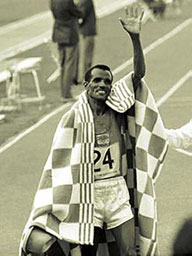
Ethiopian Olympic sprinter Mamo Wolde
Don’t take my word for it, how about the 1968 Olympic Marathon Champion, Mamo Wolde? It was 1968 at the Mexico City Olympic Games. The spectators at the marathon went wild as a relatively unknown Ethiopian, Mamo Wolde, won the marathon. Not only was the thirty-five-year-old runner the oldest man ever to win this prestigious event, he did it in record time. He also was a silver medalist in the 10,000 meters at the same Olympics.
Wolde grew up in an Ethiopian village. His life consisted of running after and hunting wild game on foot. His diet was high in animal meat and fat, with practically no carbohydrate. Subsequent tests showed that Wolde's body, under conditions of physical load, readily burned fat as its main energy source. Wolde had no concept of 'hitting the wall'. It never happened to him.
While there is little or no scientific evidence that carbohydrates are a particularly good energy food, we know that fats are. Dr. Groves explains further why the best performance is only possible with the correct diet and this applies to humans and animals. With the correct diet, constant exercise and practice to maintain muscle suppleness, strength and stamina doesn't seem to be needed either.
It is well known that carnivorous animals such as lions and tigers are fed their natural diet of fatty meat, even when confined in cages or small pens in zoos for long periods of time, without the opportunity to exercise, do not lose their vigor, strength and endurance. Such animals in circuses are even more confined but they are still able to make prodigious leaps when called upon to do so.
Eskimo sled dogs are normally kept on leashes or in small kennels during the summer months and fed fat meat and fish. When, after some months of such inactivity, the winter arrives and they are required to pull sleds again, they have no need of a period of training or conditioning before they go about their arduous task. And they still manage to pull heavy sleds for up to twelve hours a day. The same applies to English hunting dogs. They do not lose their ability to run hard for long distances when correctly fed.
The same is true of Man. The Eskimo spends most of the year in practical inactivity during the winter months. Confined to his snow-covered hut or igloo, eating meat, fish and fat, he rarely ventures outside for months at a time. But when spring arrives, he immediately begins a very strenuous life, traveling many miles to hunting grounds. He, too needs no period of conditioning after his long winter of inactivity. He also requires less sleep and is much more resistant to fatigue.
In 1895 two Norwegians, Fridtjof Nansen and Frederik Johansen, landed on an island of the Franz Joseph group. They had 'conventional' provisions to last for several weeks but, as there was abundant game in the form of walrus and polar bear, they decided to live off the land and save their provisions until the following summer. From the end of August 1895 until the spring break up of the arctic ice they got no exercise, did not wash themselves or change their clothes, yet they remained in perfect health and were able to do a full day's sledging on their first day of travel.
Rear Admiral Robert Peary also noted the ability of Arctic explorers to subsist for more than a year with no food other than pemmican twice a day. Men doing heavy work required two pounds of pemmican, which was the equivalent of six pounds of meat and a pound of fat per day.
This ability to do fantastic feats of strength and endurance was not confined to the Arctic. Native porters in Australia, eating only kangaroo meat, carried heavy loads for up to twelve hours without rest or refreshment; and Aborigines in the desert, would lope for distances of up to twenty miles, with occasional bursts of speed to catch game, on a handful of worms, bugs and insects, and kangaroo meat.
What all these people (and animals) have in common is their carbohydrate-free diet. Fat is the best fuel for an athlete, carbohydrates are the worst. It really is as simple as that.
THANKS for that well-reasoned retort to the Atlanta Journal-Constitution column touting carbohydrate consumption for runners, Charles. You know from whence you speak and I look forward to sharing our interview with everyone in July. Let's e-mail Chris Rosenbloom at dietitian@ajc.com and let her know about how high-fat, low-carb living (or in Charles' case, NO carbs!) has positively impacted your athletic performance.
In Episode 137 of "The Livin' La Vida Low-Carb Show with Jimmy Moore," we will hear from Mary Bissell, an independent filmmaker in Canada who shot the hit CBC-TV Newsworld documentary which aired earlier this year called My Big Fat Diet. I met up with Mary in Phoenix for a few moments to talk about her movie which highlights what happened when a low-carb researcher and physician named Dr. Jay Wortman decided to put a community of First Nations people on a high-fat, low-carb diet (see my blog post about this documentary by clicking here).
Although I wasn't able to meet with Dr. Wortman at the Nutrition & Metabolism conference in Phoenix last month, he managed to squeeze in a few minutes over the weekend for me to interview him about My Big Fat Diet while he was visiting New Zealand. I sincerely appreciated his sacrifice to appear on this podcast and I think you're gonna like what he has to say regarding this important film.
Click on the "LISTEN NOW" link below or download it to your iPod to hear Episode 137:
"The Livin' La Vida Low-Carb Show with Jimmy Moore" Episode 137 [32:55m]: LISTEN NOW | Download
After the one-hour Sunday morning showing of My Big Fat Diet was shown to nearly 150 bariatric physicians at the conference, you would have thought there were rock concert tickets on sale in the lobby with the stampede of people headed to the conference store to buy the DVD of this masterful documentary. It was an encouraging sign that the movie resonates a positive message of livin' la vida low-carb because it just made sense for the members of this Canadian community to get back to the roots of the diet of their ancestors.
Mary Bissell was so excited about this podcast interview that she agreed to give me three copies of the My Big Fat Diet DVD to give away to my listeners. As you may or may not know, this has not yet been shown in the United States, but they are encouraging people who support a healthy high-fat, low-carb nutritional approach to contact their local PBS stations and other broadcasters about showing it since it has been so well-received in Canada. There has been a great amount of interest in having this shown in the US, so let's do our part to provide our feedback to PBS about wanting to see this outstanding documentary here.
In the meantime, YOU can possibly win your own copy simply by going to the show notes section of Episode 137 and sharing a brief essay explaining how a high-fat, low-carb diet has transformed and changed your life forever. Even if you are still in the midst of this journey or simply want to share your own low-carb success instead, that's fine. Just tell us YOUR low-carb experience and we will have three big winners to share on next Monday's podcast. GOOD LUCK EVERYONE!
Never miss a beat on the latest in low-carb living by:
So, are you excited about going on your own big fat diet after hearing from Mary Bissell and Dr. Jay Wortman? What do you think about the premise of their documentary and do you think something like this could ever happen in America? Talk about it in the show notes section of Episode 137. We need to rally behind something like this because it is a rarity in our fat-phobic culture.
By the way, there's a new way for you to provide audio feedback for my podcast show. We have set up a special telephone number so you can sound off on anything you've heard on the show or in the news about livin' la vida low-carb. Got a rant and want to share it? We want to hear from YOU! Simply dial (206) 202-6516 and leave us your feedback. Who knows? You may just hear yourself on a future episode of "The Livin' La Vida Low-Carb Show with Jimmy Moore." THANKS so much for your support everyone!
Jennette Fulda is coming up on Thursday's show...SEE YA THEN!
Click on the "LISTEN NOW" link below or download it to your iPod to hear Episode 128:
"The Livin' La Vida Low-Carb Show with Jimmy Moore" Episode 128 [19:54m]: LISTEN NOW | Download
If you are a fan of livin' la vida low-carb, then this podcast with Kat James today will bring a big smile to your face. Kat shares the cold hard facts about why fat consumption in conjunction with a low-carb diet is an awesome way to take care of your body and make yourself truly beautiful inside and out. She has invested her life into helping others overcome their food addictions and it starts with getting them off of the sugar/carb rollercoaster ride. Let Kat inspire you anew in your low-carb weight loss efforts today.
Meet remarkable low-carbers like Kat James anytime by:
Be sure to tune in against next week as we continue the interview series with two more inspirational and motivational health leaders I am confident you will love and enjoy. THANK YOU for listening to "The Livin' La Vida Low-Carb Show with Jimmy Moore."
We all know low-carb is great for weight loss, but can you gain?
When people first start livin' la vida low-carb and come to me with all their wide-eyed inquisitive questions about this and that regarding this truly amazing lifestyle change, I am always happy to share from my own experiences eating this way for the past four years as well as asking some of my low-carb expert friends who are studying, researching, and working daily within the scientific community into why and how the low-carb diet works so well to help people lose weight and improve their health.
One question I received from a reader in the Netherlands has been partially addressed before in a previous blog post. Longtime readers may recall in December 2006 I wrote a blog post entitled "Can Low-Carb Evolve Into Making You Fat?" It was about a ridiculous study done on caterpillars fed a high-protein/low-carb diet that claimed that their metabolism actually changed over time to begin storing the few carbohydrates they did eat into fat. Preposterous to say the least and many of my low-carb expert friends agreed.
But what if it was possible that livin' la vida low-carb could actually make you fatter somehow? It this even within the realm of possibility? That's what my reader wanted to know when he sent me the following e-mail:
Hi Jimmy,
I've been reading all the low-carb/high-fat diet books including Good Calories, Bad Calories by Gary Taubes and I'm following all the major low-carb blogs, too. Of course, I am applying what I've learned and started with The TNT diet from Dr. Jeff Volek and Adam Campbell ever since late October 2007. So far, I have lost 9 kilograms in 3 months and 10 centimeters from my waist. However, ever since I hit that weight of 87 kg, I have been stuck there. So, I have a question for you:
Is it possible for you to actually get fatter on a very low carb diet?
I am like you--I really can't tolerate more than 50 grams of carbs a day. So I only eat avocados for my fruit and I eat the right kind of vegetables. For the rest I eat all kinds of fatty fish (herring, salmon, sardines) as well as beef and pork. I also like sugar-free whipped cream and sometimes I eat mixed natural nuts. I think that's 50-60% fat and the rest is protein with the vegetables. I also take a good multivitamin, fish oil, and potassium.
So I'll ask it again: Is it possible to store fat with such a diet? I measure myself every now and then and my waist size can fluctuate from 84 cm to 89 cm. That's happened a lot lately. I travel a lot visiting clients and I only eat nuts with some cranberries. But that has resulted in the extra centimeters.
Can you eat too many calories on low-carb? As far as I can tell, I never eat much more than 2500 calories (most of the time it's more like 2100) and I am 6'2" and weigh 87 kilograms. For exercise, I run three times a week for an hour.
As I understand it, Gary Taubes says being overweight is NOT caused by eating too many calories, but is caused by too much insulin released in the body from eating too many carbs. So why am I getting fatter?
WOW, what a loaded question and one that is certainly worth taking up as an important topic again here at my blog. I've addressed this sensitive subject of weight gain while on low-carb before and I even talked this week about how my weight has gone up by about 30 pounds ever since I started weight lifting in December 2007 (thanks to everyone who has offered their various opinions about this, by the way! I really appreciate it!). But can you REALLY get fatter on a low-carb diet? Is it metabolically possible to gain weight while eating this way?
To answer this question, I asked one of the most knowledgeable and highly-respected low-carb scientists of our day Dr. Richard Feinman from SUNY Downstate in Brooklyn, New York and Co-Editor-In-Chief of Nutrition & Metabolism to answer my reader's question. Here's what Dr. Feinman wrote:
Gary Taubes' position is an exaggeration. The way we describe it to medical students is that insulin (via carbohydrate) is like the handle on a faucet. The handle regulates the flow from dietary fat into stored fat. If you turn down the handle, the flow is drastically reduced but if you supply enough fluid pressure from the reservoir, you will increase the rate through the faucet--it's not a perfect analogy but you get the idea.
Remember that there is always insulin--whereas insulin turns off production of glucagon (the hormone that signals low glucose). And glucagon turns on insulin production. For many people--my guess is probably half the male population--keeping carbs low makes it very hard to overpower the inhibition in the fat storage mechanism but for some people the level of total calories that is required to continue to lose weight may be very low indeed.
The impact of the ideas behind Livin' La Vida Low-Carb is that fat plays a passive role and that its disposition (storage or oxidation) is controlled by insulin and other hormones which are control elements--it does not mean, however, that fat is not important. You can overpower a low carb diet and, depending on your age, 2500 calories may be a limit on weight loss.
On the other hand, from a practical standpoint, the real advantage of Livin' La Vida Low-Carb is that you don't have to think about food all the time and maintaining your weight is actually a real accomplishment. There are some tricks that may help--I have observed anecdotally and Dr. Mike Eades (from Protein Power) saw this regularly in his clinic that the three things that look okay on a low carb diet but may actually be trouble are cheese, nuts, and peanut butter. But if you are living in the Netherlands, giving up gerijpte Gouda (is that the right term?) might be a major sacrifice.
Hope this helps,
Richard D. Feinman
THANK YOU Dr. Feinman for that explanation. I appreciate the fact that you acknowledge for about half of us, watching calories may be necessary while restricting carbs may be necessary to lose and/or maintain weight loss. I've never personally counted calories while on the Atkins diet, but I know many of my readers who have to if they want to see success on their low-carb lifestyle. It's also important that you stated that "fat plays a passive role" in your diet and that eat too much of it can pile on the calories for those who need to be mindful of their total caloric intake. Outstanding information!
At the same time, your belief that eating low-carb makes it so you don't have to think about food is dead on the money. Listing those three culprit carb foods--cheese, nuts, and peanut butter--is gonna help so many people (myself included!) improve their low-carb weight maintenance plan immensely. Although I don't eat peanut butter (not the ones that are loaded with sugar, though), I have consumed my fair share of cheese and nuts. Perhaps it's time for me to cut back on these things. :)
The response provided by Dr. Feinman was very much appreciated by my reader who answered back with his gratitude about his inquisitive question:
Thanks Dr. Feinman,
In my case, I guess it's nuts and cheese (I don't eat peanut butter) because I observed that especially when I ate many nuts and also in the case of a lot of cheese I immediately stored fat around my waist. But I thought all the time: "This can't be true, because fat doesn't trigger insulin, so why am I getting fatter anyway and I read in many low-carb books that the amount of calories don't matter."
At the beginning of my low-carb lifestyle in the first few months, I really could eat all the fat I wanted. But ever since January 2008, I suddenly noticed a big difference: I was gaining fat/weight with exactly the same diet as the three months before and in those months I had lost weight!? So that was the riddle: how can one first lose fat/weight and after 3 months start gaining fat/weight with the same diet?
I love to eat and a lot of it and again that was no problem the first 3 months of Livin' La Vida Low-Carb (what a sensation: eating a lot and losing fat!). But what a disappointment that suddenly I had to watch the amount of calories and now I am convinced it's the nuts and cheese. So that's how one can be blinded by an idea. And although I saw the difference, I just couldn't believe it, because all the books say you can eat all what you want as long it is fat and some protein and vegetables.
So thanks a lot, and yes some cheese we call "gerijpt" but that's a bit old. I prefer the younger cheese, because it's fattier. Thanks Jimmy, I appreciate your help with this a lot. You once wrote in your blog that you reply to all e-mails and indeed you do!
It's my pleasure, my friend. THANK YOU for your question and I hope Dr. Feinman's advice helps you tweak your diet so you start losing again. Remember, even if you aren't losing weight while livin' la vida low-carb, the improvements you are making to your health are just as if not more important in the grand scheme of things. DON'T GIVE UP HOPE! You're doing fantastic and are well on your way to some awesome accomplishments in your life. I'm proud of you!
Do you have a question about the low-carb lifestyle that's been bugging you? Never hesitate to e-mail me directly at livinlowcarbman@charter.net. If I don't know the answer, I've got a lot of people who support the work I do here who are more than happy to help. By the way, I'll be meeting Dr. Feinman at that obesity conference in Phoenix, Arizona next weekend, so I hope to interview him for my podcast show. He's one truly remarkable man with a depth of knowledge as deep as anyone else when it comes to the subject of low-carb diets.
Are you constantly thinking of food on your low-carb diet?
One of the reasons why so many of us got to be overweight or obese in the first place is we were always anticipating our next meal and making it the focal point of our lives. It may not have been a conscientious thought process, but it was there whether we admit it or not. Food, and specifically sugary and starchy high-carb food, was our reason for living because we had a deep, deep hunger.
But when you start livin' la vida low-carb, those feelings of hunger and dwelling on what you are gonna eat next go away, right? Well, not exactly if you don't follow your low-carb plan EXACTLY as prescribed by the author of that program. That's what I talk about in Episode 104 of "The Livin' La Vida Low-Carb Show with Jimmy Moore" to help you pinpoint why you may be feeling hungry on your low-carb diet. It ain't normal, so tune in to today's podcast to find out why and how you can remedy this.
Click on the "LISTEN NOW" link below or download it to your iPod to hear today's podcast:
"The Livin' La Vida Low-Carb Show with Jimmy Moore" Episode 104 [12:38m]: LISTEN NOW | Download
I'm not sure where people got the notion that they should suffer in their weight loss, but that's precisely what most people think. Being hungry and craving food are just a part of what it takes to shed the pounds (so they think!). But when you are livin' la vida low-carb, all that conventional wisdom is thrown out the window and you discover a way of eating that is both delicious and nutritious that helps you burn body fat and feel better than you ever have in your entire life!
Never get hungry for low-carb news and info again by:
Have you experienced hunger on your low-carb lifestyle? If so, then what did you do to remedy it? Eat more fat? Eat low-carb meals more often? Or are you STILL suffering from hunger? Tell us your experience in the show notes section for Episode 104.
Research Showing There's No Debate About The Fate Of Low-Carb In 2008
I've become convinced that one of the greatest assets that those of us who believe in the power of livin' la vida low-carb possess is the ever-growing litany of respectable published research that continues to pour in at breakneck speed. A young researcher from the University of Pennsylvania recently confirmed that there is "strong interest" in low-carb diets and how they relate to treating obesity and disease. This has me very excited about the future of the low-carb lifestyle because we're just getting started.
Now that the new year is here, there will be even more positive studies regarding livin' la vida low-carb to be released. All this encouraging research shows us there's no debate about the fate of low-carb in 2008. Things are looking up--WAY UP!--and we should be holding our heads high as the science finally begins catching up with the experiences those of us who have been eating this way already know.
Today I have four newly-released published studies that will encourage you as you continue to live the low-carb life. It's an amazing journey that is so much deeper and more meaningful than simple weight loss. It's about living healthier than you ever thought possible while enjoying amazing high-fat, low-carb foods that are delicious, nutritious, and will keep you satisfied. What other "diet" plan can you say THAT about? Anyone? :)
Here are those new studies for you to add to your arsenal:
Looking at female athletes, the researchers wanted to see if the amount of dietary fat intake played a role in the occurrence of foot and knee injuries sustained during training and competition. They observed 86 female runners who ran at least 20 miles a week and asked them to keep a food log for a period of one year. The study participants were asked to report any injuries they sustain over that period of time for the researchers to analyze their food intake to see if there was a contributing factor.
The results were astonishing! Those female runners who were injured were more likely to be consuming "significantly lower intakes of total fat" and calories from fat compared with the study participants who did not sustain an injury. In fact, the researchers conducted a logistic regression analysis to predict with 64 percent certainty which of the female athletes would be injured based on their dietary fat intake.
MY CONCLUSION: If a female runner wants to reduce her risk of an injury, then the best course of action is to EAT MORE FAT! Betcha didn't see that one coming!
What seems like an encouraging bit of research about a low-carb diet for controlling Type 2 diabetes over a one-year controlled study is actually anything but. All you need to do is read Regina Wilshire's take at the "Weight Of The Evidence" blog to realize this study was bogus from the start. Why? Because their idea of a "low-carb" diet is putting the study participants on (hold on to your hat) NEARLY 200 grams of carbs a day! HOLY CRAP! Are they TRYING to kill these people?!
It should come as no surprise that all the major health indicators got WORSE on this diet, including weight gain, HbA1c increases, HDL "good" cholesterol decline, sharp increases in triglycerides--all tell-tale signs that these people did NOT follow the dictates of the low-carb lifestyle. Perhaps the researchers would do themselves a lot of good if they performed this same study using a very low-carb ketogenic diet consisting of 10g carbohydrates for comparison purposes. The results of this study would be quite stark!
MY CONCLUSION: Just because research shows some supposed positive aspect of livin' la vida low-carb in a twisted interpretation of the data doesn't mean it should be celebrated. Demand better and more accurate studies to compare the REAL low-carb with the fake 200g carbohydrates one!
Like that last study, this one was also published in the same journal. But unlike the previous one, this is a legitimate body of research that bears a closer look. The lead researcher is Dr. Alex Johnstone from the Rowett Research Institute who I previously blogged about her study of low-carb diets on brain health. This time she wanted to know if changing the amount of protein and carbs in the diet would impact hunger for the study participants. Specifically, is being in a state of ketosis brought on by a high-protein, low-carb ketogenic diet more satiating and effective for weight loss than a high-protein, moderate-carb nonketogenic diet? Interesting study, huh?
She carefully observed 17 obese men over a four-week period as part of a residential trial and carefully measured out the specific food content for each of the study participants. Each of them were provided 2 high-protein diets (consisting of 30 percent of total calories) along with either a low-carb diet (consisting of 4 percent of total calories like the Atkins diet) or a moderate-carb diet (consisting of 35 percent of total carbohydrates a la The Zone). She measured their body weight daily along with ketosis. Computer analysis also measured hunger.
The results? Hunger was lower and weight loss was "significantly greater" with the low-carb diet compared with the moderate-carb diet. This all happened while the low-carb participants remained in ketosis and actually ate less food for the duration of the study. It was further proof that ketosis is indeed safe and extremely effective for both satiation and losing weight. Of course, we knew that already.
MY CONCLUSION: If you're looking for a diet composition where you are never hungry, will lose a whole lotta weight, and will feel better than you ever thought possible, then you should turn to a high-fat, moderate protein, low-carb ketogenic diet. Ketosis is the key. Nuff said!
Although the American Diabetes Association (ADA) recently endorsed low-carb as equally effective for diabetics to use as part of their weight management program, similar positions have not been taken by other health advocacy groups like the American Medical Association (AMA) and the American Heart Association (AHA) for example. But there hasn't been as much published research on low-carb weight loss for Type 2 diabetics--until now!
Researchers from the Oxford, England-based Center for Diabetes, Endocrinology and Metabolism wanted to compare the effects of a low-carb diet on the body weight, HbA1c levels, ketones and cholesterol levels in both diabetics and non-diabetics to see if there would be a difference over a three-month period. A total of 13 Type 2 diabetics controlling their disease with disease or metformin as well as 13 non-diabetics were placed on either a low-carb diet (with 40g or less carbohydrates daily) or a "healthy-eating diet" as prescribed by the ADA-equivalent group in the UK (basically a moderate-to-high-carb, low-fat diet).
The low-carb study participants, both diabetic and non-diabetic, experienced "greater" weight loss with no changes in HbA1c, ketone or lipid levels. While I'm encouraged by the weight change that occurred, I'm surprised there were not improvements in the HbA1c and lipid levels at all on those who followed low-carb. But it's still good new for the low-carb lifestyle.
MY CONCLUSION: Whether you have diabetes or not, livin' la vida low-carb is an "equally effective" way to lose weight and get healthy. Are you hearing this AMA and AHA as well as the low-fat bureaucrats in the FDA and USDA? If low-carb and low-fat are equal, then why not recommend them side-by-side as the ADA began doing this year, hmmmm?
Keep reading the "Livin' La Vida Low-Carb" blog throughout 2008 as we'll continue to share with you the latest from the research community. If you see any studies about livin' la vida low-carb that catch your eye and you want to bring them to my attention, then please e-mail me a link to the study or article about it anytime at livinlowcarbman@charter.net.
Nina Planck says it's time to get back to real, whole foods again
1. What a real treat we have at the “Livin’ La Vida Low-Carb” blog as the author of the book Real Food: What To Eat And Why is here with us today. She’s food enthusiast Nina Planck and she has quite a perspective as it relates to advocating people start eating more “real food” in their diet while shunning the processed garbage that unfortunately has become all-too-common in the modern diet.
Welcome Nina and I appreciate you spending a few moments with me and my readers. You grew up around fresh produce and quickly fell in love with farmer’s markets. How did that experience shape you into the enthusiastic lover of “real food” today? And what is “real food” as opposed to “fake food?”
My mother read Adelle Davis and she taught me that real food is whole food. We ate meat, fish, poultry, dairy, eggs, and lots of produce. The only thing that was restricted in our house was junk food, and that boiled down to white flour and sugar of all kinds. So dark chocolate was a popular dessert. So was proper ice cream, not too sweet, and homemade fruit pies, and real pancakes, made with whole grains we ground ourselves.
My definition of real food is food we’ve been eating a long time and food which is more or less farmed and prepared the way it used to be. So that means wild salmon and grass-fed beef; ecological fruit and vegetables; traditional fats and oils (animal and vegetable); raw milk cheese (not processed fake cheese or low-cholesterol cheese); and whole eggs (not egg-whites, pasteurized eggs, and powdered eggs). If you eat around the edges of the supermarket, you’ll be eating real food. Avoid the highly processed, high-profit-margin, low-nutrition foods in the center. Except, as my mother would say, the brown rice and olive oil.
2. You believe (as do I) that most people would actually enjoy eating a more traditional diet of fruits, vegetables, grass-fed meats and dairy products, and other real food if they simply tried them again and greatly reduced or eliminated their reliance on the overabundance of what I like to call “carbage” from their diet. But we are a nation full of people who wants what we want (junk food, fast food, meals in a box) and we don’t want to pay a lot of money for it.
How do you convince someone who says they can’t afford to eat a “healthy” diet with all those foods and is that a good enough excuse for not eating “real food?” Should the government or some other third party step in and help make fresh healthy foods more readily available to the lower-income consumer?
Carbage is expensive and because it contains so little nutrition, it’s worse than expensive: it’s wasteful. Why put all those empty calories in your body? The nutrients are in the foods we’ve eaten since the Stone Age: meat, fish, poultry, produce, nuts, and fats. I’m also a fan, nutritionally and personally, of real dairy foods (especially raw milk and good butter) but they’re not for everyone.
3. Many people have come to the conclusion that the best way for them to start eating better and living a healthier lifestyle is to start cutting the fat out of their diet. After all, we’ve always been told--at least over the past three decades--that dietary fat is the reason why we have become such a nation full of overweight and obese people. But you devoted an entire chapter of your book on the reasons why fat should be consumed, including saturated fat.
For my readers who may still be skeptical about why fat will not “clog” their arteries and give them a heart attack, explain why real foods like butter, coconut oil, beef, and other high-saturated fat sources are indeed safe for consumption. If fat is not the culprit in heart disease, then what are we eating that is contributing to this health problem?
The main villains of obesity, diabetes, and heart disease are industrial foods: corn oil, corn syrup, white flour, and trans fats. Don’t eat them. The good guys are omega-3 fats in foods like wild cold-water fish; whole eggs; and natural fats, including saturated fats, like coconut oil, and unsaturated ones, like olive oil. If you eat traditional fats rather than industrial ones, you’ll be fine.
Many traditional cultures eat traditional fats, including saturated fats, and don’t get heart disease. That’s because natural saturated fats don’t raise cholesterol in unhealthy ways AND because they don’t eat industrial foods. Coconut oil in particular BALANCES HDL and LDL. Deficiency of B vitamins raises homocysteine, which damages arteries.
How did we get deficient in B vitamins? By eating carbage. Don’t eat white flour and sugars, which deplete the body of B vitamins. You’ll get plenty of B vitamins from meat, fish, poultry, and whole grains.
4. As Michael Pollan outlined in his amazing book The Omnivore’s Dilemma, one of the real problems we face with our food supply nowadays is the prevalence of a corn derivative in virtually every food out there. And the worst culprit of them all is sugar’s evil twin--high fructose corn syrup (HFCS) which sneaks its way into just about everything the average American eats.
Why do you think people are so unconcerned about eating all these foods that are nutrient-deficient and absolutely loaded with excessive amounts of sugar and carbohydrates? Is there any practical way to get through to them and hammer home the message that they are destroying their body and their health by forgoing a “real food” diet?
There is only one way: you must eliminate all forms of industrial corn from your diet, including corn oil, corn syrup, and even corn-fed beef. Of the three, corn-fed beef is by far the healthiest food. But what a New Year’s Resolution!
For the average American, a personal ban on industrial corn would be a radical move, and, I think, not a difficult one, if your eyes are open to all the foods that ARE good for you. There are so many real foods. I’m getting hungry just thinking of one category: nuts. Brazil nuts in my pantry, almonds, walnuts, pecans, pine nuts – I love them all. On you can go, with another category of real food: cheeses, say, or fruits.
5. I'm with you on the nuts and cheeses! Your passion for “real food” is so evident as I read through the pages of your book and I’m sure it makes you wonder why more people aren’t as enthusiastic about adding fresh, whole foods to their diet as has become such a normal part of your life.
Let’s see if we can help people who sincerely want to change their diet from a typical, meal-in-a-box one into a farmer’s market-styled plan. What would you suggest they do to begin making that transition starting right now?
After the corn suggestion above, I suggested eating fresh fruits and vegetables at every single meal. People are astonished at how much produce I eat everyday and I’m too often astonished at how little they eat. It’s more important to eat fresh fruits and vegetables every single day wherever they come from than to eat local and seasonal foods. The grocery store is your friend in this respect. Even the sorriest grocery story has a produce section. Use it.
6. A major problem that people who are unfamiliar with eating “real food” may not even be aware of is the big factory-styled farms. Before I lost 180 pounds eating a healthy low-carb diet in 2004, I didn’t care how a tomato got to my supermarket’s produce section. I just wanted to be able to buy one to slice up for my cheeseburger when I wanted it.
But not all fruits and vegetables and even beef are the same, are they? Explain the difference between a mass-produced food product and one that you can purchase at a farmer’s market.
Local food tastes better. There’s no doubt about it. And there is junk-–pesticides, fungicides, waxes--on a lot of industrial produce. But there is a greater difference, for your health, between processed foods and junk foods and whole, real foods. If your only choice is supermarket broccoli and grain-fed ground beef, eat it. Don’t eat the other garbage that comes in TV dinners and canned soups. Eat simple, whole foods.
If you can afford it, spend more money on foods high up the food chain. So, in our house, we spend more on grass-fed and pastured meat and dairy and eggs, and on wild seafood. Ideally, these foods should also be free of hormones and antibiotics. We buy local fruit and vegetables because we love them and are lucky to get them near us in New York City, but in the winters, my mother raised us on the produce department at the local discount chain, Magruder's. You must eat fruit and vegetables every day.
7. We hear a lot of nutritional buzz words these days that don’t mean very much to the uninformed. They’ve become such marketing slogans for food manufacturers that they are almost rendered useless in the modern vernacular since nobody really knows what they mean. Perhaps you can help clearly define what “organic,” “healthy whole grains,” and “grass-fed” means for my readers. Are there any other popular labels that you feel have become too convoluted, too?
Organic is defined by US law and it means the food was produced without chemicals, nitrogen fertilizer, irradiation, and genetic modification. Organic food is certainly a better choice, a cleaner choice, than industrial food.
Grass-fed is not defined, but it means, generally, that the beef or dairy cattle, goat, or sheep was raised on its God-given diet of grass, not grain. Many grass farmers feed some grain, so you’ll need to ask if you want 100% grass-fed.
Whole grains should mean the whole grain is there: bran, fiber, germ, and starch. Don’t be fooled by "wheat flour." It must say 100% whole wheat or whole rye to be whole grain.
8. I blog about these issues all the time, but we seem to have an ever-increasing problem with people becoming overweight and obese, getting diabetes, and putting their health at risk with such calamities as heart disease, stroke, and cancer, among others. All of this seems to coincide eerily with the nationalized promotion of a high-carb, low-fat diet ever since I was a child.
If there is such a rise in weight problems and disease despite the fact that our government and health organizations like the American Heart Association, American Diabetes Association, and others have been pushing this kind of a diet, then why haven’t other nutritional alternatives such as a low-carbohydrate diet become more embraced as an alternative for those who don’t do well on the recommended low-fat regimen?
They just haven’t moved with the science. It’s clear from the Nurse’s Health Study-–heck, it’s clear from observing the population even superficially--that the high-carbohydrate, low-fat advice has led to a nation ever more fat, diabetic, and heart-diseased. The folks in the nutritional establishment will come around when the last people who believe the failing theory have died. That’s how scientific and nutritional opinion changes shape--slowly. Too slowly!
9. One of the world’s most perfect foods in my opinion is eggs. They are chock full of some of the healthiest ingredients in the world--including protein, antioxidants, omega-3s and other essential nutrients. And yet we’ve been sternly warned against consuming them because of their high cholesterol content no thanks to the erroneous hypothesis forwarded by Ancel Keys regarding cholesterol.
Like the “fat will clog your arteries” concerns that many people have, how do you overcome the perception that a high-cholesterol diet is unhealthy? Why shouldn’t people worry about their LDL and total cholesterol so much that they’ll take a statin drug like Lipitor or Crestor to artificially lower it?
Eggs are a perfect food. They contain excellent protein, digestible fats, and many nutrients for eye and brain and heart. We have known for some time (1999, I think) that people who eat MORE eggs have LESS heart disease. We have known for some time that DIETARY cholesterol has little effect on BLOOD cholesterol. So there is no reason not to eat eggs.
There is a very good reason not to eat junk eggs: powdered, spray-dried eggs contain oxidized cholesterol which does clog arteries. Not natural fresh eggs. Don’t eat phony foods; eat real foods. One thing we notice about cholesterol-rich foods is that cholesterol likes to hang out with other nutrients. Thus some of the most nutritious foods are rich in cholesterol: eggs, shellfish, dairy, organ meats.
All these foods were (and are) prized by traditional cultures. That tells you something. There are many skeptics on statins and statins do have serious side effects. Read more at www.thincs.org.
10. What an honor it was to have you with us here today, Nina Planck. Your book Real Food: What To Eat And Why is absolutely amazing and I cannot recommend it highly enough to my readers interested in learning to eat better by putting more “real food” in their mouths.
It seems like an impossible task to get people to stop spending their money on “fake food” and to begin investing in “real food” for the sake of their weight and health. Do you believe a major paradigm shift could happen to make people become more conscious of their choices and to begin caring about the food they put inside of their bodies? And what final recommendations would you make for people wanting to adopt your "real food" philosophy?
Remember this: the information is there for anyone to read--nutrition counselors, government advice-givers, individuals. And the carbage and other junk food is also there for everyone to eat. You can’t change that. You can only change yourself. Start with your fridge.
If you’re doing all this already, you’re probably at your natural weight, so relax. Here are a few final tips I've learned along the way:
• Eat breakfast every day • Get a lot more sleep • Exercise (take the stairs & walk everywhere) • Take smaller portions • Eat real meat, poultry or fish every day (think deck of cards) • Eat whole dairy foods as often as you like • Eat real eggs as often as you like • Eat a lot of vegetables at every meal (more than you think) • Eat as many whole grains as you need (the size of your fist) • Eat nuts, chocolate & coconut (if you like them) • Eat a lot of omega-3 fats from wild fish (daily flaxseed oil for vegetarians) • Don’t eat industrial vegetable oils • Reduce or eliminate white flour, white rice & sugar • Don’t eat junk food, diet food, or foods engineered to be low-fat
Learn more about Nina Planck and her Real Food concepts by visiting NinaPlanck.com. And be sure to sign up for her newsletter to stay current on all the latest news and information about living healthy with "real food."
"Fat Head" movie obliterates the low-fat lie with humor-filled facts
I recently shared with you about two amazing new documentaries on the subject of diet and obesity that are coming out soon and today I have an interview with one of those filmmakers to talk about his movie designed to be a direct response to Morgan Spurlock's Super Size Me. Tom Naughton was kind enough to send me a special advance release of his new movie Fat Head to review and I was blown away by how well done it was with all the professional quality of Spurlock's documentary, but with the truth on his side.
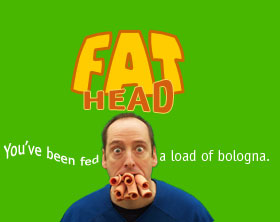
Naughton says Morgan Spurlock fed us all "a load of bologna"
Currently, Naughton is seeking distribution for Fat Head and would like to expose it to as wide an audience as possible because of the potential lifechanging impact it could have on so many people who have never heard the facts he shares in this film. It's an eye-opening experience to learn why fat isn't so bad for you and carbohydrates are.
Watch this trailer for Fat Head posted at YouTube and then read my exclusive interview with the filmmaker Tom Naughton afterwards to find out more about this new movie and how you can help spread the word to others about it:
1. I’m so stoked to share with you an interview today with one of the most hilarious people you will ever meet in your entire life. His name is Tom Naughton and he’s a stand-up comedian who is on a personal mission to prove Morgan Spurlock was dead wrong for blaming McDonald’s and the fast food industry for obesity in his hit documentary film Super Size Me. He’s doing that through a very funny documentary of his own called Fat Head which I have been privileged to watch from start to finish.
Welcome, Tom, and tell us why you felt it was necessary to challenge Spurlock’s conclusions regarding obesity. Was it the cause-effect factor he promoted that got you the most or was Spurlock simply missing a key element in his analysis of the problem?
The cause-effect factor had a lot to do with it. There’s that famous H.L. Mencken quote that for every complex problem there is a solution that is clear, simple, and wrong. Blaming McDonald’s for the so-called obesity epidemic is the clear, simple, and wrong explanation. You can’t solve a problem by pointing a finger at the wrong cause.
2. Of course, Super Size Me was one of the most critically acclaimed documentaries on nutrition in the history of filmmaking. Spurlock was given high praises by those who approved of the message of his film and it indeed forced the corporate executives at McDonald’s to make certain changes to their business model to deal with the public relations fallout from the movie’s message.
But what you share in Fat Head is that much of what Spurlock spouts in his finger pointing flick is “a load of bologna!” Tell us about some of the things what he got wrong in Super Size Me and why the truth about those things is important to know.
For one, Spurlock swallowed-–hook, line and sinker-–the CDC’s assertion that there is an obesity “epidemic.” There isn’t. Since 1970, we’ve gained an average of eight pounds per person. We’re also nearly 10 years older on average, so an extra eight pounds is hardly a shocking gain. And much of the overall weight gain is concentrated in a small fraction of the population. In other words, a few folks have gotten very, very fat. The rest of us gained a bit of weight.
I’ve been hearing for years that a third of American adults are obese, that three-quarters of us are overweight, and that always struck me as suspicious. When I look around in public, I do see more fat people than I did 20 or 30 years ago, but it’s not a majority by any means. My research confirmed my suspicion. The obesity “epidemic” was wildly exaggerated by the CDC, because they were established to fight epidemics, and so they need on-going epidemics to justify their budgets. Remember when we were all told there were 2 million homeless people in America, and later we found it was never more than 200,000 and probably even fewer? Same thing is happening with the obesity figures.
For another, Spurlock promoted the idea that people are getting fat on fast food because not every McDonald’s had a nutrition menu available when he went looking. You know, we didn’t have a so-called obesity epidemic when I was growing up, and in those days, not a single restaurant had nutrition information available, anywhere. Most people recognize high-calorie meals when they see them.
When you get down to it, Spurlock is proposing that people are stupid, that they don’t know big orders of fries and huge cups of soda are fattening unless McDonald’s holds a nutrition menu up to their noses. That’s just silly and, when you think about, elitist and snobbish to boot.
Finally, Spurlock blamed–-or at least his doctor blamed-–a high-fat diet for causing the fatty liver he developed. Where did his doctor go to med school? I know a fatty liver is caused by gorging on simple carbohydrates, and I’m not a doctor. So that was just plain wrong information.
3. Your documentary Fat Head actually started out as a means for shining a light on the enormous fat prejudice that exists in our society today. In fact, the movie begins and ends with this point asking why we have become so obsessed with fat people. What was the impetus for wanting to share this message in a documentary? How did the message of your film shift from the prejudice as the primary focus to Spurlock’s interpretation of the perceived obesity problem?
I actually started this project intending for it to be a humorous video essay of sorts that would deal with what I think is a ridiculous prejudice against fat people in our society. Not everyone cares about being skinny, and if some folks prefer to go through life eating whatever they like and gaining weight as a consequence, that’s their business and we should stop trying to shame them into eating the way the rest of think they should.
In fact, as Dr. Eric Oliver explained to me, and details in his book Fat Politics, equating being thin with being virtuous is an attitude left over from our Puritan heritage. Anything involving sensuality made the Puritans uncomfortable, to put it mildly, and that included enjoying your food. In many, many cultures, being fat is either no big deal or even embraced as a sign of wealth and success.
I rented Super Size Me as research for that project--otherwise I never would’ve seen it. When I did see it, I was so annoyed with the overall message and the twisted logic Spurlock used to promote it, I felt compelled to create a reply. So the focus of my project changed. And of course it changed again when I discovered how much of the nutritional advice we’ve been fed over the years is a load of bologna.
4. The most compelling argument against the message of Super Size Me in your documentary is when you cry foul on the nutritionist who told Morgan Spurlock he was consuming over 5,000 calories a day on his McDiet. Since you were unable to have access to any of his menus, it was impossible to determine exactly how many calories he consumed in the 30 days he ate at McDonald’s. But by using deductive reasoning assuming what Spurlock ate, you did the math and it just didn’t add up especially in light of the fact that he was only asked to Super Size a total of nine times.
What did you discover his actual calorie counts to be? Do you think he purposely lied about the calories to sensationalize and hyperbolize the point of his movie even further?
Yes, I think he fudged on his rules to make sure his weight gain would be dramatic and impressive. I don’t know how many calories he actually consumed; we just know it was more than 5,000 per day. But that fact, all by itself, creates a little calculation problem for Mr. Spurlock.
When I’m not doing standup comedy, I’m a computer programmer, so math and logic are part of my daily existence. When Spurlock’s nutritionist told him he was consuming more than 5,000 calories per day, alarm bells went off in my math-loving brain. I’ve eaten at McDonald’s while on a diet, so I already had a rough idea of the calories in their meals, and I knew immediately something didn’t add up.
According to his rules, he would eat three meals per day and only super-size if they asked him. But he was only asked to super-size nine times in 30 days--that’s twice per week. You simply can’t consume 5,000 calories per day at McDonald’s unless you’re super-sizing, or eating more than three meals per day, or piling on extra sandwiches and desserts, or drinking a lot of milkshakes, or some combination of the above.
And remember, between weeks three and four, he actually lost a pound, which means he managed to gain more than eight pounds in each of the other three weeks. Again, that just doesn’t add up, not if you’re following his supposed rules. He won’t show anyone his food log, which to me means it’s almost certain that he gorged himself like a madman.
But he can’t let us know that, because that would undermine the message of his film, which is that we’re becoming obese simply by eating ordinary meals at McDonald’s. That just isn’t true. He absolutely stuffed himself. I could do the same thing at his girlfriend’s favorite vegan restaurant and gain just as much weight.
5. So basically Fat Head is a direct response to the distortions presented in Super Size Me. And might I add that your film is every bit as hilarious and truly educational as Spurlock’s film. You got a lot of outstanding health and nutrition experts to help you out with this film that my readers will likely recognize, including Eric Oliver, Drs. Michael & Mary Dan Eades, Dr. Al Sears, Dr. Mary Enig, Sally Fallon, and others.
Why did you choose these people to discuss the points of your film as opposed to people like Dr. Dean Ornish or representatives of the American Heart Association, USDA, or FDA, for example? Was there an overriding message you felt has been missing in the discussion of diet and weight loss?
I chose the people I believe are offering the correct advice, even though it’s not the advice that’s accepted by the nutritional establishment.
My own experience with low-fat diets has ranged ranged from ineffective to disastrous. I didn’t lose weight unless I also severely restricted my calories, and by the time I did that, I felt listless or even depressed. I never--and I mean never--get depressed, so if a diet does that to me, it’s a bad diet in my book.
The first relatively low-carb diet I tried was The Zone Diet by Dr. Barry Sears. To get to that 40/30/30 ratio, I cut my carbs and ate more animal fat than I had in years, and yet my cholesterol ratio improved. Since then, I’ve never accepted the low-fat diet dogma.
Naturally, I was delighted that so many outstanding nutrition experts agreed to be part of my film. I’m a complete unknown, a first-time filmmaker, and yet all the people you mentioned took several hours of their time to let me interview them. I think that underscores how dedicated they are to overturning what they consider to be load of bologna when it comes to dietary advice.
6. On your FatHead-Movie.com web site, you have a wonderful list of “No-Bologna Facts,” such as “there's never been a single study that proves saturated fat causes heart disease,” “half of all heart-attack victims have normal or low cholesterol,” and “being fat is not, in and of itself, bad for your health,” just to name a few. Why are these such obvious dietary truths not common knowledge and how do you hope your movie will help change that ignorance in our society?
Scientists are--I hate to say this, but it’s true--more or less just employees of their funding sources, and you don’t anger the boss by telling him he’s wrong. The scientists who disagreed with the cholesterol-is-a-killer theory, like Dr. Kilmer McCully, were effectively silenced. They were blackballed, denied tenure, denied grants, denied publication in the prestigious journals. That’s one of the reasons I’m against the federal government setting an official nutrition policy. What they decide goes, and if they get it wrong--which they did--we all pay the price.
Obviously I hope my film changes some minds, but the truth is, I wish a film weren’t necessary to accomplish that. I didn’t discover anything new here; as X-Files fans would say, the truth is out there, in dozens of excellent books. But like it or not, more people watch TV and films than read books, so maybe a film can be an important part of the discussion.
7. To challenge the conclusions made in Super Size Me, you wanted to put yourself on a fast-food diet for a month to show that it is possible to eat healthy, lose weight, and live to tell about it despite the hyperbole that Spurlock felt he needed to engage in to make his points. Prior to beginning this project, you went to see your doctor for some baseline readings. I could tell by your high (above 50) HDL “good” cholesterol and very low (under 100) triglycerides that you are livin’ la vida low-carb!
But what did your doctor think about this little experiment BEFORE you began? And judging by the reaction he gave you at the end of the 28 days, he seemed to be rather shocked by what he found. What was his explanation for what happened to your weight and health?
I didn’t tell my doctor what I was going to eat, so of course he counseled me to choose the grilled chicken and the salads and the other low-fat foods. When he saw afterwards that my fast-food diet was 55 percent fat and 23 percent saturated fat, he proclaimed it a “widow-maker” diet. Then he started checking the lab work. Yes, he was definitely shocked. I’m sure you saw it in his face. He ultimately decided that I’d escaped the “widow-maker” effects of a fatty diet because I had also exercised more during the 28 days.
8. Unlike Spurlock, you were more than happy to post your four-week menu eating at only fast food restaurants right there on your web site for all the world to see. I enjoyed reading what you ate and I was imagining what I would choose if I had to be forced to eat in fast food restaurants exclusively for a month. EEEK! But you did it, lost weight and even lowered your cholesterol. How can this possibly be? Were you slipping in diet pills off camera or something? Your results couldn’t possibly be due solely to your food choices, would it?
No diet pills for me, thanks. It was a combination of things. I kept my daily average around 2,000 calories, I walked six nights per week instead of my usual three, and I kept my carb intake at around 100 grams per day. That’s not down to Atkins levels, but it’s relatively low.
I believe that by keeping the carbs down, I kept my insulin down too, and that’s why I didn’t experience any of the ill effects Spurlock did. He was consuming a pound of sugar per day, which will pretty much ruin anyone’s health. And that’s really the point I was trying to make. You can eat fast food and still be healthy and keep your weight down if you just make some reasonable choices.
ith a biting sense of humor and a brief trip down memory lane, you lay it all out for people to see just how quickly we devolved from a nation of people with rational nutrition down to a politically-correct, agricultural-loving dietary red tape society that is now more confused than ever about what “healthy” really means. How much longer is the low-fat lie gonna last before the gig is up? How is your film going to help re-educate people that they need to be more concerned with the excessive carbohydrates they are consuming than fat?
I sincerely hope that by working so hard to make this film entertaining, with all the Monty-Python style animations and the Super Size Me parody scenes, we can get thousands and thousands of people to see it and then learn something even as they’re laughing. One of the most gratifying experiences for me was showing a draft of this film to some friends who really liked Super Size Me.
They still don’t agree with me, and probably never will, that when people overeat in fast food restaurants, it’s their own fault, not Ronald McDonald’s. But when they saw how the cholesterol theory was basically made up and then forced down the public’s throat, they were stunned. They loved that part of the film. So perhaps even people who tend towards a blame-McDonald’s mentality will get something out of this.
I’m an optimist, but I don’t expect the low-fat dogma to disappear anytime soon. Too many careers have been built on it. Literally thousands of doctors and researchers and bureaucrats and health writers would have to admit they were wrong.
10. We appreciate you visiting with us to discuss Fat Head today, Tom! As a strong supporter of the low-carb way of life, I wish you well as you seek movie distribution in the United States. Surely there is enough interest in a film like this that challenges all that we’ve ever been taught about diet, health and nutrition and questions whether it’s all true or not.
I consider your film a cinematic version of Gary Taubes’ book Good Calories, Bad Calories because it shares the same basic message. If you were in control of how this film is shared with the public, tell us what your dream would be. Do you feel Fat Head will be given a fair shake at getting a similar amount of publicity that Super Size Me did? How can people who support your film help you right now?
I’m flattered by the comparison, but of course Gary’s book is way more detailed than my film--a 96-minute film can maybe cover a tenth of what a 500-page book covers. So please, don’t anyone watch this film and think you can skip reading Gary’s book.
That being said, my dream would be some kind of major release. That could mean a theatrical release, or getting it placed with a major cable network. It’s an uphill battle because the mentality that informs Super Size Me-–you know, people are innocent, zombie-like victims of large, evil corporations--is rampant in Hollywood. A film like mine isn’t as likely to appeal to the Sundance Film Festival crowd.
Your readers can help just by spreading the word. Visit our web site, encourage your friends to visit the web site. Information can spread so rapidly in the digital age, it’ll only be a matter of time before word gets around to the people who can make that big release happen.
Jimmy, thanks for having me today and for all the good work you do to help people make smarter choices.
THANK YOU Tom! It was such a pleasure watching your film and I know it CAN make a real difference in the lives of many if given the attention it deserves. Please visit FatHead-Movie.com for more information about this amazing film that challenges the low-fat dogma and tall tales that Morgan Spurlock shared in Super Size Me. Or, as Tom calls it, "a load of bologna!"