MOVED TO LIVINLAVIDALOWCARB.COM/BLOG

PLEASE UPDATE YOUR BOOKMARKS TO LIVINLAVIDALOWCARB.COM/BLOG

Monday, July 28, 2008

'Livin' La Vida Low-Carb Show' Episode 162: Zero-Carb Dieting With Charles Washington


Charles Washington makes a compelling argument for zero carbs

Oftentimes people who are unfamiliar with livin' la vida low-carb mistakenly describe it as a "zero-carb diet." Anyone who has ever read Protein Power, Dr. Atkins' New Diet Revolution, or any of the other respectable books about low-carb dieting knows that NONE of them advocate NO carbs. Not a single one. It just doesn't exist despite that pervading stereotypical view of what this way of eating is all about. But today's guest not only eating zero carbs, but he is also an active athlete running in half marathons.

In Episode 162 of "The Livin' La Vida Low-Carb Show with Jimmy Moore," we hear from Charles Washington, one of my moderators at the "Livin' La Vida Low-Carb Discussion" forum, and he's proudly zero-carbing and loving it. After following the low-fat diet dutifully and losing a good amount of weight on it, Charles gained it all back when he started lifting weights. That's what drove him to learn more about low-carb nutrition, led him to my blog, and put him on a learning path that has him doing what he is doing today.

Click on the "LISTEN NOW" link below or download it to your iPod to hear Episode 162:

icon for podpress "The Livin' La Vida Low-Carb Show with Jimmy Moore" Episode 162 [31:10m]: LISTEN NOW | Download

There's one thing about Charles Washington that you cannot deny--he backs up everything he says with the facts from researchers, authors, and people who survived and thrived on basically a zero-carb diet. For someone who has not been trained in medicine or nutrition, he articulates his point of view clearly and logically. That can be difficult to pull off when you are suggesting something like eating only meat for your diet, but Charles does it.

He's been sharing his views on the zero-carb path at my forum with quite a response--it's the #1 most-read thread at "Livin' La Vida Low-Carb Discussion!" Today's podcast is the first time many people will hear Charles talking about eating this way, why he chose zero-carb over low-carb, how Gary Taubes' book Good Calories, Bad Calories changed his life, what he does to prepare for a half-marathon eating no carbs, his response to Dr. Mike Eades' recent blog post stating that calories count on a low-carb diet, and so much more! I've been dying to share this interview with you and now it's here.

Hear all kinds of perspectives on low-carb living anytime by:

1. Listening at the official web site
2. Calling (818) 688-2763 to listen via Podlinez
3. Subscribing to the RSS feed
4. Going to iTunes--Click here to subscribe!

What's your impression of Charles Washington and his zero-carb diet? Were you persuaded that perhaps eating no carbohydrates is possibly a healthy way not just to live, but also a preferred method for runners and athletes looking for maximum performance? Tell us about what you think in the show notes section of Episode 162. Read more from Charles Washington by visiting LivinLowCarbDiscussion.com.

Coming up on Thursday's podcast--another one of my moderators at my forum named Christin Sherburne. This former cover girl in Woman's World magazine last year is one of the central characters in the continuing Kimkins diet scam saga and she wanted to provide an update about what is happening with the continuing lawsuit against Kimkins founder Heidi Diaz. You'll enjoy hearing from Christin pouring out her heart and soul about how this entire experience has changed her life.

Labels: , , , , , , , , , ,

Thursday, June 26, 2008

No-Carb Runner Takes Exception To Georgia Nutritionist Pushing Carbs For Athletes


Chris Rosenbloom, meet zero-carb runner Charles Washington!

We are surrounded by people who insist on repeating the same health mantras we've always heard over and over again until they're blue in the face. I'm sure they mean well with their conventional advice and had the right motives when they continued their education into the subject of diet and fitness. But somewhere along the line, many of these people who are placed on a pedestal and declared "experts" have lost their objectivity and ability to think logically about the advice they are sharing. Such is most definitely the case with those healthy journalists at major newspapers.

Whether it's Sally Squires from The Washington Post, Heather McPherson from The Orlando Sentinel, Juliette Kellow from the UK Mirror, Bill Laitner from The Detroit Free Press, Bryant Stamford from The Louisville Courier-Journal...the list goes on and on...one thing always remains the same. These people need to be educated about what life is like in the REAL WORLD outside of their monopolistic world view that oftentimes does not match what is happening to real people. As you can tell from those links above, I LOVE challenging these darlings of the health media to do a better job of researching before they go off talking about something they obviously don't have a clue about.

But today I wanted to bring in a special guest to respond to a rather ludicrous column that appeared in the Atlanta Journal-Constitution this week by Chris Rosenbloom, Ph.D., R.D. called "For runners: 'A low-carb approach...can spell disaster'." She asserts in not-so-uncertain terms that a runner absolutely NEEDS carbs for fuel during their workout and that a low-carb diet is NOT recommended for running. We already know the "body needs carbs" mantra is nonsense because of a fascinating metabolic process that is essential to livin' la vida low-carb called gluconeogeneis where the body makes its own carbs through the liver from the dietary protein you consume. You never hear any of these "experts" even mention this--EVER!

This topic about carbohydrates being needed for running and training is something an Olympic athlete repeated to me in August 2007 reacting to a blog post I wrote about about a study showing more athletes are choosing low-carb diets to help them achieve maximum performance. Then you also have people like world-class marathon sprinter Roy Pirrung pushing a high-carb, low-fat diet for runners while my blogging friend and fellow Atkins diet weight loss success story Kent Altena talks about how you can burn fat for fuel when you are running in marathons. There's a great disparity between these two camps and very clearly this Rosenbloom lady is heavily espousing the high-carb theory.

How about we hear from someone from the OTHER side who chooses to burn FAT for fuel during his running experiences? His name is Charles Washington and he is one of my moderators over at my "Livin' La Vida Low-Carb Discussion" forum. For those of you who have not heard about Charles, this man is simply amazing. He runs in half-marathons throughout the spring and summer and does it all eating a ZERO-CARB diet. That's right, he doesn't even eat veggie carbs. He's hardcore on what he describes as the "Zero Carb Path" and I'll be sharing an interview with Charles on my podcast show coming up in July.

For now, I wanted to introduce you to Charles by allowing him to respond to Rosenbloom's idiotic column. As you will quickly see in this guest blog post from Charles, he is quite knowledgeable about what he writes about and has the personal experience from his own life to back up everything he says. I appreciate his willingness to share today and I hope you enjoy this very intelligent rebuttal to the claim that you need carbohydrates for athletic performance. ENJOY!

Here's what Charles wrote in response to Chris Rosenbloom:

Dr. Barry Groves observed that athletics is becoming increasingly competitive. More and more stress is being placed on how well we perform. To reach our highest potential, all of our body systems must be perfectly tuned. Nothing is more important to our well-being and ability to perform than good nutrition. Eating the right foods helps us to maintain desirable body weight, stay physically fit, and establish optimum nerve-muscle reflexes. Without the right foods, even physical conditioning and expert coaching aren't enough to push you to your best. Good nutrition must be a key part of your training program if you are to succeed.

The problems arise when deciding the best nutrition for exercise and athletics.

Chris Rosenbloom of The Atlanta Journal-Constitution recently posted an article describing the preparations of runners preparing to race in the world-renowned Peachtree Road Race in Atlanta. She quoted Lee Fidler, an area running coach since the early 1980’s:

"Nutrition is an important part of preparing for a road race. I try to get a balance of fruits, vegetables, dairy products and some high-quality protein, but I also use sports drinks and energy bars to boost my calorie and fluid intake. I see too many runners try a low-carb approach, but that can spell disaster for a runner."

That's very interesting because I am a runner and I have no carbohydrates or sports drinks as a part of my diet. Has it always been this way that carbohydrates were totally necessary for athletics?

The late Gordon Pirie, an Olympic medalist from the 1952 games in Helsinki wrote a book called Running Fast and Injury Free. There he wrote:

“Never eat white flour or its products, nor any sugars, nor any milk that has been homogenized. Scientists can tell you this, unless they are funded by one of the major food companies. Do not believe scientific 'facts' that have been purchased on the backs of food packages.”

Nowadays, athletes regularly use sugar and sugar drinks as training aids. How did we get to this point and is this a healthy way to achieve the performance we all seek?

Chris Rosenbloom quoted athletes as all agreeing that carbohydrates with some protein are crucial for training. Pasta and pizza were top choices, with potatoes, brown rice, whole grains, fish and chicken all making an appearance at their training tables. Some rely on energy bars and energy drinks, but most stick to real foods for their training.

To this information, Rosenbloom assigns a letter grade of “A” because in her opinion, carbohydrates fuel runners. “Protein, while important, is not a good substitute for carb[ohydrate]s.” She would love for runners to have iron-rich foods as well to help carry oxygen to muscles.

Unfortunately, advice like this is peddled about in most major athletics publications and most of us accept these so-called truths without qualification. However, upon closer inspection, we find that there is:

No mention of the best fuel for the body: fat. In fact it says earlier that “Carbohydrates are crucial for training.” There was not even a mention of the essential fatty acids necessary to sustain life. Neither does the advice recommend that the fruit and vegetables be cooked. As we know any minerals and vitamins these may contain (and there are actually precious few to begin with) are not released from uncooked fruit and vegetables.

It is also important to note her understanding of what constitutes a “low-carbohydrate” diet. The emphasis is on protein, not fat. We need to understand that low-carbohydrate diets are not high-protein diets. Rather, they are high-fat diets and they regularly only contain little more protein than that recommended by so-called balanced diets. Consuming a high-protein diet causes serious problems as the Inuit Eskimos sometimes learned in the springtime when only lean rabbits were available. They suffered a malaise that swept over the entire population. They called it rabbit starvation. In scientific terms, Dr. Groves explains:

"Excess intake of nitrogen leads in a short space of time to hyperammonaemia, which is a build up of ammonia in the bloodstream. This is toxic to the brain. Many human cultures survive on a purely animal product diet, but only if it is high in fat. A lean meat diet, on the other hand cannot be tolerated; it leads to nausea in as little as three days, symptoms of starvation and ketosis in a week to ten days, severe debilitation in twelve days and possibly death in just a few weeks. A high-fat diet, however, is completely healthy for a lifetime."

Therefore, one would not want to substitute protein for carbohydrates as Rosenbloom assumes. Those like her who recommend carbohydrates as the “best fuel for the body” don’t seem to realize two very important points:

First, the body can't store carbohydrates in large quantities and most people already get more than enough carbohydrates to fuel their bodies' daily activities. All carbohydrates, whether they are bread, pasta, sugar or jam when you put them in your mouth, enter the bloodstream as glucose. And the bloodstream can only hold so much.

The body, being a well-run power plant, puts the leftovers in storage to use in the future if it's needed. Some is stored as a type of starch called glycogen, but as it can't store much of this, the body turns most of the excess into fat and keeps it on deposit in the body's fat cells. We see it walking around the streets wherever we go, hanging off bodies in a most unattractive way.

Put simply, carbo-loading cannot work simply because excess carbohydrates are not stored in a readily usable way.

The second problem lies in how the body uses its various options for fuel. Each of our body's cells contains lots of very small power plants called mitochondria. It is they that produce the energy we need from the food that we consume. Glucose is usually called the body's 'preferred fuel' because, if it is available, our bodies have been conditioned from birth to use it first. But it is not the best fuel. That distinction belongs to fats--or fatty acids, to give them their scientific name. Before the mitochondria can use either glucose or fatty acid as a fuel, it has to be transported into the mitochondria.

Fatty acids are transported into the mitochondria as completely intact molecules. Glucose, on the other hand, can be transported only after it has been broken down first into pyruvate by the process of glycolysis. This is then used anaerobically to produce energy with lactate as a by-product.

The by-products of the energy-production process when fatty acids are used are carbon dioxide and water, both of which are easily excreted. But when glucose is used, the lactic acid produced in the conversion process can build up in muscle cells and make them ache. It is this that is the cause of the aching muscles or pain involved in strenuous exercise--'the wall' as athletes call it. This 'wall' severely limits an athlete's performance.

So why would a person want to limit their performance by using carbohydrates for fuel?
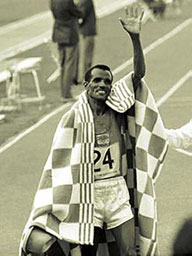

Ethiopian Olympic sprinter Mamo Wolde

Don’t take my word for it, how about the 1968 Olympic Marathon Champion, Mamo Wolde? It was 1968 at the Mexico City Olympic Games. The spectators at the marathon went wild as a relatively unknown Ethiopian, Mamo Wolde, won the marathon. Not only was the thirty-five-year-old runner the oldest man ever to win this prestigious event, he did it in record time. He also was a silver medalist in the 10,000 meters at the same Olympics.

Wolde grew up in an Ethiopian village. His life consisted of running after and hunting wild game on foot. His diet was high in animal meat and fat, with practically no carbohydrate. Subsequent tests showed that Wolde's body, under conditions of physical load, readily burned fat as its main energy source. Wolde had no concept of 'hitting the wall'. It never happened to him.

While there is little or no scientific evidence that carbohydrates are a particularly good energy food, we know that fats are. Dr. Groves explains further why the best performance is only possible with the correct diet and this applies to humans and animals. With the correct diet, constant exercise and practice to maintain muscle suppleness, strength and stamina doesn't seem to be needed either.

It is well known that carnivorous animals such as lions and tigers are fed their natural diet of fatty meat, even when confined in cages or small pens in zoos for long periods of time, without the opportunity to exercise, do not lose their vigor, strength and endurance. Such animals in circuses are even more confined but they are still able to make prodigious leaps when called upon to do so.

Eskimo sled dogs are normally kept on leashes or in small kennels during the summer months and fed fat meat and fish. When, after some months of such inactivity, the winter arrives and they are required to pull sleds again, they have no need of a period of training or conditioning before they go about their arduous task. And they still manage to pull heavy sleds for up to twelve hours a day. The same applies to English hunting dogs. They do not lose their ability to run hard for long distances when correctly fed.

The same is true of Man. The Eskimo spends most of the year in practical inactivity during the winter months. Confined to his snow-covered hut or igloo, eating meat, fish and fat, he rarely ventures outside for months at a time. But when spring arrives, he immediately begins a very strenuous life, traveling many miles to hunting grounds. He, too needs no period of conditioning after his long winter of inactivity. He also requires less sleep and is much more resistant to fatigue.

In 1895 two Norwegians, Fridtjof Nansen and Frederik Johansen, landed on an island of the Franz Joseph group. They had 'conventional' provisions to last for several weeks but, as there was abundant game in the form of walrus and polar bear, they decided to live off the land and save their provisions until the following summer. From the end of August 1895 until the spring break up of the arctic ice they got no exercise, did not wash themselves or change their clothes, yet they remained in perfect health and were able to do a full day's sledging on their first day of travel.

Rear Admiral Robert Peary also noted the ability of Arctic explorers to subsist for more than a year with no food other than pemmican twice a day. Men doing heavy work required two pounds of pemmican, which was the equivalent of six pounds of meat and a pound of fat per day.

This ability to do fantastic feats of strength and endurance was not confined to the Arctic. Native porters in Australia, eating only kangaroo meat, carried heavy loads for up to twelve hours without rest or refreshment; and Aborigines in the desert, would lope for distances of up to twenty miles, with occasional bursts of speed to catch game, on a handful of worms, bugs and insects, and kangaroo meat.

What all these people (and animals) have in common is their carbohydrate-free diet. Fat is the best fuel for an athlete, carbohydrates are the worst. It really is as simple as that.

THANKS for that well-reasoned retort to the Atlanta Journal-Constitution column touting carbohydrate consumption for runners, Charles. You know from whence you speak and I look forward to sharing our interview with everyone in July. Let's e-mail Chris Rosenbloom at dietitian@ajc.com and let her know about how high-fat, low-carb living (or in Charles' case, NO carbs!) has positively impacted your athletic performance.

Labels: , , , , , , , , , ,

Saturday, October 28, 2006

Smuckers Axes Aspartame, Switches To Splenda


Smuckers Sugar-Free Jam is now made with Splenda

I went out shopping last night to pick up a few groceries since my wife was in the mood for some raw cauliflower, broccoli and carrots with ranch dipping sauce. Mmmm, a low-carb dieter's delight for a meal since all of those veggies are EXCELLENT when you are livin' la vida low-carb. Since that is what Christine was craving, I was happy to take care of making sure my beautiful darling got what she wanted. Ain't I such a good hubby-wubby?!

I, on the other hand, also enjoyed a delicious and healthy low-carb dinner: a barbecued rotisserie chicken! Mmmm, that bad boy was off-the-chain! Oh, sorry, that means it was good in the vernacular of kids these days. Yep yep!

Anyways, as I was going up and down the aisles looking for any new products that may have come out appropriate for the low-carb lifestyle, I caught something out of the corner of my eye that was way down on the bottom shelf of the jellies and jams section. What was it that I saw? THE SPLENDA LOGO!


I look for the "Sweetened With Splenda Brand" all the time

When I bent down to pick up this glorious "new" product to see what it was featuring Splenda, imagine my surprise when I saw the product was made by Smuckers. Yep, the same Smuckers jams, jellies and preserves that have long been made with the artificial sweetener Nutrasweet or aspartame (my new name for it is nasty-tame)!

See for yourself the old packaging:


Nutrasweet pervaded the entire Smuckers line of products...until now!

Now it seems the manufacturers of Smuckers have been listening to the complaints we have been making about the questionable-for-your-health Nutrasweet even as other companies are REMOVING Splenda from their products! This is especially a BIG concern of mine in the soft drink industry where all the marketing dollars are going to support aspartame-infested products like this one while very little support has been given to superb Splenda-sweetened products such as this.

Hooray for Smuckers!!! FINALLY, somebody is listening!!!

The store I shopped at had four flavors available: Apricot Preserves, Strawberry Preserves, Seedless Blackberry Jam, and Concord Grape Jam. Each teaspoon serving size has just 50 calories and 5g carbohydrates (ZERO sugar!). They are made with REAL fruit which only add a trivial amount of natural sugars rather than the gobs of man-made sugar (aka high-fructose corn syrup) generally poured into most jams and jellies these days. These Smuckers jellies are an EXCELLENT product for diabetics and low-carbers alike to use as part of their healthy lifestyles.

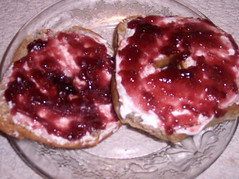
I was so excited about trying these Smuckers jams for myself, I decided to dab some on a ZERO carb cinnamon bagel available from Viva Low-Carb along with some real full-fat Philadelphia-brand cream cheese.

Holy cow, look how good this breakfast I had turned out:


A bagel with cream cheese and jelly with about 5g carbs

As gorgeous as it looked, the taste was even more phenomenal! I cut the bagel in half and toasted it in my toaster for about a minute. Then spread a layer of cream cheese and then added the Smuckers. Oh...my...goodness!!! That was an amazing experience and I was thrilled to be able to taste Smuckers jams again without all the nasty-tame in it. YEAH!

My only advice to you if you find a "Sweeted With Splenda" logo on the front of a product is to check the ingredients list on the back. If sucralose or Splenda is not the primary or only sweetener listen, then you might want to put it back. Some companies (not Smuckers, thank God!) put substances like stomach-busting sugar alcohols such as maltitol as their top sweetening agent while sucralose is near the bottom of the ingredients.

What is most sickening is how they so proudly display that Splenda logo like it means something. To me, that is nothing mroe than just false advertising and food companies should be compelled to stop deceiving the public! We should demand truth in labeling on sugar-free products so that others don't fall prey to this marketing gimmick!

The sugar-free companies STILL need a wake-up call and I'm so glad to see a leading industry name like Smuckers serving as an example for adding Splenda to their jams and jellies now. I hope they continue to extend this to their other product lines, such as the hot fudge topping, caramel topping, etc. as long as they avoid the maltitol. We will hope for the best and see.

Are there any other companies ready to axe the aspartame, too? If you are a company that has products that contain Splenda or if you run across a product that has not previously been sweetened with Splenda and would like for me to highlight it here, then please e-mail me this information. I want to share with my fellow low-carbers these excellent options for them to use while they are livin' la vida low-carb.

Labels: , , , , , , , , ,

Monday, October 23, 2006

My Almost-Not-Quite Interview With 'The Bear'


"The Bear" advocates eating less than 5g carbs daily for health

One of my regular readers sent me an e-mail today after listening to the debut episode of my new podcast show and suggested that I consider interviewing the man who calls himself "The Bear." I responded that I may do interviews once I get a few more shows under my belt, but that I would be open to having him do an interview at my blog.

You might recall that "The Bear" is the man behind the zero carb diet that our friend Rob from The Zero Carb Daily blog so strongly advocates. In fact, you could almost consider Rob the long lost stepson that "The Bear" never had considering how much he so closely emulates the nutritional ideas of this former member of The Grateful Dead.

When I got in touch with "The Bear" today, he responded to me rather quickly by basically declining my request stating he does "not have the time to waste on a 'blog' on any subject, but particularly on one which in fact would only cater to food-obsessives who want a constant stream of 'reasons' to eat the right food and 'proof' it is good for them."

Ooooookay, I can understand not wanting to agree to an interview with me if the premise of his reasoning is sound. But anyone who knows me and the nature of my blog is abundantly aware that I am willing to hear new ideas to further broaden my knowledge about what is right, especially on the subject of diet and health. I think an interview would have been quite fascinating for you to read, but "The Bear" was simply not interested.

Nevertheless, although he didn't want to be interviewed, "The Bear" did share a little bit about why he believes the way he does regarding an almost totally carniverous, nearly zero-carb diet. It's a fascinating concept to think about from a man who has lived this way for decades. See what you think of the brief remarks he made to me.

"You will find everything I have to say on my totally carnivorous WOE in my closed forum thread on lowcarber.org.

I have found that people are so socialized to eat vegetable rubbish that the number of people who can actually permanently get onto the carnivorous path is maybe one in fifty thousand or less.

Our bodies are those of carnivores. Carbs are damaging to us, both in making us fat and in causing insulin release. Our minds and the acculturation which we receive from birth overrides instinct and provide the only reason we eat anything. If you are unfortunate like virtually everyone in today's society and receive early training to eat primarily vegetation with high amounts of carbs and avoid fats, then you are unlikely to ever adapt to the proper human diet.

So, I have to tell you that I do not have the time to waste on a 'blog' on any subject, but particularly on one which in fact would only cater to food-obsessives who want a constant stream of 'reasons' to eat the right food and 'proof' it is good for them.

Trust me, I have eaten as a total carnivore for 48 years, I am nearly 72 and I still have much the same body as I did at 30. Experience is the ONLY proof. The rules of the path are so simple as to be a no-brainer.

They reduce to the following:

- Eat only food from animals
- No vegetables
- Limit liver intake
- Avoid liquid milk (except for butter and cheese)
- Eat as much fat as you like
- Don't cook your food much
- Avoid salt

And the most important one: Eat your meals as a matter of course, don't waste any time thinking about food--it is merely a way to stay alive, and must not rule your life.

By the way, for many obese people "low carb" does not work--only "zero carb" does (defined as less than 5 g/day).

Cheers

Bear


I will agree there is some truth to the dietary principles that "The Bear" espouses and I am happy to know it has helped him remain happy and healthy for most of his life. I know he doesn't care what anyone thinks of his way of eating which is why he turned down my request for an interview. So with my almost-not-quite interview with "The Bear," we have learned to each his own when it comes to the diet that's right for you. May you have many more years of health and vitality!

Labels: , , , , , , ,

Tuesday, September 26, 2006

People Who Post On Low-Carb Blog Not Necessarily Spouting Atkins Ideals

I enjoy writing posts at my blog that garner lots of feedback from my readers. It's one of the goals I set out to accomplish when I begin typing at this keyboard each and every day. An honest, open debate of ideas that is inclusive of a variety of voices and opinions from one end of the spectrum to the other is what helps us expand our cranium and discover fresh, new perspectives about what we believe.

But anything you read from people who post at my blog should never be misconstrued by anyone that I necessarily agree with it or that it jives with what most low-carbers support. In other words, what you read in the comments section of my blog may not necessarily be the ideals and concepts of the Atkins diet. I've never required it to be and never will.

Unfortunately, our vegetarian friends over at the "Disease Proof" blog (led by Dr. Joel Fuhrman--remember my review of his "Eat To Live" book?) posted a column today entitled "Will America Ever Eat Better?" where a regular poster at the "Livin' La Vida Low-Carb" blog is quoted.

In a discussion of eating a healthy diet, Gerald Pugliese from "Disease Proof" lamented that not everyone will follow Dr. Fuhrman's vegetarian diet because they don't see any value in eating vegetables.

Here's what Pugliese wrote:

"Get a load of this commenter on the low-carb blog LivinLaVidaLowCarb:

Who the hell cares about the veggies anyway? You don't need them and there is absolutely nothing essential about them. Don't let the acculturated veggie sympathizers tell you otherwise.

Pretty crazy right? Especially since even the Atkins Diet calls for the daily consumption of vegetables.


That quote from my recent blog post showing one of my weekly low-carb menus is from none other than Rob from the "Zero Carb Daily" blog. Most of my readers already know that he is on a zero-carb, carniverous diet as his way to lose weight and get healthy.

However, people who follow the Atkins diet DO eat daily amounts of vegetables, Mr. Pugliese! If you go back to that same post where Rob made his comments that you quoted and actually LOOKED at the low-carb menu I posted, then you will see something very peculiar: VEGGIES, VEGGIES, VEGGIES! Duh!

To extrapolate one blog reader's comments and interpret them as what everyone who visits and reads that blog believes about livin' la vida low-carb is irresponsible. Just as everything I write in this forum is not necessarily what some low-carbers believe, the same is so for the people who post comments.

This probably has more to do with Furhman and his team's utter disdain for the late Dr. Robert C. Atkins than it does about getting the facts right about what the Atkins diet and its followers actually follow. If you are interested, Mr. Pugliese, a survey last year found that low-carbers eat DOUBLE the amount of vegetables than before their low-carb lifestyle. Sorry to rain on your parade, but that's the cold hard truth.

As for Rob, well, he's slamming my "Omega Diet" that I am following right now claiming that he's "roughly keeping pace" with my weight loss. But what Rob conveniently forgets is that I don't have near as much weight to lose as he does right now.

When I was losing my weight back in 2004, it was coming off at about a 5-7 pound weekly average. Now that I'm much lower in weight, I SHOULDN'T be losing more than a pound or two every week. That's why I started my "30-In-30" Low-Carb Weight Loss Challenge. Even still, to date I have lost 21 pounds in two months and will continue to strive for losing another 20 pounds by the end of February.

Rob, when you lose 180 pounds, keep it off for two years, and then seek to lose another 30-40 pounds, then you can come back and talk all you want about how zero carb is helping you. Until then, your analogy of my weight loss with your weight loss efforts is simply apples and oranges, my friend. Nice try, though.

Whether I make it to my goal of 199 or not is not as important as the changes I have made in my life since I started livin' la vida low-carb almost three years ago. I gladly eat healthy carbohydrates as most low-carb followers do which includes nuts, berries and non-starchy veggies, along with meats, cheeses, and eggs. Rob has his strong opinions about these foods and that's fine with me. But the fact is you CAN lose weight and get healthy eating carbohydrates (even if they are greatly reduced from what I used to eat!). I'm living proof!

So, Mr. Pugliese, you might want to go back to your boss Dr. Fuhrman and remind him that Rob doesn't speak for all practicing low-carbers and neither do I. We are simply presenting opinions to help others make their own decisions about what to do about their weight and health.

To quote Dr. Furhman from his "Eat To Live" book:

"I do not expect the majority of individuals to live this healthfully. However, they should at least make that decision being aware of the facts rather than having their food choices shaped by inaccurate information."

That's all I want for people as well. Let THEM make the decision based on everything they learn about the healthy low-carb lifestyle whether it is for them or not. When we stop hyperbolizing what low-carb living is, then people can make wise choices for themselves. That's all I ask.

9-27-06 UPDATE: I attempted to respond to comments made by someone named Helena who posted remarks about me and my blog at the "Disease Proof" blog today and the adminstrators there have refused to post it. Are they afraid of dissenting opinions? Go ahead and try to send your own comment to see if they will post yours. That's such a shame from a web site purporting to spread information about health. That's the difference between what I do at my blog and these radical web sites like "Disease Proof."

9-28-06 UPDATE: Gerry Pugliese sent me an e-mail about my concerns today:

Hi Jimmy-

I noticed your post. There must be some kind of misunderstanding--we want your comments! As far as I have seen you have never even posted one on DiseaseProof. There are dissenting comments all the time. We have been pretty clear about our commenting policy. Every legit comment gets approved. Please try commenting and you'll see.

-Gerry Pugliese


My response to Gerry was the following:

THANKS for your note, Gerry. However, I have tried MANY times over the past year to post my comments to the "Disease Proof" web site in response to columns there and they have NEVER been published. Why? Are they ALL being blocked by a "spam filter?" That's just too convenient an answer and seems rather suspicious in my book. But, I'm willing to give you the benefit of the doubt and try to post something again in the future. THANKS again for e-mailing.

Anyone else having trouble posting comments at the "Disease Proof" blog? How about taking Gerry up on his offer to make dissenting comments. Try it NOW by clicking here.

Labels: , , , , , , , ,