Aspartame targeted for bogus study funded by parent company in Japan
Imagine for a moment that you read a news headline that proclaimed, "Study Concludes Eating French Fries Does Not Cause Obesity." Would that get your attention? Sure it would, until you kept reading and discovered that the company who paid for that study to be conducted was none other than McDonald's! Now how credible is that headline?
As off-the-wall as that example may sound, that is PRECISELY what has happened with a study on a rather controversial subject. This University of Maryland press release details the results of a study conducted by a panel of "experts" who declared the artificial sweetener aspartame is 100% absolutely safe for human consumption. Oh really?
Regular readers of my blog already know what I think about aspartame--or as I like to call it, NASTY-tame! I warned my fellow low-carbers to avoid aspartame if at all possible in my latest YouTube video because there are too many unanswered questions about this sugar substitute with some rather peculiar side effects.
Speaking from personal experience, I try to avoid NASTY-tame because it has done a doozy on my body in many ways when I consume more than just a little bit of it. I can tolerate about 1-2 diet sodas made with aspartame and that's it. Besides the disgusting flavor of aspartame (aka Equal and Nutrasweet), it also can bring on some of the most vicious headaches I have ever experienced.
Dr. Bernadene Magnuson assures us aspartame is completely safe
And this is something lead researcher Dr. Bernadene Magnuson, assistant professor of Nutrition and Food Science at the University of Maryland, acknowledged in this Reuters column about the study when she named headaches as "one possible area of concern" because "a small subset of the population" could be impacted by it.
Why do these "experts" attempt to say this side effect is somehow the exception and not the rule? Statin drug companies claim the same thing about their products causing joint pain in only a very small segment of the population when just about everyone I know who takes Lipitor, Crestor, or any of the other statins experience this. What's wrong with this picture?
Dr. Magnuson, along with various other panel members from the United States, The Netherlands, and Great Britain, examined previous research conducted on aspartame to determine whether there is validity in the claims that it leads to health concerns such as brain abnormalities and cancer, among other things. After sifting through over 500 studies dating back three decades, their conclusion was to give aspartame nothing but high marks as an approved sweetener.
“There have been continued questions in the media and on the Internet about the safety of aspartame,” Dr. Magnuson remarked. “Our study is a very comprehensive review of all of the research that’s been done on aspartame. Never before has a group with the breadth of experience of this panel looked at this question.”
But the real sticking point to this whole so-called study goes back to the point made at the beginning of this blog post: Guess who paid for this study to be done? It was none other than the Japanese manufacturer of aspartame--Ajinomoto Company Inc. who has an entire web site devoted to this "core strategic product" of theirs.
Just how credible is a study like this one? I'm not saying a study can't be objective simply because it is paid for by a company whose product stands to benefit from a positive report. But you have to admit something really screwy is going on around here when aspartame is given such flying colors by an allegedly unbiased panel.
The U.S. Food & Drug Administration (FDA) has given their seal of approval for aspartame, but my personal experiences consuming it are all that matter to me. Headaches, memory trouble, and even weight stalls have occurred whenever higher amounts of aspartame are in my body. I don't know about you, but I'd rather not even mess with these side effects which is why I stick with sweeteners like Splenda instead (even if it is more difficult to find diet sodas made with it).
You can contact Dr. Bernadene Magnuson about her study on the safety of aspartame by e-mailing her at bmagnuso@umd.edu.
In our eagerness to pump out another video in our new "Livin' La Vida Low-Carb On YouTube" series, Christine and I went a bit long with Episode 4. It's not so much that we don't want to do longer videos, but YouTube limits the length to NO MORE THAN 10 MINUTES.
I found out this little factoid the hard way last night when I was up until 2AM trying to whittle this thing down to size so we didn't have to record it over again! UGH!
We had recorded a new video yesterday afternoon on artificial sweeteners and what a low-carb dieter can do to get something sweet in their diet. It was the usual fun video and I even started off serenading Christine with my own unique rendition of "Sugar, Awww Honey Honey." Plus, at the end, we gave a BIG shout out to all the wonderful people at my new "Livin' La Vida Low-Carb Discussion" forum.
Unfortunately, the raw feed went 13 1/2 minutes long and that didn't even count the intro and outro! BOO HOO! Oh well, so I had to chop off the front and the back and leave the primary meat of the video as the totality of the content. It's just a lesson learned for future videos to keep a closer eye on the clock.
So, with that perspective in mind, now you'll understand why it seems the video abruptly begins and ends. Sorry about that, we'll do better next time. Check it out as we talk about Splenda, aspartame, xylitol, maltitol, oligofructose, and erythritol as well products that contain these sweeteners:
Yes, I know about stevia and even included several minutes of the original video talking about this all-natural supplement that's a popular sweetening agent that low-carbers use, but it was part of the chopping block. Perhaps I could do an entire video just on the subject of stevia since it is becoming more and more popular.
Leave a comment for Episode 4 and be sure to rate it and favorite it if you enjoyed what was presented. :) If not, then I'd still love to know what you thought about it.
Just in case you missed any of our previous YouTube videos, here they are:
- Promo video--A half-minute promotion of the new video series - Episode 1--Introduction of Jimmy & Christine Moore - Episode 2--What kind of fruits can you have on a low-carb diet? - Episode 3--What kind of veggies can you have on a low-carb diet?
Be sure to subscribe to our YouTube videos so you'll never miss an episode! THANK YOU so much to everyone who has supported us by watching and commenting on our videos. Please send your suggestions for future YouTube video topics to me anytime at livinlowcarbman@charter.net.
Who says you can't have chocolate cake on a low-carb diet?
Just mention to someone that you're on a low-carb diet and I'll bet the first thing that starts rolling off their tongue are all the foods you CAN'T eat. No rice, no pasta, no this, no that--yadda yadda yadda.
Let me tell you something. Livin' la vida low-carb isn't about deprivation, but rather dedication to making healthier choices that will be keeping me around for many more years than my old habits would have. It's all about living better than I ever thought possible while still enjoying some rather decadent treats along the way.
One such treat that you can have on the low-carb lifestyle is featured in a brand new video (FINALLY!) from my friend and fellow low-carb blogger Kent Altena. Kent is like a low-carb brother to me and our stories are VERY similar--we're the exact same age and height, we both love politics, we both started our low-carb journeys weighing 400+ pounds, we read and followed by the book Dr. Atkins' New Diet Revolution, we both lost around 200 pounds on low-carb, we both share about the low-carb lifestyle in our blogs, and we both currently weigh 220 pounds.
Oh, and with my recent foray into the world of YouTube, that's something else we both do now, too. However, after having a quite prolific run of excellent videos in 2006, Kent's been MIA for most of 2007 except for this cheesecake recipe back in January.
But he has a GREAT excuse. Besides working full-time and being a devoted husband and dad, Kent has also taken up marathon running since losing his weight. He's been setting some personal bests as he prepares for the BIG ONE. We're all so proud of you, Kent, and wish you well as you continue pursuing this dream. Go get 'em, buddy!
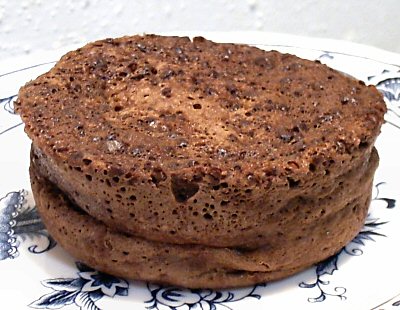
You'll hear a quick update from Kent at the end of his video today featuring that mouthwatering, flourless low-carb chocolate cake--which has become his wife's FAVORITE low-carb comfort food with a dollop or two of some Splenda-sweetened whipped topping. Mmmm mmm!
In fact, Kent says if you let this recipe cool down, then you can actually cut the cake in half to make a low-carb "Oreo" or ice cream sandwich. As I tell Christine when I eat something like this that's low-carb, "I'm suffering on my low-carb diet!" HA!
Here is the basic recipe that Kent used in his video:
3-MINUTE FLOURLESS LOW-CARB CHOCOLATE CAKE 1 TBS Butter, microwave for 10 seconds to soften 1 Egg 1 TBS Da Vinci SF Vanilla syrup 2 TBS Splenda 1 TBS heavy cream Pinch salt 2 TBS cocoa
Mix together all the ingredients until it is as smooth as possible. It should look similar to cake batter at this point. Microwave for 1 minute. For the special treat, add 1 TBS of whipped heavy cream (sweetened with Splenda).
Makes 1 serving
With granular Splenda:
267 Calories 23g Fat 9g Protein 11g Carbohydrate 4g Dietary Fiber 7g Net Carbs
You can also access several other alternate versions of this same recipe using liquid versions of Splenda, mayonnaise and other such ingredients at Linda's web site page for this outstanding recipe. If you like this recipe, then you'll be pleased to know that Linda herself is the moderator of my Recipe thread at my "Livin' La Vida Low-Carb Discussion" forum (sadly, it's been down for a few days, but I hope to have it back up and running real soon!).
In the meantime, WELCOME BACK KENT and I encourage you to keep those videos rolling, my friend. You have such a unique perspective that needs to be heard early and often. If you haven't already, then be sure to subscribe to Kent (bowulf) Altena's videos. Show him your support and THANK HIM in an e-mail for the excellent work he is doing on behalf of livin' la vida low-carb!
I get flooded with e-mails about Splenda-sweetened diet sodas
There is a lot of interest by people who are livin' la vida low-carb to find a diet soda that is sweetened with sucralose, commonly known as Splenda, instead of aspartame, aka Nutrasweet. Unfortunately, the options are few and far between and are getting smaller by the minute.
One of my readers wrote to me recently about how Diet 7-Up has changed from Splenda back to aspartame without even telling anyone. This happened about six months ago, but some people are only just now noticing the change.
Here's what she wrote in the e-mail:
My Mom and I are both diabetics and we bought some Diet 7-Up to drink knowing that it has Splenda, which is safe for us, instead of aspartame. There was nothing on the bottle about the change except in the ingredients label.
My poor Mother was in bad shape for an entire day because of the violent sudden diarrhea that aspartame causes in both of us. If you could warn your readers about this, I am sure many people would be thankful.
In my diabetic class, over 90% of us have some type of reaction to aspartame ranging from stomach problems to migraines. None of us ever had any problems from Splenda.
Because of this e-mail, I thought it would be best to share a list of the Splenda-sweetened diet sodas currently available on the market. It is certainly slim pickins, but well worth looking for when you want a diet soda.
Keep in mind these Splenda-sweetened sodas are mixed with another sweetener called acesulfame potassium, aka ACE-K, to enhance the sweetness:
SPLENDA-SWEETENED DIET SODAS WITH NO CAFFEINE Diet Rite, all flavors (12-packs, 2-liter bottles, 20 oz bottles) Diet Cheerwine (12-packs, 2-liter bottles, 20 oz bottles) Waist Watcher (12-packs, 2-liter bottles, 20 oz bottles)
You can also find many store brands that are sweetened with Splenda and ACE-K, but most of them have caffeine in them. Just read the labels carefully to avoid the ones with aspartame.
It will be difficult, but try not to buy into the highly-marketed, hyped-up diet sodas like the new energy cola Diet Pepsi Max and even Diet Pepsi Jazz or the vitamin-infused Diet Coke Plus and the ever-growing line of Coke Zero products just because they taste good with the ACE-K blend. They all contain NASTY-tame (that's my word for aspartame!) and should be absolutely avoided since there are just too many good alternatives available with very real questions about aspartame's safety still left unanswered.
Coke is currently going through the process of getting FDA approval for their name for stevia--rebiana--but The Coca-Cola Company has some corporate muscle to strongarm them into acceptance. If and when this comes out, it will become my new favorite diet soda. I'm assuming this one will also be an ACE-K blend.
The diet soda market is currently dominated by NASTY-tame offerings, but hopefully that will soon begin to change. If it's a cost issue, then I know I wouldn't mind paying a little more to get Splenda in Diet Cherry Coke or Diet Mountain Dew. I'd even like to taste Splenda in Diet Barq's root beer sometime.
Why not offer a few more choices?
For low-carbers like me who love drinking diet soda, that's all we're asking for. How about it soda manufacturers?
Sugar-Free Mentos snags another victim of dubious side effects
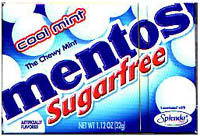
There oughta be a big bold WARNING label placed on any sugar-free product that purports to be "sweetened with Splenda" if sucralose is not the top sweetener. You know what I'm talking about--while the Splenda logo appears prominently on the front of the packaging of many low-carb, sugar-free products, the truth is there's something else making that product sweet.
That something else is sugar alcohols usually, most notably and notoriously the one called maltitol. Just as sugar-free doesn't mean the product is necessarily low-carb, neither does having the Splenda emblem on the packaging mean it is the primary sweetener. In fact, many times it comes in dead last in the ingredients.
If this is happening, then why does maltitol show up as the #1 ingredient, hmmm? Sounds like a bait and switch scam to me! I've warned about the negative impact this sugar alcohol can have on your stomach many times and even had this humorous story from a reader named Fred Scuttle who found out the hard way what the sugar alcohol maltitol can do to you.
Now I've got another horror story to share with you from Sarah who thought she would get away with downing some Sugar-Free Mentos without a hitch. HA!
Here's what happened to her:
My experience with maltitol happened just today at my restaurant job.
I bought some Sugar-Free Mentos just the other day and was relieved to see the Splenda emblem proudly displayed on the package...I have had problems with other artificial sweeteners, so I thought I was safe.
Wrong!
So, while I was busy serving food on a busy lunch shift, I snacked on the box of candy. Mind you, this was a small package---maybe 15 pieces or so.
Well, an hour into my shift, my stomach started to do that dreaded gurgle and roll and I knew immediately I was in trouble.
I literally had to run to the bathroom, lest I "sharted" in my pants. It was totally awful. It felt disgusting having explosive diarrhea while serving food to customers and the gas and bloating were so terrible I had to go to the bathroom to undo my pants.
Upon closer inspection of the box, in all capital letters I noticed (too late), this disclaimer: EXCESSIVE CONSUMPTION MAY CAUSE A LAXATIVE EFFECT!
That's nice. Glad to know that candy now has the ability to make me shit my pants."
Some lessons can only be learned through experience. This will certainly make Sarah read food labels carefully from now on, don't ya think?
By the way, that's the first and last time you'll ever see the word "sharted" at my blog. TMI and EWWWW!
Did you know Diet Coke in Japan is sweetened with the plant-based stevia?
About a year ago I blogged about the controversial all-natural sugar alternative called stevia. At the time, I lamented that stevia was not approved by the Food and Drug Adminstration (FDA) to even be called a sweetener...yet! But that may be about to change if a joint venture with The Coca-Cola Company and a major food additive business has anything to say about it (and you KNOW they will because money talks!).
This USA Today story notes that Coke as well as Cargill Foods have decided to take a serious look at a sweetener they want to call rebiana (a shortened word used for Stevia Rebaudiana). Remember that name they have come up with because it's the term these companies are going to be using for stevia soon and it's been three years in the making.
For people who are livin' la vida low-carb and choose to avoid the use of the chemical-based sweeteners that dominate the marketplace, such as saccharin (Sweet 'N Low), aspartame (Nutrasweet, Equal), and sucralose (Splenda), many of us have been using stevia instead because it contains ZERO calories and carbohydrates. That's certainly impressive nutritional info for a natural alternative to sugar.
But it's gonna be a bit of an uphill battle to get stevia approved since the FDA has come down so strongly AGAINST approving it while this list of sugar alternatives get a free pass--all of which are made from chemicals. But there are still a lot of people who have concerns over the safety of these products (and I get e-mails from people ALL THE TIME about my support for Splenda--get over it already people. That stuff helped me overcome morbid obesity, so leave it be!).
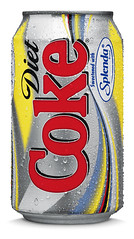
As a result, that's the allure of having commercial acceptance of stevia in a popular product like Diet Coke. With crazy new product concepts like the vitamin-infused Diet Coke Plus (made with aspartame), the "calorie-burning" Enviga (also sweetened with aspartame and a touch of ACE-K), and their marketing darling of the moment Coke Zero (yep, you guessed it, sweetened with aspartame and ACE-K), this idea of making a Diet Coke with Stevia is the best thing they've come up with since my favorite sugar-free soda Diet Coke with Splenda was released to the market (although they've never given it the proper marketing IMHO!).
Interestingly, stevia IS already being used in Diet Coke--in Japan, where stevia boasts a robust 40% of the sweetener market, as well as in Brazil, China, and nine other industrialized countries. So what's taking America so long to get going with this in this country already? The FDA needs to get its head out of their backside and approve stevia as a sweetener.
Are they afraid of the competition it will give that disgusting NASTY-tame? If so, then GOOD! They should be because it's high time people have other alternatives. I'm tired of seeing Nutrasweet in EVERYTHING sugar-free/low-carb I would want to purchase. Put Splenda or stevia in some of these products already! There's a bunch of us who don't like aspartame at all!
Currently, the Coca-Cola Company has been seriously looking at this since 2004 and last week filed a total of 24 patents to begin removing the sweetest parts of stevia so they can come up with the perfect taste and blend of rebiana to be used in their future versions of Diet Coke.
It's not yet known if this new sweetener will eventually be phased in to replaced aspartame or if it will be mixed with ACE-K or other sweeteners in totally different products altogether. But clearly Coke is ready to put stevia on the fast-track to FDA approval.
As for Cargill Foods, they intend to use this stevia-based sweetener in foods like yogurt, cereal, ice cream, and other sugar-free sweet treats. This is expected to be a huge undertaking that could quite literally shake up the food and beverage industry unlike anything that has come along in the past few decades. This is long overdue in America and I can't wait to see it come.
A Cargill representative said this was a "significant investment," so don't expect them to take no for an answer from self-serving interest groups who will oppose the use of stevia in this manner to cover their bedonkadonks with the artificial sweetener companies. That's why Cargill has already begun the process of petitioning the FDA to use stevia as a food additive. It's gonna be difficult, but I'm confident they'll get approval. Stay tuned!
Although Coke is saying the stevia they have tested in several of their products has performed just as well as the aspartame and sucralose for sweetness, I'm not as convinced about it. Sure, stevia is an excellent product and I have used it myself in various forms, but the black licorice-like bitterness can be a real turn-off to some people. The blend will have to be perfect.
I'm sure if stevia finally does make it into a Diet Coke product in the next few years that they'll make it taste as sweet as possible by very likely using an ACE-K blend. It'll probably resemble the aspartame/ACE-K blends that dominate the Coca-Cola line of sugar-free products today. This will be a HUGE step in the right direction for the world's #1 beverage maker (although I wouldn't mind having more Splenda-sweetened options, too--HINT HINT!).
If rebiana becomes a household name thanks to Coke and Cargill Foods, then you can expect PepsiCo, Dannon, and other rivals in the sugar-free/low-carb market to develop their own versions of stevia-sweetened products--perhaps they'll be allowed to actually call it stevia. Actually, if they're smart, then they'll start working on this NOW!
I've long held that having an "all-natural" sweetener like stevia is already on the cutting edge and it's only a matter of time before it is as widely used in the United States just as it is in Japan today. It's not a matter of if, but when. I can't wait to try a Rebiana Coke with a green stevia leaf on the can as a logo to distinguish it from the other versions. This will be the most unique diet soda product to ever release!
Get ready for the brand new Diet Coke Plus coming in April 2007
The "healthy diet soda" wars continue on with the upcoming release of the brand new Diet Coke Plus™ coming to a store shelf near you in April. With nationwide distribution set for next month, The Coca-Cola Company is excited to provide their very first calorie-free, carbohydrate-free soda product that has been infused with vitamins and minerals.
According to the nutritional label, Diet Coke Plus includes 25% of the recommended daily allowance of niacin (vitamin B3), vitamin B6, and vitamin B12 as well as 15% of the RDA for magnesium and zinc in each 12-ounce serving. It is sweetened with an aspartame/ACE-K blend that has become the industry norm for just about every diet drink nowadays.
Attempting to get a leg up on their primary competition--Pepsi-Cola North America--as that company is set to release their own diet "energy" drink called Diet Pepsi MAX in June 2007, Coca-Cola North America is seeking to provide their loyal consumer base with a diet soda product that will serve as a supplement to their healthy diet, according to Coke's senior VP Katie Bayne.
“Consumers, including Diet Coke drinkers, are increasingly looking for more beverage options, and we wanted to offer them the convenience of a calorie-free beverage that is a good source of several essential vitamins and minerals, and one that delivers on the great taste that they have come to expect from us,” she said.
This is the second such "energy" drink that will be released in 2007 by the #1 beverage company in the world. In January 2007, the Coca-Cola Company in conjunction with Nestle launched Enviga, aka "The Calorie Burner," under a cloud of controversy from some who believe the product is misleading to consumers. But many people have been curious about the product likely BECAUSE of the criticism which is why Enviga spokesman Ray Crockett reports in this news story that it is "doing very well."
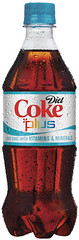
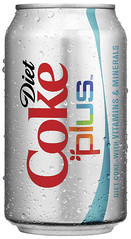
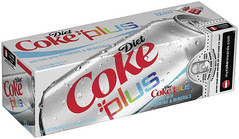
I was lucky enough to be one of the first people to try the new Diet Coke Plus today when the media press kit arrived at my door this morning. The packaging for this product is top-notch as we have come to expect from the folks at Coke. It's includes the famliar Diet Coke logo along with a multi-colored "Plus" with the wording "Diet Coke with vitamins & minerals" listed on the product.
Here's the packaging for the 20-ounce bottle, 12-ounce can, and 12-pack:
I really didn't know what to expect when I went to taste this new Diet Coke Plus. I just assumed it would taste like all the other new aspartame/ACE-K drinks that have come out over the past year or so including Diet Pepsi Jazz and Coke Zero. Boy was I wrong!
When I took my first swig from the 20-ounce bottle, I noticed a somewhat recognizable (but not in a good way!) taste I hadn't had in my mouth in a while--REGULAR Diet Coke! EWWWW! I'm so used to drinking my FAVORITE Diet Coke product--that would be Diet Coke with Splenda--that this Diet Coke Plus was not nearly as sweet as I have grown accustomed to.
Nevertheless, after that initial shock to my tastebuds, I put it back in the fridge for a few hours and tried it again to discover that although it wasn't nearly as sweet as say Coke Zero or Diet Coke with Splenda, it is certainly a little bit sweeter than a regular Diet Coke. I'd have to say that the creators of this new drink have hit a pretty happy medium between the aspartame-only and the aspartame/ACE-K blend versions that fans of both should enjoy Diet Coke Plus.
Even still, whenever a new version of Diet Coke comes out the diehard lovers of the original version worry that their beloved drink is changing formulas. Not to worry, loyal fans of regular Diet Coke who do not want the ACE-K! The Coca-Cola Company learned their lesson about messing with a formulation (remember New Coke from the 1980s?), so you can rest assured your favorite diet soda is not gonna change one bit.
“The millions of current Diet Coke devotees across America shouldn’t be concerned – America’s #1 diet sparkling beverage is staying just as it is,” Bayne added.
Diet Coke Plus is the next in an ever-growing line of Diet Coke products on the market today, including original Diet Coke, Caffeine Free Diet Coke, Diet Coke with Lime, Diet Cherry Coke, and Diet Coke with Splenda (which I'll explain in a moment why it is still hanging around despite the fact it was supposed to be discontinued in 2006).
You will begin seeing advertising for Diet Coke Plus in the near future with the slogan "Great Taste Has Its Benefits." They want to push the fact that this Diet Coke product has several essential vitamins and minerals while giving people the familiar taste of Diet Coke they have grown accustomed to. It's an intriguing concept that will certainly capture the attention of a public looking to live healthier. We'll have to wait and see if that can translate into positive sales numbers.
Personally, I like the idea of having a vitamin-infused diet soda. Heck, if you're gonna drink diet soda (and I AM!), then why wouldn't you want to add some vitamins and minerals to the mix to make it even better? Drinking just four 12-ounce cans of Diet Coke Plus daily will provide you with 100% of the RDA of vitamin B in your diet. Now that's just cool!
I had the opportunity to speak briefly with Coca-Cola North America spokeswoman Susan McDermott today about a few concerns from the low-carb community regarding her company. On the issue of aspartame use, she said they have conducted field marketing tests and the aspartame/ACE-K blend has been preferred by consumers as well as universally accepted across the industry as the blend for sweetening diet drinks. Fair enough.
When I stated that many of my readers would prefer a Splenda/ACE-K blend instead, McDermott insisted that aspartame is the most tested artificial sweetener in history and has been found to be completely safe by the Food & Drug Administration. While I acknowledged her point, I did express that my readers would like to have some more Splenda-sweetened options available as well. She said there are no new Diet Coke products in the works for the rest of 2007, but to not give up hope for the products you desire in the future. I guess we'll just have to be patient for now. :)
Speaking of Splenda, I asked McDermott specifically about Diet Coke with Splenda and what the availability of this product was like in 2007 since it was set to be discontinued last year. She said the product tends to sell great in certain regions and not at all in others, but it is still available for purchase. With so many different Coke products available today, local stores will only stock what they think they can sell. So if you want it and it isn't available in your area, then let the manager of your favorite grocery or retail store know. I was assured it IS available!
I'm so glad they took the feedback from so many of my readers last year after all and decided to keep Diet Coke with Splenda around for a little while longer just for us. Awww, wasn't that just so nice of them? :) Now if we can only get them to make Diet Cherry Coke with Splenda (and maybe caffeine-free), I'll be one happy camper!
Feel free to send your comments and feedback to The Coca-Cola Company regarding what you think about their product line by clicking here.
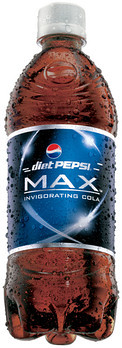
The "invigorating" Diet Pepsi MAX drink arrives June 2007
In what is an obvious response to The Coca-Cola Company's hip and hot new low-carb energy drink product called Enviga, Pepsi-Cola North America today announced the creation of a brand new low-carb energy drink of their own called Diet Pepsi MAX.
There is very limited information available about this new Pepsi product releasing nationwide in June, but we do know it has zero calories and is fortified with extra caffeine and a little bit of ginseng to help "adults to get through the day." Pepsi has high hopes that this product will compete directly with Enviga and other similar energy drinks that have dominated the beverage market in recent years.
Nicknamed the "invigorating cola," Diet Pepsi MAX, which has done very well in test marketing with real consumers, is a product aimed at the 25-34 year-old demographic as well as anyone who is transitioning from sugary soda to diet soda. Even before I saw what it was sweetened with, I already knew Pepsi would be using a version of the ACE-K blends that have become popular with their current product line, including Pepsi One (made with Splenda) and the brand new Diet Pepsi Jazz (which has aspartame in it).
Rather than continue expanding their Splenda product line, Pepsi has stuck with their tried and true aspartame/ACE-K blend that has become the mainstay of products like the overhyped Coke Zero (which recently expanded their line to include Cherry Coke Zero as well). This is too bad since many low-carbers would prefer a Splenda/ACE-K blend instead, but the soda companies just haven't gotten that message clearly enough yet. Will they ever realize we don't like aspartame?!
Ever since I ended my recent diet soda embargo, I have been looking for more variety in my choices and Diet Pepsi MAX may provide that. But the jury is still out on it right now.
I contacted the corporate office for Pepsi today and left a message with someone there about conducting a taste test and blogging about it. I'll blog about it if I get the opportunity to try this product before June. Otherwise, I'll do a review as soon as it comes out in June.
One of the reasons Pepsi decided to make this new product at this time (aside from the heavy marketing presence of Coke's Enviga everywhere) is in direct response to a survey they conducted that found 8 in 10 people say they have trouble maintaining their energy during the day and 6 in 10 feel they can't get everything done that they need to get done in their daily activities.
Diet Pepsi MAX is being set up to meet the demands of that market of consumers with a delicious, calorie-free diet soda. Pepsi marketing spokesperson Cie Nicholson believes this is the right product at the right time for busy Americans.
"Adults have told us that they're constantly looking for the right balance to get them through their day and Diet Pepsi MAX is uniquely formulated to give the mind and body a boost," Nicholson contended.
You will see Diet Pepsi MAX coming in 20-ounce bottles, two-liter bottles and 12-packs of 12-ounce cans. This is a widespread product release that Pepsi is banking on being a viable product as will be evidenced by some pretty heavy-duty marketing and advertising when it comes out. Diet Pepsi MAX becomes the 13th cola product under the Pepsi name.
Stay tuned soon hopefully for my review of Diet Pepsi MAX if I hear back from them about the taste test. What do you think about the concept of a higher caffeine, ginseng-infused diet soda?
There are plenty of subjects that are considered controversial within the realm of livin' la vida low-carb. From the amount of carbs consumed to the use of artificial sweeteners, we as a community have a uniquely sadistic way of recklessly sabotaging what is by all intents and purposes the best nutritional approach known to mankind. I suppose there are some who just get bored with a plan that works.
That may explain why there are some who are so vehemently opposed to drinking diet soda while on a low-carb diet. I've never really understood this dynamic at all and simply kept smiling while the pounds melted off of me in 2004. As a former Coca-Cola addict which ballooned me up to 410 pounds, I knew I needed an alternative when I started the Atkins diet.
What I did was switch from regular Coke to diet sodas--primarily Diet Rite, Diet Coke with Splenda, Cheerwine, and Pepsi One. This was a monumental step for somebody like me who used to guzzle sugary sodas like they were nothing and NEVER drinking water.
But when I switched from regular to diet soda overnight, I also started drinking water, water, and more water. While I was losing weight, it wasn't uncommon for me to get down two gallons of H2O daily along with my diet sodas. Yes, I'm one thirsty man, but I am thoroughly convinced this was an instrumental part of my success.
Soon thereafter, I become a BIG FAN of diet sodas and have never experienced any adverse effects on my weight and health as a result of drinking them. There has been nothing but positive benefits to diet soda from the day I started drinking them on my low-carb lifestyle.
But after about a month of going cold turkey on diet sodas, I couldn't take it anymore. Snacking more, gaining a few pounds, and missing this calorie-free part of my low-carb life, I decided to end my self-imposed diet soda embargo recently and couldn't be happier about my decision.
After blogging about my experience with diet soda, I was pleasantly surprised by the outpouring of feedback I received from so many of my readers about this subject. It was heartening to learn so many of you find diet soda to be an integral part of your low-carb weight management plans as well. It certainly seems diet soda gets the low-carb thumbs up from many of you.
Here are just a few snippets from the e-mails I received:
"Diet sodas are a great treat. I miss the fizzy when I can't get it but I am trying to be a role model for the kids and only have it in the weekends."
"Well, you know that I'm FOR diet soda being that my blog is entitled, I Love Diet Soda. I read about that study that says diet soda makes you gain weight and that's complete rubbish. How can something with no calories make you gain weight? Impossible I say! I drink diet soda because I love its taste and the fact that I can sip on it all day without worrying about excess calories."
"I read your article and totally agree. I don't understand how drinking diet sodas could contribute to a weight gain problem as many articles seem to be saying. Unless people believe that drinking diet sodas allows them to eat more as a substitute for the sugar they are avoiding, I don't see how they can be a negative. If one drinks a certain amount of soda, daily anyway, diet soda can only reduce the overall calories if nothing else is added."
"My triglycerides were extremely high and the doctor put me on medication for this which I didn't like. Every time I stopped the medication, triglycerides would go back up. I decided to try drinking diet sodas only instead of the sugary ones I was drinking. To my surprise and my doctor's, my triglycerides dropped to the normal range without medication. I have stuck with diet sodas ever since."
"I read your article on diet soda and loved it! I have kept off a 70 lb weight-loss of over 5 years and have tried quiting diet soda cold turkey. I have to be honest,I was miserable! I hated not having something sweet to look forward to. Of course I get plenty of flack from some family members that comment about the amount of chemicals, etc. I am consuming, but like you said what is the alternative? I really just wanted to say thumbs up and I'm glad I'm not alone."
WOW, what a response that article received in both my e-mail as well as the whopping 24 comments to my blog post about diet soda. Anyone else have a thought about the subject of diet soda they would like to share? Especially if you are adamantly AGAINST them being a part of a healthy low-carb lifestyle, please share WHY with any evidence to back up what you are saying.
Until I am convinced otherwise, diet soda is here to STAY in my diet.
On my 35th birthday on December 27, 2006, I made the fateful decision to stop drinking diet sodas for good. Why? Because I wanted to and felt at the time that it was a logical progression in my weight and health management routine.
I've always said losing weight was priority #1 and I have kept the weight off long enough now that I'm evaluating areas of my diet and fitness that can be examined to continue improving upon my lifestyle. It's a good lesson for anyone who is livin' la vida low-carb to take things incrementally rather than trying to change everything is one swell foop!
That is what led me to look at my diet soda intake seriously and make some appropriate changes in my consumption habits. Although I was not experiencing any apparent negative consequences to my weight or health from drinking these calorie-free bubbly drinks, I thought I would give it a go in 2007 to ditch them for good.
Or at least that was my goal.
I actually listed "stop drinking diet sodas" as one of my very few New Year's resolutions to start the year. Unfortunately, though, since I was not seeing or feeling any benefit from being off of diet sodas completely for over a month, I was extremely disappointed. In fact, my weight didn't get better, but worse--climbing back up to 229 pounds again! EEEK!
So, I decided last week with the blessing of my wife Christine to end my self-imposed diet soda embargo and started drinking diet sodas again. Christine commented that she thought it was probably a good idea since they seemed to help me more than hurt. As of today, I have been drinking my sugar-free, Splenda/ACE-K sweetened fizzy drinks (like my favorite Diet Rite brand!) again and couldn't be happier.
In fact, guess what else?! In the week since I started drinking diet sodas, I have already lost 5 1/2 pounds and feel so much better than I did when I wasn't drinking them. And whether anyone else wants to admit it or not, that's what matters. Nobody is going to tell me what's good for me but me. Say it with me now, "That's just the way it is!" :D
Yeah, yeah, I can hear a small minority of dieting purists telling me how "empty" and "unhealthy" drinking diet sodas will be for me, but I just don't care about that opinion because it doesn't hold true for me. The bottom line is they provide me with intangible benefits that keep my weight and health on the straight and narrow. Nobody can convince me otherwise, which is why I'll keep drinking them from now on.
If somebody doesn't like that, then nothing is standing in their way of cutting out diet sodas from their life. But don't criticize my decision to keep drinking them when it's obvious they have been an integral part of my low-carb weight loss success and continuing maintenance. There's no doubt about it!
The truth of the matter is that there is absolutely NOTHING wrong with drinking diet soda as part of your healthy low-carb lifestyle as long as you stick with the ones sweetened with Splenda/ACE-K, including Diet Rite, Diet Coke with Splenda, Diet Cheerwine, and Pepsi One, among others. I'll still avoid aspartame-infested diet drinks like Diet Coke, Diet Pepsi, Coke Zero, etc. because I am not very fond of Nutrasweet for health reasons. I'll just leave it at that for now!
You may have heard about this study claiming diet soda makes you fat, but I've never heard anything more absurd! During my 180-pound weight loss in 2004, I drank LOTS of diet soda along with my regular water consumption and I have kept on drinking these diet sodas for most part over the past couple of years.
They didn't make me fat, but kept me sane while I transitioned off of regular soda to diet soda. Sure, I will admit I need to discipline myself to limit my number of diet sodas to a reasonable daily number--say 3-4 instead of the 8-10 I was drinking. But that's still better than the 16-20 sugary sodas I USED to drink before my low-carb lifestyle.
It's all about choices and I'm making better ones now. Rather than cut them out completely, I will gladly continue drinking my diet sodas if they are instrumental in keeping me a weight loss success for the rest of my life. That's where I am now and I couldn't be more pleased.
Do you have any comments or reaction to my decision? I'd love to hear what you have to say. Hit me with your best shot if you think I'm crazy for drinking diet sodas again. Or if you are like me and have found success using these calorie-free drinks as part of your healthy low-carb lifestyle, then share your story, too.
Click on the comment link and let us know what you think!
This supposedly healthy supplement wallops you with excess sugar
I enjoy participating in product surveys and personal evaluations of the latest products because I feel like it gives me the ability in some small way to influence what actually comes to the marketplace. While I am the first to admit that I'm not your "normal" person when it comes to evaluating most food and health products because I am livin' la vida low-carb, it most certainly gives me great pleasure to represent those of us who are attempting to live a healthier lifestyle.
Recently I was asked a series of questions about whether I took vitamin supplements or not. HA! Ya think! Of course, as many of you know I take a big handful of pills daily (no prescription drugs, mind you, just supplements!) ranging from a multivitamin to calcium, Co-Q 10 to fiber, fish oil tablets to chromium picolinate and much more!
Yes, I LOVE my supplements and wouldn't think of living another day of life without them. Even if they're as useless to me as a placebo, the fact of the matter is they make ME feel better about my health. And that's all that matters.
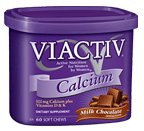
When the survey company realized I qualified for their survey about supplementation, they asked me if I would be interested in giving them feedback about a specific product that they would mail for me to try--VIACTIV! Was this some kind of joke? I had never thought much about this particular supplement because it has a slogan that states "Active Nutrition for Women by Women."
Ooooookay, since I'm not a woman, why would I take this supplement? Perhaps that was the purpose of having a male survey participant taking this product to see if they can branch off into the other half of the market to increase their portion of the revenue pie so to speak. Fair enough and I was happy to give them my HONEST feedback. They ALWAYS get that!
So the package arrives in the mail this week and they ask me to stop taking any multivitamins, Vitamin K, Vitamin D, and Calcium supplements immediately and replace it with up to 3 of the Viactiv Calcium Milk Chocolate Soft Chews daily instead. The allure of this product is that you can enjoy a delicious way to get your calcium without the "big chalky pills" that are generally associated with calcium supplements.
There's no doubt in my mind that getting adequate amounts of calcium is important for anyone and everyone living a healthy lifestyle. Some people can get enough of it in their diet, but others of us choose to bump that level up with calcium carbonate supplements. So why not do it using a tasty chocolate soft chew, right? Sounds logical enough.
Well, there was just one problem with the Viactiv: the list of ingredients! As I do with ANYTHING I put inside my mouth these days, I turned to the nutritional label on this "healthy supplement" product to see what I would be ingesting. I immediately got completely bug-eyed at what I saw and decided right then and there that there was no way on God's green Earth I would be taking these Viactiv chews for my calcium intake.
Why? Read my response to the survey people today:
"The first ingredient is corn syrup.
The second ingredient is high-fructose corn syrup.
The fourth ingredient is sugar.
Three out of the first four ingredients are what I consider poison for my body. I am not diabetic, but I am on a healthy lifestyle change where I avoid sugar and corn syrup to keep my body weight low and my blood sugar regulated."
That's right, this health supplement is LOADED with sugar, corn syrup and high-fructose corn syrup! EEEEK! Why don't they just tell people to grind up their calcium pills and melt them in the microwave on top of a Snickers bar instead?! It would be just as healthy for them as these soft chews and they'd still get their calcium by golly. Sheeez!
You know, these are the kind of products that make me just wanna hurl when I see them because they fool people into thinking they are doing something GOOD for their bodies because after all "it has calcium in it so you are helping your bones" or they market it as "for those people who care about their health." GAG ME! When the product has as much sugar in it as Viactiv Calcium Milk Chocolate Soft Chews do, then it is anything BUT healthy in my book.
Being the helpful person that I am, I suggested to the survey people that the makers of Viactiv need to consider an alternative to their product that DOESN'T contain sugar. Hmmm, that's a thought!
"Perhaps Viactiv would consider making a sugar-free version of their soft chew vitamins made with sucralose, acesulfame potassium, erithyritol, and/or oligofructose instead of sugar and corn syrup. Just avoid using the sugar alcohol maltitol because it can cause an unpleasant laxative effect.
I'm sorry I could not participate in the survey, but the thought of eating all that sugar was quite repulsive to me. Come up with a sugar-free version and I'm ALL OVER IT! :) THANKS!"
Wanna know what's ironic about all of this? Guess who the parent company for Viactiv is? It's McNeil Nutritionals! Does that company ring a bell with anyone? Come on, think hard. Okay, I'll let you off the hook because you won't believe this when I tell you.
McNeil Nutritionals is the same company that makes, markets, and manufactures the most famous artificial sweetener available today--can you believe it's SPLENDA?! Isn't this so ironic that the same company behind Splenda feels the need to load up their "healthy" vitamin supplement product with sugar, corn syrup, and high-fructose corn syrup?! UGH! What's wrong with this picture?!
Get a clue, McNeil Nutritionals! Start making Viactiv with a Splenda/ACE-K blend and I betcha it'll taste just as good. But even better than that is it will be much healthier for people who are livin' la vida low-carb and diabetic, too!
Don't you wonder sometimes whether these big companies think at all?
Why don't we express our concerns and make our suggestions about Viactiv directly to McNeil Nutritionals by using their contact page. Let them hear from YOU! :)
Why have Splenda in some products, aspartame in others?
I have been so thrilled to see the reemergence of Splenda showing up in a lot of products this year that used to contain aspartame in them. From Smuckers jelly to Mt. Olive pickles, it looks like the food manufacturers are FINALLY listening to the concerns of low-carbers and others who don't want aspartame in their diet at all anymore. Yet, it's almost impossible to avoid it nowadays.
For example, last night my throat started feeling a little sore and dry, so I knew a cold was coming on. I bought some sugar-free Robitussen when it was on sale a few months ago and didn't read the labels. Guess what the #1 ingredient in it is? It's ASPARTAME! UGH! Oh well, this is the only exception I'll make to my aspartame-free diet plan because I want to feel better from my cold and Robitussen usually does the trick.
While the move from Nutrasweet to Splenda has been slow, it is happening. But have you seen what Kraft Foods is doing with their Crystal Light products? One of my readers wrote to me so excited about discovering that Crystal Light now has a Splenda/acesulfame potassium (ACE-K) blend to sweeten their products and proudly displays the Splenda logo on their packaging. I was not aware of this, so I did a little investigating today and found something rather odd.
It is true that the ready-to-drink Crystal Light products do have Splenda and ACE-K in them, but the powdered versions of Crystal Light still contains aspartame. HUH?! What's up with that? If you are going to use Splenda in the ones that are already mixed, then why not use Splenda in the ones you mix yourself, hmm?
For the record, here are the ingredients in the ready-to-drink raspberry ice flavor of Crystal Light:
Ingredients: WATER, CONTAINS LESS THAN 2% OF NATURAL AND ARTIFICIAL FLAVOR, CITRIC ACID, MALIC ACID, SUCRALOSE AND ACESULFAME POTASSIUM (SWEETENERS), RED 40, SODIUM BENZOATE, POTASSIUM SORBATE, AND CALCIUM DISODIUM EDTA (PRESERVATIVES).
Now, here's that same flavor in the powder mix version:
Ingredients: MALTODEXTRIN (FROM CORN), CITRIC AND MALIC ACIDS (PROVIDES TARTNESS), RASPBERRY JUICE SOLIDS, ASPARTAME (SWEETENER), RED 40, CONTAINS LESS THAN 2% OF NATURAL AND ARTIFICIAL FLAVOR, CALCIUM PHOSPHATE (PREVENTS CAKING), ACESULFAME POTASSIUM (SWEETENER), BLUE 1.
Nevermind the fact that the powder mix has the corn-based maltodextrin in it (see, Michael Pollan was right about corn being in EVERYTHING!), there is a bunch of aspartame in this stuff. I don't know about you, but I don't want all of that in my body because it can bring on headaches and stall your weight loss. BAD NEWS INDEED!
According to the Crystal Light page at KraftFoods.com, the aspartame powder mix has a short storage life once it is prepared by the consumer since it has to remain refrigerated to prevent spoilage.
"For freshest taste, beverages containing Aspartame sweetener should always be consumed within 5 days of preparing."
Ah, so therein lies the problem with putting aspartame in the ready-to-drink versions of Crystal Light. It won't last very long before going bad. That's why sucralose (Splenda) is used instead because the shelf life is longer without compromising the taste and quality of the end product.
So my question is this: Why not put Splenda in ALL of the Crystal Light products? What is the purpose of having aspartame as the sweetener in the powder mix and Splenda as the sweetener in the ready-to-drink products? It looks like we have a case of sweetener schizophrenia going on here, Kraft!
If you want to endear yourself to the discriminating sugar-free consumer who prefers to avoid aspartame in favor of Splenda, then why not change your sweetener to Splenda across the board? Doesn't that just make good business sense anyway without confusing your customer base? Consistency and honesty go a long way towards building a good rapport with customers, especially those who are concerned about their health.
My reader who saw the Splenda logo on a ready-to-drink Crystal Light product automatically assumed that Splenda was now in all of the Crystal Light products now. How many people like him will be surprised to see aspartame STILL in the powder mix? That can't be good for public relations, would it Kraft?
Let me tell you, for fans of juice Crystal Light is the bomb! These ready-to-drink products come in lemonade, raspberry ice, lemon tea, strawberry kiwi, peach iced tea, sunrise classic orange, and ruby red grapefruit. Just be aware that the Splenda is NOT in the powder mixes...yet! Perhaps they'll read this and hear from YOU and decide the time has come to take the plunge and go all-Splenda! We can hope, can't we?
Use this Contact Us page to provide Kraft with your feedback about putting Splenda in the Crystal Light powder mix, too. We might just convince them it's a good idea, so make your voice heard today! And let me know if you see Splenda pop up in any other products that used to contain Nutrasweet.
Look for the blue label on Mt. Olive pickles for the Splenda logo
I'm beebopping through the grocery store looking up and down the aisles for something new to add to my low-carb menu options and looky what I was able to find: LOW-CARB PICKLES! Granted, regular dill pickles aren't overly loaded with sugar anyway, but sweet pickles and bread & butter pickles have more sugar than I'm comfortable eating.
That's why I was glad to find the major pickle manufacturer Mt. Olive has created a whole line of their outstanding pickle products with no added sugars and they replaced the sugar with Splenda. WHOA, that's awesome! Just like Smuckers who recently changed from using Nutrasweet to Splenda to sweeten their jams and jellies, Mt. Olive is the next to get on the bandwagon and giving low-carbers a choice when it comes to their products.
I especially like sweet gherkins and their awesome sweet relishes which are made with cucumbers, water, vinegar, salt, and sucralose (Splenda). Each sweet gherkin pickle has about 1g carbohydrate and worth every delicious bite, too! I eat these in my spinach salads or as a side with a turkey and cheese wrap. The relish goes great with hot dogs and just about anything you would eat with pickle relish. The best part is you'd never know you weren't eating the regular version of these pickles because they taste so good!
I went out shopping last night to pick up a few groceries since my wife was in the mood for some raw cauliflower, broccoli and carrots with ranch dipping sauce. Mmmm, a low-carb dieter's delight for a meal since all of those veggies are EXCELLENT when you are livin' la vida low-carb. Since that is what Christine was craving, I was happy to take care of making sure my beautiful darling got what she wanted. Ain't I such a good hubby-wubby?!
I, on the other hand, also enjoyed a delicious and healthy low-carb dinner: a barbecued rotisserie chicken! Mmmm, that bad boy was off-the-chain! Oh, sorry, that means it was good in the vernacular of kids these days. Yep yep!
Anyways, as I was going up and down the aisles looking for any new products that may have come out appropriate for the low-carb lifestyle, I caught something out of the corner of my eye that was way down on the bottom shelf of the jellies and jams section. What was it that I saw? THE SPLENDA LOGO!
I look for the "Sweetened With Splenda Brand" all the time
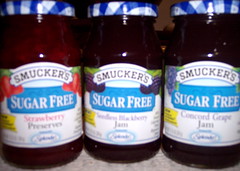
When I bent down to pick up this glorious "new" product to see what it was featuring Splenda, imagine my surprise when I saw the product was made by Smuckers. Yep, the same Smuckers jams, jellies and preserves that have long been made with the artificial sweetener Nutrasweet or aspartame (my new name for it is nasty-tame)!
See for yourself the old packaging:
Nutrasweet pervaded the entire Smuckers line of products...until now!
Hooray for Smuckers!!! FINALLY, somebody is listening!!!
The store I shopped at had four flavors available: Apricot Preserves, Strawberry Preserves, Seedless Blackberry Jam, and Concord Grape Jam. Each teaspoon serving size has just 50 calories and 5g carbohydrates (ZERO sugar!). They are made with REAL fruit which only add a trivial amount of natural sugars rather than the gobs of man-made sugar (aka high-fructose corn syrup) generally poured into most jams and jellies these days. These Smuckers jellies are an EXCELLENT product for diabetics and low-carbers alike to use as part of their healthy lifestyles.
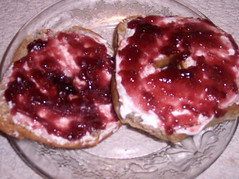
I was so excited about trying these Smuckers jams for myself, I decided to dab some on a ZERO carb cinnamon bagel available from Viva Low-Carb along with some real full-fat Philadelphia-brand cream cheese.
Holy cow, look how good this breakfast I had turned out:
A bagel with cream cheese and jelly with about 5g carbs
As gorgeous as it looked, the taste was even more phenomenal! I cut the bagel in half and toasted it in my toaster for about a minute. Then spread a layer of cream cheese and then added the Smuckers. Oh...my...goodness!!! That was an amazing experience and I was thrilled to be able to taste Smuckers jams again without all the nasty-tame in it. YEAH!
My only advice to you if you find a "Sweeted With Splenda" logo on the front of a product is to check the ingredients list on the back. If sucralose or Splenda is not the primary or only sweetener listen, then you might want to put it back. Some companies (not Smuckers, thank God!) put substances like stomach-busting sugar alcohols such as maltitol as their top sweetening agent while sucralose is near the bottom of the ingredients.
What is most sickening is how they so proudly display that Splenda logo like it means something. To me, that is nothing mroe than just false advertising and food companies should be compelled to stop deceiving the public! We should demand truth in labeling on sugar-free products so that others don't fall prey to this marketing gimmick!
The sugar-free companies STILL need a wake-up call and I'm so glad to see a leading industry name like Smuckers serving as an example for adding Splenda to their jams and jellies now. I hope they continue to extend this to their other product lines, such as the hot fudge topping, caramel topping, etc. as long as they avoid the maltitol. We will hope for the best and see.
Are there any other companies ready to axe the aspartame, too? If you are a company that has products that contain Splenda or if you run across a product that has not previously been sweetened with Splenda and would like for me to highlight it here, then please e-mail me this information. I want to share with my fellow low-carbers these excellent options for them to use while they are livin' la vida low-carb.
(This is fourth and final part of my interview with Dr. Dean Ornish with Part 1, Part 2, and Part 3 in a four-part series already published this week. Part 4 has Dr. Ornish sharing what he thinks about sugar substitutes, his unique role working with companies like McDonald's, the worldwide obesity epidemic, and coming together on a consensus about good nutrition.)
JIMMY MOORE: You were talking about chocolate a moment ago, what do you think about the sugar substitutes?
DEAN ORNISH: I think they can be a transition for some people. I think that sucralose, aka Splenda, is probably better than aspartame just based on what the studies are showing. I think clearly sugar substitutes can be a better choice than eating a lot of sugar. But it's also to me a transition because they tend to perpetuate a preference for sweets. What we find is your palate is remarkably adaptive.
For example, if you switched from whole milk to skim milk, then at first it will taste watery and doesn't taste good. If you stay with it, after a while it tastes fine. But then you go out to dinner and someone gives you whole milk it tastes too rich. The cow is the same, but your palate has adapted.
If you begin to stop eating sweets, then you begin to prefer foods that aren't so sweet. However, if you use a lot of sugar substitutes your palate never really gets a chance to adapt. But in the transition I think it can be very helpful. I think it's even better if you train your palate to prefer foods that are lower in salt and sugar.
JIMMY MOORE: Let's talk about McDonald's for a second. I noticed that you're now working with them and they recently donated $2 million to childhood obesity research. Everybody seems to be pointing the fingers at fast food and soft drink companies for causing obesity in America. Talk about why you decided to join forces with them and what kind of changes you think you are going to help bring about there.
DEAN ORNISH: I've been working with McDonald's for several years. I also sit on the health & wellness advisory boards of some other major food companies like PepsiCo, I consult with Del Monte, and Safeway as well. To me, it's a great opportunity to make the difference in the lives of a lot of people.
You know, 50 million people go to McDonald's every day. And so, when I began working with them, they didn't have the premium salads, the fruit and walnut salads, the Asian salads and so on. They are now giving people the choice of apple dippers with caramel sauce made with low-fat milk as opposed to a burger, fries and a shake.
I've been working with them to make healthier food choices available so that they could truly offering their customers a full spectrum of choices. But also as a way to educate people about energy balance, the importance of exercise, and about making healthier food choices as well.
Are they moving as quickly as I would like? No, of course not. Are they moving faster than I ever dreamed possible? Yeah. So there a divergence of forces that have raised the awareness of the American public and food companies.
For example, I was able to introduce the President Clinton Foundation and the American Heart Association to the heads of PepsiCo which ultimately led to the agreement that they brokered to block the sale of soft drinks to elementary schools and to reduce the sweetened beverage consumption in middle and upper schools as well.
It's a tremendous platform to make a difference in the lives of tens of millions of people every day. I'm also hoping to change the whole mystery of how we choose foods. The old joke says, "Am I gonna live longer or it just gonna seem longer if I eat healthier?" The reality is that you can eat foods that taste good that are good for you, make you feel good and look good.
These big food companies with their celebrities and advertising and marketing have the opportunity to make it fun and sexy and hip and convenient to eat more healthfully not only in this country, but worldwide. And there's a growing epidemic of the globalization of illness which I wrote about in Newsweek earlier this year. Other countries are starting to live like us, eat like us and die like us and it's completely preventable for most people.
JIMMY MOORE: Obesity has become a worldwide epidemic. Why?
DEAN ORNISH: With all the attention on AIDS and tuberculosis and malaria, in most countries around the world more people are dying from chronic diseases such a heart disease and obesity and diabetes that are essentially completely preventable for the vast majority of people simply by changing diet and lifestyle.
What's ironic is people in Asia are forging their own lifestyle and copying ours and unfortunately they're copying our ways of living and copying our ways of dying. We are trying to change that through my work with McDonald's. We helped them develop an Asian salad. It's almost like the people in Asia need to see their own diet come back to them when they eat at McDonald's so they can appreciate the value of what they already have.
JIMMY MOORE: One final question for you, Dr. Ornish, and again I appreciate you taking time out of your busy schedule to do this interview with me. Two out of every three Americans right now are either overweight or obese. What can we do to turn the tide of obesity that is headed towards 100 percent by the year 2056 according to a recent study? We've got various people ascribing to a low-fat diet, cutting your calories, cutting your portions, cutting your carbs--how are we going to put all of this together to make it palatable to the public so that we can try to turn this tide before it's too late?
DEAN ORNISH: Well, I think it's a very important question you've asked and I think that education is ultimately the key. I think the web site that you have can be a powerful force for that. If you can help people get out of this adversarial mindset of low-fat versus low-carb and say, "Wait a minute, what's really going on here?" You can help people understand it's a little more complicated than that and ultimately that makes it more sustainable.
So in my own way, I'm trying to educate people in any way that I can by doing the best science that we can and PCRM and collaborating with investigators around the world on studies. Also by levering with other food companies to provide healthier products and educate the people about the benefits of eating healthier. I also educate people through my monthly columns with Newsweek and Reader's Digest as well as writing books for the general public. By educating physicians and scientists through getting more insurance coverage for the kinds of interventions we talked about. And finally by giving public lectures and media appearances, whatever I can do to try and educate people the importance of all of this.
Because ultimately awareness if the very first step in any kind of healing. And science can help us understand what the effects of our choices are in our lives for better or for worse. Then to try to implement them in ways that can not only help us to live longer, but also to help us live better as well.
So I applaud your efforts trying to educate people. I think to the degree we can look for common ground at this point is going to be everyone's advantage. Otherwise, people will just throw up their hands and say, "The damn doctors, they can't even make up their minds. To Hell with them, I'll just eat whatever I want." This is bad for me, this is good for me--people get so frustrated by this.
The irony is there's more evidence than ever what a powerful difference a change in diet and lifestyle can make. So, to the degree that we can find ways of working together rather than be adversarial towards each other--which is why I agreed to do this interview with you--I think that's gonna be very helpful.
JIMMY MOORE: Well, I certainly appreciate that you've taken time because your voice is an important one and you have been for a long time. And I wanted people to know that despite our differences that we could come together and certainly try to make sense of this whole diet and nutrition thing to help people because that if my bottom line goal as well is to help people.
DEAN ORNISH: I know that and I think that's why we're here. As insipid as that may sound, I think that's why we're here is to help each other. And so the more we can do that, I think everyone will benefit from that. I am grateful for the chance to be interviewed by you today.
JIMMY MOORE: Thank you very much for agreeing to the interview, Dr. Ornish.
Did you miss one of the previous three part of my interview with Dr. Dean Ornish? If so, then go back and read Part 1, Part 2, and Part 3 of this enlightening interview with arguably the most influential diet and health icon of our lifetime. Like him or not, he gets attention for what he believes.
I'm totally surprised that so many people haven't heard of one of the greatest and bestselling low-carb products that has ever been released! Seriously, these DaVinci syrups are so wild and crazy good you'll never believe they are sugar-free and made with Splenda. SWEET!
Try this on for size, too: ZERO calories, ZERO carbs, and ZERO sugar! What more could you want in a flavored syrup? What's that? You wanna know how it tastes, you say? Oh man, this is the best part of DaVinci syrups in my opinion.
In my sample menu, I listed "heavy whipping cream with DaVinci syrup." With over 44 different varieties of flavors to choose from, I could have a different low-carb dessert every night for the next 1 1/2 months! WOO HOO! And they're all so yummy to my tummy without an ounce of guilt in the world.
Like Baskin Robbins ice cream, you'll have trouble figuring out which one to try next. Here is a listing of the DaVinci syrup flavors that are currently available:
Butter Rum Caramel Dulce de Leche Cookie Dough Banana Pineapple Raspberry (MY PERSONAL FAVORITE!) Butterscotch Malibu Rum Blueberry Maple Pancake French Vanilla Chocolate Spice Blend Egg Nog Gingerbread Star Fruit Almond Amaretto B52 (Kahlua, Grand Marnier, Irish Cream) Cherry Cinnamon Coconut Cola Creme de Menthe English Toffee Grape Hazelnut Huckleberry Irish Cream Kahlua Lemon Lemon Lime Macadamia Nut Orange Peanut Butter Peppermint Paddy Red Hot Cinnamon Strawberry Toasted Hazelnut Toasted Marshmallow Vanilla Watermelon
With such a large variety of flavors to choose from, there should be at least a few of these that you can use to infuse a little flavor into your favorite beverage or food. Oh my goodness, the possibilities with the DaVinci syrups are endless.
Now, let me warn you, don't let the word "syrup" fool you into thinking this product is a rich, thick liquid like honey or pancake syrup. It is not. The consistency is more like vanilla extract with the same kind of results in terms of flavoring. You will NOT be disappointed with the way these syrups flavor your food and drinks.
The DaVinci syrups come in 750 ml bottles for those flavors you KNOW you will love and enjoy often, 375 ml bottles for those flavors you want to use only on occasion, as well as the convenient sample-size 50 ml bottles if you just want to try some of the more popular flavors first.
I personally use DaVinci syrups all the time because they are an excellent way to add flavor to just about anything you are eating or drinking while livin' la vida low-carb without having to worry about extra calories or carbs. So why not try DaVinci syrups for yourself and you'll unlock the mysterious secrets to the low-carb code. Okay, it's no secret, but you really oughta try 'em for yourself. ORDER SOME TODAY!!!
I couldn't resist sharing with you this press release bragging about how consumers "overwhelmingly prefer pure cane sugar to Splenda in taste tests." Ooooookay, let's see what this is all about.
Not surprisingly, the suspicious "taste tests" were commissioned by the C&H Sugar Company and was conducted on June 9 and 10 in Redwood City, California and Buffalo Grove, Illinois by an independent market research company. This "independent survey" found that people who cook fresh baked desserts such as brownies were much more pleased with the taste, texture, and appearance of pure sugar cane (which C&H sells) than either Splenda or Splenda Blend (which is C&H's primary competition). I wonder how objective a study paid for by a company against it's #1 competitor is REALLY gonna be? But I digress.
They go on in the press release to show statistics that allegedly prove that people prefer pure cane sugar over Splenda and even found a pastry chef from a restaurant in San Francisco to slam Splenda on their behalf.
"Sucralose (Splenda) tends to block flavors provided by other ingredients, especially chocolate," this pastry chef said. "Brownies baked with Splenda and Splenda Blend don't offer the rich cocoa flavor or taste of those made with pure cane sugar. They are dry and dense."
He goes on to sing the praises of the product made by C&H Sugar Company to help them solidify their point even further.
"Pure cane sugar adds more than sweetness to recipes; it also provides bulk, moisture and browning. Artificial sweeteners do not," he explained. "Why would you want to sacrifice the taste of something you love just to save a few calories?"
This is where I have to step in to steer this debate back in the right direction.
Is this "world renowned pastry chef" really telling people to ignore the nutritional content of sugar and to just eat, drink, and be merry gorging yourself on sugar?!
I have been using Splenda almost exclusively since I started livin' la vida low-carb and losing over 180 pounds since January 2004. It is 600 times sweeter than sugar and can provide people who are wary of the impact sugar can have on their weight with an alternative way to give the foods they eat sweetness.
Despite the advancements in sugar substitutes and artificial sweeteners in recent years, I am still seeing people scrunch up their nose at me when I tell them I don't eat sugar but rather sugar-free products. That's what one television reporter who interviewed me the other day about my weight loss did. I assured her and others who react like she did that the taste is absolutely fabulous.
When I was addicted to sugar at the beginning of my low-carb lifestyle, there was a transitional period where my body had to wean itself off of the negative effects of sugar and literally detoxify itself from the years of damage that had been done to both my weight and my overall health. I discuss these issues in a special chapter on sugar of my book "Livin' La Vida Low-Carb" because this is much too important an issue to turn a blind eye to.
Even "The Biggest Loser" personal trainer Bob Harper said in an exclusive interview with the "Livin' La Vida Low-Carb" blog recently that "sugar is a very powerful and strong drug that people are extremely addicted to" and "has most everything to do with our problem with obesity." Why aren't we listening to voices like this one and pushing harder to provide the public with the truth about sugar? There are fundamental facts that should not be overlooked about how sugar is impacting the health of the American people.
Nobody will argue with you that consuming a lot of sugar can and will harm your body. It's an understood fact, although millions of people still consume it like there's nothing wrong with eating gobs and gobs of sugar.
But I saw what it can do firsthand to a person's body (MINE!) and it's not a pretty sight. The cravings and headaches that come when I didn't get my "hit" of sugar would slam me in the face like a cast iron skillet until I stuffed my face with even more sugar. Over and over again, that ruthless cycle continued until I "got clean" last year. Thankfully, that rollercoaster ride is one that I don't ever plan on getting on again. It's just not worth it!
Thanks to products like Splenda, I can enjoy the great sweetness of sugar without suffering the consequences it will have on various aspects of my health. Quite simply, Splenda is a miracle product for people who are livin' la vida low-carb. Sure, there are some like my friends Connie Bennett and Regina Wilshire who do not promote ANY sugar or sugar substitutes as part of a healthy lifestyle, but a lot of people are like me and need to have some sweetness in the foods we eat.
This little "taste test" released by a sugar company really means nothing regarding comparisons to Splenda because they only show the front-end qualities of their product. On the back end over the long-term, sugar will do more to pack on the pounds and destroy people's health than Splenda ever will. That's why I said goodbye to sugar once and for all nearly two years ago. And so should you!
I guess I've just invited Qorvis Communications back to my blog again today with this post! :-O
This Kansas City Star article is about the new increased focus by Americans on the detrimental effects sugar has on their bodies. But it also takes a highly critical look at "the low-carbohydrate dieting craze" and the dangers of sugar substitutes such as Splenda in what I believe is an attempt to discourage people from livin' la vida low-carb. How about if we set 'em straight?
Presenting it as evidence that the popularity of low-carb has waned, this story describes what organic foods manufacturer Stonyfield Farms did with their popular yogurt line called Moove Over Carbs to continue the sales success it has had now that low-carb is supposedly dead.
The article explains: "In January they pulled Moove Over Carbs from the shelves, and this month Moove Over Sugar takes its place. Except for the name, the product remains the same. Sugars are, after all, carbs."
Okay, let me see if I understand this correctly. The bigwigs at Stonyfield Farms decided to change the name of their product from "Moove Over Carbs" to "Move Over Sugar" in an attempt to boost sales because low-carb is not as popular as it once was. Uh, am I missing something here?
With virtually every other food company out there falling all over themselves to put "low-carb" on their packaging, why is Stonyfield Farms switching gears all of a sudden? I guess you could say they've become convinced that low-carb is out and low-sugar is in. But isn't it interesting they haven't changed the ingredients in this product at all? I guess you could conclude it's still low-carb although it isn't marketed that way.
Interestingly, while the packaging and name may have changed, a quick visit to the Stonyfield Farms web site description of the yogurt shows you a picture of the new "Moove Over Sugar" packaging, but at the very top of the page they still call it "Moove Over Carbs" as of Sunday night when I posted this story on my blog (they might change it now that I've pointed this error out to them!). I guess they can't make up their mind whether mentioning their product as a low-carb item is a good thing or not!
Supposedly, according to the article, "low-sugar food has become the new low-carb food." But my only response to that is "WHO CARES?!" If something has little to no sugar in it at all, then it is usually an excellent choice for people who are livin' la vida low-carb. Dr. Atkins continually focused on the negative aspects of sugar as a primary reason for weight problems in America in all of his books. In fact, I am devoting an entire chapter of my book on the subject of sugar because it is that important for people to understand the negative role sugar plays in regards to your weight and health.
Just as they did when low-carb first became popular, food manufacturers are now rushing to pump out "low-sugar" foods to help people identify products that are supposed to be "healthier" for them. Unfortunately, though, while these products may be lower in sugar than their regular counterparts, oftentimes they still have an unusually high amount of sugar that make them off limits to people doing a low-carb lifestyle. Just as so many of the so-called "low-carb" products failed to sell because they were not low enough in carbohydrates to warrant that lofty description, these new low-sugar products will face the same fate when people realize they are still getting much more sugar than their body needs.
Right now there isn't a standard to regulate what can be described as "low-carb" or "low-sugar" on the grocery shelves. While I do not advocate the government getting involved in this process, there needs to be an independent organization or board that gives what would amount to the "Good Housekeeping Seal of Approval" to those products that are actually found to be "low-carb" or "low-sugar" as defined by a consensus of health and nutritional experts on the panel. Representatives from Atkins Nutritionals and others would judge whether a product should be allowed to be labeled "low-carb" or "low-sugar" by establishing a carbohydrate and sugar threshold which cannot be exceeded. If we're going to be serious about truth in advertising regarding "low-carb" and "low-sugar" products, then this is something that must be taken into consideration as soon as possible.
Whenever people ask me about what to eat when they want something sweet while doing the low-carb lifestyle, I recommend they choose sugar-free items because they just don't need all that sugar. Even in popular diet bars there can be large quantities of hidden sugars you have to be aware of. I always tell people to read food and nutrition labels carefully and immediately put down any product that has more than a gram or two of sugars per serving in it. It's just not worth putting in your mouth when there are plenty of viable sugar substitutes that, in my opinion, taste just as good as sugar, but without the consequences that come from eating too much of it.
The article warns about the move to market low-sugar products and whether the sugar substitutes in those products are safe for people to use. Interestingly, the only sugar substitute mentioned in the article is sucralose, sold under the product name Splenda.
Splenda is the sugar substitute highly recommended by Dr. Robert Atkins in his books. That brand has become a household name with its little symbol found on thousands upon thousands of products these days. Most people (and especially low-carbers) are extremely comfortable with using Splenda and recognize it as an excellent sugar substitute with 600 times the sweetness of sugar.
But there are some who question the safety of Splenda. While I can appreciate the honest concerns about the foods sold on our supermarket shelves, this alarmist response to Splenda is a bit of an overreaction. There is nothing in this article about the real dangers that have been documented about some other sugar substitutes like aspartame (Nutrasweet) and saccharin. Just as they have done with the low-carb lifestyle, the media is attempting to villify Splenda to discourage people from using a product found to be safe in over 100 studies in the past two decades and prominently used by low-carbers everywhere.
The story cites a recent survey conducted by the Grocery Manufacturers Association, the world's largest association of food, beverage and consumer product companies, which found nearly half of all grocery shoppers are looking for products that contained "reduced sugar."
Well duh? This group of survey participants who want less sugar in the food they buy doesn't exactly exclude people who are livin' la vida low-carb as the story implies. Actually, it's quite the contrary. Those of us who are watching our carb intake are the ones who are most likely to be especially careful about the sugar content in the products we buy. Low-sugar generally equates to being low-carb.
But the same can't be said about low-fat. The vast majority of low-fat products have loads of added sugar and sodium in an attempt to as closely replicate the taste of the original versions of various foods as possible. The resulting consequence is usually something that tastes very discusting and the addition of even more sugar in your diet that you just don't need. If you're cutting out sugar from your diet, then you can't exactly be doing a low-fat diet!
So how about starting the low-carb lifestyle like millions and millions of us who have already done it with great success and you can cut your sugar while enjoying lots of tasty foods you just can't have on a low-fat diet! It'll be the best thing you've ever done in your life in regards to shrinking your waistline and improving your overall health.
At the end of the article, a nutritionist named Dr. Stuart Fischer, who runs his own practice in Manhattan and formerly worked under the leadership of Dr. Robert Atkins for nine years as associate medical director of the former Atkins Center for Complementary Medicine, expresses his opinion that artificial sweeteners do nothing to help people's "overall health" because they supposedly make you crave sugar-laced treats.
"They remind dieters about the taste of the forbidden fruit," Fischer said. "Does Alcoholics Anonymous recommend alcohol-free beer? Of course not."
While I am not even going to pretend to question Dr. Fischer's expert medical analysis of sugar substitutes, all I can offer is my own experience with sugar substitutes during my weight loss and weight maintenance over the past year and a half.
Sugar substitutes have been a godsend to me. Before I started livin' la vida low-carb, just the mention of the words "sugar-free" caused me to cringe. But times have changed and so have the sugar substitutes. You just don't know what you are talking about if you haven't even tried how wonderful sugar substitutes make Russell Stover candies or Z-Carb chocolate bars taste.
While Dr. Fischer said he is worried about people wanting to gobble up foods with sugar in them after consuming these sugar substitutes, I found just the opposite is true. Because the sugar substitutes are so good, I don't feel compelled to eat anything with sugar in it because I know it would go against my goal of losing and maintaining my weight. I have a unique phrase I often tell myself whenever I might be tempted to eat something with sugar in it. I can't tell you what it is right now because I use it in my book. But I think it can help anyone who wants to overcome their addiction to sugar. You'll have to wait until my book comes out to find out what it is.
The bottom line is this: Sugar is not good for you at all. You need to do whatever you can to avoid it completely, especially when you are on a low-carb lifestyle. Even just a little bit of sugar can kick you out of ketosis and foil your plans to lose and maintain your weight. If everyone in this country would just cut sugar out of their lives, I contend we would see the obesity numbers plummet to near single digits!
While the media has focused much of their attention on fat consumption, especially with people on a low-carb lifestyle, they need to turn their attention to sugar consumption, generally associated with people on a low-fat diet. The truth is that we can live without sugar. It might be difficult for many to break their addiction, but it can and must be done.
05/16/2005 UPDATE: I got a personal e-mail response today from Dr. Fischer.
Thanks for your e-mail and your excellent article. I am also glad for your personal success story and your hope of helping many others. After dealing with this tremendous subject since 1988, I wish that it would lend itself to monolithic thinking and simplistic answers (I am referring to how the media treats overweight and obesity), but human physiology and behavior are much more complex. Keep up the good work!
Best wishes,
Dr. Stuart Fischer
I guess he's on our side after all! Thanks for your kind comments, Dr. Fischer. I look forward to hearing more from you regarding how we need to deal with the obesity problem in the coming years.