Sugar-Free Mentos snags another victim of dubious side effects
There oughta be a big bold WARNING label placed on any sugar-free product that purports to be "sweetened with Splenda" if sucralose is not the top sweetener. You know what I'm talking about--while the Splenda logo appears prominently on the front of the packaging of many low-carb, sugar-free products, the truth is there's something else making that product sweet.
That something else is sugar alcohols usually, most notably and notoriously the one called maltitol. Just as sugar-free doesn't mean the product is necessarily low-carb, neither does having the Splenda emblem on the packaging mean it is the primary sweetener. In fact, many times it comes in dead last in the ingredients.
If this is happening, then why does maltitol show up as the #1 ingredient, hmmm? Sounds like a bait and switch scam to me! I've warned about the negative impact this sugar alcohol can have on your stomach many times and even had this humorous story from a reader named Fred Scuttle who found out the hard way what the sugar alcohol maltitol can do to you.
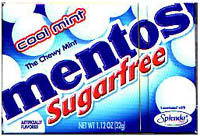
Now I've got another horror story to share with you from Sarah who thought she would get away with downing some Sugar-Free Mentos without a hitch. HA!
Here's what happened to her:
My experience with maltitol happened just today at my restaurant job.
I bought some Sugar-Free Mentos just the other day and was relieved to see the Splenda emblem proudly displayed on the package...I have had problems with other artificial sweeteners, so I thought I was safe.
Wrong!
So, while I was busy serving food on a busy lunch shift, I snacked on the box of candy. Mind you, this was a small package---maybe 15 pieces or so.
Well, an hour into my shift, my stomach started to do that dreaded gurgle and roll and I knew immediately I was in trouble.
I literally had to run to the bathroom, lest I "sharted" in my pants. It was totally awful. It felt disgusting having explosive diarrhea while serving food to customers and the gas and bloating were so terrible I had to go to the bathroom to undo my pants.
Upon closer inspection of the box, in all capital letters I noticed (too late), this disclaimer: EXCESSIVE CONSUMPTION MAY CAUSE A LAXATIVE EFFECT!
That's nice. Glad to know that candy now has the ability to make me shit my pants."
Some lessons can only be learned through experience. This will certainly make Sarah read food labels carefully from now on, don't ya think?
By the way, that's the first and last time you'll ever see the word "sharted" at my blog. TMI and EWWWW!
Tasty and firm ready-to-eat low-carb fudge without sugar alcohols
Fudge was a household tradition in my family when I was growing up. Especially around the holidays, my momma used to whip up a big batch of homemade fudge to ship to friends and loved ones as well as for our immediate family to enjoy. It's such a shame that this sugary, high-carb food has to be so unhealthy for you to eat when you start livin' la vida low-carb.
So, in my quest to find a low-carb version of fudge, let me tell you how disappointed I was in most of them. They were either too soft (who likes a squishy block of fudge), tasted awful (needs to be a rich, flavorful hunk of chocolate), or were too artificial (you gotta make fudge homemade and not in a chemical lab). UGH!
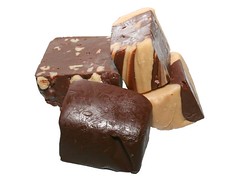
Can't somebody come up with an authentically great-tasting low-carb fudge that tastes like the stuff momma used to make? Uh-huh and it's from our friends at Dixie Diner yet again. They call it Carb Counters Ready-to-Eat Fudge and I have to tell you I'm quite impressed! This fudge is just the way I remembered it as a child, but even better!
Only 3g net carbs per one-ounce serving, this low-carb fudge is absolutely decadent and loaded with healthy amounts of fiber, fat, and protein that your body needs in each delicious bite. As we have come to expect from Dixie Diner products, this ready-to-eat fudge contains NO SUGAR ALCOHOLS or polydextrose. Yeah, no gas-inducing maltitol in this fudge!
Available in Chocolate and Peanut Butter flavors, the Carb Counters Ready-to-Eat Fudge is an excellent low-carb snack or treat you can use to stay committed to the low-carb lifestyle. Also, if you are sensitive to wheat gluten, you'll be glad to know this fudge is gluten-free!
Here is the list of ingredients in this amazing fudge:
Chocolate, vegetable fiber, coconut oil, palm oil, water, heavy cream, maltodextrin, milk protein concentrate, whey protein concentrate, natural flavor, low glycemic monosaccharides, sodium caseinate, salt, soy lecithin, carrageenan, sodium bicarbonate, low glycemic fruit concentrate
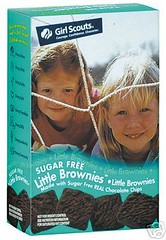
Now the Girl Scouts offer a sugar-free cookie called Little Brownies
Give yourself a big pat on the back because I think we may have had an influence with the decision makers at the Girl Scouts after something I blogged about last year. Long-term readers will remember this blog post I wrote in January 2006 about Girl Scout cookies and how they were teaching little girls that it's okay to push a product that is loaded with sugar and excessive carbohydrates.
I said a few more things in that post that stirred the pot a bit, but the basic theme of my column was about encouraging them to come up with a sugar-free cookie for diabetics and people on a low-carb diet to enjoy since we can't or don't want sugar in our food.
Last year they heralded the fact that they removed the trans fats from their cookies (which I applaud them for doing), but I asked them to take their initiative to make healthier cookie offerings one step further by removing the sugar.
Here's what I suggested:
Why don't they offer some SUGAR-FREE versions? I was disappointed in the politician-like answer provided by the Girl Scouts organization regarding concerns that both diabetics and low-carb supporters have with their cookies:
"The ingredients and nutritional elements of all cookies are listed on the order forms and the side of the cookie box so those concerned about carbohydrates can make informed choices. For more information, check the bakers' Web sites."
I did that and it wasn't a pretty story. As we have already seen from the carbohydrate totals, you're pretty much out of luck when it comes to eating Girl Scout cookies if you are staying committed to livin' la vida low-carb. This clear lack of concern by the Girl Scouts disturbs me and it should you as well.
That's why I urged my readers at the time to e-mail the Girl Scouts directly with their concerns regarding the absence of any kind of Girl Scout cookie for diabetics and low-carbers and to encourage them to make a sugar-free cookie available next year.
Apparently, they listened to us! :)
Here's a statement released about the demand for sugar-free cookies:
"In response to consumer requests received received by the hundreds of thousands of Girl Scouts who visit with consumers each year during Girl Scout Cookie Season, we have worked diligently to produce great-tasting brownie treats while eliminating the sugar content."
YEAH! WOO HOO! Party time! Can you tell I'm excited?! :)
Little Brownies are the first sugar-free Girl Scout cookie
To meet the demand of sugar-free consumers, including diabetics and low-carbers, the Girl Scouts commissioned one of their vendors Louisville, KY-based cookie manufacturer Little Brownie Bakers to come up with a delicious, bite-sized chocolate cookie without the sugar. The result was a brand new sugar-free cookie called Little Brownies.
I came across these cookies just yesterday when the local Girl Scouts troop were parked directly in front of my local grocery store selling away to the people passing by. When the cute little energetic girl asked me if I would like to buy a box of cookies, I responded, "Do you have any that are sugar-free?" She surprised me when she enthusiastically retorted, "Yep, we sure do!"
This took me back a little since I hadn't heard that they made a sugar-free cookie beforehand, so I asked the adult who was with her if she knew what the cookies were sweetened with and if they tasted good or not. She didn't know about the sweeteners, but she let me look at the box with the ingredients list. Also, they were also very curious about how they tasted and opened up a package to try. I was offered one to try for myself.
When I first bit into it, I was bracing myself for that disappointing "wang" you get when you eat something low-quality that is sugar-free (generally made with inferior ingredients). But, to my delight, these "brownies" were remarkably tasty and actually resembled a real cookie, but without the sugar. WHOA!
Don't let the name Little Brownies fool you, though. They're not soft and chewy like a brownie would be. But these are still minature cookies that had flavorful little chocolate chips in them, too! If you have a hankering for something chocolately and sweet, then this would certainly be your fix.
As I was licking my tongue around in my teeth enjoying this new sugar-free Girl Scouts cookie, I continued reading the label. A serving size of 4 Little Brownies gives you 130 calories, 8g fat (4.5g of saturated fat), 2g protein, and 18g total carbohydrates. Of course, although there is no sugar in these cookies, they do have some sugar alcohols and fiber in them. There are 4g sugar alcohols and 1g fiber for a net carb count of 13g.
This is not a completely terrible option for people who are livin' la vida low-carb at a little more than 3g net carbs per cookie (but you wouldn't want to eat more than 1-2 of these if you are in the earlier stages of your low-carb weight loss plan). I'd still prefer to see them try to get rid of the flour as the #1 ingredient to make them even lower in carbs and still taste just as delicious. There are ways to do that, but this is a VERY good start on their part! KUDOS!
What about the sugar alcohols, you ask? Well, with only 4g for 4 cookies, that's just 1g sugar alcohol per cookie. Unless you down the whole box at one time (which is quite possible if you aren't careful because they taste so good!), you should be okay. For those of you who are wondering, the Little Brownies include a blended mixture of a little bit of all the popular sugar alternatives: polydextrose, maltitol, sorbitol, isomalt, ACE-K, and Splenda. There is no aspartame in these cookies (Thank God!).
Incidentally, that listing of sweeteners is in order of most to least--sucralose (Splenda) was dead last as usual. But don't you know they heralded the fact that it is "sweetened with Splenda." No, it's actually MORE sweetened with everything else. Nevertheless, for all intents and purposes this cookie has not been a problem for me even after having 4 at one time. That's my personal limit despite the temptation to eat more than that.
Each 5.5-ounce box of Little Brownies sugar-free Girl Scout cookies contains around 22 cookies and they are designed specifically for people with diabetes and who are watching their sugar intake. Just be sure to stay within the portion size and you should be fine whether you are a low-carber or diabetic. Ask your healthcare professional if you have any specific concerns about eating this product.
By the way, here's the complete ingredients listing:
Has anyone else tried these new sugar-free Little Brownies from the Girl Scouts yet? If you did, then what did YOU think about them? I'm really interested in your feedback, questions, and concerns so please leave a comment.
3-5-07 UPDATE: A registered nurse was concerned about what she believed was my endorsement of these Girl Scout cookies in an e-mail to me today.
Hi Jimmy!
I applaud your weight loss efforts and your success in doing so. However, I am very concerned about your excitement about Girl Scout Cookies having aspartame and artificial anything in it!
I feel that Americans would be much better off eating "real food" instead of all this additive-laden junk that is so widely advertised. I am also very concerned about children ingesting all of these chemicals.
I hope that you find it in your heart to start researching these chemical additives before you applaud them. And don't just take the company's word for it either.
I was a huge Diet Coke drinker and now know that I was terribly addicted to it! This was 3 years ago right before being diagnosed with CNS lupus. Aspartame is a neuroexitotoxin and just isn't a good thing for any living creature.
I hope that you think long and hard before you applaud such efforts of businesses who are only making money off of poisoning the population. This is why studies have been suppressed as they have. Too much money is being made in the sweetener industry.
I wish you the best, Jimmy!
THANKS so much for your e-mail and expressing your concerns about my apparent "excitement" over the new sugar-free Girl Scout cookies. But I think you were mistaken to think I was endorsing this prouduct.
I could not agree MORE with your assessment about aspartame. It is something I have hit hard and hit often in my writings and I STRONGLY urge my readers to avoid it at all costs.
Sure, I still support Splenda, but I am vehemently opposed to sugar alcohols like maltitol as well as NASTY-tame. My column was more an applause to the Girl Scouts and their cookie manufacturer for moving in a POSITIVE direction. Sure, it would be great to have the kids eating more whole foods, but the reality is they're not gonna do it overnight.
I'm a big believer in incrementalism, so sugar-free, low-carb options to popular foods like Girl Scout cookies is what truly excites me because we can get them to start thinking about eating healthier and healthier. It's a lesson I wish I had learned when I was their age.
Again, THANK YOU for sharing your comments! I'm right there in agreement with you. :)
Eat Well Be Well makes chocolate chips with no sugar alcohols
There are all kinds of sugar-free, low-carb products on the market today that are excellent alternatives to the sugary, high-carb offerings which dominate store shelves. While these healthier versions of our favorite foods will never supercede their carb-loaded counterparts in quantity, it's nice to know these high-quality options are available for the discerning dieter.
But you may have noticed a rather conspicuous absence of one very popular baking item that has not been easy to find: sugar-free, low-carb semi-sweet chocolate chips that are NOT made with sugar alcohols such as maltitol. I have been begging companies to stop using this awful sweetener and to start using more preferred ones like Splenda and ACE-K.
Well, one company was listening!
Introducing the sugar-free, low-carb, and sugar alcohol-free Semi Sweet Chocolate Chips from Eat Well Be Well! Perfect for diabetics and low-carbers alike, these amazing chocolate chips will get you baking again in the kitchen just in time for the holidays. Available in convenient 8-ounce bags of rich chocolately-flavored chips that are loaded with nutritional goodness.
Each 2 tablespoon serving contains just 80 calories, 8g total carbohydrates, a whopping 7g fiber, only 1g net carbs and 1g protein. Made with chocolate liquor, polydextrose (a soluble fiber), cocoa butter, cocoa powder, soy lecithin, sodium bicarbonate, vanilla, ACE-K, and Splenda. These Semi Sweet Chocolate Chips from Eat Well Be Well are just what you've been looking for to cook up some chocolate chip cookies or brownies using low-carb baking flour like Carbquik.
So bake up some chocolate chip cookies or brownies with these great-tasting new chocolate chips! You won't be disappointed. Stock up on your supply TODAY!
Finally, we have a topic that my fellow Atkins weight loss success story Kent Altena and I actually disagree about. I'm not saying he's wrong or I'm right necessarily about this subject, but it is quite controversial among many active low-carbers. It's the issue of "net carbs."
Most people only vaguely understand what that phrase means and Kent seems to think it's nothing more than a marketing gimmick to sell products. I agree that companies exploit this "net carbs" or "digestible carbs" claim to peddle their products, but that's an intelligent way to educate your customers to convince them they need to buy your low-carb food product.
The way I explain it to most people is you don't have to count the carbohydrates in dietary fiber or sugar alcohols. So, if a product has 15g total carbohydrates with 5g fiber and 9g sugar alcohols, then the product is said to have 1 "net carb." I have used this simple subtraction method from the very beginning of my low-carb lifestyle and it has served me well.
But Kent disagrees as he explains in his latest Atkins video:
NET CARBS VS. NET EFFECTIVE CARBS - MARKETING HYPE
Back in 2004 when I was losing the majority of my weight, I can't tell you what a lifesaver having low-carb chocolates and other sweet products available to me as I transitioned from eating sugary snacks to sugar-free ones. As Kent alluded to in his video, we do need stricter standards regarding the labeling of what constitutes a "low-carb" product because people are being duped by the hype. Furthermore, sugar-free, low-carb candy companies need a wake-up call to start using better ingredients in their products rather than settling for the cheapest, worst possible sweeteners they can find (do I need to mention the "m" word again?!).
Kent isn't buying any of the hype about sugar alcohols and only subtracts the fiber in his carb counts. There's certainly nothing wrong with doing that, but it was not necessary for me when I was losing weight and even now. For the record, Kent believes sugar alcohols should count anywhere between 25-75 percent of what the same amount of sugar carbs would be. He says the body reacts to the sugar alcohol in the same way as it does sugar by releasing insulin into the body. As a result, some people experience stalls in their weight loss while eating low-carb foods containing sugar alcohols.
This has not been my experience, but we are all very different as I have said before. If you notice the scale stops moving downward, then stop eating the low-carb chocolates for a week to see if it makes a difference. Perhaps your body is ultrasensative to the sugar alcohols and adjustments should be made in the amount of these products you consume. For others, it's a non-issue. Don't just assume it either is or is not a problem. Monitor it closely for YOU and act accordingly.
There are some invaluable links to other articles about this subject if you are interested in pursuing it further by visiting Kent's blog. Be sure to leave Kent a comment while you are there thanking him for his hard work and dedication to making these videos about how to do the Atkins diet.
One of the points I constantly harp on is READ YOUR LABELS to find out the nutrition in everything you buy to put inside that mouth of yours. It's the only way for you to know EXACTLY what you are allowing to enter your body right down to the exact number of carbohydrates you are eating.
Or is it?
I recently became aware of a shifty numbers game that the Food & Drug Administration (FDA) allows regarding nutrition labeling on your favorite low-carb foods. When you see 1g net carbs listed on a nutrition label of that low-carb product you have purchased, would you believe it is POSSIBLE that very same product might actually be closer to 2g or even 3g net carbs instead?
WHAT?! How can this be?
It's all in the rounding that the FDA allows companies to do with the carbs especially. When you are livin' la vida low-carb, you can come up with the net effective carbohydrate count by taking the total carbs and subtracting the dietary fiber and sugar alcohols.
For example, here's the nutritional info for a low-carb product:
That would be 19 minus 8 for the fiber and minus 10 more for the sugar alcohol for a grand net carb total of 1, right? The unsuspecting low-carber might think that's low enough to eat TWO servings since that would equal a mere 2g net carbs.
But watch this...
According to the FDA Nutritional Guidelines on rounding (See Section II, #7), < .5g of dietary fiber or sugar alcohols can be considered zero carb because they allow them to be rounded down when the value is 0.49 or less.
So let's look at our example again:
Total carbohydrate: 19.49g (rounds to 19g) Dietary fiber: 7.5g (rounds up to 8g) Sugar alcohol (i.e. erythritol): 9.5g (rounds up to 10g)
When you take the 19.49g of total carbs and subtract the 7.5 for dietary fiber and 9.5 for sugar alcohol, you are left with a carb count of 2.49g net carbs, NOT just 1g net carb as the packaging shows and as you assumed to be true. When you add that second serving of this product that was thought to be 1g net carb, the low-carb product you just ate actually may have been a lot closer to 5g net carbs instead of just 2g. Whoa!
While that may not sound like a lot, compound that problem with EVERY SINGLE LOW-CARB PRODUCT you eat and you can easily see how those sneaky extra carbs that the FDA is allowing to be excluded from the actually labeling can quickly add up to a lot more carbs than you expected. When you are in the early stages of counting carbs, this is especially important to watch out for because even a few extra carbs may kick you out of ketosis and stall your weight loss.
Of course, not all low-carb products have this issue, but the rounding issue is a problem that you must be aware of and willing to deal with. I know that I routinely added an extra .5 to 1g of carbs to almost EVERY labeled product I ate when I was losing my 180 pounds in 2004 on the Atkins diet. It helped me keep from overconsuming carbohydrates that I did not need.
A word to the wise...watch out for those shifty nutrition labeling practices!