This is promising news for Americans who are seeking healthy NATURAL choices for sugar alternatives since Truvia is made from the sweetest part of the stevia leaf--rebiana. The very best-tasting stevia is then combined with the sugar alcohol erythritol as a bulking agent to create a very clean-tasting, maltodextrin-free substitute for sugar. And it's not bitter even in the least. I was VERY pleased with that since the major complaint most people have with stevia is the puckered-up face they get when they taste it. Not with Truvia.
In Episode 46 of "Livin' La Vida Low-Carb On YouTube," Christine and I share about my trip to the Rockefeller Center in New York City on July 9, 2008 as the people passing by the Truvia Greenhouse were given a golden opportunity to be some of the first people in the entire world to try this new product coming to store shelves in the Fall 2008. There was iced tea and lemonade available for people to try and most of them gave a very positive review of the Truvia. There were a few knuckleheads who refused to even try "nature's first zero-calorie sweetener," but it was their loss. This stuff is OUTSTANDING!
Learn more about Truvia and what makes it different in today's video:
If you're excited to try Truvia for yourself, then it is currently available for purchase online at Truvia.com and in a few select New York City stores. The immediate reaction I had to the Truvia when I tasted it was how much it resembled cotton candy. That's a good tasting product, I'd say! There is a bit of the "cooling" sensation from the erythritol, but it's not unpleasant. In fact, that gives it a very nice mouth feel to me and Truvia is just about as close to real sugar I have seen in a sweetener before! Try it for yourself and I'll be telling you more about this product when widespread availability hits later this year.
THANK YOU for watching "Livin' La Vida Low-Carb On YouTube." Please send us your comments at livinlowcarbman@charter.net and watch our previous YouTube videos anytime you'd like! Take a moment now to subscribe to our YouTube videos and catch the low-carb wave that's rolling across YouTube right now. :D We'll be back again soon for another fun and quirky video about the healthy low-carb lifestyle.
Today, I am pleased to share with you a very informative post from Judy that appeared on her companion web site about the various sweeteners available on the market today. Most people who are livin' la vida low-carb already know to avoid sugar, but what about other so-called "healthy" sweeteners like maple syrup, stevia, and Splenda. Which ones should a low-carber be using and which should be avoided? Judy Barnes Bakers cuts to the chase and shares her knowledge with you to help you make smarter choices for your healthy low-carb lifestyle.
Special thanks to Judy for continuing what I started in this recent blog post about fructose with a more in-depth look at the good, the bad, and the ugly when it comes to providing good alternatives to sugar. ENJOY!
I have received questions as to why I did not include some of the all-natural alternatives, like brown rice syrup, agave nectar, and date sugar in the discussion about the different kinds of sweeteners in my book. I did not include most of them because, in my opinion, they offer little advantage over common table sugar. However since the subject continues to come up, I will address it here.
Let me point out at the start that “natural” is not synonymous with “safe.” Nature abounds with natural poisons: arsenic, mercury, lead, death cap mushrooms, puffer fish, anthrax, and snake venom to name a few. Also, keep in mind that many foods that we consider healthful, like parsley, cabbage, beans, celery, tomatoes, and basil contain poisons and antinutrients that can be dangerous in large amounts.
Potatoes can contain lethal amounts of solanine; those big green bananas called plaintains cause heart disease; lima beans, flax seed, and almonds contain high levels of cyanide. (Fifteen bitter almonds, the kind used in the Italian cookies called amaretti, can cause serious illness or death.) In fact, most vegetables, even after thousands of years of selective cultivation, still contain some potentially harmful substances. (Jeffery Steingarten included a chapter titled: “Salad the Silent Killer,” in his very entertaining book, The Man Who Ate Everything.)
Let’s look at some of those “healthy, all-natural, minimally-processed” sweeteners:
-Agave nectar is touted as a healthful, natural alternative to sucrose because it has a very low glycemic index, so it doesn’t cause a spike in blood sugar or raise insulin levels. However, the dangers of fructose are well known and agave nectar is almost 100% pure fructose. High fructose corn syrup contains only 45% fructose; agave syrup has twice as much of this most dangerous of all the sugars. The reason fructose doesn’t provoke an insulin response is that it does not enter the blood stream but is metabolized in the liver where it is converted directly into triglycerides (fats). It promotes fat storage, especially around the midsection and the organs.
It has been implicated as a major contributor to obesity, diabetes, heart disease, hypertension, and metabolic syndrome. Fructose also increases the formation of advanced glycation end-products, known by the acronym AGEs, because they promote the cross-linking of proteins which speeds up the aging process. According to Dr. Michael Eades, fructose “… is a driving force behind the development of insulin resistance and all attendant problems. When researchers want to give lab animals insulin resistance, they feed the animals high doses of fructose.” Here is a link to an article on fructose by Dr. Eades: "Unclear on the Fructose Concept"
-Date sugar is simply ground up dates. It is more than 96% sucrose; sucrose is about half glucose and half fructose. Date sugar contains some fiber and some trace minerals and vitamins, but it is essentially the same as common table sugar and causes a similar rise in blood sugar and insulin levels. It does not dissolve and is not a useful substitute for sugar for baking or cooking.
-I did include information about stevia in the book. Many people like it, but many find it to be bitter. Some of the more refined brands are said to be less so. Stevia can only be sold as a supplement in this country because it has never been tested orapproved for sale as a sweetener. The FDA has been petitioned three time to grant GRAS (generally recognized as safe) status for stevia so that it will not have to go through safety testing, but it has been rejected so far. If you feel more comfortable with stevia than Splenda, one packet of most sweeteners is equal to 2 teaspoons of sugar so they can be used interchangeably in some recipes for sweetening. Stevia powder does not dissolve, ferment, or caramelize. It is heat stable up to 392 degrees F.
-Maple syrup is made from the sap of maple trees, which is 2 to 3 percent sucrose. It is collected in buckets and boiled down to make a concentrated syrup. It takes 40 gallons of sap to make one gallon of syrup. Most of the sugar is sucrose (like common table sugar), but some, especially in the lesser grades, is glucose and fructose. Maple syrup contains traces of vitamins, especially the B vitamins, and minerals.
-Succanat is cane sugar with the water removed. It retains trace amounts of vitamins and minerals that may be lost in the refining process for regular table sugar, but it is still concentrated sucrose.
- Brown rice syrup is made by fermenting brown rice with enzymes to break down some of the starch into sugar and then cooking it until it is thickened. It is only half as sweet as table sugar. It contains 45% maltose (the kind of sugar in beer), and 3% glucose. The rest is starch. Maltose has a glycemic index of 110, higher than pure glucose (glucose or blood sugar has a GI of 100) and will provoke a very high insulin reaction. It contains 34 net grams of carbohydrate and 132 calories in a serving of 2 tablespoons. I’ll pass on this one.
Note: Brown rice syrup is one of several malt sugars made from grain that include barley malt, barley/corn malt, and rice syrups. Malt sugars are used in making beer, which is why beer is sometimes called “liquid bread.”
Why I prefer Splenda®: Sucrolose, the sweetener in Splenda, is made from sugar by replacing a few atoms of hydrogen and oxygen on the sugar molecule with three atoms of chlorine, making it 600 times as sweet as sugar.
Splenda has been used in Canada since 1991 and in Australia since 1992. It has been approved in 60 countries worldwide. In 1998, after reviewing 110 studies, the FDA approved it for use in the U.S. It is not required to carry any warning label and is considered safe for pregnant women and nursing mothers. After much anticipation, we finally had a safe alternative to sugar that tasted good and held up to cooking temperatures.
So why suddenly is there so much hysteria about Splenda?
Dr. Eades brings up some very important points about Splenda in this article. He contends that Splenda is not really artificial since chlorine is a natural substance, but that it is instead an altered sugar molecule. Half of common table salt is chlorine (NaCl), and chlorine is a normal part of the makeup of our blood serum. Chlorine is a necessary chemical that our bodies need for metabolism and the amount is carefully maintained by the kidneys at the proper level. At any given time you have about 1 teaspoon of chlorine circulating in your blood which is about 20,000 times as much as you would get in a serving of Splenda, if it were digestible, which most of it is not.
The study most often cited as proof of the toxicity of sucralose is one conducted by the National Industrial Chemicals Notification and Assessment Scheme of Australia that showed that feeding large amounts to rats caused shrinkage of the thymus gland, which is important to the immune system. The dosage used in the study was the equivalent of 240 grams of sucralose per day for a 176-pound human for 28 days. That works out to 20,000 packets of Splenda every day for 28 days. To put it in perspective: If you drank 560,000 cups of coffee with one packet of Splenda in each one over a 28 day period, you would reach the level of sucralose fed to the rats. But you would have no symptoms because you would be dead within 15 minutes from the caffeine contained in the first 75 cups of coffee.
Dr. Jonny Bowden, fitness expert and author of The 150 Healthiest Foods on Earth, gave the following response to Jimmy Moore (in this blog post) when asked about Splenda: “…I've looked like mad and can't find any really good, responsible argument against it that can be substantiated. That does NOT mean I won't be proven wrong in a year and I reserve the right to change my mind if there's more compelling stuff coming out. But right now I see it as the least bad of the choices."
This is very much like what I said about Splenda in my book. When you write a cookbook you must use ingredients that are readily available and reasonably priced. Splenda is safe, it tastes good, it is in all the stores, and it is not terribly expensive. There are some other sugar substitutes already available that have the bulk and physical characteristics of common sugar and actually offer some health benefits, but for now they are only available by mail order and are very expensive.
Oligofructose, for example, is made from chicory root. It has been popular in Japan for many years. It consists of long chains of fructose molecules that are not broken down by our digestive enzymes. It is prebiotic, meaning that it selectively feeds the beneficial microbes that live in the lower intestines and so enhances the immune system. (It can be ordered from Low-Carb Specialities. The company also sells fantastic chocolate bars sweetened with oligofructose.)
The decision to eliminate sugar is more important than just avoiding a few extra carbs. Sugar is the prime contributor to the epidemic of obesity, diabetes, and the cluster of diseases called the metabolic syndrome that have devastated this country for the last 40 years. In Good Calories, Bad Calories, Gary Taubes explains how sugar and simple carbs may also promote cancer and speed up the aging process.
Most people already know that they need to cut down on sugar, but the goodies and snacks that constantly surround us are hard to resist. If we can have food that satisfies our cravings without harming us, we are less likely to give in to temptation. If you have an iron will and are always in complete control of your impulses, eliminate sweets altogether and more power to you! But if you are subject to human frailties like me, then try the next best thing.
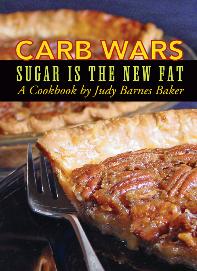
THANK YOU again for sharing your wisdom with us today, Judy! Be sure to pick up YOUR copy of CARB WARS and pay a visit to see Judy Barnes Baker at CarbWarsCookbook.com.
NuNaturals is a company on the cutting edge with NuStevia™
Last month I blogged about how Coca-Cola is pursuing putting the all-natural plant-based Stevia in their diet sodas as a healthier sweetener than the artificially-made chemical aspartame (aka Nutrasweet) that they so readily use in almost all of their calorie-free beverages today. Their crusade represents what I believe is the beginning of the end in the battle for FDA-approval.
With the inevitability of Stevia joining the sweetener market in the United States looming large, one company is already out there leading the charge by producing delicious and healthy Stevia-based products for people to enjoy. It's NuNaturals and they have a full line of stevia and stevia blends that will suit the tastes of anyone who is livin' la vida low-carb.
The quality of these products is unmistakable and I've tried many kinds of Stevia products that were supposed to taste good. Not even close!
NuStevia™ is revolutionizing the sugar alternative industry
Most Stevia products are very bitter, but not NuNaturals. These taste amazing in drinks, used in recipes, and so much more. You can feel confident in sprinkling NuStevia™ White Stevia products on whatever you usually sweeten with sugar for an economic and natural substitute.
For those of you with allergies, you'll be pleased to know NuStevia™ is gluten-free and contains NO soy, yeast, wheat, milk, synthetics, artificial colors, flavors, or preservatives. Cool deal!
Anyone wanting to keep their carbs at ZERO or close to it should try the NuStevia™ NoCarb Blend™ made with just a touch of erythritol. This is the purest form of Stevia you will find anywhere, so it's highly recommended.
If you'd prefer to have a liquid version, they've got that, too!
Of course, there are also liquid versions of NuStevia™, including the hot new Vanilla Stevia Liquid. This does not contain flavorings as other companies products do, but Pure Vanilla Extract from the famous Singing Dog™ Vanilla products.
Liquid Vanilla Stevia is one of the hottest new NuNaturals products
NuNaturals also makes some excellent versions of other popular sweeteners, including Xylitol, Lo Han, and Erythritol. CLICK HERE and check out these sugar alternatives for yourself. I love using them as part of my low-carb lifestyle so that I'll never go back to eating sugar again!
Did you know Diet Coke in Japan is sweetened with the plant-based stevia?
About a year ago I blogged about the controversial all-natural sugar alternative called stevia. At the time, I lamented that stevia was not approved by the Food and Drug Adminstration (FDA) to even be called a sweetener...yet! But that may be about to change if a joint venture with The Coca-Cola Company and a major food additive business has anything to say about it (and you KNOW they will because money talks!).
This USA Today story notes that Coke as well as Cargill Foods have decided to take a serious look at a sweetener they want to call rebiana (a shortened word used for Stevia Rebaudiana). Remember that name they have come up with because it's the term these companies are going to be using for stevia soon and it's been three years in the making.
For people who are livin' la vida low-carb and choose to avoid the use of the chemical-based sweeteners that dominate the marketplace, such as saccharin (Sweet 'N Low), aspartame (Nutrasweet, Equal), and sucralose (Splenda), many of us have been using stevia instead because it contains ZERO calories and carbohydrates. That's certainly impressive nutritional info for a natural alternative to sugar.
But it's gonna be a bit of an uphill battle to get stevia approved since the FDA has come down so strongly AGAINST approving it while this list of sugar alternatives get a free pass--all of which are made from chemicals. But there are still a lot of people who have concerns over the safety of these products (and I get e-mails from people ALL THE TIME about my support for Splenda--get over it already people. That stuff helped me overcome morbid obesity, so leave it be!).
As a result, that's the allure of having commercial acceptance of stevia in a popular product like Diet Coke. With crazy new product concepts like the vitamin-infused Diet Coke Plus (made with aspartame), the "calorie-burning" Enviga (also sweetened with aspartame and a touch of ACE-K), and their marketing darling of the moment Coke Zero (yep, you guessed it, sweetened with aspartame and ACE-K), this idea of making a Diet Coke with Stevia is the best thing they've come up with since my favorite sugar-free soda Diet Coke with Splenda was released to the market (although they've never given it the proper marketing IMHO!).
Interestingly, stevia IS already being used in Diet Coke--in Japan, where stevia boasts a robust 40% of the sweetener market, as well as in Brazil, China, and nine other industrialized countries. So what's taking America so long to get going with this in this country already? The FDA needs to get its head out of their backside and approve stevia as a sweetener.
Are they afraid of the competition it will give that disgusting NASTY-tame? If so, then GOOD! They should be because it's high time people have other alternatives. I'm tired of seeing Nutrasweet in EVERYTHING sugar-free/low-carb I would want to purchase. Put Splenda or stevia in some of these products already! There's a bunch of us who don't like aspartame at all!
Currently, the Coca-Cola Company has been seriously looking at this since 2004 and last week filed a total of 24 patents to begin removing the sweetest parts of stevia so they can come up with the perfect taste and blend of rebiana to be used in their future versions of Diet Coke.
It's not yet known if this new sweetener will eventually be phased in to replaced aspartame or if it will be mixed with ACE-K or other sweeteners in totally different products altogether. But clearly Coke is ready to put stevia on the fast-track to FDA approval.
As for Cargill Foods, they intend to use this stevia-based sweetener in foods like yogurt, cereal, ice cream, and other sugar-free sweet treats. This is expected to be a huge undertaking that could quite literally shake up the food and beverage industry unlike anything that has come along in the past few decades. This is long overdue in America and I can't wait to see it come.
A Cargill representative said this was a "significant investment," so don't expect them to take no for an answer from self-serving interest groups who will oppose the use of stevia in this manner to cover their bedonkadonks with the artificial sweetener companies. That's why Cargill has already begun the process of petitioning the FDA to use stevia as a food additive. It's gonna be difficult, but I'm confident they'll get approval. Stay tuned!
Although Coke is saying the stevia they have tested in several of their products has performed just as well as the aspartame and sucralose for sweetness, I'm not as convinced about it. Sure, stevia is an excellent product and I have used it myself in various forms, but the black licorice-like bitterness can be a real turn-off to some people. The blend will have to be perfect.
I'm sure if stevia finally does make it into a Diet Coke product in the next few years that they'll make it taste as sweet as possible by very likely using an ACE-K blend. It'll probably resemble the aspartame/ACE-K blends that dominate the Coca-Cola line of sugar-free products today. This will be a HUGE step in the right direction for the world's #1 beverage maker (although I wouldn't mind having more Splenda-sweetened options, too--HINT HINT!).
If rebiana becomes a household name thanks to Coke and Cargill Foods, then you can expect PepsiCo, Dannon, and other rivals in the sugar-free/low-carb market to develop their own versions of stevia-sweetened products--perhaps they'll be allowed to actually call it stevia. Actually, if they're smart, then they'll start working on this NOW!
I've long held that having an "all-natural" sweetener like stevia is already on the cutting edge and it's only a matter of time before it is as widely used in the United States just as it is in Japan today. It's not a matter of if, but when. I can't wait to try a Rebiana Coke with a green stevia leaf on the can as a logo to distinguish it from the other versions. This will be the most unique diet soda product to ever release!
It seems that dogs will be dogs and eat just about whatever they can get their teeth into. Unfortunately for Buster, though, that curiousity can be bad news if the item he is eating contains Xylitol because it can cause a sudden drop in your pet's blood sugar which can lead to depression, lack of coordination and even seizures. APCC said this can happen as quickly as thirty minutes after ingesting the Xylitol-based product.
APCC veterinary toxicologist Dr. Eric Dunayer once believed only higher doses of Xylitol would cause problems in canines. However, the latest research has shown that this assumption was incorrect.
“We seem to be learning new information with each case we manage,” he said. “We also have begun to see problems developing from ingestions of products with lesser amounts of this sweetener.”
Just how bad has this problem gotten? In 2005, there were a little more than 170 cases involving pets eating Xylitol products and having medical issues as a result. In 2004, there only 70 such cases. So what about the first six months of 2006? There have already been 114 cases through the end of June.
“It’s difficult to say why there’s such an increase,” an APCC representative explained. “Xylitol products are relatively new to the United States marketplace, so one possibility may be an increase in availability.”
It's true. Xylitol is beginning to be used more and more in a lot of low-carb, sugar-free gums, mints, and other such products. If you are livin' la vida low-carb and use these foods sweetened with Xylitol, then please keep them in a place where your dog cannot get to them. Make sure you read the labels of the products you use to see if they contain Xylitol or not so you can be aware.
This story did not say anything regarding the effect of Xylitol on cats or whether any other sweeteners such as Splenda, Nutrasweet, ACE-K, Sweet N' Low, etc. But it's probably a good idea to keep all of these away from any pets you may own as a safeguard.
There is an excellent resource provided to pet owners by APCC if you believe your pet has consumed anything with Xylitol in it. A toll-free emergency hotline number is available 24 hours a day if you need them:
888-426-4435
Of course, you should also contact your local veterinarian if you need immediate assistance with helping your pet in the event of an adverse reaction to ingesting Xylitol.
On a personal note, that beautiful orange cat you see at the top of this blog post is the latest addition to the Moore household's pet population. Her name is Peaches and she replaces our beloved Millie Jo who died of cancer earlier this year. This kitten is a wild one, too, getting into anything and everything without a care in the world. She's spunky, energetic, and provides Christine and I LOADS of free entertainment! :D I've never seen a cat play with her food like Peaches does. She's our little "stupid." LOL!
I'll be sure that she, Muffin, Ginger and Smokey (the rest of our cat crew!) stay away from the Xylitol. Unless I'm mad at them...JUST KIDDING! Do what you have to do to protect your dogs and cats from this seemingly harmless sweetener.
Why does Audrae Erickson claim HFCS is good for you?
Guess who's unhappy with what I'm writing about sugar and its unhealthy subsidiary product high fructose corn syrup (HFCS) at this blog? It's none other than the President of the Corn Refiners Association named Audrae Erickson.
In a terse response to my article entitled "Diet Soda Study Results Are Absolutely Preposterous," Erickson claims that I "mischaracterized" HFCS as a "unique contributor to obesity." I had previously mentioned HFCS by name in only one other article I wrote at this blog. However, since Erickson has chosen to address the subject of HFCS, let's take a closer look at this villain to your health and waistline.
Erickson describes HFCS as "a natural, home-grown sweetener from U.S. corn fields."
Is that glowing, sentimental description of HFCS supposed to make people forget about how harmful it is for them to consume it? Sugar is sugar no matter what you call it. And HFCS is a potent sugar that is literally catastrophic to anyone who is trying to lose or maintain their weight. Why would anyone suggest otherwise?
Erickson asserted that scientific experts have found that HFCS is "not a unique contributor to obesity." But there are plenty of other studies that have found just the opposite to be true. I invite you to visit my friend Regina Wilshire's blog to get further educated about these new research findings. She'll be happy to share with you the very clear link that has been found between sugar in the form of HFCS and obesity.
But Erickson shocked me the most when she actually had the gall to claim that HFCS "has been proven beneficial to consumers through its use in many foods and beverages, including several products that are specifically made for people trying to control their weight."
Are you kidding me? Is Erickson actually suggesting that HFCS is good for you? The mere fact that it is found in foods and beverages does not necessarily mean it is not going to have an effect on your weight and health. That's like saying the alcohol found in beer is good for your because it is so prevalent in adult beverages. Just because it's in there doesn't mean you body needs it.
As for HFCS being included in products made for people trying to control their weight, that's not surprising since low-fat foods are generally loaded with sugar and/or HFCS. While this sweetener may not have any fat, HFCS is certainly not healthy. Anyone following a low-carb lifestyle knows to avoid this hidden sugar at all costs because it is nothing more than pure, unadulterated sugar!
Characterizing HFCS as "safe," Erickson said it's just as good as table sugar and honey. Is that supposed to make HFCS look better?! My contention is that those sugars are not good for you either! Sugar in ANY form can cause you to rapidly gain weight in excessive amounts.
But HFCS is a lot different than plain sugar. Actually, it is a highly refined, artificially-made product that transforms cornstarch into a sweet, thick and clear liquid that is sweeter than sugar and prevents the body from burning stored fat. Yikes! Not good when you are livin' la vida low-carb!
HFCS replaced sugar during the 1970's because it is cheaper to produce and the obesity problem has gotten progressively worse ever since. Americans consume more than 63 pounds each of HFCS annually today compared with just a half pound in 1970. Fifty-five percent of sweeteners used today are made from corn.
So the next time someone heralds the healthiness of HFCS, just remember it is a dangerous sugar that should be avoided if we are ever going to get this obesity problem under control. But we're glad to see the big boys are watching, though!
06/20/2005 UPDATE: I got the following e-mail from one of my faithful readers today in response to this article.
Hi Jimmy,
I just read your blog posting regarding Audrea Erickson's reply to your previous posting about HFCS. I nearly choked when she stated that it's "a natural, home-grown sweetener from U.S. corn fields." Natural?!! Far from it, considering the processing that HFCS goes through when manufactured. Here are some links regarding HFCS, one about the manufacturing process and the other about the effects that it has on heath:
I quit eating sugar about 1 ½ years ago when I realized that Type II diabetes runs in my mom's side of the family after my mom was diagnosed with it. Fortunately, she had a doctor that advocated a low-carb diet for her to control it (which she has, and has lost about 30 lbs, too.) While I do not follow a particular low carb diet since I do not need to loose weight (I avoid sugar, grains and starchy foods and eat primarily meat, veggies, nuts and some fruits and dairy such as cheese), I have lost 10 lbs, gained a ton of energy (for years I complained to my doctor about fatigue and she want to put me on anti-depressants even though I knew I wasn't depressed) and most wonderful of all, my Irritable Bowel Syndrome which had plagued me for over 20 years literally disappeared overnight when I quit eating grains. My resolve to stick with this way of life is always strengthened when I read about people such as yourself, who have literally transformed their lives with a LC lifestyle. And I really do appreciate your dedication to tearing down the myths and fighting all the misconceptions out there regarding what Living La Vida Low-Carb is all about. Keep up the good fight!
THANK YOU SO MUCH for your encouraging words and for sharing your story of success with me today. You really made my day!


 .)