
 Chris Rosenbloom, meet zero-carb runner Charles Washington!
We are surrounded by people who insist on repeating the same health mantras we've always heard over and over again until they're blue in the face. I'm sure they mean well with their conventional advice and had the right motives when they continued their education into the subject of diet and fitness. But somewhere along the line, many of these people who are placed on a pedestal and declared "experts" have lost their objectivity and ability to think logically about the advice they are sharing. Such is most definitely the case with those healthy journalists at major newspapers.
Whether it's
Sally Squires from The Washington Post,
Heather McPherson from The Orlando Sentinel,
Juliette Kellow from the UK Mirror,
Bill Laitner from The Detroit Free Press,
Bryant Stamford from The Louisville Courier-Journal...the list goes on and on...one thing always remains the same. These people need to be educated about what life is like in the REAL WORLD outside of their monopolistic world view that oftentimes does not match what is happening to real people. As you can tell from those links above, I LOVE challenging these darlings of the health media to do a better job of researching before they go off talking about something they obviously don't have a clue about.
But today I wanted to bring in a special guest to respond to a rather ludicrous column that appeared in the
Atlanta Journal-Constitution this week by
Chris Rosenbloom, Ph.D., R.D. called
"For runners: 'A low-carb approach...can spell disaster'." She asserts in not-so-uncertain terms that a runner absolutely NEEDS carbs for fuel during their workout and that a low-carb diet is NOT recommended for running. We already know
the "body needs carbs" mantra is nonsense because of a fascinating metabolic process that is essential to livin' la vida low-carb called
gluconeogeneis where the body makes its own carbs through the liver from the dietary protein you consume. You never hear any of these "experts" even mention this--EVER!
This topic about carbohydrates being needed for running and training is something
an Olympic athlete repeated to me in August 2007 reacting to a
blog post I wrote about about a study showing more athletes are choosing low-carb diets to help them achieve maximum performance. Then you also have people like world-class marathon sprinter
Roy Pirrung pushing a high-carb, low-fat diet for runners while my blogging friend and fellow Atkins diet weight loss success story
Kent Altena talks about how you can burn fat for fuel when you are running in marathons. There's a great disparity between these two camps and very clearly this Rosenbloom lady is heavily espousing the high-carb theory.
How about we hear from someone from the OTHER side who chooses to burn FAT for fuel during his running experiences? His name is
Charles Washington and he is one of my moderators over at my
"Livin' La Vida Low-Carb Discussion" forum. For those of you who have not heard about Charles, this man is simply amazing. He runs in half-marathons throughout the spring and summer and does it all eating a ZERO-CARB diet. That's right, he doesn't even eat veggie carbs. He's hardcore on what he describes as the
"Zero Carb Path" and I'll be sharing an interview with Charles on my podcast show coming up in July.
For now, I wanted to introduce you to Charles by allowing him to respond to Rosenbloom's idiotic column. As you will quickly see in this guest blog post from Charles, he is quite knowledgeable about what he writes about and has the personal experience from his own life to back up everything he says. I appreciate his willingness to share today and I hope you enjoy this very intelligent rebuttal to the claim that you need carbohydrates for athletic performance. ENJOY!
Here's what Charles wrote in response to Chris Rosenbloom:
Dr. Barry Groves observed that athletics is becoming increasingly competitive. More and more stress is being placed on how well we perform. To reach our highest potential, all of our body systems must be perfectly tuned. Nothing is more important to our well-being and ability to perform than good nutrition. Eating the right foods helps us to maintain desirable body weight, stay physically fit, and establish optimum nerve-muscle reflexes. Without the right foods, even physical conditioning and expert coaching aren't enough to push you to your best. Good nutrition must be a key part of your training program if you are to succeed.
The problems arise when deciding the best nutrition for exercise and athletics.
Chris Rosenbloom of
The Atlanta Journal-Constitution recently posted an article describing the preparations of runners preparing to race in the world-renowned Peachtree Road Race in Atlanta. She quoted Lee Fidler, an area running coach since the early 1980’s:
"Nutrition is an important part of preparing for a road race. I try to get a balance of fruits, vegetables, dairy products and some high-quality protein, but I also use sports drinks and energy bars to boost my calorie and fluid intake. I see too many runners try a low-carb approach, but that can spell disaster for a runner."That's very interesting because I am a runner and I have no carbohydrates or sports drinks as a part of my diet. Has it always been this way that carbohydrates were totally necessary for athletics?
The late
Gordon Pirie, an Olympic medalist from the 1952 games in Helsinki wrote a book called
Running Fast and Injury Free. There he wrote:
“Never eat white flour or its products, nor any sugars, nor any milk that has been homogenized. Scientists can tell you this, unless they are funded by one of the major food companies. Do not believe scientific 'facts' that have been purchased on the backs of food packages.”Nowadays, athletes regularly use sugar and sugar drinks as training aids. How did we get to this point and is this a healthy way to achieve the performance we all seek?
Chris Rosenbloom quoted athletes as all agreeing that carbohydrates with some protein are crucial for training. Pasta and pizza were top choices, with potatoes, brown rice, whole grains, fish and chicken all making an appearance at their training tables. Some rely on energy bars and energy drinks, but most stick to real foods for their training.
To this information, Rosenbloom assigns a letter grade of “A” because in her opinion, carbohydrates fuel runners. “Protein, while important, is not a good substitute for carb[ohydrate]s.” She would love for runners to have iron-rich foods as well to help carry oxygen to muscles.
Unfortunately, advice like this is peddled about in most major athletics publications and most of us accept these so-called truths without qualification. However, upon closer inspection, we find that there is:
No mention of the best fuel for the body: fat. In fact it says earlier that “Carbohydrates are crucial for training.” There was not even a mention of the essential fatty acids necessary to sustain life. Neither does the advice recommend that the fruit and vegetables be cooked. As we know any minerals and vitamins these may contain (and there are actually precious few to begin with) are not released from uncooked fruit and vegetables.
It is also important to note her understanding of what constitutes a “low-carbohydrate” diet. The emphasis is on protein, not fat. We need to understand that low-carbohydrate diets are not high-protein diets. Rather, they are high-fat diets and they regularly only contain little more protein than that recommended by so-called balanced diets. Consuming a high-protein diet causes serious problems as the Inuit Eskimos sometimes learned in the springtime when only lean rabbits were available. They suffered a malaise that swept over the entire population. They called it rabbit starvation. In scientific terms, Dr. Groves explains:
"Excess intake of nitrogen leads in a short space of time to hyperammonaemia, which is a build up of ammonia in the bloodstream. This is toxic to the brain. Many human cultures survive on a purely animal product diet, but only if it is high in fat. A lean meat diet, on the other hand cannot be tolerated; it leads to nausea in as little as three days, symptoms of starvation and ketosis in a week to ten days, severe debilitation in twelve days and possibly death in just a few weeks. A high-fat diet, however, is completely healthy for a lifetime."Therefore, one would not want to substitute protein for carbohydrates as Rosenbloom assumes. Those like her who recommend carbohydrates as the “best fuel for the body” don’t seem to realize two very important points:
First, the body can't store carbohydrates in large quantities and most people already get more than enough carbohydrates to fuel their bodies' daily activities. All carbohydrates, whether they are bread, pasta, sugar or jam when you put them in your mouth, enter the bloodstream as glucose. And the bloodstream can only hold so much.
The body, being a well-run power plant, puts the leftovers in storage to use in the future if it's needed. Some is stored as a type of starch called glycogen, but as it can't store much of this, the body turns most of the excess into fat and keeps it on deposit in the body's fat cells. We see it walking around the streets wherever we go, hanging off bodies in a most unattractive way.
Put simply, carbo-loading cannot work simply because excess carbohydrates are not stored in a readily usable way.
The second problem lies in how the body uses its various options for fuel. Each of our body's cells contains lots of very small power plants called mitochondria. It is they that produce the energy we need from the food that we consume. Glucose is usually called the body's 'preferred fuel' because, if it is available, our bodies have been conditioned from birth to use it first. But it is not the best fuel. That distinction belongs to fats--or fatty acids, to give them their scientific name. Before the mitochondria can use either glucose or fatty acid as a fuel, it has to be transported into the mitochondria.
Fatty acids are transported into the mitochondria as completely intact molecules. Glucose, on the other hand, can be transported only after it has been broken down first into pyruvate by the process of glycolysis. This is then used anaerobically to produce energy with lactate as a by-product.
The by-products of the energy-production process when fatty acids are used are carbon dioxide and water, both of which are easily excreted. But when glucose is used, the lactic acid produced in the conversion process can build up in muscle cells and make them ache. It is this that is the cause of the aching muscles or pain involved in strenuous exercise--'the wall' as athletes call it. This 'wall' severely limits an athlete's performance.
So why would a person want to limit their performance by using carbohydrates for fuel?
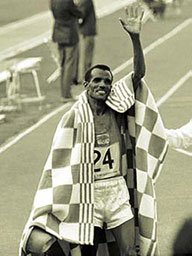 Ethiopian Olympic sprinter Mamo Wolde
Don’t take my word for it, how about the 1968 Olympic Marathon Champion,
Mamo Wolde? It was 1968 at the Mexico City Olympic Games. The spectators at the marathon went wild as a relatively unknown Ethiopian, Mamo Wolde, won the marathon. Not only was the thirty-five-year-old runner the oldest man ever to win this prestigious event, he did it in record time. He also was a silver medalist in the 10,000 meters at the same Olympics.
Wolde grew up in an Ethiopian village. His life consisted of running after and hunting wild game on foot. His diet was high in animal meat and fat, with practically no carbohydrate. Subsequent tests showed that Wolde's body, under conditions of physical load, readily burned fat as its main energy source. Wolde had no concept of 'hitting the wall'. It never happened to him.
While there is little or no scientific evidence that carbohydrates are a particularly good energy food, we know that fats are. Dr. Groves explains further why the best performance is only possible with the correct diet and this applies to humans and animals. With the correct diet, constant exercise and practice to maintain muscle suppleness, strength and stamina doesn't seem to be needed either.
It is well known that carnivorous animals such as lions and tigers are fed their natural diet of fatty meat, even when confined in cages or small pens in zoos for long periods of time, without the opportunity to exercise, do not lose their vigor, strength and endurance. Such animals in circuses are even more confined but they are still able to make prodigious leaps when called upon to do so.
Eskimo sled dogs are normally kept on leashes or in small kennels during the summer months and fed fat meat and fish. When, after some months of such inactivity, the winter arrives and they are required to pull sleds again, they have no need of a period of training or conditioning before they go about their arduous task. And they still manage to pull heavy sleds for up to twelve hours a day. The same applies to English hunting dogs. They do not lose their ability to run hard for long distances when correctly fed.
The same is true of Man. The Eskimo spends most of the year in practical inactivity during the winter months. Confined to his snow-covered hut or igloo, eating meat, fish and fat, he rarely ventures outside for months at a time. But when spring arrives, he immediately begins a very strenuous life, traveling many miles to hunting grounds. He, too needs no period of conditioning after his long winter of inactivity. He also requires less sleep and is much more resistant to fatigue.
In 1895 two Norwegians, Fridtjof Nansen and Frederik Johansen, landed on an island of the Franz Joseph group. They had 'conventional' provisions to last for several weeks but, as there was abundant game in the form of walrus and polar bear, they decided to live off the land and save their provisions until the following summer. From the end of August 1895 until the spring break up of the arctic ice they got no exercise, did not wash themselves or change their clothes, yet they remained in perfect health and were able to do a full day's sledging on their first day of travel.
Rear Admiral Robert Peary also noted the ability of Arctic explorers to subsist for more than a year with no food other than pemmican twice a day. Men doing heavy work required two pounds of pemmican, which was the equivalent of six pounds of meat and a pound of fat per day.
This ability to do fantastic feats of strength and endurance was not confined to the Arctic. Native porters in Australia, eating only kangaroo meat, carried heavy loads for up to twelve hours without rest or refreshment; and Aborigines in the desert, would lope for distances of up to twenty miles, with occasional bursts of speed to catch game, on a handful of worms, bugs and insects, and kangaroo meat.
What all these people (and animals) have in common is their carbohydrate-free diet. Fat is the best fuel for an athlete, carbohydrates are the worst. It really is as simple as that.
THANKS for that well-reasoned retort to the
Atlanta Journal-Constitution column touting carbohydrate consumption for runners, Charles. You know from whence you speak and I look forward to sharing our interview with everyone in July. Let's e-mail Chris Rosenbloom at
dietitian@ajc.com and let her know about how high-fat, low-carb living (or in Charles' case, NO carbs!) has positively impacted your athletic performance.
Labels: athletes, Atlanta Journal-Constitution, carbohydrates, Charles Washington, Chris Rosenbloom, fat, journalist, low-carb, performance, runner, zero carbs


