Don't you know that your body needs carbs in order to function properly?! Come on, you idiot low-carb supporters, how can you tell people to cut down or even eliminate most of their dietary carbohydrate intake from things like healthy whole grain foods like brown rice and pasta and even fruits and vegetables? What kind of reasonable diet would suggest you remove whole categories of foods like this in order to lose weight and live a healthy lifestyle, hmmmm? Well? WELL?!?! How about it Mr. Livin' La Vida Low-Carb Man?!
Siiiiiiiiiiggggghhhhh. That, my friends, is just a typical day in the life of what I put up with in my e-mail box most of the time. People have become so incredibly misinformed about diet and health that they are content with merely repeating back the same old diatribes from those so-called health "experts." It really is a pity that more people can't learn to think for themselves by getting all the facts, analyzing them carefully with the intent on learning the truth, and then applying that knowledge to their own personal experience while sharing it with others. That's what I try to do here at my blog and all my other projects.
It certainly gives you more credibility if you constantly remain a student of health whether you are a doctor, dietitian, nurse, or even a low-carb blogger. I may not have a bunch of letters after my name (although I do have an M.A. in Public Policy...does that count?), I have worked hard to NEVER stop soaking in every bit of information that I can about health so I can share what I discover with you. Then, hopefully you can take that knowledge, apply what is relevant to your own life, share it with someone else, and continue to education further. We live in an age of information and ignorance is no longer a viable excuse--especially on the subject of diet and health.
In Episode 45 of "Livin' La Vida Low-Carb On YouTube," Christine and I wanted to share with the YouTube viewers about a word that is inextricably linked to low-carb dieting, but you really don't hear about it much outside the realm of low-carb research. The word is gluconeogenesis and I contend every single person who is on a carbohydrate-restricted or even a zero carb diet needs to know about this word. I've blogged about it and even did a podcast show on it, but this is much too important a concept for people to miss. Although gluconeogenesis (GNG) is rather complex from a metabolic standpoint looking at all the biochemistry that's involved. Check out this T-shirt from The Nutrition & Metabolism Society that illustrates all the pathways involved with GNG:
Order one of these "geeky" shirts TODAY by clicking here
Learn more about gluconeogenesis in today's video:
Since I uploaded this video to YouTube, there has been some confusion about what I shared in it about how the protein is converted into glucose. My friend Charles Washington, the zero-carb half-marathon runner who recently wrote a guest blog post said it seemed like I was saying that ALL protein gets converted to glucose. I certainly don't want to mislead anyone in that direction because it's not a one for one ratio of conversion. Dr. Eric Westman from Duke University says the studies he has seen say for every 2g of dietary protein consumed, one gram of it is converted to glucose/sugar/carbs. So it's about a 2-1 ratio of conversion which could cause SOME people problems who are especially carbohydrate sensitive (like me!).
This is what I was referring to when I said eating too much protein could POSSIBLY stall your weight loss if you are especially sensitive to carbohydrate whether through eating them or through gluconeogenesis. In looking at some of the reasons for my own struggle this year to get my weight back down despite doing all the right things, gluconeogenesis has come up as a possible culprit for my difficulty. Perhaps for me I need to be eating LESS protein than I currently am while increasing my fat and keeping my carbs to a minimum. This isn't a universal thing for everyone and could be genetic in nature. I'll be blogging more with an update about my weight and health situation very soon.
You guys are awesome for watching our "Livin' La Vida Low-Carb On YouTube" videos and we appreciate hearing your comments about them and suggestions for future topics at livinlowcarbman@charter.net. Don't miss our previous YouTube videos and be sure to subscribe to our YouTube videos if you like what you see. THANK YOU for all of your support and, as always, let us know how we can help you along in this journey to better health. Keep on livin' la vida low-carb! :D
The original 1972 book that made Dr. Atkins famous!
Sometimes I don't even think we realize just how brilliant the late great Dr. Robert C. Atkins really was for espousing what he did during his amazing career. Sure, low-carb diets had been out there in the public eye for over a century (most notably from William Banting in 1864 with his Letter On Corpulence) before he came along. But it was the charisma and enthusiasm for the low-carb lifestyle that Dr. Atkins brought to the public arena that captured the attention of millions of people worldwide who were interested in learning more about how low-carb could help them shed the pounds and restore their good health.
When the original Dr. Atkins' Diet Revolution was published in 1972, it ignited a firestorm of controversy that still lingers on to this day. Despite all the best efforts by those who have appointed themselves the "experts" in diet and health in the United States over the years, none of them have been able to slow down the momentum that the healthy Atkins low-carb nutritional approach has had in the United States and around the world. And if I have anything to say about it, we'll keep that ball rolling for many more years to come.
While his original book has since been updated several times since with Dr. Atkins' New Diet Revolution, there were some incredible nuggets of truth shared in that original book that make it worth having a copy of for your low-carb library. ORDER A COPY and read it from cover to cover because you will learn more about livin' la vida low-carb in just that one book alone that was written nearly forty years ago. Like I said, we're only just beginning to realize what a genius Dr. Atkins really was.
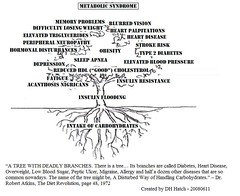
One of my blog readers from Green Bay, Wisconsin named Dave Hatch wrote to me recently stating he had read Gary Taubes' Good Calories, Bad Calories and that inspired him to go back to the original Atkins' Diet Revolution book from the 1970's and read it again. When he did, a light bulb moment happened for Dave when he saw the following quote from Dr. Atkins.
"A TREE WITH DEADLY BRANCHES. There is a tree...it's branches are called, Diabetes, Heart Disease, Overweight, Low Blood Sugar, Peptic Ulcer, Migraine, Allergy and half a dozen other diseases that are so common nowadays. The name of the tree might be, A Disturbed Way Of Handling Carbohydrates."
That quote appears on page 48 of Atkins' Diet Revolution and it got the wheels turning inside of Dave's head to recreate that image into the shape of a real tree illustration to vividly demonstrate these signs of failing health and their connection to carbohydrate intake. He did a masterful job of showing that carbs are the roots that feed all of these diseases that Dr. Atkins talked about in his book.
Click on the image below to see a larger version of Dave's tree:
Isn't this GREAT?! Dave did a yeoman's job of taking that quote from the 1972 book and illustrating it perfectly so that anyone and everyone will be able to see the carbohydrate connection to all of these conditions. And every single one of those health ailments have been documented in the research literature to be tied to the consumption of carbohydrates.
My favorite part of the tree analogy is the trunk itself. As I stated, the roots are the "intake of carbohydrates" and the branches are the negative health manifestations from eating all those carbs. But look right there in the middle of those two things at what is the real reason that most people should be livin' la vida low-carb--INSULIN!
Yes, this "flooding" of insulin into our bodies is a direct result of consuming carbohydrates, especially in the amounts that are being recommended by people supposedly in authority over matters concerning health. And don't even get me started on the diet diabetics are told is best for them by the American Diabetes Association (ADA). UGH! If a doctor or dietitian tries to convince a diabetic to include eating lots of "healthy" carbs, then they ought to have their medical and nutritional credentials revoked!
If you control the insulin, then you can prevent these diseases from happening in the first place. And the best way to control this insulin release is by following a significantly reduced-carbohydrate diet. There's just no bones about it, this way of eating that we talk about here is not just a healthy diet (which it is), but it is the ONLY way you can eat to prevent this insulin rush from happening. Try eating a low-fat diet and you'll find yourself trying to make up that lost fat intake with (surprise, surprise!) MORE carbohydrates. This in turn produces MORE insulin which leads to the vicious cycle of disease all over again. Why do that to yourself?
While low-carb is often dismissed by its critics for supposedly being too "high-protein" (it's not high in protein, but rather moderate in protein) and/or "high-fat" (which is not a negative factor for your health when you are reducing your carbohydrates and only the total caloric percentage of your fat actually goes up), the fact of the matter is neither of these other macronutrients have the instantaneous insulin response that carbohydrates do. Carbs equals insulin equals disease. Nobody can even dispute this fact.
It's impossible to ignore the indelible link between carbs which heavily increases insulin in the body which then manifests itself in all of these terrible health conditions. Dr. Atkins saw this coming decades ago and yet we still ignore all the warning signs and try to come up with a pharmaceutical answer to these health problems in 2008. Haven't we learned ANYTHING in the years since 1972 when Dr. Atkins wrote his book?
You very likely don't need a prescription drug to treat that medical condition you have. Just take a closer look at your diet and realize you are feeding your disease by the foods you are eating. Fix that and you'll very likely fix your health problem. Low-carb is not some "magic pill" for every health problem you will encounter. But it will certainly address MANY of the ones that are tied metabolically to carbs. And there's a bunch of 'em!
Dr. Atkins, you were indeed a bona fide genius and your legacy will continue to live on strong for many years to come! Special thanks to my reader Dave Hatch for sharing his tree illustration with us and I think he'd appreciate hearing what you have to say about it in the comments section. Do you think he encapsulated what Dr. Atkins was talking about in the quote? Or does that illustration lack essential part of the equation? Share your thoughts about it below.
I am now a contributor to the outstanding diabetes site dLife
I'm pleased to share with you another new writing opportunity I have been given with one of the premier health web sites on the Internet today--dLife. They were impressed by my writing skills and strong blog following and asked me to contribute to their Food and Nutrition section on a monthly basis. It was such an honor to have this opportunity to write about livin' la vida low-carb in an arena that is not necessarily pro-low-carb.
My very first column is now available for you to read: "Research Round-Up: The Case For Low-Carb." I shared about how the new Gary Taubes book Good Calories, Bad Calories has brought low-carb back to the forefront again and that some very exciting research has come out in support for low-carb living in 2007.
These dLife columns will feature much of the research showing why carbohydrate restriction is healthy and why high-carb, low-fat diets are not. My column for November will take a closer look at the high-carb diet studies showing how this nutritional approach leads to a decline in health. You'll enjoy that one! :)
Be sure to tell everyone about Jimmy Moore's new dLife column!
Dr. Matthew Hayes interested in how and why low-carb diets work
I am so encouraged to know there are some absolutely phenomenal talents coming up through the ranks of higher education who are dedicated to looking further into the subject of livin' la vida low-carb. Although low-carb has been battered and beaten insde and out by those who fear it the most--that would be the low-fatties!--it's arguably the most popular subject of nutritional research happening right now.
Working behind the scenes of this low-carb science movement are some especially gifted and intelligent individuals who are literally putting themselves and their reputations out there amongst their peers in the research community because they would dare share positive information as it relates to low-carb diets. I have the greatest respect for so many of these people, especially the young ones who will be around for the next 40, 50, or 60 years adding layer upon layer of evidence to continue proving the veracity of the low-carb lifestyle.
Now we can add Dr. Matthew R. Hayes from the University of Pennsylvania to that list.
This Atlanta Journal & Constitution story details a new study from Dr. Hayes confirming a low-carb diet is good for people suffering from metabolic syndrome, a condition where obesity, high triglycerides, low HDL "good" cholesterol, high blood sugar, hypertension and insulin resistance leads to a greater risk for diabetes, stroke and heart disease.
We first heard this message before from Dr. Volek and Dr. Richard Feinman from SUNY Downstate in Brooklyn, NY way back in 2005. This new research further solidifies the strong signs that this remarkable way of eating we know and love is indeed what's right for optimal weight and health.
Dr. Hayes, who started this study of low-carb diets on metabolic syndrome while still earning his doctorate degree, and his fellow researchers looked at 20 men and women diagnosed with metabolic syndrome and placed them on a South Beach-styled low-carb diet over a three-month with the following parameters regarding carbohydrate consumption:
PHASE ONE--Two weeks of 10 percent of their calories from carbs PHASE TWO--Ten weeks of up to 27 percent of their calories from carbs
The average starting weight off the study participants was slightly higher than 200 pounds and the diet itself worked to bring about the expected weight loss as well as total body fat.
"By the end of the study, the subjects weighed about 193, 194," Dr. Hayes noted. "They lost close to 10 pounds during the three-month study."
I always hate seeing such small weight loss results in small studies like this because it doesn't give people the full potential of what livin' la vida low-carb can actually produce in people. Ten pounds lost in three months is ONLY about 3 pounds a month. The same results happened in the infamous Gardner study published in JAMA earlier this year.
What's up with such a LOW amount of weight loss on low-carb? When I started out on the Atkins diet in January 2004, I lost 30 pounds in the first month and then another 40 pounds in the second month. Granted, I was 410 pounds at the beginning, but most low-carbers I know EASILY lose 3-4 pounds a month as a bare minimum when they begin a low-carb regimen. Why is the weight loss so slow for these study participants? Things that make you go hmmmm.
Perhaps what I'm about to share with shed some light on the lower weight loss results.
As with most studies of this type, compliance with the parameters set by the researchers was a problem because the study participants did not follow it exactly as prescribed (why they wouldn't want to is beyond me!). Here's the ACTUAL carbohydrate intake average for those members of the study:
PHASE ONE--25 percent of calories from carbs (15 percent HIGHER) PHASE TWO--35 percent of calories from carbs (8 percent HIGHER)
Even still, Dr. Hayes said these higher carb counts were significantly LOWER than what they were eating prior to the study--a whopping 47 percent of their calories from carbs. And, more importantly than the weight loss was the impact on their health.
"By the end of the study, about 50 percent no longer had metabolic syndrome," he added.
Can you imagine how much better both weight loss and metabolic syndrome would have been if they did low-carb like they were supposed to? The pounds shed could have been 30+ pounds and metabolic syndrome could very well show a nearly 100 percent improvement in ALL of the study subjects. We need to somehow have a study that mandates compliance so that abnormalities in the data don't reflect poorly on the low-carb diet itself.
As for the weight loss, Dr. Hayes looked at various metabolic markers to find a clue about how low-carb diets treat obesity and disease. This included measuring the hormones in the blood, insulin levels, leptin, and cholecystokinin (CCK). He found there were changes happening in the hormones, including a drop in insulin and leptin levels after PHASE ONE.
"It was fast," Dr. Hayes explained.
In PHASE TWO, insulin and leptin levels came back up, but something interesting happened. While insulin levels returned to the same place they were prior to the study, leptin levels remained BELOW baseline.
Dr. Hayes says this is what may explain why livin' la vida low-carb works.
"These alternations in hormone levels acting together help reduce the amount of food consumed," he revealed. "There's a synergy. Based on the literature already out there, we are speculating that this synergy of hormones may be the mechanism explaining why people are satisfied with less food and [low-carb] results in weight loss."
The results of this stunning new research are published in the August 2007 issue of The Journal of Nutrition.
Of course, Dr. Hayes admits his study is too small to make broad generalizations about using a low-carb diet to treat metabolic syndrome, but it certainly opens the door of opportunity for an even larger, more extensive study for the future. I have a feeling he is probably already in the process of making that larger study happen and I can't wait to see what he finds out.
I was very pleased to see Dr. Hayes talk about the electricity happening within the research circles behind the scenes regarding low-carb diets because I have longed held the belief that the future of low-carb acceptance hinges on the research.
"There is this strong interest in the field in carb-restricted diets in the treatment of obesity," he said. "That [interest] comes from a number of controlled clinical trials that demonstrate overweight or obese people, maintained on low-carb diets, are successful if they adhere to the diet."
This has brought about a "hot debate" in the diet work that shows no signs of cooling off anytime soon, especially with data being promoted by the advocates of a low-fat, vegan diet seeming to capture most of the headlines. Sooner or later, somebody somewhere is gonna have to fess up that their diet is not as healthy as they claim. I'm putting my money on the high-carb, low-fat supporters having to cave.
You can e-mail your support for and comments to Dr. Matthew Hayes about his study on low-carb diets and metabolic syndrome at hayesmr@sas.upenn.edu.
One of the problems with discussing the subject of low-carb at this blog is the unfortunate problem that has always existed about this way of eating. It's the inescapable reality that there is no clear-cut definition of what constitutes a "low-carb" diet.
When I started on the Atkins "low-carb" diet in 2004 to help me lose weight, that called for me to begin a two-week Induction period of 20g carbohydrate daily followed by an average of 30-35g carbs for the duration of my weight loss. Nowadays, I eat 50-60g carbs daily.
There are other "low-carb" plans like South Beach and The Zone which call for more carb consumption as high as 75-100g a day, but I am not aware of any that allow more than 100g daily. That's clearly too many carbs to be considered "low-carb."
Then you've got the issue of fiber and sugar alcohols. Should you count them in your total carbohydrates or subtract them since they do not impact your blood sugar as quickly as refined and simple carbs? I have never counted fiber or sugar alcohols personally, but everyone is different.
With this misunderstanding about what a REAL "low-carb" diet is, it's easy to see how someone may THINK they are meticulously livin' la vida low-carb when they really aren't. Such is the case of one of my readers who e-mailed me about his "low-carb" diet the other day and wondered why it isn't working very well.
Here's his e-mail:
Jimmy,
I wanted to tell you that I really like how you write your blog about eating limited carbohydrates and trying to lose weight. I have been in a "psychological" tailspin for the past few weeks and it seems to be helpful to my psyche to read what others have experienced and to ask as many questions of people as possible. It's kinda like a web support group.
So, if you have a minute I'd like to ask you your opinion. Here goes....
1) I was diagnosed with Type 2 diabetes 6+ months ago. Totally eliminated all those "bad" sugar-filled foods that I ate and denied that I did so. As a result my A1C went from 10.4 to most recently 5.6. So, obviously I'm feeling like I have this blood sugar problem handled.
2) But here's the problem. I'm 50 years old, lost 36 pounds in the first 4 months with a goal of losing a total of 60 pounds(from 247 to 185 or so). However, although my BS level is in check, this past visit to the doctor I learned that I had lost a whopping 1 pound. That is why I was devistated.
3) I really haven't changed my diet all that much from the first 3-4 months to the most recent 3 months and can't figure out why I have stopped losing weight. I also greatly increased my workout routine as an obvious result of having more energy. I run 10 miles a week on the treadmill and do a 10-station routine of weight lifting, so I'm wondering how in the heck I could go 3 months of eating lettuce, some chicken and fruit and lose only 1 pound.
4) My doctor doubted that I was eating less than 1500 calories a day and not losing weight. Well, I kept a diary for the past week or so, including every single calorie I ate from packets of ketchup to the occassional whole wheat crackers (5 at a time as a snack). My regular eating does include a bowl of cereal and a slice of whole wheat bread with low fat cottage cheese every day for breakfast, but you know what, it is the exact same thing that I ate while I lost the 36 pounds.
5) Over the past week I confirmed what I thought. Am I eating like a rabbit, no. But I've averaged 1350 calories a day, 40 grams of fat and about 135 carbs per day. Plus I am running and lifting weights 3-4 times a week, and play 3 sets of tennis 2-3 times a week. I know I could stand to lose some of the carbs, but then again, keep in mind that I was probably eating the same amount before and I lost 36 pounds, so what gives?
Sorry for the long, long message, but if you have any insight as to what gives, I would appreciate it. Personally, I am thinking that my body's metabolism has reset itself to a lower level and maybe I am changing some of my previous fat into small muscle, although I really can't see too much of this visually. I want to lose pounds. That's the bottom line. So, what do you think? Thanks again for your time.
Do you see what I mean about the problem with no definition of "low-carb?" After reading this man's story, I have a few observations to share that may help get him past this "tailspin" he finds himself in.
First, let me say CONGRATULATIONS on making this your way of eating for treating your diabetes. The low-carb lifestyle has been found to be an excellent way to control blood sugars and reduce your dependence on insulin and medications for diabetics. Here's an excellent article every diabetic absolutely must read.
While I applaud your effort to remove the "bad" sugar carbs from your diet, can I let you in on a secret? When you eat carbohydrate, whether it is in the form of sugar or starch, your body treats it exactly the same way. Yep! That slice of whole wheat bread, the low-fat cottage cheese, and the bowl of cereal are all turning into sugar inside your body which could be the culprit in your inability to lose weight.
At 135g carbs daily, you are not even close to being in a ketogenic state. This is absolutely critical if you are expecting to be successful at making livin' la vida low-carb into a permanent lifestyle change that will produce weight reduction and diabetes control.
Sure, you may have seen some weight loss and improved blood sugars from the way you were eating, but a more significant reduction in carbohydrate intake will help you even more. It doesn't sound like you've read any book on low-carb, so might I suggest Atkins Diabetes Revolution by Dr. Mary C. Vernon and Jacqueline Eberstein? It's FANTASTIC and will help you understand how and why low-carb works so well for weight loss and diabetes management.
If the scale is "devasting" you, then put the stupid thing away for a while. If you are following the plan as you are supposed to, then it won't be necessary to obsess over the scale. The last thing you want to do is give up, so hang in there. Think about your blood sugars being under control and how your clothes feel. These are better indicators of your success than just your weight loss.
Finally, make sure you are eating enough fat and calories to sustain your energy needs. With all the exercise you are doing, it doesn't seem like you are eating enough food. I ate well over 2000 calories a day while losing weight and still do today eating a diet with a fat/protein/carbohydrate ratio of 60/30/10. Hopefully this helps and I welcome your feedback anytime!
I think I love this guy (in a brotherly kind of way, of course!) because he just makes sense. And he should know what he's talking about since he has appeared on magazine covers, on television shows, and headed up an anti-obesity campaign in Houston, Texas. As a world-class bodybuilder, Labrada has seen all the good and the bad when it comes to health and he shares it in this engaging book.
With a natural wit and ability to connect with his reader, Labrada goes through step-by-step what YOU need to do to overcome the mental obstacles that stand in the way of your eventual success, provides examples of people who have been successful to serve as inspiration for your new journey, arm you with ample motivation for getting the job done, providing specifics about the kind of diet you should be eating to attain optimal results, and, of course, give you specific direction about how to workout your body to look and feel better than you ever imagined.
Sounds awesome, doesn't it? But aren't books like The Lean Body Promise just a bunch of marketing hype from people who have never had to deal with being overweight and out of shape? While that's probably true about many such programs, you can sense Labrada takes a personal interest in seeing real success from average everyday people like you and me. I think he really does care about YOUR success and will celebrate with you once you reach your goals.
The chapters in this book zoom by quickly thanks to Labrada's unique conversational style and the very clean formatting. Of course, it doesn't hurt to have his smiling picture looking at you from time to time to encourage you to implement his strategies into your life to change it for the better. It's like he's watching you as your own personal weight and fitness coach!
Easy-to-digest sections in each chapter are followed up by "The Skinny So Far..." to recap the primary points Labrada wanted you to remember. This is an extremely helpful way to reinforce the lessons you have learned so that you'll be well on your way to having that "lean body" he promises in just three months! YOU CAN DO IT!
As someone who has lost nearly 200 pounds on the low-carb lifestyle, I did have a few concerns about Labrada's views about diet in The Lean Body Promise. It wasn't all bad, especially his disdain for sugar and simple carbs, processed foods, trans fats, junk foods, and even those packaged low-fat foods. We totally agree that these are NOT good for you no matter how you slice it.
Where we part company is on the subjects of saturated fat and complex carbs.
Tons of research has come out and will be coming out very soon (remember the names Dr. Jeff Volek and Dr. Stephen Phinney) showing the minimized impact of saturated fat on the body when carbohydrate-restriction is in place. On a low-carb diet, such as Dr. Atkins New Diet Revolution (the one I followed), consumption of red meat, egg yolks, bacon, butter, and the like are all extremely healthy for you because the atherogenic impact is minimized.
Actually, what Volek and Phinney have found is those who eat a high-carb diet that is lower in saturated fat content actually have more saturated fat in their blood than those who eat a low-carb diet that is higher in saturated fat content. This is a revolutionary new discovery that's gonna turn everything we've ever known about fat and heart health on its head. It's something the late great Dr. Robert C. Atkins talked about frequently and now the science is catching up to him.
As for the subject of complex carbohydrates, Labrada claims these are not as bad for you as simple carbs because they take more time to be digested and broken down which slows their impact on your blood sugar. While that's true, these carbs are still metabolized in the body as sugar. Even the supposedly "healthy" whole grain foods like oatmeal, brown rice, beans, corn, rice cakes, peas, and whole-grain breads and pastas should be avoided as much as possible to limit insulin spikes.
Despite our differences on these issues, I am still glad to know there are people like Lee Labrada out there trumpeting the cause of improving health and helping people realize they CAN change their diet for the better. The Lean Body Promise is an excellent resource for anyone who wants to learn more about how to whip their body into shape, shed the pounds, burn the body fat, and get healthier than they've ever been in their entire life.
That's a promise this former Mr. Universe says you can take to the bank!
We all know how well livin' la vida low-carb works for adults to produce weight loss, improvements in health, and changes in your life that are simply indescribable. I can personally attest to all three of these and enjoy proclaiming them boldly and proudly here at my blog as much as possible on a daily basis.
But what about children and teenagers? Is a low-carb diet appropriate for them, too? Well, according to this Newswise story, there's a new study that answers that question with a resounding and undeniable YES!
Lead researcher Dr. Robert Siegel, medical director at the Cincinnati Children’s Hospital Medical Center, wanted to see the impact of a low-carbohydrate diet weight loss approach on obese teenagers when a pediatrician is involved in dietary recommendations and support. The study lasted six months and carbohydrate restriction was the primary means for attaining the objective.
The study participants were from 25 pediatric offices with 47 pediatricians in the Cincinnati, Ohio area and were between the ages of 12 and 18 with a body mass index (BMI) in the 95th percentile range for their age, or clinically morbidly obese. Nearly two-thirds (63 percent) of the children were placed on a ketogenic low-carb diet with 50g or less carbohydrate daily.
The pediatrician and a dietitian counseled the study participants regularly to make sure they understood their new diet and to provide any helpful tips and advice about what they can eat and thrive on low-carb. Nearly 60 percent of the study participants stuck with the plan for the entire six-month period.
So, how well did livin' la vida low-carb perform for these teens?
Very few of the study participants failed to lose weight with an impressive 84 percent of them experiencing an average 11-pound weight loss. There was a wide range of results from a 12-pound weight GAIN (how much you wanna bet this kid didn't eat less than 50g carbs?) to an eye-popping 53-pound weight LOSS (an average of 18 pounds a month! WOW!).
Just as impressive was the fact that the teenagers saw a "significant decrease" in their BMI and a huge boost in their self-esteem. This is one of the most overlooked aspects of livin' la vida low-carb. Because you see such quick weight loss on low-carb rather than the discouragingly slow drip-drip-drip of a half-pound or so a week on low-fat diets, you DO feel more confident and better about yourself.
When you are a teenager, this is VERY important when self-image is magnified a MILLION times more than when you become an adult. Perhaps these obese teens who are losing weight have never had the courage to go out on a date, speak up in class, participate in social activities, and other such formative events in their life. I remember how it felt to be an outcast of sorts because of my weight as a child and young adult. Livin' la vida low-carb changed that FOREVER! WOO HOO!
Dr. Siegel was impressed with the results of the low-carb diet and warned that the obesity epidemic will only get worse the longer we ignore low-carb as a possible remedy.
“Most obese children go on to become obese adults and will face related morbidity and mortality risks," he said. "Pediatricians are often frustrated in finding an intervention that is feasible and successful in the office setting. A low-carb diet may be one answer.”
What was that? A LOW-CARB DIET MAY BE ONE ANSWER!
Can we put that in the headline of every newspaper in America, flash it across the screen on all the cable news channels, quote it on the radio at the top of the hour news...oh, sorry, I got so caught up in how amazing that quote from Dr. Siegel that reality escaped me momentarily. You and I both know that'll NEVER happen with the anti-low-carb bias that exists in the media! Otherwise, it would have ALREADY happened, right?
Wanna know what else happened to the teens in the study typical of a low-carb diet? They spontaneously cut back on their calories. Yep, even without counting them, the average daily caloric intake was CUT IN HALF--an incredible 1200 calories--from 2,401 down to 1,153. This study shows it's true!
Also typical of the low-carb lifestyle that was borne out in this study is that the amount of fat consumed actually remains unchanged, although the percentage of fat in the diet increases. As much as the low-fatties like to claim the Atkins low-carb diet is so "high-fat," the fact is the amount of fat eaten is the very same as what people have been eating. So much for that lame excuse. How's that for some cold hard truth?!
It all comes down to making better food choices rather than obsessing over foods and even teenagers can learn an invaluable lesson that will serve them well for the rest of their long and healthy lives. No more inevitable weight loss surgery for these kids.
In a related story, this London Telegraph story takes advantage of the popularity of television shows like NBC's "The Biggest Loser" and CBS's "Survivor" to create a reality show for obese British teenagers unlike anything you've ever seen before!
The six one-hour shows over a three-week period, set to feature five boys and five girls 16-19 years old, will be called "Fat Teens Can't Hunt" and will feature the original Aborigines children teaching 10 overweight British teens about how to eat like the native people did. Yep, you heard me right, these kids will have to become hunter-gatherers just like our early ancestors.
It won't be airing until late 2007/early 2008, but what an incredible concept! Much in the same way Michael Pollan described in his book The Omnivore's Dilemma, the kids will be required to find and kill their own food or go hungry. EEEK!
What's gonna be in their diet? Nuts, berries, fish...hmmm...
Do you notice what the macronutrient composition of that diet is? If you answered high-fat, high-protein, and low-carb, then you would be absolutely correct! Yeah!!! When can we get this show to come to the United States, hmmm?
I'm sure low-carb researcher Dr. Jay Wortman, who I met this past weekend in Nashville, Tennessee at the Nutrition & Metabolism seminar, would be more than happy to introduce some obese American teenagers to the First Nations aborigines people in Canada.
Although they have already been criticized for being cruel to the children on the show by making them actually find the food they want to eat, the show's producers say it's a novel concept that will make the teenagers appreciate where their food comes from.
"These kids will have to catch, trap, pluck, skin and eviscerate the animals they come across," the producer said. "We'll film them tasting the fruits of their labours."
If the teens get stuck and can't find any food to eat for two days or more, then the television show's producers will provide "emergency rations" to help them survive. Of course, medical professionals will be on hand to keep track the health of the contestants. The producers anticipate the move to livin' la vida low-carb as a permanent healthy lifestyle change takes about three weeks, so they are hopeful the contestants will continue their new habits beyond the show.
I love the attitude of the producers about their show.
"This experiment gives our teenagers a unique opportunity to address their dysfunctional relationship with food, once and for all, before they reach adulthood," they said.
Hallelujah! Somebody pinch me because this has got to be a dream. Livin' la vida low-carb is gonna be on full display featured prominently in a major television series in the UK. When the kids successfully start losing weight and on the road to a healthy life. It's a beautiful visual of what Dr. Siegel found to be true in his study.
Let the endless screaming by the pompous low-fat gurus begin!
Antonia Trichopoulou found that higher protein leads to increased death
Oh no! I guess all of us low-carbers need to make sure our will is written because it looks like we're all headed for a one-way ticket to the cemetary. Well, that's what some are claiming after reading this European Journal of Clinical Nutrition study about mortality rates of people on a high-protein, low-carb diet.
Lead researcher Antonia Trichopoulou from the Department of Hygiene and Epidemiology in the School of Medicine at the University of Athens in Athens, Greece wanted to see what the mortality rates of people who stay on a high-protein, low-carb diet over the long-term.
Using the Greek population to comprise her pool of study participants, Trichopoulou observed the diet of 22,944 healthy adults and assessed their diet by way of a questionnaire. The researchers paid especially close attention to the protein and carbohydrate levels of the people in the study and more specifically their relationship to the rate of death among specific categories of people.
What she found was that 455 deaths happened over the 10-year period which Trichopoulou contributed to "high values of the additive low carbohydrate-high protein" diet. She also added that the study participants who ate such a diet saw more cardiovascular and cancer deaths than those who ate a high-carb diet.
Trichopoulou's grim conclusion? She said, "Prolonged consumption of diets low in carbohydrates and high in protein is associated with an increase in total mortality."
Aw man! I was just getting used to eating this way and now this researcher has to come along and ruin my day like this! Actually, while it is certainly an interesting study to look at, I'm not buying it. Whenever you leave the study data in the hands of the participants as they did in this study, you are opening yourself up for suspicious results.
But, despite my doubts about the veracity of the study results, you and I were challenged by a board certified dietitian named Dr. Steven Acocella to refute it under the assumption that it is a legitimate study. Before I share with you his challenge, I think you need to know a little more about this gentleman first.
As you can see from this DiseaseProof.com article featuring Dr. Acocella, he's no fan of the late great Dr. Robert C. Atkins and his low-carb, high-protein diet. As a fellow colleague of low-fat vegetarian diet advocate Dr. Joel Furhman, we can presume he too believes meat should not be a major part of a healthy diet. Thus, a study like this one from Greece seems to further his position.
So, here's his challenge to people who are livin' la vida low-carb:
Dear Jimmy and blog members -
I know that the low-carb approach focuses caloric intake on high-fat but we all agree by default this diet style is also low-carb and high in protein, as fatty foods are often derived from high-protein foods. I know I'm in the lion's den here but Jimmy often posts opposing view and allows hearty debate. My post will hopefully inspire such discourse.
I will not editorialize on the study, but simply listen to you and your reader’s comments. I will say that there's no reason that we need to dispute the efficacy of the study itself. Let's go from the position that the study is not flawed. Let's discuss the science and findings.
The conclusions of the authors are reproducible and consistent. What do you all think? If you do post this study I applaud your willingness to explore the science and not ignore nor dismiss it.
I am keen on hearing the comments.
Dr. Steven Acocella Board Certified Dietitian Doctor of Chiropractic Medicine Master of Science Human Nutrition Fellow - American College of Lifestyle Medicine Diplomate - American Clinical Board of Nutrition
THANK YOU for the challenge, Dr. Acocella! I'm more than happy to let my intelligent audience of readers share with you their collective wisdom about carbohydrate restriction. Debate of ideas is what I'm all about and I appreciate your willingness to listen.
Okay, if you are on a high-protein, low-carb diet and STILL living, please let us know by leaving a comment. LOL! Just kidding, but I think it makes a point.
The idea that you are killing yourself eating this way is absolutely absurd, study or no study. I don't need a study to tell me this because I'm living it, Dr. Acocella. And so are millions more to the betterment of their health and weight.
Also, you can e-mail Antonia Trichopoulou about her study at antonia@nut.uoa.gr.