MOVED TO LIVINLAVIDALOWCARB.COM/BLOG

PLEASE UPDATE YOUR BOOKMARKS TO LIVINLAVIDALOWCARB.COM/BLOG

Tuesday, July 17, 2007

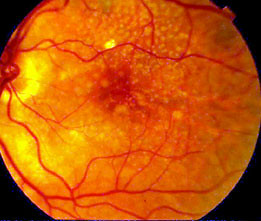
Study: High-Carb Diet Leads To Advanced Age-Related Macular Degeneration, Possible Blindness


Dr. Allen Taylor found AMD speeds up rapidly on a high-carb diet

It's not looking good for the highly-recommended, government-approved high-carb diet. We already know from previous research that such a diet leads to acne, increased blood pressure, an inability to lose weight in people with hyperinsulinemia, lower HDL "good" cholesterol and much higher triglycerides, the development of esophageal cancer, kidney cancer, and other forms of cancer, the development of Type 2 diabetes, and negligible weight loss, among a variety of other health-related concerns.

Now we can add to that ever-growing list of ailments something else--an increase in the risk of developing advanced age-related macular degeneration, or AMD, according to this Food Navigator story.

Dr. Allen Taylor, Senior Scientist and Director in the Laboratory for Nutrition and Vision Research at the Jean Mayer USDA HNRCA at Tufts University in Boston, MA, and his fellow researchers observed nearly 4,100 nondiabetic senior citizens between the ages of 55-80 years old (average age for men was 79.3, for women was 77.9) in a nationwide study called the Age-Related Eye Disease Study (AREDS) to determine the impact of their diet on AMD, a very serious eye condition that has become the #1 reason for blindness in people 50 and over.

What the researchers found was those study participants who consumed a higher-carb diet than the average for their age experience a 49 PERCENT INCREASE in the risk of developing advanced AMD. Dr. Taylor said the more carbs that were consumed, the greater the risk.

"Men and women who consumed diets with a higher glycemic index than average for their gender and age-group were at greater risk of developing advanced AMD," he said. "The severity of AMD increased with increasing dietary glycemic index."

Interestingly, the kind and amount of carbs was not even a factor in this study originally, but it quickly became one once the researchers noticed the correlation between carbohydrates consumed and the advancement of AMD.

"Although carbohydrate quality was not the main focus in the AREDS, we were fortunate that the investigators had collected the dietary carbohydrate information we needed to do our analyses," Dr. Taylor revealed.

The results of this study found that 1 in 5 cases of advanced AMD would likely have been PREVENTED entirely by consuming a lower-carb diet.

As those of us who are livin' la vida low-carb know, the higher the glycemic index in the foods you eat the greater the impact on blood sugar which spike insulin levels causing all sorts of health problems. Eating a true low-G.I. diet (and I mean a REAL one, not the one being promoted by Rick Gallop!) which will be naturally low in carbs can help avert many of these issues.

The connection has now been made between the level of carbohydrate and AMD, too.

"Our results support our hypothesis that dietary glycemic index, which has been related to the risk of diabetes, is also associated with the risk and severity of AMD," Dr. Taylor noted.

He likens the damage to the eye tissue caused by a high-carb diet to that of a diabetic. Low-carb is now being considered as a possible simple resolution to these conditions, but Dr. Taylor said there will need to be further studies to confirm this as a recommended treatment for preventing AMD.

The results of this study appear in the July 2007 issue of the American Journal of Clinical Nutrition.

You can e-mail Dr. Allen Taylor about his study at allen.taylor@tufts.edu.

Labels: , , , , , , , , , , ,

Saturday, April 28, 2007

Study Suggests Find The Diet Right For You


Dr. Susan Roberts studied low-carb and low-fat diets for weight loss

What's the secret to losing weight and keeping it off over the long-term?

I've probably revealed the simple answer to that question a million times before at my blog--find the diet that's right for you, learn all you can about that particular plan to do it correctly, and then keep doing it for the rest of your life. Yes, I lost nearly 200 pounds on the Atkins low-carb diet and have been blogging about it for over two years, but I realize this way of eating is not for everyone.

Now this WebMD story highlights a new study that confirms this notion of discovering the customized plan that works for the individual. However, there are some aspects of this research I didn't think were fair to livin' la vida low-carb. I'll discuss my objections in just a moment.

Lead researcher Dr. Susan B. Roberts, Senior Scientist and Director of the Energy Metabolism Laboratory in the Jean Mayer USDA HNRCA at the Boston, MA-based Tufts University, and her fellow researchers wanted to try to settle the age-old question of which diet makeup is best for weight loss and weight maintenance.

The researchers observed 34 healthy, but overweight men and women who were placed on a calorie-restricted diet where their total caloric intake was cut by 30 percent. However, the study participants were split into one of two groups:

LOW-GLYCEMIC LOAD LOWER-CARB DIET (LG) or
HIGH-GLYCEMIC LOAD LOW-FAT DIET (HG)

The LG group avoided foods with sugar and starch, but still ate 40 percent of their calories as carbohydrates. The macronutrient breakdown of the fat and protein were 30 percent each. Interestingly, they call this a "low-carb" diet, but it's not low enough for most of us who are livin' la vida low-carb. This more closely resembles The Zone diet.

The HG group, on the other hand, ate 60 percent of their calories as carbohydrates while limiting their fat and protein to 20 percent each. This is what many would describe as the Standard American Diet (SAD). The researchers took great pains to try to match the foods in this group with the taste, appearance, and calorie counts of the LG group (yeah, good luck with that!).

Weekly shopping and cooking classes for each of the groups were provided with a dietitian (HOO BOY!) and the exact foods needed to do each diet were distributed to the study participants for the first six months of the study. Yet, after that they left them to their own devices to eat on their own for the second six months of the study. Uh-oh!

Over the one-year study, the study participants kept a food diary with the amount of calories and food that were consumed. The reseachers noticed that all of them "cheated" at some point in their plan. Furthermore, both the LG and HG groups lost statistically the same amount of weight and body fat regardless of the program they were following.

Of course, the opponents of low-carb use this as an excuse that people shouldn't do this diet since it's no better for weight loss after one year. But I see it differently.

Since both the low-fat and low-carb diet are shown to be equally effective after one year in this study, what that means is people have a choice about what is right for them. In other words, let's see both plans promoted alongside each other as options rather than just the low-fat diet.

But why can't these studies look at a truly ketogenic low-carb diet rather than this 40 percent carbs diet? That's way too many carbs for my blood. While it is certainly LOWER carb, it's not "low-carb" like many of us low-carbers would define it. I'd LOVE to see this same study conducted putting a third group of study participants in a VLG (very low-glycemic) group on a diet with even 20 percent carbs--HALF the amount in this study.

For Atkins dieters, it could even go as low as 10 percent or less carbohydrate daily along with upwards of 60 percent fat and THEN let's see what the weight loss difference between this REAL low-carb plan and the high-carb, low-fat diet. There would be no comparison in my eyes because the genuine low-carb diet would blow the competition out the water. Why would you want to squelch this kind of result from taking place, Dr. Roberts? Are you too afraid of what you KNOW will happen?

The fact is you DO get to enjoy delicious and nutritious foods when you are livin' la vida low-carb compared with a high-carb, low-fat diet. Nobody is gonna argue this point and nor should they. It's true and the low-fatties just need to get over it already.

I think they're jealous of us low-carb dieters because we eat good and lose weight, too. Sorry, but that's just a fact they're gonna have to live with. Say it with me now--that's just the way it is.

If you had to choose between the low-carb lifestyle or the high-carb, low-fat diet since both have been shown to bring about similar weight loss after one year, then it's a no-brainer which one most people would choose. Livin' la vida low-carb, of course!

The reseachers stated that people should find the diet right for them.

"The present results suggest that a broad range of healthy diets can successfully promote weight loss," they concluded.

Well, then what the heck are we waiting on?! Let's make it happen already and stop all the bashing of low-carb in the media and by the so-called health "experts." If the studies are showing low-carb and low-fat are equals, then the dietary recommendations should be immediately amended to include low-carb options alongside the low-fat ones.

This study was funded by the National Institute on Aging and the results appear in the April 2007 issue of the American Journal of Clinical Nutrition.

Just like they did following the release of the Stanford study published in JAMA in March 2007 showing the Atkins diet is best for weight loss after one year, the researchers were skeptical of the results and tried to explain away the positive impact of low-carb in the study. Look at this quote from one of them.

"However, we did detect a greater tendency for weight and body-fat regain among low-glycemic-diet participants," the researcher remarked. "This finding suggests that reduced caloric intake may be harder to sustain on low-glycemic diets over time."

Sigh. Eating LESS calories is "harder to sustain" for people who are livin' la vida low-carb, eh? Did it ever occur to the researchers that many of us aren't paying any attention to calories anyway?

When you are eating a low-carb diet, you don't need to worry about calories, fat grams, and all those other things that the "diet" mentality make you obsess over. You simply live your life and let your weight manage itself. That's what I've been doing for the past 3 1/2 years and will keep doing for the rest of my long, happy, and healthy life.

I've now successfully maintained my weight since 2004 eating this way and I'm not micromanaging my calories or worrying about eating too much fat. That's the old way of thinking that frustrated me into getting obese to begin with. Why do we put these strict instructions on what people should be doing to maintain their weight loss that only makes the problem harder and harder to deal with? It boggles my mind!

There's no greater freedom than knowing I can eat yummy low-carb foods and STILL keep my weight in line. If I want a high-fat, high-protein steak to eat, then I can do it and keep my weight in check. How about a delicious spinach salad with salmon, sugar-free pickle relish, and fatty mayonnaise topped with cheese and full-fat Ranch dressing? Mmmm, now that's what I call living healthy baby! And my weight and health are NOT adversely impacted.

The point is this study confirms my belief that people can find what works for them and do it confidently knowing they can not just lose weight but keep it off forever. Whether it is low-fat or low-carb, I'll never squabble with anyone who can find the permanent solution to a lifelong problem. That's what livin' la vida low-carb has been for me and it can be your nutritional solace as well. GO FOR IT!!!

You can e-mail Dr. Susan Roberts about her study at susan.roberts@tufts.edu.

Labels: , , , , , , , ,

Tuesday, January 09, 2007

Report: Obesity Rise Not Tied To Government Welfare Programs


Kennedy says welfare programs are not increasing obesity

This Medical News Today column looks at a new report debunking a popular myth that poverty is actually leading to an increase in the rates of obesity in the United States. I addressed this issue somewhat back in September 2006 in this blog post which may be worth revisiting in light of this new report.

The lead author of the report is Eileen T. Kennedy, dean of the Friedman School of Nutrition Science at the Boston, MA-based Tufts University, who looked at data regarding the participants in such government-funded programs as Food Stamps and the Special Supplemental Nutrition Program for Women, Infants and Children (aka WIC) which come directly from the U.S. Department of Agriculture (USDA). With doubling obesity rates resulting in a tripling in the costs of Medicare, this is a poignant topic for serious discussion.

It's interesting to note that Kennedy worked at the USDA for seven years prior to her tenure at Tufts University which may give her a more optimistic view of the work they are doing there since she was a part of it for so long. Nevertheless, she says the government has made great progress at helping underprivileged families get adequate nutrition to feed their families well enough despite their lack of income.

We've discussed the issue of affordability of healthy food for the poor before and whether obesity should be confronted as a society or if it is the personal responsiblity of the individual. The bottom line on obesity-fighting efforts is that they be reasonably realistic to actually work, especially among the poor.

But the lingering school of thought that still exists out there about low-income families has been that the nutritionally poor food options that are available to them on such programs is actually leading participants to gain weight. That was the purpose of creating the report entitled "Creating Healthy States: Building Healthier Nutrition Programs" (download the PDF file) which was presented with input from both Democrats and Republicans through the National Governors Association Center for Best Practices.

In that report, Kennedy and her co-authors proposed specific public policy changes in the Food Stamp and WIC programs to zero in on the underlying issues that are impacting the health and weight of the participants. But she was quick to point out you cannot lay the onus for obesity at the feet of the people receiving government assistance.

"The population as a whole is struggling with overweight and obesity, not just those who are enrolled in federally-funded nutrition programs," she said.

Her research into this specific issue bears out that assertion because both programs improved the nutritional value of the foods the participants ate prior to going on welfare. In fact, the only group of WIC partipants who ate more calories than before were ones who were pregnant, which is desirable for the sake of the weight and health of the newborn babies.

The authors of the study note an interesting statistic over a 25+ year period regarding people getting Food Stamps.

"Data indicate that from 1976 to 2002, the probability of a woman being overweight grew the least among food stamp recipients," the report explained.

Recognizing that improvements in the diet of those people who are benefitting from Food Stamps and WIC are still sorely needed, Kennedy knows there is very inadequate education about healthy living that is simply perpetuating the problem even further.

"Many low-income households face what is known as the 'double burden of disease' meaning that those who are food-insecure are often overweight or obese," Kennedy remarked. "This creates an opportunity for federally-funded nutrition programs to restructure goals to address obesity, which is now a more prevalent problem for low-income households than under-nutrition."

But there is a problem that comes into play when you start talking about conducting "federally-funded nutrition programs." Guess who the federal government is? No, it's not those politicians in Washington on Capitol Hill pretending they have these big stacks of free money to spend at will and it's not even the President of the United States of America. It's YOU and ME! WE pay the bill for any such programs, so shouldn't WE have a say in what makes up those progams?

Try as they may (and they do try), the government will not find an answer to obesity. We can turn the tide of obesity when we stop doing the same failed approach to weight loss over and over again (isn't that the definition of INSANITY?!) and start taking a serious look at other nutritional approaches that REALLY work--like livin' la vida low-carb, maybe? :) Then we'll start making progress in the obesity debate.

So, what does the USDA need to do to bring this problem under control according to Kennedy and her fellow nutrition experts? They propose the federal government empower the leaders of each state with both funding and education to promote healthy living principles to their citizens and to coordinate these efforts for a consistent message about diet, nutrition, fitness, and health in an organized manner. If low-carb is taught alongside low-fat, then I have no problem with that.

Additionally, Kennedy and her team want the USDA to convert to a multi-year renewal from an annual plan for approving Food Stamps to provide more sustainability of benefits rather than the constant disruptions. At the same time, a greater role should be played in providing these assistance participants not just with monetary, but also educational support about what foods are the best options for them in their area. I'm not a big fan of government handout programs, but there could be some benefit if the information provided is not monopolized by the low-fat dogma.

It's a sad fact that many poor families receiving this assistance don't have easy access to grocery stores in their area where healthy foods are as readily available to them. Kennedy believes states should offer supermarket chains tax breaks and special financing to attract these businesses to the low-income neighborhoods. This is an EXCELLENT idea that is already used by states to attract businesses to build new facilities, so why not in poor areas?

They also suggest in the report that states need to offer assistance to farmers' markets to sell their products at a reduced price to low-income families with the government footing the bill for the remainder of the costs. Plus, any unsold produce that would usually be discarded as waste at the local farmers' market should be donated to the poor, Kennedy stated. Food stamps are usually wasted on high-carb garbage junk food, so why not allow them to shop at the farmers' market and get a discount, too? This one makes so much sense.

Calling for more accountability with the taxpayer dollars being spent on Food Stamps and WIC, the authors of the report note that we should be "increasing the purchasing power of WIC and food stamp dollars that are spent on fruits and vegetables or whole-grain items, while decreasing the purchasing power of dollars spent on less-healthy options."

I agree healthy foods should be the focus, although the definition of such should be made explicit. Potatoes are NOT health foods. Sugary fruits and starchy veggies are better than candy and potato chips, but not by much. These foods should be limited as well.

Above everything, Kennedy concluded, is the need to educate the participants in these government programs about the importance of looking for nutrient-dense foods that provide the healthiest ingredients with the lowest number of calories.

"Choosing nutrient-dense foods is challenging for everyone, but it can be especially difficult for families on a budget," she admitted. "However, despite the fact that many people believe that healthful diets cost more money, research has shown that there can be great variability among the price of foods with similar nutrient density."

That's why education is the key because it will enable the government to "to influence their food choices [which] could result in a more nutritious diet for less money." By the way, the most nutrient-dense nutritional approach available today is low-carb living. :)

Kennedy believes forward-thinking is needed among nutrition leaders to help ward off the continuing rise in obesity rates among the participants in the Food Stamp and WIC programs. She is confident that "these programs can play an integral role in preventing obesity."

"There are some exciting activities taking place in many states across the nation," Kennedy exclaimed. "We need to build on these existing initiatives and determine how we can leverage the existing Food Stamp and WIC programs to promote healthier lifestyles."

I can certainly appreciate the efforts that individual states are making to take on this issue of obesity, especially among the poor. But we must come to grips with the reality that low-fat doesn't work for everyone and that low-carb is a viable and healthy option for people to use for weight loss as well.

This is something my home state of South Carolina have ignored. They are not alone, though. Can we simply provide all the information to people and just let them make an educated choice about what is best for them? Am I being unreasonable with my request? If not, then when can we expect to move forward with my proposal to teach low-carb alongside low-fat, hmmm? Now there's a proposal that can make a REAL difference, Ms. Kennedy.

You can e-mail Eileen Kennedy about her report at eileen.kennedy@tufts.edu.

Labels: , , , , , , , , , ,