|
PLEASE UPDATE YOUR BOOKMARKS TO LIVINLAVIDALOWCARB.COM/BLOG
'Livin' La Vida Low-Carb Show' Episode 134: Face-To-Face With Protein Power's Drs. Mike And Mary Dan Eades (Part 2)
 The Eades at the 2008 Nutrition & Metabolism meeting in Phoenix After being surrounded by a virtual who's who of low-carb royalty at the recent American Society of Bariatric Physicians and Nutrition & Metabolism Society conference in Phoenix, Arizona in early April 2008, it's now time to share a few of the interviews I conducted while I was there. I shared Part 1 of my chat with Protein Power authors Drs. Mike and Mary Dan Eades on Monday and can't wait for you to hear Part 2 today. In Episode 134 of "The Livin' La Vida Low-Carb Show with Jimmy Moore," the Eades talk about some of the more absurd dietary delusions of one Dr. Dean Ornish, the bias that exists from people when looking at the latest scientific studies, Dr. Mike's response to the brouhaha that arose between him and Anthony Colpo a few months back, and the tortuous yet effective intermittent fasting concept. This podcast is chock full of a goldmine of content that I hope you will absorb and enjoy! Click on the "LISTEN NOW" link below or download it to your iPod to hear Episode 134:  "The Livin' La Vida Low-Carb Show with Jimmy Moore" Episode 134 [25:14m]: LISTEN NOW | DownloadI probably could have gone on for hours upon hours talking to this remarkable couple about livin' la vida low-carb. They are living legends in the world of low-carb living and I appreciated their gift of time to me so I could share their wisdom with you in these podcasts this week. THANK YOU Dr. Mike and Dr. Mary Dan for this opportunity and I hope to see you again at future Nutrition & Metabolism Society meetings. Get amazing interviews like this one anytime by: 1. Listening at the official web site2. Calling (818) 688-2763 to listen via Podlinez3. Subscribing to the RSS feed 4. Going to iTunes-- Click here to subscribe! Do you have any response to what you heard from the incredible Mike and Mary Dan Eades this week? Share whatever is on your mind in the show notes section of Episode 134. Be sure to stop by the blogs of both Dr. Mary Dan Eades and Dr. Mike Eades for even more inspiration and scientific analysis of the latest research. They are low-carb national treasures. Coming up next week on "The Livin' La Vida Low-Carb Show with Jimmy Moore" is another interview from Phoenix with biochemistry professor and co-editor of the Nutrition And Metabolism journal Dr. Richard Feinman. I did a blog interview with Dr. Feinman in 2006, but this was the first time I got to sit down with him for an audio interview. He's a fascinating intellectual and I think you'll enjoy what he has to say in next week's two-part podcast on Monday and Thursday. See you then! Labels: ASBP, interview, Jimmy Moore, Mary Dan Eades, Michael Eades, Nutrition And Metabolism, Phoenix, podcast, protein power, research, The Livin' La Vida Low-Carb Show
LLVLC, Protein Power Among NOEDb's Top 100 Health and Wellness Blogs List
The "Livin' La Vida Low-Carb" blog has once again been recognized by a respected health web site to be one of the best of the best on the Internet today. I am always surprised when something like this happens because I am only one person with my own opinions and experiences about the subject of diet and health. It is what I learn from my faithful readers on a daily basis that warrants praise. So this is for YOU! In August, my blog was featured at HealthCentral.com as one of the Top 5 "Diet And Exercise" web sites of 2007 and what an honor that was. Now the Nursing Online Education Database (NOEDb) has tipped their hat to my blog in their list of the "Top 100 Health and Wellness Blogs" among the distinguished "weight loss blogs" included. There were other categories in the list, including an overall top ten, diet blogs, nutrition, walking & hiking, faster than walking, general fitness, physical health, strength training, medical outlooks, and alternative health. It was quite an undertaking to compile such a comprehensive list of 100 blogs, which also happened to include one of my favorite blogs in the whole world: Drs. Michael & Mary Dan Eades from Protein Power were listed among the top "nutrition" blogs. CONGRATULATIONS Dr. Mike and MD! You DESERVE it for your contributions to the low-carb community!!! Other blogs of note that I recognized on the list from fellow bloggers I have dealt with include Amy Tenderich's Diabetes Mine (who recently featured my blog and forum), Steve Vaught's Fat Man Walking (I featured his amazing weight loss journey in this blog post last year), and Jim Foster's Diet-Blog (who was kind enough to publish an interview with me last April). I'm proud of you Amy, Steve, and Jim! Keep up the fantastic work you are doing for the sake of health! It seems the staff over at NOEDb had some rather specific criteria on which they judged potential blogs to include on their prestigious list. This wasn't just thrown together real quickly, but rather there was a methodical set of requirements that needed to be fulfilled before the site would be considered. They are: 1. Must include contact information."After all, you don't want to take advice from someone who wants to remain anonymous, do you?"2. Exhibits a sense of humor."Losing weight, getting fit, and learning about diseases is serious enough - a laugh or two can provide some good medicine along the way."3. Popularity among users and personal success."Both as professionals and as individuals who have changed or who are publicly changing lifestyles and overcoming their diseases and disabilities."So there you have it! Special THANKS to Jimmy Atkinson from the Nursing Online Education Database (NOEDb) for honoring the readers of the "Livin' La Vida Low-Carb" blog with this and I encourage everyone to show their appreciation to him for naming two low-carb blogs--mine and Drs. Mike & Mary Dan's--in the Top 100 Health and Wellness Blogs of 2007. You can e-mail Jimmy Atkinson at contact@noedb.org. Let's flood NOEDb with positive messages of support for the work they are doing to educate their readers on other health options for those seeking education, encouragement and inspiration in their personal health journey. THANK YOU!!! :D Labels: Amy Tenderich, blogs, Diabetes Mine, Diet-Blog, eades, Fat Man Walking, health, Jim Foster, Livin' La Vida Low-Carb, NOEDb, Nursing Online Education Database, protein power, Steve Vaught, wellness
Eades: Huge Comeback For Low-Carb In 2007
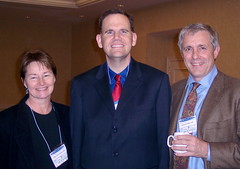 Drs. Michael & Mary Dan Eades are still strong believers in low-carb I cannot tell you how thrilled and honored I am to introduce to you today two very special people in the world of livin' la vida low-carb. This husband and wife team works tirelessly promoting the principles of low-carb living that we cherish so dearly because of the changes they have made in our lives with weight loss and improved health. Of course I'm talking about Drs. Michael (MDE) & Mary Dan (MRE) Eades! I recently named them one of my low-carb movers & shakers of 2006 because they really are literally on the frontlines of promoting the healthy low-carb lifestyle to the masses through their books, television show, public appearances and blogs. Be sure to visit the official web site for the Eades at ProteinPower.com as well as the always thought-provoking personal blogs of both Dr. Mike and Dr. Mary Dan. I had the distinct privilege of meeting them in Brooklyn, New York at the low-carb science conference that was held there. You'll never meet two more gracious people who have opened themselves up to a world looking for answers about their weight and health problems. I think you will quickly sense that in my interview with them today. 1. I am pleased to welcome to the "Livin' La Vida Low-Carb" blog today Drs. Michael and Mary Dan Eades, the husband and wife co-authors of the low-carb book "Protein Power," among many others. Since your original book was released in 1995, literally millions of lives have been positively changed forever by finding this way of eating as their permanent solution for weight loss and disease management. Did you ever dream over a decade ago that this diet plan based on what our ancestors ate that would become the center of your lives and be such a hit with so many people around the world?MDE: No, not really. We hoped it would be successful, of course, as did our publisher, but at the time that it came out, the low-carb approach, Atkins included, was as far out of favor with mainstream Americans as it seems to be today with the media. The early and mid-90s were the peak of the low-fat craze.
I remember our going one day to a bookstore to count the low-fat cookbooks and the low-carb cookbooks and the score was 660 low-fat and 0 low-carb (at least in our local Barnes and Noble) at that time. We used to say in interviews that we were out to change the way America eats and I think we were without doubt a part of a change that did occur and that is really still happening.
MRE: Ditto.2. In just the past few years, the low-carb diets have seen the thrill of victory and the agony of defeat in the court of public opinion. While most of us low-carbers are grateful that the "low-carb craze" and all those disgusting processed Frankenfoods are now gone from our supermarket shelves, the unfortunate remnants of that fallout is that so many people have been unreasonably discouraged by misinformed medical professionals and the media that livin' la vida low-carb is too "dangerous" and "unsafe" for people to be doing at all. What do you as doctors and subscribers to this way of eating say in response to such criticisms?MDE: Balderdash! The low-carb marketing craze, which rose like a tidal wave and crashed like a tidal wave has indeed swept away the bad and, unfortunately, much of the good (as tidal waves will do) but I’d wager that the number of people doing some variant of carb-watching is at an all-time high. The nomenclature has changed and marketers are justifiably frightened of and shying away from the words ‘low carb’ but the concept thrives. People are much more conscious of carbs, of starch, of sugar, of HFCS, of trans fats and of eating closer to the field and pasture than ever before.
Because the science of low-carb is utterly sound, and getting stronger it seems with every new journal publication, it won’t go away. As an effective tool for weight loss and revitalizing health it works like no other. That’s why it’s been around since Banting and why no matter what ‘fad’ comes along, it will be back again. It works, pure and simple.
MRE: The low-carb marketing craze—and that’s just what it was: a marketing craze—was based on the idea that low-carb was about switching from low-fat junk foods to low-carb junk foods. Low-carb junk foods are maybe a little better than low-fat junk foods, but they’re still junk foods.
Until people can get their arms around the idea of a quality whole-food low-carb diet, they’re not going to be successful. The fact that so many low-carb junk foods were promoted provided grist for the mills of the misinformed naysayers who want nothing more than to be able to seize upon any reason to trash low-carb. The promoters of these foods gave them the opportunity.3. Speaking of that dastardly media, their transparent hatred for anything and everything to do with low-carb is evident in the stories they put out there with such hyperbolic headlines meant only to further present a convoluted interpretation of what this way of eating is all about (such as the recent saturated fat study). I try to respond to a lot of this misinformation at my blog and I notice that both of you do it at your respective blogs as well. But what more can be done to help educate people about the truth concerning low-carb and all of the incredible positive scientific research that is coming down the pipeline supporting livin' la vida low-carb over the next few years? Can the media keep on ignoring the preponderance of the evidence?MDE: Well, they have so far. When Knopf brings out Gary Taubes’ book (which I think will probably be in the late winter/early spring of 2007) the media will have a much tougher time ignoring the facts. (When it hits, watch out; it’s huge, detailed, incredibly well researched, well documented, and well-written and, like his NY Times Sunday Magazine cover story back in July 2003, it should grab more than a few headlines.)
MRE: Despite their arresting and prosecuting Galileo for proclaiming the Earth wasn’t at the center of the universe, the Catholic Church could only suppress the truth for so long. Ultimately, the truth will out. As those of us who have followed the low-carb diet know, there is no better way to lose weight and improve health.
Now the research community knows this based on the recent spate of published, peer-reviewed studies, all of which demonstrate the superiority of the low-carb approach. It will take a while for this information to filter down to the local doctors who are spending so much time treating patients and fighting with insurance companies to stay abreast of all the recent scientific literature.4. There has been a definite move away from using the term "low-carb" in describing the lifestyle that many on the Protein Power and Atkins diets, for example, have become accustomed to using since now there is such a stigma attached to it. Is there a downside for people who support low-carb living to continue using the term "low-carb" when talking about nutritional approaches such as Protein Power or do we need to consider changing the terminology to make our message more palatable for people to give the low-carb lifestyle a serious try? Why or why not?MDE: Really only if you’re trying to sell something—a book, a TV show, a product. As I noted in a previous question, the marketers are already doing just that. Carb Sense has relabeled its low-carb line as Eat Well Be Well or something like that, I think.
And you’ll note on a lot of products that used to say ‘low-carb’ that they now just add a sunburst or tag that lists some low number of carb grams along with some low number of fat grams and/or 0 cholesterol or sodium or some other thing. It’s as if low-carb has just become a mainstream choice, like low-fat or low-cholesterol have done. Maybe "carb conscious" is a decent euphemism.
MRE: It’s a low-carb program. I don’t have a problem calling it that. Having said that, however, the South Beach Diet, which is clearly a low-carb diet, marketed itself to great success by claiming to not be a low-carb diet. The author got the best of both worlds, I guess. His readers got great results and he didn’t get tarred with the low-carb brush.
Still, I’m not a mincer of words, so I think it should be called low-carb or carb-restricted. I like the term Paleolithic diet also, but, unfortunately, some authors of Paleolithic diet books have tended to make their version of the Paleolithic diet a low-fat one, leading to some confusion.5. Low-carb programs such as Protein Power are definitely meant to be a lifetime commitment for people to not only maintain their weight, but to maximize their health with a solid nutritional approach. That is why I have committed to eating this way for the rest of my life, despite the constant cries from people that I am destroying my health (even after losing 180 pounds!). How would you respond to those people who only believe low-carb is a short-term method for losing weight, but not safe to do over the long-term?MDE: They need to take an open-minded and critical look at the hard clinical research, which is coming in almost every day. To my knowledge, there has never been a head-to-head trial between low-carb and low-fat/high-carb that has turned out any way other than the low-carb plan’s kicking the other’s tail. Mike regularly blogs on the truth or fallacy of studies that come out and our Discussion Board has compilations of the pertinent articles available to anyone who wishes to learn more about it themselves. Those of us who have implemented this lifestyle ourselves for decades prove the point that it’s a long-term healthy lifestyle—as anyone who tries it will also do. If the rest choose to ignore what’s obvious, it’s to their detriment and I’m sorry for that.
MRE: The idea that the low-carb diet is for the short term only slays me. It’s just a way for these idiots who embrace low-fat to save a little face. Early on in the low-carb movement these morons always went around with the cry on their lips: show us the studies, show us the studies. All you low-carb advocates say that low-carb does all these wonderful things, well, show us the studies. Well, we have shown them the studies.
Over the past 6 or 8 years there have been dozens of well-controlled studies showing at the worst that low-carb is the equal of low-fat in terms of weight loss and at the best that low-carb is vastly superior. In no case in these published studies has low-fat bested the low-carb diet in anything. So, now that the low-fatters can’t obfuscate the issue by demanding to see the studies, they have retreated into saying, "Oh sure, it works for the short term, but it can’t be safe over the long run."
I say: show me the studies. Show me the studies demonstrating that the low-fat diet is safe in the long run. These studies don’t exist. What we do have, however, is about 2.7 million years of archeological data showing that the low-carb diet was the diet humanity cut its teeth on.6. Have you read independent researcher Anthony Colpo's book "The Great Cholesterol Con" where he discusses the positive role of saturated fat in the diet and how the cholesterol concerns that doctors have are more about lining the pocketbooks of the pharmaceutical companies than on protecting the cardiovascular health of their patients? What are your thoughts regarding saturated fat and cholesterol?MDE: There is quite good evidence that saturated fats (especially certain ones, such as stearic acid) are beneficial for health—even cardiovascular health. Stearic acid, found richly in beef, for instance, has been clinically shown to lower cholesterol—if that matters, a connection for which, in our view, a case can’t really be made by the science. As to doctors lining the pockets of the drug companies, I think that’s a pretty unfair to subscribe evil motives to most of them.
You have to realize that most doctors, busy in their practices, get the vast bulk of their ongoing medical education courtesy of the drug companies—through meetings sponsored heavily by drug companies, through the ‘information’ the drug reps who visit their clinic ‘teach’ them, through the literature they read, which is heavily subsidized by drug company ad dollars. They prescribe cholesterol lowering drugs, blood pressure drugs, and diabetes drugs along with a high-carb diet (destined to make those drugs more and more necessary) because that’s what they were trained to do—to follow along with what the mainstream is told is correct. I know; we were those people twenty some odd years ago.
MRE: I agree with Colpo (though I haven’t read his book, I have skimmed through it) and Dr. Uffe Ravnskov that saturated fat isn’t an issue. There is no conclusive evidence that saturated fat causes any kind of problems. What I always find strange is the idea that people who worry about saturated fat usually also believe that palmitic acid, a 16-carbon saturated fat, is the most dangerous one of all. These people advocate consuming large quantities of high-carbohydrate foods instead of saturated fats. The irony is that the liver converts excess carbohydrate into palmitic acid, the very saturated fat they fear the most.7. Many of my readers have enjoyed your PBS program "Low Carb CookwoRx" and all the yummy recipes you have shared on that show. But low-carb cooking programs are virtually dead at this point with popular shows from people like Blaine Jelus, George Stella and others sadly being cancelled and replaced with new chefs making high-carb, low-fat dishes that are decidedly unhealthy. UGH! What resources would you recommend for people who are wanting a place to find delicious and healthy low-carb recipes?MDE: Other than our show on PBS, there may not be much out there except the occasional repeat of Rachael Ray purporting to do a low-carb meal that includes dried fruit and pasta. (Don’t get me wrong; I love Rachael Ray and watch her show regularly, but she’s no expert on low-carb and that shows.) Most of our show’s episodes are available for purchase on VHS through its website and so I suspect some of the others might be available, too. Beyond that, I guess it’s back to reading cookbooks of which we now have two: "The Low-Carb Comfort Foods Cookbook" and the companion book to the show "The Low-Carb CookwoRx Cookbook." Also, we add new recipes from time to time on our blogs (especially on mine) and just by doing a Yahoo or Google search for low-carb (name of dish) you’re likely to find some useful recipes.
MRE: I wouldn’t say these shows were dead. PBS just picked up "Low Carb CookwoRx" at the network level and will be showing it on their HD network starting in 2007. Also Create, which is PBS for cable, picked up the show in high-def, standard def, and digital and will begin airing in February of next year. Were this show not watched by a whole lot of people, it would not have been basically upgraded in the PBS hierarchy and renewed.8. Where do you see low-carb going in the near future? Five years from now? Ten years from now? Will there ever be a time when this way of eating will be on an equal footing with the low-fat diet?MDE: I think for at least the remainder of this year, the words ‘low-carb’ will be anathema for selling anything. After Gary Taubes’ new book hits the shelves, all bets are off. I think he’ll do what no researcher seems able to do, make people listen to the facts. I find that amazing; the testimony of actual physicians working day to day with patients and of scientists doing hard research is viewed by the public as somehow suspect, but the word of a journalist changes their minds. I say thank goodness at least something will change their minds. And yes, I do think (in fact I think it’s happening already) that low-carb will not only achieve the same footing as low-fat but will ultimately eclipse it.
MRE: Low-carb has been around literally for several million years. It’s going to be with us for a lot longer. It has only been fairly recently that the light of serious scientific scrutiny has been shined on this way of eating, and the evidence is all positive. Unfortunately, good things take a while to get widely accepted, especially in the face of a lot of naysaying know nothings. 9. If you had the opportunity to ask low-fat diet guru Dr. Dean Ornish anything you wanted, what would that question be and why?MDE: How much Lipitor do you take?
MRE: Actually, I almost had the opportunity to ask Dr. Ornish a lot of questions, but he bailed. A few years ago one of the networks—CBS, I think—tried to schedule a debate between the two of us. Dr. Ornish declined.
I learned an interesting thing several years ago about how Dr. Ornish operates. He was going to appear on a local Denver radio show in a debate with our partner in our medical practice. His ground rules for the debate were that he, Dean Ornish, could decide AFTER the debate whether or not the show could be aired with him on it. Our partner ate him for lunch and he (Dr. Ornish) refused permission to have the show aired with his name or voice. The producer of the show was so infuriated that she aired the debate using herself as the stand in for Dr. Ornish. Unfortunately, she could not even tell the listeners what was going on.
Apparently in a venue like CBS in which he can’t dictate the terms of engagement to his sole advantage as he could with the Denver radio station, he is unwilling to debate the merits of his ultra-low-fat philosophy.10. One of the things I enjoy the most about my low-carb weight loss blog is the people who give me the privilege and joy of encouraging and educating them on a daily basis with information they can use as they are livin' la vida low-carb. Do you have any specific words of inspiration for them as we conclude this interview?MDE: Don’t be swayed in your opinions about nutrition by what this or that talking head says about it today or tomorrow or next week. Adopt a true, serious low-carb diet, follow it diligently, and then believe what you see in yourself, in your body, in your lab work. That’s the best evidence I can think of for deciding if a diet is "right" for you.
MRE: One of the best things about the low-carb diet is that it works so quickly. People don’t have to give it a three-month test drive to see if it is going to live up to its promise. I always tell those uncertain as to whether or not to try to give it a week. In one week on a low-carb diet people can get rid of GERD, sleep better, feel better, think better, get rid of excess fluid, and lose weight to boot.
For those folks on a low-carb diet, I can only say congratulations. You are on a regimen grounded in several million years of natural selection that will keep you healthy while keeping you free from hunger like no other eating program around. Keep it up because it will pay countless health dividends over the rest of your long life.10-2-06 UPDATE: After reading the answers provided by the Eades for Question #9, Dr. Dean Ornish wrote me the following e-mail regarding what they said: "All of this is completely false. And I have never taken any cholesterol-lowering drugs."I responded back to Dr. Ornish, who I have also interviewed, to share what was "false" about what the Eades had alleged about him. As soon as he responds, I will post him comments here. 10-3-06 UPDATE: Okay, I heard from Dr. Dean Ornish with his response to the allegations made about him by Drs. Mike and Mary Dan Eades in my interview with them. I welcome an open dialogue, which is why we had an in-depth interview last week, Jimmy--but it is not helpful for people to say things that are simply not true.
First, I have never taken any cholesterol-lowering drugs, as my cholesterol level has been below 140 mg/dl since I was a teenager.
Second, this story he tells about the Denver radio show is completely false. No radio show would agree to such terms, nor would I ask for them. Clearly, I'm not "unwilling to debate the merits of a low-fat diet" since I debated Dr. Atkins and others on numerous occasions.
I think it's time to get past these adversarial, personal attacks and try to find common ground, which is why I wrote an essay about this in TIME magazine.
Thank you. With best wishes and warm personal regards,
Dean Ornish, M.D.
Founder and President, Preventive Medicine Research InstituteComments? Questions? Response from Dr. Eades? 10-4-06 UPDATE: I got a response from Dr. Mike Eades...er, sort of. He blogged about the Ornish controversy at his popular blog today and promised to show evidence that supports the position he took. If you want to dig a little deeper into why they answered #9 the way they did, then read this post! Labels: Atkins, blog, cholesterol, Dean Ornish, eades, Gary Taubes, health, interview, low-carb, low-fat, protein power, research, saturated fat, television
Intermittent Fasting To Reduce Calories, Hmm?
Have you seen the latest blog post from Protein Power author Dr. Mike Eades on a subject known as "intermittent fasting" (IF)? It has generated the most comments that he has ever received on any subject he has previously written about at his blog. If you haven't seen it for yourself yet, then click here to go read it right now and come back. Go on, I'll wait for you... Okay, so what did you think? I like it a lot better than the traditional fasting methods of one day on, one day off because you would go through a longer period of time between meals. But the IF plan that Dr. Eades suggests is more practical. Here's the schedule: Day 1 - Eat food anytime until 6:00PM and stop eating Day 2 - Don't eat until 6:00PM Day 3 - Eat food anytime until 6:00PM and stop eating Day 4 - Don't eat until 6:00PM So forth and so on. Of course, you aren't CONSTANTLY eating on the days you stop eating at 6:00PM, but rather you are eating as you normally would when you are hungry. And, for the sake of his experiment with IF, Dr. Eades even said feel free to eat WHATEVER you want. That's right, you can even eat chocolate cake if you wanted to. However, he did recommend people stick with low-carb foods and IF to maximize the impact of this way of eating, especially for weight loss. I especially enjoyed this lesson from IF that Dr. Eades shared: "One of the things MD (Mary Dan Eades) and I took away from our IF experience is the idea that we don't have to eat three meals per day. We now often skip lunch and don't seem any the worse for it. Sometimes we get up and get going with all our projects and don't eat breakfast. We try to skip a meal here and there because figure it's probably good for us. When you get used to it, you don't really even think about it. And it's good for you. Don't take my word for it--look at the medical literature."Hmmm, interesting. I've been noticing lately on the weekends when my schedule is not as planned as it is during the week that I tend to eat fewer meals than on weekdays. Perhaps I should practice skipping meals, hunger notwithstanding, as well rather than eating simply because it is lunch or supper time. For those of you who are people of faith and believe in God, fasting is actually something Christians are encouraged many times in the Bible to do from time to time. Aside from the obvious physical advantages to fasting, the spiritual implications of doing without food and other such necessities of life for a period to spend time praying on behalf of others in intercession is a sign of maturity in your walk with the Lord. In fact, a few years back when I worked in a Christian bookstore, there were several books about fasting including one entitled "Fast Your Way To Health." This idea of fasting has been around for a while, but many are unwilling to give up food even for a day here and there. How sad. What do you think about this? I for one think it is fantastic and am willing to do it myself once I get one question answered about it from Dr. Eades himself (who is responding to EVERY post about this, by the way!): What about my exercise routine? How can I get in my 30-45 minute workout on the days that I don't eat until 6:00PM? I can't exactly hop on the elliptical machine on an empty stomach now, can I? I'm awaiting his reply. Has anyone tried this IF plan yet? If so, tell us about your experience. If the ultimate goal is to eat less calories, then perhaps implementing a fasting schedule like this one could enable you to reduce your caloric intake and you are still eating every single day. What a concept! Are you ready to start livin' la vida intermittent fasting? :D 9-18-06 UPDATE: Like I said in this post, Dr. Mike Eades is answering EVERY comment with a personal response and here's what he posted at his blog to me about my exercise concerns: Hi Jimmy--
I would give it a try to see what happens. I doubt that you will run out of energy, but if you do, you might want to exercise only on eating days.
Keep me posted on your progress.
Best--
MREI had certainly thought about reserving exercise for the days I would be eating, but I may give it at least one or two times on the "off" days just to see how I feel. I workout pretty vigorously and burn upwards of 700-1000 calories during my cardio. Without a meal before doing exercise like this, I'm sure I would collapse. But we'll see. What I did this morning was wake up very early in the morning and went to the YMCA to get a workout in before work and then I'll also do ANOTHER workout session this afternoon on my lunch break like I always do. Then when I am on day two of the IF tomorrow when I am not eating until 6:00PM, I don't have to push myself to get the exercise in since I'll have an extra session under my belt from the previous day. So, yes, I am going to try IF for at least a week. I officially start my IF program today and will stop eating entirely at 6:00PM tonight. Then I will go without food until 6:00PM Tuesday night. We'll see what happens and I'll keep you and Dr. Mike posted. Anyone else gonna try this with me? :) 9-18-06 UPDATE: I had one more question for Dr. Eades regarding protein shakes. Here's what I wrote to him: Does a protein shake count as food or drink? In other words, can I drink an Atkins shake on the mornings I am supposed to be fasting or not?Here was his speedy reply: Hi Jimmy--
Since an Atkins shake contains calories, if you took it in you would not be fasting. Many people don't realize that caloric liquids--as far as the metabolic system is concerned--are no different that solid foods. One of the jobs of your teeth and your stomach acid is to convert solid foods into liquid foods.
So it doesn't matter whether it's a protein shake or a rib-eye steak when it goes in your mouth, by the time it reaches your small intestine where it is absorbed and kicks off all the metabolic processes it is a liquid.
Hope this helps.
MREWell, then, I ALMOST fasted the whole day sans my Atkins shake at 5:15 this morning. I was still plenty hungry by the time the fasting ended at 6:00PM. I took care of that problem in short order. :) Labels: calories, eades, exercise, fasting, hunger, protein power
|


