|
PLEASE UPDATE YOUR BOOKMARKS TO LIVINLAVIDALOWCARB.COM/BLOG
Tim Russert's Fatal Heart Attack Was Preventable, He Followed Antiquated Advice
In this supercharged and oftentimes volatile political election year, something tragic and sudden struck this country and has everyone buzzing in Washington and across the United States. No, it wasn't some sex scandal, drug bust, or any of the other usual news that has become almost too commonplace these days. This was something much more serious and has greater implications than even the extensive coverage the mainstream media is giving to it. Last Friday afternoon, hard-hitting political interviewer and long-time host of NBC-TV's Sunday morning news talk show "Meet the Press" Tim Russert experienced his first heart attack and it almost instantly killed him. I cannot imagine how his family is responding to this news and my sympathies and prayers go out to them during this very difficult time. Tim was in the midst of doing what he loved--preparing for his television show--when the heart attack took his life and took him away from all of us. So, how did a 58-year old man die from a heart attack when he was doing all of the things his doctor said he should to prevent it? Should we be concerned about what doctors are telling us about how to ward off cardiovascular disease so that we don't become the next victim of what befell Tim Russert? These are the questions people are asking in the wake of this tragedy and was the subject of what one of my readers wanted to know in an e-mail I received. Here's what she wrote: Hi Jimmy, I have been an avid reader of your blog for a long time. I am so scared since Tim Russert died suddenly of a heart attack at only age 58 (my husband is 57 and I'm 54) that I'd really like to get some clarification on the statin drugs and cholesterol issue. Seems like Tim Russert's doctors did all the usual things and he died anyway. I trust what Dr. Jonny Bowden has to say as he has an advanced degree in nutrition and he seems to think for himself instead of just following the status quo. Can you see if he would help reassure me with this? Thanks for your assistance, and keep up the fantastic work!While I am no Dr. Jonny Bowden, I do have some things to say about Tim Russert's death that need to be said. I can understand your concerns and I am delighted to forward your questions to Dr. Jonny Bowden. He's one of the brightest, most articulate people on nutrition in the entire world, so you are in good hands with the information he provides to you. But if you would allow me to comment on this subject, I have some thoughts about it. Isn't it interesting that Tim Russert did everything exactly as his doctor wanted him to and yet his very first heart attack was a fatal one? I don't think that's a coincidence either and it happens every single day without a blink of an eye from anyone. Watch this video interview with Russert's doctor to see how dejected he is about Russert's "unexpected" death despite his best treatment strategies. It's amazing to hear his doctor basically say that Tim did everything he was "supposed" to do and yet it wasn't enough to save his life. Wanna know what the scariest part of this story is? Check out Tim Russert's lipid profile: LDL--68 HDL--37 (up from the lower 20's) Total Cholesterol--105 Did you see that? Most doctors would look at those numbers and say, "See how healthy this person is because we lowered his cholesterol." And they would pound their chest with pride at putting someone like Tim Russert on a statin drug to artificially make this happen. But what good did it do him in the end? He's gone now because of that advice and there's no outrage about it. Worry, concern, perplexity, yes--but nobody is angry that this preventable death was made WORSE by the use of all the traditional means for improving heart health. According to Russert's doctor, he didn't have Type 2 diabetes nor did he have any blood sugar issues at all. His A1c was in the normal range and as I noted previously his cholesterol was considered VERY healthy. For all intents and purposes according to the modern day medical conventional wisdom, he was the epitome of perfect health. And yet he tragically died before his time. We now know posthumously that Russert had coronary heart disease that he was being treated for, but his doctor apparently didn't know how severe it was. But even if he did know it was extremely serious, what else would he have recommended to Tim? Higher doses of his statin drug? Even less fat in his diet? More exercise? In the end, all of these seemingly good strategies from the conventional wisdom point of view would have very likely done NOTHING to prevent this from happening. His doctor put him on blood pressure lowering medication as well as a cholesterol-lowering statin drug to see if that would help. And Russert even rode an exercise bike to try to lose weight, although it didn't work. There's no doubt the plaque buildup around his heart was getting bigger and bigger over the years until his heart couldn't take it any longer. We know that too low LDL can lead to depression, suicide and death. We also know that HDL "good" cholesterol (Russert's was very low--NOT good) and triglycerides (something Russert dealt with having too high over the past few years) are better indicators of heart health than LDL and total cholesterol. And it's a high-carb, low-fat diet that leads to lower HDL and higher triglycerides. No doubt this is precisely the kind of diet Russert's doctor had him on. As you know from reading my blog, my most recent total cholesterol reading was 326 with an LDL of 246, HDL of 65, and triglycerides at 77. I am confident I don't need to go on a statin drug now or ever and I am as healthy as I have ever been in my entire life. On face value, any typical physician in America would say to me, "Oh my God, you need to be on Lipitor, Crestor, or Zetia to lower your LDL and total cholesterol." Of course, they would be 100% wrong because my LDL particle size is the protective large, fluffy kind that your body wants and needs. Dr. Eric Westman from Duke University Medical Center in Durham, North Carolina, who is the physician who ran this test on my behalf, said almost all of my LDL is this protective kind and the percentage of small, dense LDL (which was the likely culprit in Russert's fatal heart attack) is virtually nil. And that's a GREAT thing! High LDL can be good, but low HDL is most certainly ALWAYS a bad thing to have. When you are livin' la vida low-carb correctly, then your HDL will be well above 50 and for women well above 70. At the same time, your triglycerides will drop below 100 for an HDL/triglyceride ratio of around 1. That's what you want. Of course, you will need to get the particle size of your cholesterol subsets measured using a VAP or Berkeley test, but you can almost be guaranteed that if your HDL is up over 50 and your triglycerides are down below 100 that your LDL particle size will be the large, fluffy protective kind. This cholesterol issue is one I am quite passionate about because the modern means for dealing with it is simply exacerbating the problem. The medical community has the blinders on and they refuse to take them off long enough to see the harm they are doing to patient after patient they put on these risky prescription drugs for a purpose that is futile and fatal in the end like it was for Tim Russert. Here are quite a few posts I have penned about the subject of cholesterol that I think you should read when you get a chance to help you understand this issue even better: "Doctor Claims Blood Sugar, Not Cholesterol Linked To Heart Disease""Low-Carb Can Raise HDL Levels Without Cholesterol Medication" "Cholesterol Numbers Drop But At What Cost" "Cholesterol Drugs Are About Money Not Health" "Cholesterol Conundrum: Do I Statin Or Not?""Doctor Gives Me Four Months To Get LDL Down" "Consensus On Cholesterol Is Avoid Statins" It's time to break all those years of cholesterol indoctrination. There will be confusion and concerns in your mind at times, but that's okay. My pithy response to anyone who challenges me on cholesterol is PROVE IT'S UNHEALTHY! They can't because there isn't one iota of truth to the cholesterol con. There's much more to this cholesterol issue and the connection to Tim Russert's death than most people even realize. I encourage you to read a few more commentaries from people in the health community who I respect and trust about this: JACKIE EBERSTEIN from Controlled Carbohydrate Nutrition"What We Can Learn From Tim Russert's Death"DR. WILLIAM DAVIS from Heart Scan Blog"Another failure of conventional cardiac care""Tim Russert's heart scan score 210...in 1998" Hopefully my answer will make you feel better about this and that consuming a diet lower in carbs, higher in fat, and with moderate protein at every meal is what is going to work best for improving your heart health over the course of your life. If only Tim Russert had been given this information instead of the antiquated traditional advice he received, then his fatal heart attack may have been averted. Perhaps this event will begin a serious discussion of heart health treatment in this country so that others can benefit from the healthy low-carb lifestyle, too. We can only hope. Anyone interested in learning more about the alternative cholesterol hypothesis I've written about today must check out the following books: The Great Cholesterol Con by Dr. Malcolm Kendrick The Great Cholesterol Con by Anthony Colpo Hidden Truth about Cholesterol-Lowering Drugs by Shane Ellison Malignant Medical Myths by Dr. Joel Kauffman The Cholesterol Myths by Dr. Uffe Ravnskov Good Calories, Bad Calories by Gary Taubes 6-24-08 UPDATE: In response to an anonymous comment left about this blog post regarding the kind of diet Tim Russert ate OBVIOUSLY being a low-carb one, here's my comment: Actually, anonymous, livin' la vida low-carb is arguably the easiest diet you can possibly go on and do for the rest of your life. I tried livin' la vida low-fat in 1999 and THAT was not sustainable in the least. No, it doesn't take some willpower to lose weight, but rather a steadfast resolve to make better choices for your health. For me and many here at my blog, that was a low-carb diet. As for Tim Russert, he most certainly was NOT on a low-carb diet because his triglycerides were very high and his HDL was very low...these are signs of a HIGH-carb, low-fat diet that his cardiologist no doubt put him on. Here's an excerpt from the New York Times about Russert's health: Mr. Russert had low HDL, the protective cholesterol, and high triglycerides. He was quite overweight; a waist more than 40 inches in men increases heart risk. A CT scan of his coronary arteries in 1998 gave a calcium score of 210, indicating artery disease — healthy arteries do not have calcium deposits — and a moderate to high risk of a heart attack.None of this happens on a low-carb diet and the studies show your HDL goes above 50 and your triglycerides fall below 100 when you are low-carbing correctly. And this is PROTECTIVE against a cardiovascular event. The studies also show that a diet low in fat and high in carbs (generally recommended as "healthy" by most of the so-called experts) is what leads to lower HDL and higher triglycerides like Tim Russert had. This is the diet that ultimately killed him, not a low-carb diet. Labels: cholesterol, conventional wisdom, coronary heart disease, death, drugs, HDL, health, heart attack, heart health, LDL, Meet The Press, NBC, statins, Tim Russert
The Most Beneficial Health Supplement You've Probably Never Heard Of--CoQ10!
Most people are confused and bewildered about what supplements they should be taking as part of a healthy lifestyle change like livin' la vida low-carb. We all know the benefits of a solid multivitamin as part of your daily nutritional routine. But what else can we take to help improve our health while losing and then maintaining our weight? I've shared a few of the specific supplements I take on a daily basis in this YouTube video as well as this blog post. But there is one that you may not have heard much about because quite frankly the medical industry doesn't want you to know there's an over-the-counter dietary supplement that will replace some very expensive prescription drugs you may be taking. It's called CoQ10. CoQ10 stands for Co-enzyme Q10 and is as crucial for protecting your body against heart disease, cancer, AIDS, hypertension, muscular dystrophy, brain disorders like Parkinson's and Alzheimer's as well as memory loss as anything else you could take. Heck, it's even good for your gums, too! Although the benefits of taking CoQ10 as regular part of your healthy routine are well-known overseas, doctors here in the United States, including cardiologists who are supposed to be treating heart health ailments, have downplayed its importance because there's no money in promoting something that could replace many of the most bestselling drugs available today. It's kinda like our cherished low-carb lifestyle. Most doctors frown and turn their nose up at the use of low-carb diets for weight loss because of its alleged dangers. But then when someone starts using it and the weight comes pouring off, A1C numbers drop, HDL "good" cholesterol rises, triglycerides plummet, and all the other excellent health benefits of eating this way kick in, there's little a doctor can say in reaction to these results. Even still, some doctors decry these improvements as a fluke and that continuing to eat this way long-term will cause damage. WHATEVER! So you think you might wanna be a rebel and start taking CoQ10 anyway despite any objections from your doc, eh? Here are six reasons why you should consider this small, but incredible investment (and, yes, CoQ10 is a bit pricey, but well worth it for the benefits you receive) in the future of your health: 1. It naturally lowers your blood pressure.This is something that I was so pleased to know about CoQ10 because I had been taking blood pressure medicine prior to my low-carb lifestyle and taking supplements. Within a few months of taking CoQ10, I started blacking out when I stood up. It was the weirdest thing and I couldn't figure out what was happening. When I went to the doctor about it, he said my blood pressure was TOO LOW with the medication, so I'd have to stop taking it. WOO HOO! CoQ10 was doing the trick for managing my blood pressure. In fact, this University of Texas study found that over HALF of patients with high blood pressure were able to reduce or eliminate their need for blood pressure drugs after just one month of taking CoQ10. AMAZING! 2. Destroy cell-damaging free radicals.CoQ10 is a potent antioxidant (it comes in 100mg, 200mg, 300mg, and 400mg--I personally use either 300mg or 400mg) and should be replenished in your body on a daily basis for the protection of your heart, brain, kidneys, and liver from the damage that can be caused by the existence of free radicals. Think of CoQ10 as the "premium grade" of gasoline for your car helping it to run as smoothly as possible. 3. Reduces oxidized fat that leads to clogged arteries.While limiting your carbohydrate intake is certainly protective for the heart while on the low-carb lifestyle, you still want to limit the creation of arteriosclerosis that happens when fatty deposits begin to fill up in the blood vessels. CoQ10 helps to prevent this by preventing the oxidation of fat cells from happening. 4. Alleviates major heart health risk factors.If you have heart disease, hypertension (high blood pressure), or hypercholesterolemia (high cholesterol), then taking CoQ10 on a daily basis can give you relief from these conditions and quite possibly improve them! Why wouldn't you want to do that? 5. Improves pain felt by chronic stable angina patients.For those people with chronic stable angina, CoQ10 gives them the necessary relief from chest pains and the ability to perform certain cardiovascular exercise to improve their health health. 6. Regulates the rhythm of your heart rate.Having a steady heartbeat gives you peace of mind about the state of your heart health. If CoQ10 can help manage a fluttering heart, then everyone who has one should be taking this supplement! Interestingly, did you know the dangerous cholesterol-lowering statin drugs like Lipitor, Crestor, and Zetia actually ROBS THE BODY of CoQ10? Yep, that's a dirty little secret you won't be hearing in all those cutesy little commercials on television about these awful prescription medicines. And when one company attempted to supplement the statin with some extra CoQ10, they decided not to do it since they feared it would cut into the sales of their statin drugs if the word got out about the CoQ10 depletion. INCREDIBLE! As you can see, CoQ10 is an important supplement for creating energy and to help your mitochondria function (where you get your energy from!) the way it is supposed to. Taking this supplement daily will keep your cells youthful and vibrant for many years to come! Be sure to keep your fat intake up when you are taking CoQ10 since it is a fat-soluble nutrient. But you're already doing that, of course, since you're livin' la vida low-carb! Regardless of your current health, I think everyone should be taking this supplement now to prevent any possible ailments that may come in the future. You won't hear your doctor or pharmacist touting CoQ10, but it very well could be the most beneficial supplement you've never heard of. Labels: blood pressure, cells, CoQ10, drugs, free radicals, health, heart disease, low-carb, mitochondria, nutrition, prescription, supplements
An IVF Update: Shots Galore And So Much More
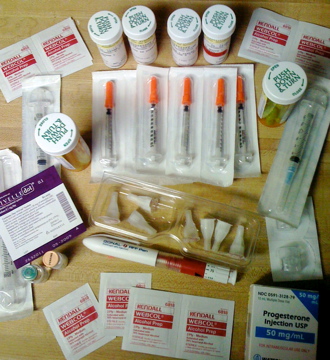 All of THIS just to have an IVF baby? Yep, that's right! All of THIS just to have an IVF baby? Yep, that's right!Since I last updated you on our decision to start the IVF/ICSI cycle to try to have a baby, the process is now well underway with tons of shots, doctor visits, tests, blood work, and one big fat loan to tell you about. More about all of that in just a moment. Special thanks to everyone who has responded to our "Beads Of Hope" fundraiser that will help us defray the costs of our medical expenses during this procedure. The total cost is going to come to about $18,000 for one cycle and thankfully we were approved for a Capital One fertility loan for most of that money. We'll be paying it back over the next five years, so every little bit of money we can raise through these homemade beads Christine creates will help us pay for what could be the miracle we've been praying for regarding having a child. Not everyone is happy about our "Beads Of Hope" campaign, though. One of my readers expressed her sincere disgust for my decision to use my blog for what she describes as "panhandling." Here's what she wrote in an e-mail to me: "I may turn out to be in a small minority -- I think your panhandling through your web site is truly inappropriate. For the low-carb planet, you have been a valuable resource. By selling your wife's beaded creations to pay your medical bills, your have gone beyond boundaries of propriety."While I respect and appreciate the opinions of those who disagree with our fundraiser, it was my decision to do this and I don't regret it one bit. I have had readers suggest that I put a PayPal link on my blog so they can pay me for the work I do here at my blog. I have refused because to me that would be in poor taste. But by offering something in return for those funds like the bead jewelry, it is in my estimation a natural trade-off of funds for merchandise. No problem in my eyes. Nevertheless, we are not discouraged by those who disagree with the fundraiser. Nobody is being forced to participate in it and yet you still get the same quality low-carb content you always have absolutely FREE every single day at my blog. I provide it willingly because it is the cry of my heart to help others find the success that I have since 2004. That commitment will NEVER change. Okay, so let's talk about the IVF cycle that began the day after Thanksgiving. My wife Christine is a real trooper and I have the utmost respect for her and anyone willing to put themselves through all these shots and drugs just to have a baby. What a sacrifice of pain and anguish she has put up with to try to make this work and I love her more than ever for being willing to do this for us. THANK YOU AND I LOVE YOU, HONEY! Here's the rundown of all the shots and drugs she has had to take on a daily basis for the past week: 9:00AM Lupron 20 units (injected in the belly with a subcutaneous needle) Gonal-F 150 (injected in the belly with a subcutaneous needle) Doxycycline 100mg (taken orally) Baby Aspirin (taken orally) 9:00PM Lupron 20 units (injected in the belly with a subcutaneous needle) Menopur 150 (injected in the belly with a subcutaneous needle) Doxycycline 100mg (taken orally) I have faithfully prepared each of these shots for Christine and she has dutifully injected them herself for over a week now alternating back and forth between one side of her belly button and the other. The purpose of these shots is to stimulate the follicles on her ovaries to help them grow to around 18mm for ideal egg-making. She had a baseline visit on the Wednesday before Thanksgiving and then a follow-up on Wednesday and Friday this week. A vaginal ultrasound was done to determine whether the follicles are growing like they are supposed to and the good news is they are. As of Friday, many of the follicles have reach 12-13mm in size and are well on the way to being ready for egg retrieval on this coming Wednesday or Thursday morning. In fact, the follicles on her ovaries right now are so big that Christine says it feels like she has "a watermelon in my abdomen." My response back to her was that it is "preparing you for when you have babies inside of you real soon." She smiled and said "yeah, I know." It's getting closer and closer! We are scheduled to go to the reproductive endocrinologist on Sunday morning bright and early for one last ultrasound to make sure Christine is ready and it looks like she will be. They have seen about 10 follicles grow which is excellent news because each one has the potential to make an egg we can use for the IVF/ICSI procedure. The more eggs we have, the better odds that several viable embryos will be ready for the transfer back inside Christine. And the shots will continue this week for Christine and they get a little worse. While all of these needles she has had so far have been subcutaneous, meaning just below the skin, many of the next ones will be intramuscular (around 1 1/2 inches long) which will require us to seek assistance from a nurse friend of ours from church to help with. I'm absolutely terrified of needles personally or I'd try to stick Christine myself. My hands would probably shake too much, though. The main shot will be the hCG IM that is administered 36 hours before the retrieval of the eggs. That means it will be either 8:00pm Monday night or Tuesday night depending on what the doctor says after the visit on Sunday morning. The egg and sperm retrieval will take place on Wednesday morning or Thursday morning where the doctors will conduct the actual procedure of placing the motile sperm in the middle of each egg to see if they will fertilize. This takes 3-5 days to happen. Then the real "fun" begins for Christine when she begins taking DAILY shots of Progesterone 50mg/mL with an intramuscular needle in the morning, a 0.1mg dot patch of Virelle in the morning, Medrol 16mg in the evening, along with the Doxycycline and baby aspirin. The torture for her body just doesn't stop, does it? But all of this is preparing Christine for the transfer back of the viable embryos that survive after a few days. If there are only a couple still around after three days, then the transfer will happen on Saturday or Sunday morning. Otherwise, if the embryos continue to do well and look good through five days, then the transfer will go as planned on Monday or Tuesday morning a week from now. From there, we wait two weeks while continuing to take the hormone shots to see if the embryos continue to develop inside Christine's womb and on or about December 24th we will know whether or not she is pregnant. It's rather ironic all of this anticipation builds up to that particular date because either way it will be a gift from God. If He chooses to bless us with a child or children, then what an awesome Christmas present that would be. But if not, we will at least have that "peace of mind" I blogged about previously. We're ready for whatever His will is for us in this. Obviously, we would love to have your prayers as we continue down this journey to have a baby and what an adventurous ride it has been so far. We really are lucky people to have so many amazing human beings show us the love and dignity that literally hundreds of you have done over the past couple of months. Our gratitude and appreciation for your support cannot be any greater than it is right now. So THANK YOU for showering us with your encouraging words during this time. The next time I update you will be after the transfer of the embryo expected in about 8-10 days. This next week is crucial in the entire IVF/ICSI process, so pray for us, the doctors and nurses, and those tiny little zygotes that will be formed. One or more of those could be a baby Moore nine months from now. Here's hoping! :) Here are some more e-mails we have received about our IVF journey: Please, before you pay so much money for IVF, let me alert you to NaPro Technology. Their success rate is much higher than IVF and much less expensive. They are a Catholic institution, but don't let that put you off, they accept all patients!
Check out their web site:
Pope Paul VI Institute
6901 Mercy Road
Omaha, Nebraska 68106
God bless!
**********
Hi Jimmy,
Just wondering have you thought about doing IVF in Ireland? An IVF cycle here costs about 3000 euro ($4394) for each IVF cycle. Including return flights and accommodations it would be cheaper to do it here.
I know it seems like a wild idea but I hate to think of you and Christine would have to shelling out so much money. According to this article, it's seen as unethical to make money from infertility treatment and I think that's the way it should be.
**********
Dear Jimmy and Christine,
You and your wife will be in my prayers for sure for the next couple of months. I have a great burden for those wanting a child and have not been able to conceive. There are times I wonder why God gave me 14 children and the next couple none. But may you and your wife be pleasantly surprised by what God has in store for you in the near future. As you and your wife have been givers to so many, He will reward you beyond all that you can ask or think.
Blessings to you both,
Michigan Mommy of Many
**********
Dear Jimmy,
I recently read your blog about your struggle with infertility. My husband and I used ICSI/IVF in 2004 and our twin daughters are now 3 years old.
My book, Tiny Toes: A Couple’s Journey Through Infertility, Prematurity, and Depression was just released. I'd be happy to send you a complimentary copy. Maybe reading about our journey will help you with yours. You can visit my web site to learn more about the book. was just released. I'd be happy to send you a complimentary copy. Maybe reading about our journey will help you with yours. You can visit my web site to learn more about the book.
Best luck to you and Christine. It's an exciting, emotional and trying time all at once!
Best regards,
Kelly DamronWe received Kelly's book in the mail this week and I'll be reading and reviewing it soon. I appreciate her generosity in sending me a copy of her new book which looks to be an OUTSTANDING resource for anyone going through this IVF process. And finally, let me give a big shout out to the "Debt Daddy" blog for helping me promote our "Beads Of Hope" fundraiser. Here's what he wrote: Speaking of kids and fathers, I came across this guy a while back and wanted to pass his name along to you. Jimmy Moore has been blogging for quite some time - one of his most read blogs is "Livin' La Vida Low-Carb" (which is just the kind of kitchy title that makes Debt Daddy giggle). Anyway, he and his wife have been trying to have children for quite some time, but have had no luck, and are now turning to IVF (IVF = in vitro fertilization, for anyone who doesn't know what the heck I'm babbling about).
IVF can get pretty expensive, but have no fear! Believe it or not, Capital One now offers an "infertility loan" to finance the long (hopefully successful) road of making a baby with doctors present. So, whether or not their attempt to procreate is successful, they will still be paying back this loan with interest. Fortunately, Jimmy's wife has a sideline business that they're hoping will help to supplement some of the expenses and get this loan paid down.
If you're still looking for Holiday gifts for people on your list, you might want to check out this link - Jimmy's wife Christine makes some very pretty beaded jewelry, and purchasing some of her handiwork would not only make a lovely gift to whomever you're giving it to, but to the people you bought it from as well.WOW, now that was too cool! I don't know who you are Debt Daddy, but God bless you buddy! You are an honorable guy and we appreciate your selfless support for us as we go down this road. THANK YOU THANK YOU THANK YOU! Labels: baby, Beads Of Hope, Capital One, Christine, drugs, embryo, follicles, ICSI, infertility, IVF, Jimmy Moore, needles, reproductive endocrinologist
Feinman To Warshaw: How Healthy Is A Diabetes Diet That Requires Medication?
  Dr. Feinman tells Warshaw what she can do with her high-carb advice Dr. Feinman tells Warshaw what she can do with her high-carb adviceOne of the most controversial debates within the diabetic community right now is around the subject of carbohydrate-restricted diets as a means for naturally controlling blood sugar levels and insulin production (we can thank Men's Health columnist Adam Campbell for writing this outstanding column about it in late 2006 to get the ball rolling). It's a fascinating subject since so much research is pointing to livin' la vida low-carb as an excellent way to tame and virtually "cure" diabetes naturally without the use of drugs or insulin in many patients. It truly is a miracle for diabetics! Nevertheless, the so-called "experts" in the field of diabetes are none too pleased with all this talk about low-carb diets because they do not give this way of eating any credence whatsoever as a legitimate nutritional approach for taking on diabetes, especially the ever-growing Type 2. One such leader in the anti-low-carb movement happening within diabetes circles is author, nutritionist, and diabetes educator Hope Warshaw. I've previously blogged about Warshaw when she went head-to-head with low-carb diabetes champion Dr. Richard Bernstein on dLife last year. Warshaw is deeply entrenched in the politics and talking points of the American Diabetes Association (ADA), so it's not surprising she would write a short but to the point column like "Why You Don't Want To Go Low Carb Or Vegan" in a major diabetes publication like Diabetes Health. Her key reasons for opposing livin' la vida low-carb for diabetics is this: - It's too "extreme" a "fad" diet to be taken seriously - It's not appropriate over the long-term - You can't stick with it and maintain your weight on it - Blood glucose levels do not return to "normal" after meals - Carbohydrate is necessary for a healthy diet - A low-fat, low-calorie diet is more effective We also learn from this "Diabetes Mine" blog interview with Warshaw that she believes that diabetes control is "not about carb restriction," but rather eating lots and lots of fruits and vegetables as part of a high-fiber, low-fat, low-calorie diet. Does this include sugary fruits like bananas and raisins as well as starchy vegetables like white potatoes (which a recent ADA report found some startling statistics about regarding typical American consumption), hmmm? Interestingly, despite including a vegan diet among those to avoid in the title of her column, Warshaw mentioned it a grand total of ONE time compared with EIGHT references to "low-carb" in the six-paragraph article. Can you say obsessive? Sure looks that way! While most diabetes professionals who read this predictable missive from Warshaw a couple of months back no doubt grinned and nodded their head in complete agreement with all of her conclusions about the low-carb lifestyle for diabetics, at least one did not. His name is Dr. Richard Feinman from the SUNY Downstate Medical Center in Brooklyn, New York who serves as Editor-In-Chief of the scientific journal Nutrition & Metabolism. I've previously interviewed Dr. Feinman at my blog and he has a rather unique perspective as it relates to helping diabetics beat their disease with as few medical interventions as possible by using a low-carbohydrate treatment option. He has been on the front line of this debate on behalf of the science regarding carbohydrate-restriction for diabetics and has seemed to step it up a bit in 2007. To directly rebut everything Warshaw wrote in her column, Dr. Feinman penned his response entitled "Low Carbohydrate Diets: Why You Don't Want the 'Experts' to Tell You What to Eat" which brilliantly laid out and explained why low-carb diets are not only appropriate for diabetics, but actually preferred for those patients desiring to end their dependence on drugs and insulin. Please go read the entire column which was published this week in Diabetes Health, but here are my favorite points that Dr. Feinman makes: - Low-carb diets control glucose metabolism problems - Encouraging carb consumption for diabetics is ridiculous - High-carb diets demand the use of more medications and insulin - Eating carbs WILL raise blood glucose levels - My favorite: How healthy is a diabetes diet that requires medication? - Reducing medication should be a sign of improvement for diabetics - Diabetes is a metabolic disease that require a metabolic response - There is no biological need for carbohydrate - Glucose can be supplied to the brain through gluconeogenesis- The obesity and diabetes epidemics caused by high-carb, low-fat diet - More carbs in the diet means worse weight and health control - If the low-carb diet were a diabetes drug, it'd be the hottest seller - Compliance is a problem with ALL diets, not just low-carb - Eating candy and taking insulin is really bad advice - Diabetes control should be left to the patient's personal choice That pretty much sums it up and Dr. Feinman should get a medal for making his points so clearly and succinctly with all the references and evidence to back up everything he wrote in that response. THANK YOU for being one of the few who "gets it," Dr. Feinman. We need more brave researchers and medical professionals who have seen the positive impact of low-carb diets on diabetes to step up like you did. Dr. Feinman is not all alone on this. Dr. Eric Westman from Duke University and Dr. Mary C. Vernon from the University of Kansas are also outspoken practitioners who have seen changes happen to patients with their own eyes day in and day out. It's funny how these so-called "experts" like Ms. Warshaw are trying desperately to ignore the findings of people like Drs. Feinman, Westman, and Vernon, but the word is starting to spread among diabetics. Patients are curious about getting off their medications and insulin if at all possible and livin' la vida low-carb is opening that door of opportunity. Something tells me we're gonna keep hearing positive reports about how low-carb is providing beneficial results to diabetics helping more and more of them reduce or eliminate their need for prescription medications in the coming years. When that happens, do you think folks like Ms. Warshaw will be singing a different tune? Doo-dah, doo-dah! :D Labels: ADA, blood glucose, diabetes, diabetic, diet, drugs, Hope Warshaw, low-carb, Richard Feinman, science, weight loss
British Medical Association Head Is Right, The Obese ARE Being 'Greedy'
 Dr. Hamish Meldrum under fire for comments, but he's spot on Dr. Hamish Meldrum under fire for comments, but he's spot onIt's not often that I find myself in agreement one of the leaders of a major health organization since most of the time they get it all backwards, but I have nothing but great admiration and respect for the head of the British Medical Association right now because of his response to the growing trend by obese people in the UK to pop a pill to deal with their weight problem rather than taking the appropriate actions to change their diet and health through lifestyle changes. After reading what Dr. Hamish Meldrum was quoted as saying in this This Is London column, I just about jumped up out of my seat and cheered him for having the courage to say what needed to be said. Although he's getting railed by everybody and their momma for being insensitive and cruel towards fat people, I think he was simply stating what most people are already thinking but were too afraid to say out loud. Dr. Meldrum has been disgusted by the trend he sees dieters using to seek out the next miracle "magic bullet" in the form of a pill that will help them lose weight. I've blogged about this many times before whenever the latest obesity pill is released and marketed to the public-- Acomplia, Obestatin, Relacore, and most recently the over-the-counter weight loss drug called Alli. The dirty secret behind these pills (in case you haven't heard and/or figured this out for yourself yet!) is you have to eat a low-fat, low-calorie diet in order for them to be effective. Jeepers creepers! If I have to do THAT in addition to taking these risky medicines, then I think I'll just stick with livin' la vida low-carb thank you very much! Desperation has set in among hopeless people who want to lose weight at any cost and it hits even those who don't have a lot of weight to lose like Britney Spears last year following her second pregnancy. Plus, why else would excitement ensue over the supposed discovery of an obesity vaccine as if it's some sort of disease you can catch?! Come on people, let's get real here! Obesity is NOT a disease, but rather a conscious choice that people make for themselves. Dr. Meldrum agrees that this constant obsession over the issue of obesity is very likely what is leading the overweight and obese to abdicate their responsibility to do something about it. Describing this issue as a disease has given doctors a license to treat it medically with drugs rather than insisting on their patients to try implementing effective lifestyle changes. AMEN TO THAT! People don't like hearing the truth about their weight problem and then lash out at doctors who are forthright about it. That's why many doctors are turning a blind eye to their patient's obesity because they don't want to risk the scorn and even potential legal liability of confronting their patients with this (remember this Florida police chief who got fired for creatively trying to motivate his pudgy officers into shape?). The bottom line, Dr. Meldrum says, is the medical profession is going about treating obesity in all the wrong ways without addressing the real problem. "We are saying, 'This patient has a hyper-appetite problem' rather than, 'They are just greedy,'" he contended.He added that obesity is not a medical issue, but rather a "societal" problem (that needs to be addresed by the individual) that will not go away just because of the creation of risky new pharmaceuticals which only serve to hide the symptoms of the bigger problem. "We are in danger of over-medicalizing," Dr. Meldrum continued. "The evidence of anti-obesity drugs is not good. The evidence for effective intervention in primary care for obesity is very weak."Then why is this the primary way we treat obesity in 2007? You see more news stories and attention given to anti-obesity drugs and gastric bypass surgery than you do the promotion of dietary changes and natural lifestyle interventions. There needs to be more confronting of obese people with these options rather than the more "extreme" measures that are currently considered the norm. With self-imposed goals to reduce the number of obese people in the UK, doctors are trying to fudge the numbers artificially to make the cut. Dr. Meldrum is disgusted with this and says it is the wrong way to bring about changes. Over a million obesity drug prescriptions were written in the UK last year raking in 47 million pounds in 2006 alone for the drug companies. This represented a sharp increase of 16 percent and those numbers are still on the rise. The only thing that will work is lifestyle change and these medicinal responses have an "effectiveness...under dispute," Dr. Meldrum contended. Especially for children, simple changes in diet and physical activity could be all that's needed to bring about the necessary reductions in weight needed to live a long, healthy and productive life well into adulthood. Lest his concerns are misunderstood (which they were!), Dr. Meldrum reiterated that he is open to all methods for treating the obese. "I am not saying we should not look at how we can medically treat people who are very obese," he asserted. "But to me it is obviously an issue where prevention is better than cure."I could not be more proud of Dr. Hamish Meldrum from the British Medical Association than I am right now for saying what needed to be said. We need even more fearless leaders in leading positions of health authority willing to speak out on behalf of the truth like this even when it is unpopular. That's the only way we'll ever see meaningful changes come about in regards to obesity and health. THANK YOU Dr. Meldrum and NEVER stop talking about this issue! Share your comments with Dr. Hamish Meldrum using this BMA contact page and be sure to share your gratitude to him for being so forthright on an issue of grave importance. Perhaps his American counterparts could follow suit? Yeah right, who am I kidding?! Labels: British Medical Association, diet, doctors, drugs, greedy, Hamish Meldrum, lifestyle change, obesity, pill, prescription, weight loss
Smuggling Acomplia, Hawking Alli All In The Desperate Name Of Weight Loss
In the same week when the media is going absolutely crazy with their feeding frenzy giving free publicity to the new over-the-counter GlaxoSmithKline weight loss drug called Alli, along comes a story like this one which just goes to show you the desperate attempts that some people are willing to make in the pursuit of getting thin--even if it's ILLEGAL! I've blogged about the next great "magic pill" for weight loss from pharmaceutical company Sanofi-Aventis before--it's called Acomplia. Like most diet pills, the dirty secret is you must eat a low-calorie diet along with them. Shhhh, don't tell anyone! ;) But Acomplia is still very popular among Americans right now despite the fact that the FDA has not granted approval of it yet because of fears that it increases the risk of suicide. With close public scrutiny on them right now over the diabetes drug Avandia, which allegedly raises heart disease risk, the FDA is being cautious with Acomplia. Nevertheless, European countries have already put their stamp of approval on Acomplia and hopeless Americans are smuggling the drug into the United States by bringing it back with them after visiting foreign lands and/or making the purchases over the Internet. It was disheartening to read about a 60-something year old woman in the story who thinks Acomplia is all she can do to lose weight. NO! As much as people like this want to believe a drug is their best option, clearly it is not. There are too many questions about side effects with weight loss pills, so why not try a natural and effective weight loss method instead? Like LIVIN' LA VIDA LOW-CARB!!! :D If approved by the FDA in the U.S. sometime in July as expected, Acomplia could rake in over $3 BILLION dollars annually in profits for Sanofi. Now there's your REAL motive for pushing this drug and other such medications on the American people, not the promise of meaningful and lasting weight loss! As for that new OTC pill Alli, I received an awesome e-mail from a reader in Fort Worth, Texas who was contemplating taking this to help her with her obesity. But in her research online, she found my blog post about it and changed her mind. Here's what she wrote: Hello! I have just discovered your blog while Googling to find some information on Alli/orlistat and how it could affect someone following the Atkins program. Your blog post was informative, helpful and inspiring! I just had to take a moment to write to you!
Hearing the ultra-hyped promotion for this new miracle pill, of course I was interested and had to do some research, but what I've found--well, lets say that instead of spending $60 on Alli tomorrow, I ordered some new low-carb cookbooks from Amazon instead!
I weigh close to 400 pounds, have 2 beautiful children and a loving husband that need me. I have got to get this weight off and doing it without surgery and medications is definitely the way I want to go.
I first tried Atkins two years ago and had lost nearly 60 pounds in three months. I felt awesome! But, unfortunately I went on a honeymoon and got into the "vacation" mentality and couldn't manage to get back into the right mindset.
Now, however, I've been on Induction for 2 weeks and I'm feeling fantastic already!
I had a moment today, wondering if I should change my diet to incorporate this new wonderful pill, seriously considering stopping the Atkins plan in favor of GlaxoSmithKline's slick advertising. But reading various web articles, especially your blog, has convinced me to keep on doing what I'm doing. Atkins is healthier, easier and faster than any diet I've ever tried. And if I feel good doing it, why change?
A low-fat diet filled with carbs would ruin any positive changes I've gained in the last few weeks, sugar is the enemy! One bagel for breakfast and I'd be craving sugar all over again. Don't want to go through that withdrawal ever again. Heh!
So, this was simply a long-winded way to say THANK YOU for your blog and I will now be a devoted reader and might even start a blog of my own weight loss via low-carb adventure--as well as get an order in for your book!
You are truly fantastic!If only we could educate more people like this very intelligent woman before they fall prey to the allure of a pill like Alli or Acomplia, then these risky gimmicks would be used only as a very LAST resort rather than the primary tool for weight loss. My hope and prayer is that many more will learn the truth now rather than suffer the heartache and physical effects of these drugs later. 6-15-07 UPDATE: It turns out the author of that e-mail to me is a 35-year old Texas woman named Morgan MacLeoid and she has a blog called "Good Carbma" (now that's pretty creative!).  Morgan is wholeheartedly committed to livin' la vida low-carb now Morgan is wholeheartedly committed to livin' la vida low-carb nowYes, ask shocking as it sounds, she seriously considered taking Alli and switching to a low-fat diet to do it. But now Morgan has thought better of that idea and is sticking with her all-natural low-carb plan. Although she currently weighs more than 400 pounds, Morgan is committed to doing this for the sake of living a long and healthy life for those two precious kids of hers. You're gonna make it, Morgan, and I'm so proud of you for making this wise choice for yourself and your loved one. Let me know if I can help you along in this journey! Labels: Acomplia, Alli, Atkins, diet, drugs, FDA, GlaxoSmithKline, low-carb, obesity, pill, Sanofi-Aventis, weight loss
Study: Low Cholesterol Levels Could Lead To Depression, Suicide, And Even Death
 Dr. Yin-Xiong Li warns your cholesterol can get too LOW Dr. Yin-Xiong Li warns your cholesterol can get too LOWWith every other commercial on your television screen these days pushing another prescription drug that is supposed to help you medicate your high-cholesterol problem to allegedly improve your health, I couldn't help but share this TheHeart.org article about an eye-opening new study showing just how dangerous it is to have cholesterol levels that are too low. Yep, you heard me right--TOO LOW! Lead researcher Dr. Yin-Xiong Li, Assistant Professor of Pediatrics and Cell Biology at the Duke University Medical Center in Durham, North Carolina, conducted a basic-science study on zebra fish embryos and cholesterol supplementation to prevent fetal alcohol defects that was published in the January 22, 2007 issue of Laboratory Investigation. Dr. Li was able to extrapolate some important information that raises questions about cholesterol levels that may prove important in light of the current cholesterol-lowering madness that we are going through in 2007. His question: Is there such a thing as too LOW cholesterol? Just asking that question has no doubt gotten Dr. Li hate mail from every pill-pushing pharmaceutical company with a cholesterol drug on the market today. Whether it is Liptor, Crestor, Zetia, or any of the other medicines designed to artificially drop cholesterol levels, you can't avoid seeing or hearing about this suddenly trumped up issue of cholesterol. They have sounded the alarm on the supposed dangers of having high-cholesterol for so long that people are actually buying into it. But Dr. Li says the presence of the right amount and kinds of cholesterol in the body is too important for people to unnecessarily reduce to an arbitrary number like the current recommendation to get it below 200. That's not necessarily a good idea for everyone because there are health risks for lowering cholesterol too much, Dr. Li added. Interestingly, Dr. Li is very concerned about the overuse of statins by doctors these days. He admitted that they are indeed helping to reduce the risk of a heart attack or stroke. But the fact is these drugs put people at a higher risk of death if they are taking one of these drugs and have a heart attack or stroke with low levels of cholesterol. EEEEK! "If you cut the cholesterol too low, the risk is that when you have an [heart attack] or stroke, the event may be much worse and the death rate could be higher, because adult stem cells do not function well under extremely low levels of cholesterol," Dr. Li explained.Many people are beginning to realize statin drugs are bad news for people who think they have a cholesterol problem when they really don't (these drugs are definitely about making money, not improving health). Especially if you are livin' la vida low-carb, cholesterol levels are not measured the same way as someone who is eating higher amounts of carbohydrates. That explains why traditional cholesterol tests that measure LDL and total cholesterol alone as the indicators of heart health risks for people on a low-carb diet are virtually irrelevant. As we saw just last week in this study, HDL and triglycerides are a better marker for heart disease risk than the way we've been doing it our entire lives. And Dr. Li knows this, but it's not just about heart health. There are other costs to our health associated with lowering cholesterol levels too much. The existence of cholesterol helps the body produce stem cells to repair tissues and organs that have been damaged. "If you cut the cholesterol too low, instead of stem cells you will get fibrous cells repairing organs, which in turn are replaced by scar tissue," Dr. Li stated.According to Dr. Li, this is why death will occur more often in people with who have too low cholesterol because their blood vessels are much stiffer and will very likely break. Additionally, the adverse mental side effects of low cholesterol levels can be quite traumatic (nevermind the fact that statins has been found to cause vivid and scary nightmares!). "If your cholesterol is too low, you are likely to be extremely unhappy, with a higher likelihood of suicidal behavior," Dr. Li contended. "We also know that drugs against depression increase cholesterol."His conclusion is that we need to have a balance between what is considered high-cholesterol and low-cholesterol to protect people from suffering a cardiovascular even, have proper levels of stem cells, and ward off depression. But what is that number? Doctors put the overall cholesterol maximum at 200, but is this the right level for everyone across the board. Nothing irks me more than to see people who have total cholesterol of 210 being put on a statin drug just to push their number below the magic line that has been drawn by doctors. One expert in the column said if LDL cholesterol goes below 50 mmol/L, then he would decide to "pull back a bit" on the level of statin drugs used. Another expert said he would let it get below 40 mmol/L before he would let it stop. Are you kidding me? Why would you allow LDL to get down to that LOW a level when clearly there are health benefits to be gained from high LDL levels, especially for the elderly among us? If you are interested in learning more about cholesterol, including why higher levels of HDL and total cholesterol aren't the massive crisis they have been made out to be, then you really should read Anthony Colpo's bombshell book The Great Cholesterol Con. It will open your eyes to some amazing facts and research behind the current cholesterol-lowering phenomena! If we really want to do something about cholesterol, then more doctors need to start putting their patients on a low-carb diet and exercise program to lower total cholesterol and even raise HDL cholesterol levels without the use of any drugs. We need to get out of the Stone Age of medicine and start showing people how they can take better care of their own health naturally and effectively. Livin' la vida low-carb can help us get there sooner rather than later. You can contact Dr. Yin-Xiong Li about his research by e-mailing him at yinxiong.li@duke.edu. 2-5-07 UPDATE: Dr. Yin-Xiong Li sent me an e-mail today regarding my focus on his cholesterol research and confirmed many of my suspicions about how he is being villified by the mainstream medical research establishment. Dear Jimmy,
Thank you for writing to introduce our work. I am currently in the craziness of applying for an NIH grant. This grant is the fourth time it has been submitted to them. As you see from the study you highlighted at your blog, our research has been conducted without government grant support for three years and it was fully supported by my own starting package from Duke.
Anyway, since the paper was published last month, I received lots of attention worldwide from intersted individuals and basic research scientists. While most of them agree with me and appreciate what I am doing by telling the truth, some doctors and drug makers are marking me and my work as ridiculous. You know from what you are doing at your blog the kind pressure that I am facing now.
I am working on my grant at this moment to help further our research. The published work I wrote about is specifically about how important cholesterol is in supporting stem cell growth in embryo development. What I said about heart disease is a reasonable speculation that needs more investigation to test.
Yin-Xiong Li, MD., Ph.D.
Assistant Professor, Department of Medicine
Pediatrics and Cell Biology
Duke University Medical CenterTHANK YOU for sharing your comments with me and my readers, Dr. Li! When you present work that goes against what many have established as irrefutable truths, then you truly are a marked man. But a real scientist (LIKE YOU!) realizes that nothing is absolutely certain without the research to back it up. Keep doing what you are doing, Dr. Li, and make us proud. Labels: cholesterol, death, drugs, Great Cholesterol Con, heart attack, LDL, research, statins, stroke, study, Yin-Xiong Li, zebra fish embryos
Health Insurance Just Needs To Be Affordable
I did something today that I absolutely LOATHE--paid a visit to my family doctor. No, it's not that I dislike wanting to feel better when I am sick. Nor am I so ignorant that I would not want to get treated by professionals who have dedicated their lives to making people better. But something has seemed to change almost overnight in recent years within the health industry that is quite disturbing to me. It's this business of health insurance. More specifically, the affordability of getting QUALITY health insurance. What the heck has happened to the cost of healthcare nowadays that everything has to cost so much money for the average person to get basic coverage? It's enough to make your blood pressure rise (but I can't afford to see the doc about it!) Sure, rising healthcare costs undoubtedly have a lot to do with the rapid increase in obesity-related diseases like diabetes, heart disease, hypertension, and cancer, just to name a few. In fact, Medicare costs have tripled because of doubling obesity rates, so it's a real problem that is rearing its ugly head. And diabetes costs $132 billion annually to treat. I have chronicled why these issues exist and how to correct them through livin' la vida low-carb many times since I started this blog. But getting back to the subject of health insurance for the average American, now we have literally tens of millions of families who don't have ANY health insurance at all. Yikes!!! This has become personal for me now because you can count my family among the ranks of the uninsured. When I was employed by a fairly large company up until October 2006, I had pretty good health insurance through one of the most well-known companies providing health insurance today. The premiums were reasonable for the insurance which only required a small co-pay for general doctor visits and prescriptions while covering my wife's gall bladder surgery and tests at virtually 100%. Like I said, it was GOOD coverage. However, losing that job meant losing that insurance unless I wanted to pay through the nose for the COBRA coverage that was extended to me. I decided to pass up the COBRA because the cost was much too unreasonable financially with the uncertainty about what my next job would be. While we are on this subject, why does health insurance have to be tied to your place of employment anyway, hmmm? That seems like a screwy way to provide adequate coverage for the millions of Americans who work for small businesses that can't afford good group coverage plans. Believe me, I've had a few of them and you've got to be rich to afford the medical care! What's the point in having insurance?! At the same time, I've also worked for big companies that have more purchasing power when providing health benefits to their employees. And that's a bonus for the people who are privileged to work for these companies. Think about it, though, that doesn't seem right now, does it? Why should your job determine the quality of your health insurance? Can't we somehow pool the resources of the self-employed, small businesses, and individuals without health insurance and come up with the largest group policy plan in the country we could call the U.S. Health Insurance Plan that would provide that same kind of GOOD health coverage (like people who work for the government get!) at an affordable cost? Plus, without delving into the politics of this issue (I REALLY don't!), why does this issue have to be so politically charged when people are seriously hurting for help? This isn't a Democrat or Republican political football that can be passed back and forth between elections while NOTHING is done about it. We need REAL solutions and not more empty pie-in-the-sky promises imploring class warfare. And, lest I am misunderstood, I am NOT advocating universal healthcare coverage like they have in Canada with people being put on extremely long waiting lists for operations, transplants and the like. I don't want FREE healthcare, just insurance that is affordable and effective. Is that too much to ask? Getting back to today's office visit, it was not for me, but my wife Christine. She bumped her knee on something a couple of months ago and just let me know last week that it still hurts (um, honey, were you gonna let me know about this anytime soon?!). She was afraid to bring it up because we are without health coverage right now. That's sad, isn't it? Actually, we TRIED to buy health insurance from a company that will remain unnamed here and we actually got approved for the reasonably-priced policy rather quickly at the end of December. But when we went to use it for another medical issue Christine had a few weeks ago, the terms of the agreement as explained to me by the insurance salesman were not the same in reality. We were told that we would have $1,000 that we could spend on doctor visits which seemed like PLENTY of money for an entire year. But after Christine's first visit which cost about $200, the insurance company said we could only use $50 until the end of the first quarter. Say what? Yeah, it seems the $1,000 is cut up into four $250 increments for each quarter. Who PLANS to get sick spread out over the year?! Needless to say, after several back and forth conversations with them about this and other discrepancies about the plan we thought we had bought, both the insurance company and I mutually agreed it was best to drop the coverage and find another place for health coverage. So that's where I'm at right now. I WANT health insurance, but finding a good plan for the right price is the tricky part. Where do you go for such coverage in this volatile environment? Since when did this issue get to be so complex that people would rather risk NOT getting sick than to pay through the nose on medical costs? Here are my three bare minimum basic requirements for a GOOD healthcare plan: 1. I must be able to use it with my family doctor whenever I get sick or go for a routine checkup and have full coverage with a copay of no more than $25. 2. Major coverage (around 90%) for any big medical emergencies that may need addressing, such as heart attack, stroke, cancer, etc. 3. Prescription drug plan that has a $10 copay for generics and $25 copay for prescriptions. Speaking of prescriptions, while I was in the waiting room for an hour listening to my iPod as Christine was getting her knee x-rayed and checked out by her doctor, I was stunned to see how many pharmaceutical reps came through this office. You can see them coming a mile away: nicely dressed, usually good-looking, carrying a gigantic tote bag (of drug samples) with their latest miracle pill they are pushing, and wearing a name tag of who they represent. Guess how many I saw come in and out while I was there? 2? 4? How about EIGHT of them in all! They've got the system down pat, too--sign in at the front desk at their special sign-in sheet and just walk back in front of the patients who have been waiting for umpteen minutes in the lobby area while their doctor gets schooled on the next can't-live-without-it drug. UGH UGH UGH! Isn't that so tacky?! Worst of all to me is the fact that they come bearing gifts like a lobbyist on Capitol Hill trying to woo a Congressman to vote for certain key pieces of special interest legislation. The same goes for these pill peddlers. I saw one of them hand about ten items to the front desk receptionist out of her big bag that undoubtedly had the logo of her company and/or name of her drug plastered all over it. I know people need to make a living somehow, but that's one occupation just about as crooked as a used car salesman or a trial lawyer is. They are helping their companies rake in literally hundreds of BILLIONS of dollars annually by convincing doctors to prescribe drugs to their unsuspecting patients that are questionable at best for treating disease while natural remedies like livin' la vida low-carb and the overwhelmingly positive research coming out about it is simply ignored. Why? It's FREE and money can't be made pushing a healthy lifestyle change! Okay, enough of my soapbox, what do you think? Have I just become too cynical about the healthcare industry these days that I've become jaded to reality? Or, is it somehow better than I'm making it out to be? Or quite possibly could it be even worse? I would LOVE to hear from doctors, pharmaceutical reps, the uninsured or underinsured, and anyone else who plays a role in this debate. There are no easy answers, but there must be a way to make this all work for the benefit of every American who wants and desires the opportunity to insure the peace of mind that comes from knowing you have a plan in place in the event a health calamity should hit. Does such a plan already exist and I just don't know about it? If you know of or represent a health insurance company that meets my basic requirements, then I am VERY interested in learning more about that plan. Please send any information to me at livinlowcarbman@charter.net. I look forward to reading your comments in response to this issue that will not be going away anytime soon. Oh, by the way, Christine's knee is fine. She has a deep contusion that the doctor said may take as much as nine months to heal. There was nothing he could do to alleviate the pain and fix her knee. That little visit to tell Christine there was nothing he could do for her cost a cool $150! Man, I'm in the wrong profession! 1-31-07 UPDATE: I received the following response from one of my regular readers who just happens to work in the medical industry and has firsthand knowledge (and of course commentary) about health insurance. Ah, Jimmy! My husband is a physician and I file the healthcare insurance for our patients. I'm sorry to say it, but you're asking for the impossible. Everything is a tradeoff.
Do you want to be able to sue your doctor for malpractice? Then be prepared to have him order umpteen tests you really don't need, just so he'll be able to cover his rear end in court when the time comes.
Do you want new drugs developed for your diseases? Then expect drug companies to act like a business and not like a charity. What's the latest chemotherapy drug developed by a charity?
Do you want to pay low copays? Then you'll see a limitation somewhere else--the number of visits, the doctors you're permitted to see, the size of the premium paid by you plus your employer.
Do you want nationalized health insurance? (I know you don't but lots of people do.)Then recognize that the cheapest outcome of all is--death. Heroic measures cost a bundle. If the nationalized healthcare system makes you wait for your cardiac cath or your liver transplant or whatever, there's a good chance that you will simply die and avoid all those unnecessary expenses. And if there's only one national insurer, the patients can't take their business elsewhere, can they?
I'm not too fond of the current system either. I scream at the stupidity of insurance companies all the time.
My husband and I have a policy with a $20,000.00 deductible(!), so we get to pay for all our prescription drugs and office visits out of pocket (no professional courtesy anymore). Believe me, we shop around!
We finally found a clinic that takes cash only and has contracted with specialty doctors in the community for reasonable rates, also in cash. They've saved so much money by not dealing with insurance that they can pass the savings on to their patients. What we pay for an office visit there is less than the copay many of our patients have to pay on their insurance.
Okay, rant over. Hope this information helps!Plenty to chew on there. THANKS for sharing your unique perspective. Anyone else? 2-2-07 UPDATE: Here's another perspective from someone who sells insurance. Hi Jimmy,
I enjoyed your article and I share your frustration. I'm a self-employed insurance agent and guess what, I have to buy this stuff, too. I don't like the price of health insurance either.
For the last twenty years or so politicians and the media have framed this issue as a "health insurance" problem, as if insurance companies manufacture money. The problem is a "healthCARE" problem, and one glaring fact that everyone in politics and the media leave out is that we have a LARGE population of baby-boomers who are getting older and starting to file more claims as their parts begin breaking down.
I'm one of those baby-boomers. I'm 55. Thirty years ago when my peers and I were in our 20's we paid premiums but didn't file many claims. As a group, we actually helped hold the cost of medical insurance down for everyone else for a couple of generations. Now we're filing claims and it's our claims that are raising the average cost of premiums for everyone else. No one gave us credit for keeping costs down, so I guess it's good that we're not getting the blame for forcing them up now, but that's the reality.
Your comments about low co-pays interest me. When a drug or a medical service costs more to provide than the co-pay you paid, who pays the difference? The answer: someone else. When other people pay co-pays that are less than the cost of the drug or the medical service, who pays the difference? Answer: YOU DO.
That's all that any kind of insurance arrangement is, a cost sharing plan. When bad things happen to you, other people help pay for it. When bad things happen to OTHER people, YOU help pay for it.
I understand your desire for a low co-pay, but it's not realistic and never has been. Co-pays were a method that the insurance companies used to force doctors to join preferred provider organizations ( PPO's ) back in the early 90's. The insurance companies basically bribed patients into demanding that doctors join PPO's by discounting their regular fees so that the insurance companies could hold their premiums down.
Insurance companies aren't stupid. They know that if prices get too high the government will nationalize their industry. Their co-pay strategy worked but now consumers have become accustomed to them and seem to think the difference is paid from some magical pot of money somewhere. It isn't. It's paid by other policyholders like you.
The future of healthcare, if it isn't taken over by the government (which might happen) lies in consumers taking more responsibility for their healthcare expenses. Insurance plans with high deductibles, coupled with Health Savings Accounts are the future, in my opinion. I suggest you take a look at some of those.
Having a family and going without ANY health insurance is like risking EVERYTHING YOU OWN at Vegas without actually having any fun.
Our governor down here in Texas, a Republican named Rick Perry, had an interesting quote the other day. He said healthcare is the only industry where the consumer doesn't know what services actually cost, and it has no incentive to care because someone else is paying the bill. Sums it up pretty well, in my opinion.
Finally, I have a funny story to share with you, too. A few years ago I was visiting with one of the small businesses whose health insurance I used to handle. It was a doctor's office and I was meeting with the doctor's wife to discuss their options for dealing with the rate increase their health insurance carrier had just issued for them and their ten employees. Doctors have to buy health insurance, too.
The doctor's wife was REALLY complaining about insurance companies and their prices when there was a knock at the door. It was her husband, the doctor, and he had an attractive young lady with him. "This is Laura. She's from Merck Pharmaceuticals and she wants to know what night next week she can take us to dinner at The Mansion on Turtle Creek". ( Look this place up. It's probably the most expensive restaurant in Dallas. Movie stars stay there when they come to Dallas.)
The doctor and his wife decided that the following Thursday would be best, the doctor closed the door, and the doctor's wife went right back to complaining about the high cost of health insurance premiums.
I get cracked up every time I think about that woman. Good luck in your search!Oh, that story at the end was TOO FUNNY! Here was my response back: THANKS for your insights. I agree with most of what you wrote and have looked into medical savings accounts as my best option right now. I've stayed healthy since losing my weight, but my wife Christine has several medical needs for her eyes and back. She's the one I'm concerned about making sure she is covered.
It's not an easy problem to solve, but it must start with the consumer making good choices for themselves and stop relying on the free ride they expect from their health insurance. People who keep themselves healthy and away from the doctor should not be penalized for being well. It's almost like you should get sick to make health insurance worth the cost. And that's sad.
THANK YOU again for your comments! I REALLY appreciate them. Take care!Labels: disease, doctors, drugs, health, health insurance, healthcare, insurance, obesity, pharmaceutical companies
It's Machine-Gun Low-Carb Blogging
Today I'd like to highlight ten recent news stories I have come across lately that I just haven't had time to blog about. Machine-gun blogging, so to speak! :) First, I found one of the most incredibly interesting articles about the vegetarian vs. meat debate that I've read in a very long time in this London Daily Mail column. It was written by a man named Alex James who decided after 17 years that it was time to give up his vegetarian lifestyle and to come join the happy world of us carnivores. Welcome home, Alex! While he still uses phrases like "carcass" to describe meat (a common tactic by vegetarians to make meat sound more disgusting somehow), he has certainly made a 180-degree turn for the better. Second, Kirsten Hawkins provides what I thought was a reasonable column combining the best of the low-fat diets with the best of the low-carb ones. It reminded me of this blog post I wrote following my interview with low-fat diet guru Dr. Dean Ornish in October 2005. She makes some good points worth pondering for both sides of the low-fat vs. low-carb debate. Third, you have GOT to read this AOL Money interview with Jim Skinner. He is the CEO of the world's largest fast food restaurant chain and has been credited with their financial turnaround in recent years. You will flip out when you read what he had to say about the company's position on a healthy diet. Here's just a snippet: "I put an emphasis on what we call balanced, active lifestyles. When you look at the kinds of choices we've provided, we've done more work here than probably any other restaurant company in trying to be part of the solution to...the world's obesity problem...We love the passion of people who want us to serve food that we feel has those characteristics that everybody wants when they're eating. But most of the time what they say is not factual relative to the quality of our food, the very high standards we have around our food safety - yet since we're the lead dog, we're the ones that people point to. I just don't think it's fair."Awww, WAH WAH WAH! NO FAIR to blame us for obesity! Frankly, Mr. Skinner, while I am not in favor of the lawsuits against your company, I do think your company could be doing a whole lot more to improve the options at your restaurants. To say you've done more to address obesity is absurd despite your latest public realtions stunt. Also, you might want to share that vision with your British CEO! Fourth, more ignorance about what the Atkins diet really is continues in this Bland County (VA) Messenger story. Another brilliant dietitian seems to think that eating the popular low-carb Atkins diet means you "cut out entire food groups" and that "there isn't enough information and research out there to determine the diet's long-term effects." Yadda yadda yadda! These people keep repeating the same old arguments over and over again, but they're just not sticking anymore since the truth is getting out there about livin' la vida low-carb. Fifth, how about this Scoop story about the "safest way to avoid death?" Have you seen this amazing study that shines the light on the number of deaths that have happened as a result of taking dangerous prescription medications as compared with taking healthy vitamins and minerals? Does it surprise you that there have been ZERO deaths from taking natural remedies? How many deaths have happened from prescribed drugs, hmmm? That's why it's scary to think there are people who want to outlaw vitamins in America. EEEEK! Sixth, a creepy new Big Brother-type action against obesity is happening in the UK according to this Times Online story. Believe it or not, "hit squads" of nutritionists would be sent into the houses of obese families to give dietary advice and help wean families off junk food. Oh my gosh, God help us if this were to ever happen in the United States of America! Yes, Dr. Ornish, I will eat that low-fat tofu and rice for supper. DOUBLE EEEK! Seventh, the Auburn Journal discusses that fact that one-third of Americans, or 71 million people, are currently on a diet--the highest number since 1992. They report that calorie-counting and lower-fat will be en vogue in 2007 and that restaurants will follow suit to accommodate this need. How many years have we heard this crap spouted off and it's still not making a dent in the obesity epidemic? Just eat low-carb already people! Eighth, why is it that people try to be cute by making fun of the low-carb lifestyle? It's like Christianity--it's okay to slam away at it with everything in the world, but don't you dare talk about Muslims or any other religion. The same goes with Atkins and low-carb. This (MS) Sun-Herald column proves that yet again in an op-ed written by a chef named Robert St. John who obsesses over a Pop Tart while on a make-shift diet of his own. Here's how he describes livin' la vida low-carb: "I once tried Dr. Atkins' torturous method of carbohydrate deprivation, and three weeks into the diet wrote this paragraph in my journal: 'Everyday I get an afternoon craving for a Milky Way bar. 'Just eat some pork rinds or beef jerky,' they say. I tried that. Pork rinds are smelly and greasy, and it takes approximately 37 hours to chew one single piece of beef jerky. Note to future Atkins dieters: 50 pounds of dried beef or fried pig skins can't come close to one tiny bite of a chocolaty, silky, heavenly, wonderfully delicious Milky Way bar - Pure joy in a brown wrapper." What a freakin' idiot! He's merely perpetuating the myths about low-carb even further with his ignorant and ridiculous hyperbole. Here's some advice to all you Atkins haters out there--stop trying to be cute, just read the book already! Ninth, we FINALLY have a positive story about low-carb in this Times Online article featuring two women who have been obese their entire lives and sought to discover the very best way possible for them to lose the weight. While they discuss the importance of looking at the emotional aspect of why you got fat to begin with, check out the actual nutritional approach they recommend in their diet plan. "So I studied the diet books, worked out the most do-able way of eating — the high protein, low-carb method — and fiddled and tweaked until it became, well, palatable."Well SHAZAM! Of all the diet books out there, including all those so-called healthy low-fat, low-calorie, portion control plans, the ONE way of eating that they found the "most do-able" was livin' la vida low-carb! It's about time they figured it out! Tenth and finally, this Globe & Mail story gleefully gloats that fewer than one percent of Canadians are on a self-prescribed low-carb diet. Hmmm, that's interesting to note. I wonder if you re-phrased the question to say "Are you eating less sugar, white flour, starchy veggies, and processed foods" if there would be a different result? Me thinks there would be. It's unfortunate that the term "low-carb" has been hijacked as a negative thing in the media and by health experts, but it's truly the healthiest way to eat. That should be plenty for you to chew on for today. Like I said, I've been behind on a lot of blogging lately during this busy month of January. I'm not complaining, just sharing with you that there's a bottomless supply of information I'm always trying to provide to you day in and day out. THANKS so much for reading and feel free to comment on any or all of these ten topics. SEE YA! Labels: Atkins, diet, drugs, low-carb, mcdonald's, vegetarian, vitamins, weight loss
Doggoneit, An Anti-Obesity Drug For Canines?
  Pfizer's prescription drugs have gone to the dogs Pfizer's prescription drugs have gone to the dogsJust when you thought the pharmaceutical industry in the United States couldn't get any crazier or overzealous than it already has developing all these so-called miracle drugs to cure every ailment known to mankind, along comes a story like this one that reminds me why these gold-digging scheisters need to be locked up in prison with the key thrown away for their dishonesty and deception on the public. The culprit this time around is the infamous Pfizer Inc., whose #1 bestselling cholesterol-lowering medication Lipitor brought down a cool $13 BILLION in revenue in 2006 (plus a few lawsuits and then a class action lawsuit about its safety which is still going through the courts), and now they're aiming for canines with a new drug called Slentrol, aka dirlotapide. Slentrol is the first prescription diet pill designed for your pudgy pet pooch. As if all the plethora of weight loss pills for humans wasn't bad enough (with some of them being fined for false advertising just this week!), Pfizer believes they have discovered the next breakthrough wonder drug that will cure obesity in the nearly 20 million dogs who are currently either overweight or obese. CHA-CHING CHA-CHING! Pfizer sees dollar signs in this! This doggie obesity drug is basically a fat blocker that prevents the absorption of fat in their bodies while working as an appetite suppressant to keep your dog from overeating. The Food And Drug Administration happily approves of Slentrol for use on family dogs nationwide. But what about the side effects on your four-legged friend? Well, they say this drug ONLY causes loose stools, diarrhea, vomiting, an overwhelming feeling of being tired, and a loss of appetite. Is that all? So you had better be ready with lots of pooper scoopers, vomit scoopers, towels, mops, and whatever else you can find to clean up these wonderful "side effects" while the dog you used to know as a playful, fun-loving companion now becomes a virtual useless invalid. Is that what you want for your dog, fat or otherwise? As if they needed to say this, the FDA warned dog owners against taking this drug for themselves or trying to give it to the family cat because the side effects are much worse in humans and other animals. Oh my, how much worse could it be than having it come out of both ends in between lying around in bed without eating anything all day? Don't ask, but here's what YOU have to look forward to if you did happen to take Slentrol--abdominal distention, abdominal pain, diarrhea, flatulence, headache, nausea, and vomiting. Isn't that just lovely?! I sure bet you'll lose a lot of weight that way, though! Jeepers creepers! Can't I just feed my dog (or myself for that matter) a whole bottle of castor oil instead? It'll have the same physical effect as Slentrol and will cost MUCH less money than the premium price Pfizer will be charging for their new dogbesity drug. Sounds like a plan, doesn't it? The story notes that dogs need a high-fat diet to be the strong and healthy animals they were created to be (not unlike humans!). Fat is essential for their bodies and yet Pfizer wants to prevent fat consumed by dogs from being absorbed? Won't this actually stunt their growth, slow their development, prevent them from procreating, and cause their coat to fall out in the long run, hmmm? Are we REALLY going to make dogs go through all this just to shed a few pounds? And for what purpose? Interestingly, just as the diet drugs created for humans need to be combined with a low-calorie diet and exercise program (it's the dirty little secret these drug companies don't ever tell you about!), so too must Slentrol be accompanied by "a complete and balanced diet and exercise" program according to the drug's label. Pfizer is quick to point out that Slentrol is "not a cure for obesity" and that the nasty side effects go away a few days after you stop giving it to your dog. But just like humans, dogs that are overweight or obese need to make lifestyle changes to help them manage their weight. That's why low-carb, high-fat diets have been recommended to help Buster lose weight and get healthy. Here's some healthy food for thought to chew on: Could it be that dogs are getting fatter and fatter because their owners are no longer taking them on walks around the neighborhood or playing with them in the yard or at the local park? Dogs are meant to be active and yet what do we do with them? Lock 'em up in a kennel all day everyday for weeks, months, sometimes years without ever letting them run like the wind as God intended for them. Is it any wonder why they are getting obese at record levels? Nice try on this one, Pfizer, but I'm not buying into your hype with this drug either. With all the troubles you have been having with the side effects from Lipitor, frankly I'm surprised you would even put something like Slentrol out there with all these side effects. Are you TRYING to get sued again? I don't think people are going to take too kindly to their dog getting sick from your drug. Slentrol sounds like a good idea until you realize it's just another blatant attempt by the pharmaceutical industry to correct a problem with a pill rather than encouraging a healthier diet and physical activity plan. When are we going to stop wishing and hoping for that magic bullet to come along for obesity and just do what it takes to get there naturally? Doggoneit, people just need to stop lining the pockets of companies like Pfizer with their hard-earned money and start livin' la vida low-carb instead! Living a healthy low-carb lifestyle, for you and your dog, is a cheaper and more enjoyable way to manage weight, ward off disease, and be around for many years to come. We don't need any new drugs to help us do that! 1-7-07 UPDATE: Annette at the "Fish and Cans" blog has some humorously interesting commentary on this dogbesity drug as well. And the "Almanak" blog has more info on the cost of this new doggie drug as well as a rather blunt reaction to it, too. Labels: dogs, drugs, fat, fat blocker, healthy, low-carb, obese, overweight, Pfizer, pharmaceutical companies, Slentrol, weight loss
|


