Dr. Julie Palmer says don't get fooled into drinking OJ
What could be healthier for you than a icy cold glass of orange juice, right? What could be more Americana and good for you than that?! I mean it comes from freshly-squeezed oranges which are grown on trees, so it HAS to be better for you than sugary soda, doesn't it? Wellllllll, not exactly as a new study published in a major medical journal from researchers out of Boston University revealed this week.
Lead researcher Dr. Julie Palmer, a senior epidemiologist from the Slone Epidemiology Center at Boston University, looked at the connection between both fruit juice and sugary soda to Type 2 diabetes as part of the enlightening and still-ongoing prospective Black Women's Health Study featuring a whopping 59,000 African-American women from across the United States. Because Type 2 diabetes has hit the black female population especially hard increasing exponentially in the past few years (double that of white women), Dr. Palmer wanted to find out specifically why and what she discovered is gonna shock a whole lotta people.
Initial questionnaires went sent out to the study participants in 1995 to obtain baseline information on height, weight, demographic characteristics, medical history, usual diet and other factors. Then follow-up questionnaires soliciting information with updates on various health conditions, lifestyle changes, and diet among other things have been sent out every two years ever since to see if there are any marked changes in the occurrence of Type 2 diabetes or other such diseases.
In all, 2,713 of the study participants (about 4.5 percent) developed Type 2 diabetes in the first ten years since the study began that paralleled with those women who increased their consumption of both sugary sodas and fruit drinks. According to the study, women who drank 2+ sodas per day experienced a 24 percent increase in getting Type 2 diabetes than those who drank less than one soft drink in a month.
Interestingly, Dr. Palmer also found a curious connection between fruit juice and Type 2 diabetes as well. Those women in the study who drank 2+ servings of this "healthy" drink alternative to sugary soda, primarily at breakfast time, saw a 31 percent increase in diabetes risk compared to those who had less than one glass of fruit juice each month.
Hmmmm...
I can remember growing up how much I LOVED drinking Sunny Delight orange juice. And my mom faithfully bought it for me, my brother Kevin, and sister Beverly thinking it was a "healthy" option since it was derived from fruit. Surely this had to be better than all that soda we would be drinking instead, right? Boy, we couldn't have been more wrong if we tried--and we have to blame it partially on the aggressive marketing of the juice lobby led by groups like the Juice Products Association who are in full spin-mode right now promoting juice as playing "an important role in a healthy diet." NOT!
Some will argue that it's fruit and that alone should make it healthy. While I sincerely believe both whole fruits and vegetables are an important part of a healthy diet (including a low-carb one, by the way!), it's a blatant copout to say they're all good for you when clearly they are not. Blueberries, strawberries, raspberries, cantaloupe, and honeydew are excellent choices for fruit in the latter stages of your low-carb life management plan. But juicing even any of these fruits simply concentrates the sugar that much more and you just don't need it. Can you imagine all the sugar you'd be adding to your body with apple, pineapple, or orange juice? EEEEEEK! No thanks! I don't need to get Type 2 diabetes.
The take-home message from this study is that fruit juice is equal if not MORE harmful to your risk for Type 2 diabetes as sugary soda is and should be avoided for the same reasons. Most of the people reading this at my blog are saying to themselves, "well duh?!" But ask just about anyone you know which of the two is healthier between fruit juice and sugary soda and you're gonna have a virtually unanimous choice for the fruit juice. My answer would be NEITHER and I haven't drank either one since I started livin' la vida low-carb in January 2004. And I have NO intentions of EVER doing so again.
Dr. Palmer said fruit drinks were favored over sugary soda by the participants in the study and that fruit drink consumption in the United States has doubled since the late 1970s. This along with the strong marketing of fruit juice as "healthy" beginning in the 1980s and still to this day has led us to higher and higher rates of Type 2 diabetes, Dr. Palmer noted.
"The public should be made aware that these drinks are not a healthy alternative to soft drinks with regard to risk of type 2 diabetes," she exclaimed.
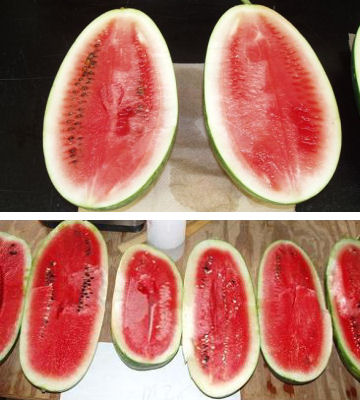
These watermelons may look normal, but they have about half the sugar
Leave it to modern-day technology in research labs to come up with some creative ways to make the foods we eat even healthier. We saw an attempt earlier this year at this concept when scientists figured out a way to produce natural low-fat milk straight from the cow (although that wasn't very healthy, IMHO!). But now there's something low-carbers and diabetics alike should cheer: a low-sugar watermelon (my low-carb blogging friend Robin from "Limenade And Watermelon" will be thrilled)!
Yep, have you heard about this yet? This Science News story details what researchers have come up with as the perfect replacement for this higher-sugar member of the melon family. You'll recall I addressed this in Episode 2 of my "Livin' La Vida Low-Carb on YouTube" video when my wife asked if watermelon was appropriate for someone on low-carb.
While it's not too terribly high in carbs, watermelon is a little higher than you would prefer for those in the early stages of the Atkins low-carb diet where you restrict your intake to around 20g daily. At about 11g net carbs for a cup of watermelon, that usually makes this fruit off limits for people trying to lose weight the low-carb way.
But now a research geneticist named Angela R. Davis from the USDA's Lane, Oklahoma-based Agricultural Research Service gives hope that this plump, juicy summertime favorite can be back on the menu again for those of us leading a lower-sugar, low-carb lifestyle! They have been working on this for years and wanted it to be perfect before releasing the technology to seed companies to replicate the results for consumer production.
Early experiments resulted in white and even yellow flesh for the watermelon--not exactly the most appetizing way to eat watermelon (kinda like the green ketchup from Heinz was for me a few years back--EWWWW!).
"The project took a lot longer than we expected," Davis remarked. "Because there's a correlation between color and sugar content."
Finally they found a way to make the flesh turn pink while virtually cutting the sugar in half! So, instead of 11g net carbs for a cup of watermelon, how about 5g instead? WOO HOO! The lighter the red in the watermelon, the lower the sugar content. And thus is born a low-carb, reduced-sugar watermelon thanks to science.
Details about these new genetically altered low-sugar watermelons will be published in the journal HortScience before the end of the year.
I bet you're wondering how they taste (yeah, me too!). Well, Davis says that will be the primary issue for people who switch from regular watermelon to this one. But for those of us who already eschew sugar in our diet to manage our weight and/or diabetes, it'll probably taste pretty good. I liken it to switching from regular soda to diet soda. The transition takes some getting used to, but it happens.
Just as the soda companies use artificial sweeteners to replace the sugar in their products, so too will those sweeteners come in handy for people choosing to eat this lower-sugar watermelon. I, of course, would recommend either Splenda or stevia if you feel like you need to use a sweetener at all.
Davis said they ran taste tests among teenagers and adults with diabetes and the low-sugar, artificially-sweetened (with Splenda!) watermelons actually BEAT the regular watermelon among those surveyed. WOW! There may be hope for us yet with those kind of results!
"Overall, there was a significant preference for the artificially sweetened watermelons compared with the conventional watermelons," the researchers concluded.
What's so healthy about eating watermelon, you ask? In a word--LYCOPENE! Yes, you can find this awesome nutrient in tomatoes (which gives it that rich, red color!) and it is a powerful antioxidant responsible for destroying free radicals which can wreak havoc on your health. You'll be pleased to know that these reduced-sugar watermelons retain their high lycopene content!
"A low-sugar watermelon is a palatable fruit choice to individuals who must restrict sugar or total carbohydrate intake--with the added benefits of lycopene," the researchers added.
These new reduced-sugar watermelons will look like a typical 10-12 pound watermelon when they do become available in stores--no specific date as of yet. We'll let you know when they're available and will try to blog about how they taste when we get our hands on them. I would think an ice-cold low-sugar watermelon should be ready for consumption by the time the dog days of summer hit in 2008. I can't wait!
You can e-mail Angela Davis to thank her for her research into making watermelons lower in sugar for those of us on carb-restricted diets for weight and diabetes control at adavis-usda@lane-ag.org.
Before we leave on our trip on Tuesday, Christine and I wanted to get one more YouTube video recorded and uploaded for you to enjoy. It's gonna be a couple of weeks until we can do another one, so we were excited about sharing Episode 2 of "Livin' La Vida Low-Carb on YouTube with you today.
Watch our video about fruit intake on a low-carb diet RIGHT NOW:
Yes, Virginia, you CAN have fruit on a low-carb diet. But it's important that you choose the right KIND of fruits to eat and not just buy into the "all fruit is good" copout thinking (because there are some VERY HIGH SUGAR fruits that you should not be eating). I cite what the late great Dr. Robert C. Atkins shared about fruit consumption in his classic Dr. Atkins' New Diet Revolution as well as Dr. Jonny Bowden's new book The 150 Healthiest Foods On Earth.
Forgive me for eating on cantaloupe for most of the video, but it tastes so good I can hardly contain myself when I'm around it! LOL! Christine pretty much had to run this episode because I was busy stuffing my face with the deliciously healthy taste of yummy melon.
We'd love to have your comments at YouTube for Episode 2 and be sure to favorite it and share it with your friends while you are there. Hundreds have watched our first few videos and I expect thousands more to do the same as we continue making these in the future.
Subscribe to our YouTube videos and you will get an alert every time a new one is posted. We'd also love to hear your suggestions for future video topics, so feel free to leave those suggestions in the comments section of any of the videos.
THANK YOU for watching and supporting us with this new project!
8-28-07 UPDATE: Leave it to my low-carb friend and fellow blogger Kent Altena to provide the first video comment in response to one of my YouTube videos. Here's what he has to say in a quick response video about his fruit consumption while livin' la vida low-carb:
YOU ARE HILARIOUS, Kent! THANKS for sharing...now I gotta go make me some of that strawberries and cream cheese recipe you were munching on! Yummy! ;)
What's so glorious about encouraging fruit and vegetable intake?
When you finally come to the place where you realize how much everything you ever knew about diet and health was wrong when you started livin' la vida low-carb, it probably made you wonder what else you've always believed was true that might not be exactly as you have always thought.
Have you ever given serious thought about some things that are commonly believed to be "healthy?" Take, for example, eating fruits and vegetables. GASP! You can't start talking about NOT eating fruits and vegetables, Jimmy. Everyone KNOWS how healthy those are to your diet and removing them from your list of foods is just too extreme.
Sigh.
Nobody is thinking of completely removing ALL fruits and vegetables from your diet. Although there are some people who believe there is no benefit whatsoever to eating these foods on a low-carb diet, I am not one of them. Selective fruits and vegetables have their place for people who are livin' la vida low-carb, but it's not a free-for-all which I'll explain in this post.
Dealing with those who fall for supposedly common sense dietary ideas like eating more fruits and vegetables (borne out of a lack of adequate nutritional education) is something I've come to realize is a fact of life that will not go away easily (but I'm trying my darndest to change that with my blog).
I don't blame people who suffer from what I describe as "educated ignorance," but it is indeed holding us back from progressing forward as an enlightened society. If only people knew how harmful certain fruits and vegetables were to their body, they wouldn't be so quick to embrace them indiscriminately.
It's not so much that eating fruits and vegetables is an unhealthy thing for your body, per se, but you really need to qualify what you mean by "fruits and vegetables." Painting that category of foods in such a broad brush is not a very wise thing to do. Let me explain by showing you some jaw-dropping numbers from one of the leading health organizations in America.
According to the report entitled "2006 ADA Nutrition Recommendations: Context of Dietary Trends" from 1999-2000, the following is the breakdown of the actual vegetables consumed by adults 20 years and over:
Others-35% Fried potatoes-22% Other potatoes-13% Tomatoes-11% Dark green/orange-11% Legumes/beans-8%
EEEEK! Over one-third of the vegetable consumption by adults is the high-carb potatoes, most of which is made up of French fries ostensibly from fast food restaurants like McDonald's. As much as you want to argue that a potato is a healthy vegetable, I would beg to differ. Not even if you chill it to lower the glycemic load can you convince me these spuds are something I need in my body. NEVER again!
Speaking of children, check out the vegetable servings from that same ADA dietary trends report for children ages 2-19 years (don't pass out when you see this!):
Fried potatoes-46% Others-22% Other potatoes-10% Tomatoes-9% Dark green/orange-7% Legumes/beans-6%
Yes, you read that right! Almost two-thirds of the "healthy" vegetable consumption by the future of our society is made up of potatoes. SAY WHAT?! These extremely starchy, carb-loaded vegetables are as harmful to your child's weight and health as eating table sugar by the spoonful! Carbs, carbs, and more carbs. Oh yummy...NOT!
Can you see how the McDonald's culture has so gripped our nation's youth that nearly half of their vegetable intake is from French fries? Yikeseroo! And this is what I'm talking about when I say it's a copout to generically say "eat fruits and vegetables." Without a qualifying statement to explain what you mean, then that is not necessarily a good thing.
In fact, I think it should be criminal to make the claim that a potato is a vegetable. Here's the truth about potatoes--It's poison for your blood sugar! You don't need it, you'll never need it, and you won't miss having it. Trust me on this, you won't.
Instead, there are some VERY good vegetables that should be consumed as part of a healthy diet because they are non-starchy and provide some excellent nutrients for your body. These are the kind of veggies that contribute to the doubling of vegetable consumption on low-carb. They include, but aren't limited to:
Green leafy veggies like kale, spinach, and lettuce, broccoli, cauliflower, green beans, asparagus, celery, and cabbage
Even vegetables like carrots, tomatoes, and onions are probably not a good idea when you are trying to lose weight on a low-carb nutritional approach. Add them back in limited quantities once you reach your goal weight, but avoid them to help keep your carb counts low enough to keep on losing weight and avoiding stalls. You'll be glad you did!
Okay, that's great for veggies, but what about fruits? Are there any a low-carber can eat? This is an interesting question that one of my readers asked me about in an e-mail this week. Here's what she wrote:
"Can you tell me if its okay to eat an apple each day on the low-carb diet along with some vegetables like salad? I eat lots of fish and meat. Or is the apple too sweet? I still need to lose weight and want to do what's best for me.
Am I better to skip the fruit for a while to lose weight? I love fruit but can manage without it as long as I have my veggies. Thanks for your help."
Very good question and I'm happy to answer it. As long as you stick to the non-starchy veggies I listed above, then you'll be okay. But the apple is probably not a good idea when you are losing weight. One apple has about 20g carbs consisting mostly of sugar. The worst fruit of all is a banana with close to 30g carbs, again LOADED with sugar. Not far behind are sugary raisins--are you seeing the trend here?
We all think that it's fruit, so it must be good for us. But these are clearly NOT healthy for you no matter how you slice it when you are livin' la vida low-carb. This is a wake-up call for a lot of people who THINK they're eating healthy.
If you just remember that sugar is not your friend on low-carb, regardless of the source, then you'll avoid the heartache of disappointment when your weight loss plan does not help you shed the pounds.
Another big no-no that a lot of people pretend is healthy for them and consider part of their fruit intake is orange juice. Did you know there is almost as much sugar in a glass of OJ as there is in a 12-ounce can of Coca-Cola?
Then you've got juice products like Sunny Delight and Juicy Juice which have tons of added sugars in them and it's a potent potion for sending your blood sugar on a tricky rollercoaster ride. Is that REALLY healthy for you? I don't think so.
Your body doesn't care if the sugar you take in comes from a supposedly "healthy" fruit or a candy bar, your blood sugar spikes in reaction to it the same way. Focusing on the low-glycemic (or low-sugar) fruits is key or even skip them altogether until you reach your weight loss goal.
Making the right choices as it relates to fruits and vegetables is an important distinction that is never made by the so-called health "experts" who advise to eat fruits and vegetables in unlimited quantities since they're so good for you. If most Americans are eating potatoes and bananas as well as drinking orange juice and grape juice, then is it any wonder why our nation is so fat and getting fatter by the moment? Chew on that one for a while.
So the next time you hear someone give you the "fruit and vegetable" copout excuse claiming they are eating healthy and you are eating unhealthy because you don't eat as much of those foods as they do, then you tell them that you're eating the RIGHT kind of fruits and vegetables for your healthy low-carb lifestyle. Then just stare at their face because it will be priceless! :)
Low-glycemic fruits are recommended for a low-carb diet
This Fredericksburg, VA-based Free-Lance Star column about how important exercise is for the sake of brain function included some rather lamebrained information perpetuating the myths about fruit consumption when you are livin' la vida low-carb that are obviously NOT based on any low-carb program I am familiar with.
Here's the quote from the article:
Low-carb diets are all wrong. "It makes me crazy," the medical expert in the story said, when his patients tell him they can't eat fruit and vegetables because they're on a low-carb diet. "Almost all the anti-aging nutrients come from carbohydrates."
If somebody is telling their doctor they can't eat any fruit at all because they are on a low-carb diet, then apparently they haven't read any of the same low-carb diet books that I have. Certainly, there are a few high-sugar fruits that are not recommended for low-carbers to consume, including bananas, raisins, and even orange juice, especially during the weight loss phases because they will kick you out of ketosis just as fast as a sugary candy bar will.
I have blogged about some of my favorite low-glycemic fruits such as yummy blueberries and strawberries as well as melons and cantaloupes that have been and still are an essential part of my Atkins low-carb lifestyle. It makes me scratch my head in bewilderment whenever people ask me if I eat fruit now that I've lost weight. Um, I've been eating fruit throughout my low-carb journey, so DUH!
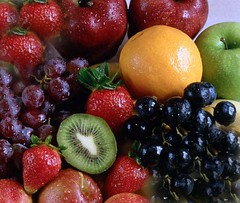
This may surprise people, but fruit is allowed on the Atkins diet
The truth is you can get all the healthy benefits of eating fruits on the low-carb lifestyle just as Dr. Robert C. Atkins suggested in his program. In fact, right now I'm looking at pages 496-497 in Dr. Atkins New Diet Revolution and Dr. Atkins has an entire list of RECOMMENDED fruits to be consumed on the low-carb lifestyle along with their carb counts.
Look at these 21 fruits with LESS than 8g carbohydrates:
Yep, that low-carb diet sure is devoid of fruit, ain't it? NOT! I suppose if you never even cracked open the book to begin with, then you would automatically ASSume fruits are not allowed. But clearly that is not the case with the real Atkins diet to anyone who bothers to actually read all 540 pages of it! How much more arrogant can you be than to spread lies and misinformation about something you know nothing about (remember Vee Jefferson)?
The article went on to say that people should "avoid the bad carbs by all means" including white flour, sugars, and corn syrup as well as hydrogenated fats (aka trans-fats). Excellent! That is all very good advice to follow indeed.
So, in the end, check out what foods are recommended:
Green leafy vegetables, lean protein from seafood and poultry, beans, soy products, whole grains, cruciferous vegetables such as broccoli, berries, nuts, ground flax, garlic, herbs, green tea, non-fat yogurts with fruit, red wine, dark chocolate and cocoa.
Hmmm, what do MOST of those foods listed above look like to you? Can you say LIVIN' LA VIDA LOW-CARB, baby! Take away the whole grains, beans, and soy products and you will probably not find that many low-carb supporters who will disagree with any of those other food choices. See, this constant drumbeat of negativity about low-carb living really has become pointless because they agree with us a lot more than they even realize it!
Now go get you a bowl of some low-carb fruit to sit down, relax, and enjoy a healthy snack while you ponder over this newfound understanding and realization of the most amazing nutritional approach known to mankind--that would be livin' la vida low-carb!