Everyone is a critic on the Internet and that's what makes the blogging universe so much fun in my opinion. You get an unfiltered, uncensored, and sometimes irreverent response from virtually every angle you can possibly think of. And the opinions that are expressed in this format include some that would never EVER be uttered in "real" life from these people. That is especially true of people who leave anonymous comments.
Over the years I have received plenty of complaints that my blog is too much this, not enough of that, blah blah blah. While I appreciate hearing feedback from a representative segment of the thousands who come here daily, the fact of the matter is I blog about what's on my mind from my perspective. I'm certainly not saying that my opinion is 100% accurate every single time I start typing and anyone who believes they are infallible should watch out for that lightning bolt coming down from the sky!
When I started writing about livin' la vida low-carb, it was with a purpose in mind. Tell others about how the low-carb lifestyle can change their life through weight loss, health improvements, and a commitment to living this way for the rest of their long and healthy life. There are all sorts of web sites and blogs just like this for the low-calorie lifestyle, the low-fat lifestyle, the vegan lifestyle, and so forth. So why not have one for the healthy low-carb way of life, too? :)
Unfortunately, some people mistakenly believe that I'm not allowed to be an advocate for low-carb at my blog. Why? Because a low-carb diet isn't necessarily for everyone--something I READILY admit is true. In fact, I tell people all the time to find the proven plan that works for them that they'll enjoy, follow that plan exactly as prescribed by the author of that plan, and then keep doing it for the rest of their lives. If that's low-carb, low-fat, low-calorie, vegan, vegetarian, meat only, WHATEVER, then DO IT!
Yes, I'm enthusiastic about low-carb living and why shouldn't I be? It has changed my life forever. And despite some minor weight gain issues this year (which I'm getting under control now, by the way, with my weight moving down again!), this way of eating has afforded me some of the best health markers of my entire life. Livin' la vida low-carb is why this is happening and I want the whole world to know what it has done for me. Again, this is what my blog is all about.
However, after blogging about that idiotic "big breakfast" study earlier this week to counter all those silly headlines that made people believe they should eat a high-carb breakfast to lose weight, I got the most peculiar comment in response to what I shared. It was an "anonymous" comment (OF COURSE!) and the person who penned it follows a low-calorie diet. While I appreciate that there are readers who come at the nutrition subject from a different perspective than me, it's a bit disingenuous on their part to expect me to kowtow to their preferred way of eating. Ummmm, this is a LOW-CARB blog, so it shouldn't come as a surprise to learn I'm gonna blog about low-carb living. DUH!
Try asking low-fat diet guru Dr. Dean Ornish to talk positively about the low-carb Atkins diet on his web site. He'd laugh in your face because this dietary philosophy doesn't jive with what he believes is the most nutritionally sound advice for people desiring weight loss and better health. He has a right to his opinions about healthy living and people can choose to embrace or reject what he has to say. The information age we live in affords us the luxury of educating ourselves about what is true and what is not.
That's what makes this comment I received from that nameless low-calorie loving reader so odd. Here's what he wrote:
While I generally agree that some of the articles you post are a bit bogus, I find that you are ever increasingly hostile towards anything non low carbohydrate. I know you are a very strong advocate for the low carbohydrate lifestyle, it has changed your life and you make a living from it. However, not everyone has the will power or the drive to make such a lifestyle change.
A calorie restricted diet is not evil, it won't hunt you down and kill you. A lot of doctors and health professionals choose for their patients to restrict their calories because they can eat the foods they love. If you take a person who has never been on a low carbohydrate diet and suddenly expect them to eat nothing but induction food for two weeks or longer, a high percent of them will fail. Even if they can later add in fruits and nuts and the like, it may be too much of a severe restriction. It may very well be that your health will vastly improve, but it does happen on a restricted calorie diet also.
I respect the work you do, and I respect your opinions, but I do not agree that you should be bashing everyone else in the process. If you had lost your weight on a restricted calorie diet, improved your health, and maintained your weight, would you not promote that and disagree with everyone else?
Jimmy, I have nothing but the utmost respect for you and your lifestyle, honestly. I am not wanting to cause arguments or hard feelings. I just think that a carbohydrate restrictive diet is not a magic cure nor is a calorie restrictive diet. Some will have success on one and not the other, neither is for everyone. I would just like to see a little less hostility towards other peoples choices and beliefs. I respect yours, please respect mine.
My response to this reader's complaint was so lengthy and detailed (because it needed to be), I decided to feature it as a post of its own today so that more people will read it and understand a little more about what I do and why I do it. ENJOY!
THANK YOU for openly expressing your concerns, anonymous. Anyone who has read my blog for any length of time knows I have often hit hard on ridiculous studies like this one because they are simply continuing to push the message that low-carb is unhealthy while propping up a low-fat diet as the preferred way. This is not something new and you can see examples of where I've come down on the low-fat/low-calorie lie many times in the past:
These are but a few examples of how my general writing style has not changed very much as it relates to challenging the low-fat diet wisdom. If anything, I've toned it down somewhat from those earlier columns.
With that said, most people who read my writings know that I am all in favor of people finding the proven plan that works for them to lose weight, following that plan exactly as the author prescribes, and then KEEP doing that plan for the rest of their lives. If that's a low-fat and/or low-calorie diet, then who am I to stand in their way and tell them NOT to do it. There are certainly a dime a dozen support sites out there for those particular ways of eating that people can visit.
But when someone comes to the "Livin' La Vida Low-Carb" blog, I want them to be encouraged, educated, and inspired about the healthy low-carb lifestyle. Yes, this way of eating worked remarkably well for me to help shed the pounds and greatly improve my health, so I can't help but share the positive experiences and research about it. It's precisely why I started this blog to begin with.
With all the constant negativity out there about livin' la vida low-carb as exemplified in studies like this one, we need MORE people to get fired up and responding to these kinds of things. There are no checks and balances on these people who espouse low-calorie, low-fat diets. They just write assuming ahead of time that low-carb is bunk. But I know better than that because of what has happened to me and to many moore people.
Trust me, if you need to hear from more low-carb success stories, I'm sure they are all too happy to fill up this comments section with their testimony of change.
I'm curious, though. What articles have I posted that you think are "a bit bogus?" Everything I write about is researched and accurate to the best of my knowledge. If you think I've made something up (ergo, the use of the term "bogus"), then I'm all ears. Don't throw something out there like that without providing examples.
And don't misunderstand my passion for wanting to get the word out about healthy low-carb living and think that means I am "hostile." Enthusiastic, maybe, but there is no hostility in my blood. I care about people enough to tell them the truth about what is healthy.
While you believe someone can only accomplish success on low-carb if they have some miraculous willpower or drive, the reality is it takes neither of those to be successful. All you need is a steadfast resolve to make better choices for the sake of your weight and health. When people start caring enough about themselves to reduce their carbohydrate intake to control blood sugar and insulin, eat some protein at each meal for satiety, and consume plenty of fat to burn as fuel and to keep their diet delicious and healthy, then we will see some pretty major changes happening with obesity and disease.
As it currently stands, the low-fat, low-calorie, portion-controlled diet has been given DECADES to rule the nutritional roost. And what has it gotten us? MORE obesity, MORE diabetes, MORE sickness, and MORE death. We're taking more prescription drugs now than ever before and nobody is disgusted by this.
This isn't me "bashing" anyone, it's just presenting the truth. Isn't it true obesity rates have gotten MUCH worse since the great low-fat, low-calorie diet began being promoted in this country in the early 1970s? And diabetes, especially Type 2, has exploded into a literal crisis of health over that same time period, hasn't it? Who is gonna argue that we are healthier as a nation today than we were 30 years ago? Anyone?!
By the way, I DID lose a whole lot of weight on a low-fat diet in 1999 and I was miserable on it. Hungry all the time, weak with barely any energy, dizzy and nauseous, and downright MISERABLE! Although I lost 170 pounds in nine months eating that way, I gained it all back within four months when I couldn't take it anymore.
With livin' la vida low-carb, that impulse to rebel against how I eat has NEVER even remotely crossed my mind. I am more satisfied now with how I eat than I even was when I was eating whatever I desired. Now I desire those low-carb foods my body was always meant to eat.
There are no hard feelings from me. Life is too short to be upset at anyone, let alone someone who was brave enough to share their thoughts and concerns with me (albeit anonymously). I can appreciate your perspective and am grateful you respect mine. Nobody is saying livin' la vida low-carb is a "magic cure," but it sure is dramatically changing the weight and health of a whole lot more people than we are being told about.
If low-calorie diets are working for you, then GO FOR IT! Keep working your plan and it will keep working for you. Get involved at a low-calorie supporting web site, forum, or blog and get all the inspiration you need for your chosen dietary approach. But this is "Livin' La Vida Low-Carb" and I will keep on talking about the healthy low-carb life. It's the purpose I have in my life right now and, God willing, nothing will ever keep me from fulfilling that purpose.
THANK YOU again for sharing your thoughts with me and my readers. I may just have to make a blog post out of this response. :)
And so I did! What are your thoughts about this criticism that I am too "hostile" towards anything that's not low-carb? Agree? Disagree? I appreciate hearing what you have to say. Even from "anonymous." :D
Dr. Daniela Jakubowicz encourages a high-carb breakfast
Have you heard about this silly study presented at The Endocrine Society's 90th Annual Meeting in San Francisco, California on Tuesday? I hear some real doozies every now and then when it comes to nutritional science as it relates to weight loss, but this one takes the proverbial cake for being one of the most bizarre, outrageous, and idiotic to come along in a while (but now let me tell you how I REALLY feel!).
This story was all over the news yesterday and it just about made me nauseous with all the fawning the media was giving it. Here are some researchers who claim to have found a way to overcome the problem with cravings on a diet which eventually leads to dieters regaining their weight. It's a big top-secret bit of nutritional advice that they've unleashed on the world. Wanna know what it is?
EAT A HUGE HIGH-CARB, HIGH-PROTEIN BREAKFAST and then EAT LOW-CALORIE AND LOW-CARB MEALS for the rest of the day. That's it! If you eat this "big breakfast," then you are guaranteed not just to lose weight, but keep the weight off long-term, according to the author of the study Dr. Daniela Jakubowicz from the Hospital de Clinicas, Caracas, Venzezuela.
I'm sorry, Dr. Jakubowicz, but with all due respect to your research my body does not need to be inundated with carbohydrates early in the day in order for me to feel satisfied and free from cravings the rest of the day. It can be argued that eating those carbs in the morning even with a high-protein intake will result in a spike in blood sugar leading to a quick mid-morning crash and hunger like you wouldn't believe. That's why I started livin' la vida low-carb so I wouldn't have to deal with that anymore.
Of course, if you are gonna consume a large amount of carbs, then it is better for it to be earlier in the day so you have time to burn them off as part of your daily activities. But this does not abdicate the body's natural response to them over the course of the day which can have health implications if this high-carb breakfast strategy is implemented long-term. This kinda sounds like a reverse Carbohydrate Addict's Diet if you ask me.
The study itself was conducted in conjunction with researchers from Virginia Commonwealth University in Richmond, Virginia and Dr. Jakubowicz wanted to see what the long-term impact of satiety (the feeling of being "full") and cravings using a strict low-fat, low-calorie, low-carb diet and one that included the "big breakfast" on 94 obese inactive women.
Well, there's your first problem. A truly effective low-carb diet cannot be calorie-restricted or fat-limited. Fat is the fuel for your body when you remove the carbohydrates, so limiting your calories from this macronutrient while cutting your portions down to minimize your caloric intake is setting your diet up for disaster from the beginning. I've said it many times before, but I'll say it again: DON'T MIX LOW-FAT AND LOW-CARB TOGETHER! It will only lead to a miserable weight loss experience.
There were a total of 46 women place on the very low-carb diet with the following macronutrient and caloric breakdown:
FAT--78g PROTEIN--51g CARBOHYDRATE--17g TOTAL CALORIES--1,085
Am I the only one to look at that minuscule amount of food and say EEEEK?! While the ratio of fat/protein/carbs is excellent coming it at around 79/14/7, the calories are way too low. I even added up the numbers and I only came up with 974 calories--over 100 calories less than the researchers claimed. If you multiply 78 X 9 calories for each gram of fat, that gives you 702 fat calories. Add that to the 51 X 4 calories each for the protein to give you a total of 204 protein calories and 17 X 4 calories each for the carbohydrate to give you a total of 68 carb calories. Adding up these three numbers, you only get 974. Do I need to tell you how deficient this is for a healthy low-carb diet? The percentages are fine, but the portions are inadequate.
Their breakfast was the smallest meal of the day at just 290 calories and they could use up to 7g of carbs in the form of bread, fruit, cereal and milk and only 12 grams of protein coming from meat and eggs, for example. The researchers were trying hard to keep this control group from having a "big breakfast" with too much protein. But let's call their bluff again on this one.
Who follows a low-carb lifestyle and has bread, fruit, cereal and milk for breakfast? Anyone? I've never heard of someone who is livin' la vida low-carb eating such foods because they are NOT permitted during Induction as this group was supposed to represent. I just did a YouTube video on what you can eat on Induction and it doesn't include any of those things. Instead, it's all about consuming healthy amounts of fat and protein to keep your hunger at bay to help you get through the day. That's what Dr. Atkins advocated, NOT this made-up version of low-carb these researchers put these people on.
Conversely, there were 48 women place on the "big-breakfast diet" with the following macronutrient breakdown:
FAT--46g PROTEIN--93g CARBOHYDRATE--97g TOTAL CALORIES--1,240
The ratio of fat/protein/carbs is about evenly balanced coming it at around 36/31/33, which isn't exactly low-carb by any real stretch of the imagination. And once again the calories don't seem to add up only totaling 1174--66 calories less than what the researchers stated. If you multiply 46 X 9 calories for each gram of fat, that gives you 414 fat calories. Add that to the 93 X 4 calories each for the protein to give you a total of 372 protein calories and 97 X 4 calories each for the carbohydrate to give you a total of 388 carb calories. What's up with this screwy math?
Regardless, it's quite easy to see that the huge high-carb "big breakfast" meal at the beginning of the day for the dieters in this group greatly skews their macronutrient totals for the day making this an odd "low-carb" diet. They consumed a 610-calorie breakfast with 58 grams of carbohydrate, 47 grams of protein, and 22 grams of fat. Their lunch was 395 calories of another high-carb, low-fat meal (13/28/34) followed by supper being a 235-calorie meal that's very low-carb, high-fat (26/18/5). I can only imagine what the bodies of these poor women were thinking on this diet. WHAT IN THE WORLD ARE YOU DOING TO ME?!?!
So, what were the "results" of this suspicious eight-month study? Four months focused on weight loss followed by another four months of weight maintenance. The strict low-carb, low-calorie group lost an average of 28 pounds compared with the "big breakfask" group who only lost 23 pounds. Statistically, this is not a big difference, according to the researchers.
But the "ah hah" part of this study Dr. Jakubowicz wants people to remember about it is what happened at the end of the eight months--after four months of maintenance. The low-carb, low-calorie dieters regained an average of 18 pounds for a cumulative weight loss of 10 pounds--just 4.5 percent of their body weight. Meanwhile, the "big breakfast" group lost an additional 16.5 pounds for a total weight loss of 39.5 pounds--an amazing 21 percent of their body weight.
Dr. Jakubowicz reminds people that the women who had the "big breakfast" said they weren't as hungry before lunch and lacked the cravings for carbohydrates that the low-carb, low-calorie dieters did.
"Most weight loss studies have determined that a very low carbohydrate diet is not a good method to reduce weight," Dr. Jakubowicz concluded. "It exacerbates the craving for carbohydrates and slows metabolism. As a result, after a short period of weight loss, there is a quick return to obesity."
Oh really, Dr. Jakubowicz. Is that a fact? Livin' la vida low-carb makes carb cravings WORSE and slows down your metabolism?! WRONG!!! My experience has been that eating a truly low-carb diet (not one that starts off your day with cereal or bread!) keeps the cravings away and consuming plenty of fat and moderate protein as every good low-carb diet does will rev up your metabolism into a fat-burning machine while you enjoy delicious foods that will keep your energy level up all day.
The major flaw in this study was the restriction on calories it placed on the low-carb dieters in the control group. Have them get rid of the fruit, milk and bread for breakfast and let them eat all the eggs and sausage they need to satisfy their hunger. Then at lunch, have them eat a hamburger patty or two with some cheese on top and a little mayo with a side salad and Ranch dressing. For supper, let them cook up a nice fatty steak and serve a little steamed broccoli or cauliflower with butter on the side. Snacks in between those meals can include almonds, macadamia nuts, sugar-free chocolates, cheese sticks, pepperoni slices, and other snackable low-carb foods.
If your control group was allowed to truly eat a healthy low-carb lifestyle as outlined above, then they would have lost more than 28 pounds in four months and they most certainly would not have gained anything back. Speaking of that, how did they gain the weight back? Did they add back more calories in the form of carbs to go with the fat they were eating? Anyone with a brain knows that a high-fat, high-carb diet is unhealthy, so why should it be surprising they'd gain the weight back, hmmmmm? This just seems so suspicious to me and they're pointing the finger of blame at the diet itself.
Look, livin' la vida low-carb works when you work it. If you stop doing it, then you are no longer following a low-carb diet. Trying to pin the blame of weight gain on low-carb is like blaming President George Washington for getting us in the war in Iraq. The only person you can fault when you decide to stop low-carbing is YOU. Dr. Jakubowicz says only 5 percent of low-carb dieters are still at it two years later, but whose responsibility is that? The diet or the dieter? I don't think you can lay that one at the feet of livin' la vida low-carb. I know many people who have been eating this way for years and they've done just fine.
Dr. Jakubowicz also says that low-carb living does not address addictive eating impulses, but I could not disagree more. When you eat this way, you bring so much balance back into your health by getting off of those blood sugar swings that are causing insulin to spike inside of your body and setting off a whole string of health consequences. Yes, you can certainly lose weight eating carbs, but what is happening to your health? There are no guarantees you are putting yourself in a better position with weight loss on a low-fat diet.
So this "big breakfast" approach is supposed to be the "be-all, end-all" diet for people now, huh Dr. Jakubowicz. It's supposed to control my appetite and make me not crave sugary and starchy carbs, eh? And it's HEALTHIER than anything else out there because you get to eat more fruit on it. Wanna know what I think (you probably don't, but you're gonna get it anyway!)? I think you're just another low-fat diet lover trying your darndest to discredit and taint the healthy low-carb lifestyle under the guise of science.
People like you doing this kind of research are what's WRONG with medical studies today. Your bias could not be more evident if you tried. Why not actually read Dr. Atkins' New Diet Revolution or Protein Power and see what they doctors have written about low-carb living. It's MUCH different than what you stupid study would have people believe and yet somehow I don't think you really care. And that's the most regrettable part of this entire scenario.
6-19-08 UPDATE: The always entertaining and opinionated Dana Carpender weighed in on this "study" today with a column entitled "Oh, Fercryinoutloud! The "Big Breakfast" Study" where she echoes many of the same points I made. GET 'EM DANA!!! :)
6-22-08 UPDATE: My blog post about this study appeared in business journalist Dana Blankenhorn's latest column entitled "Have You Tried The IHOP Diet?"
6-22-08 UPDATE: I heard from the researcher's son Dr. Salomon Jakubowicz today who said the media distorted what her research was all about. Here's what he wrote:
Regarding my mother Daniela Jakubowicz's study she tried to make a low-carb diet including breakfast for both subjects and controls but the journalists increased the importance of the carbs during breakfast incorrectly calling it a "High-Carb And High-Protein Breakfast." She does know that protein's satiety power is bigger than carbs or fats. Your review is challenging although not very respectful for a health researcher.
Well, #1 I'm not a health researcher. I'm a guy who lost weight and got healthy on a truly low-carb diet. That notwithstanding, I think it is incumbent upon your mother to set the record straight since the headlines completely skew what her study intended. I have invited Dr. Salomon to ask his mother if she would like to appear on my podcast show to clear the air about how her study was misinterpreted. We'll see what she says. :)
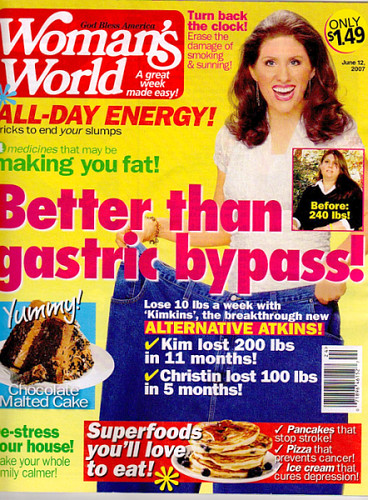
Kimkins cover girl: "I was wrong...Kimkins is not the way to lose weight"
It takes a very special person to publicly admit when they were wrong about something even after multiple warnings and concerns shared by those around them. And yet that is exactly what has happened this week when Kimkins Woman's World cover girl Christin delivered an impassioned video apology at her blog along with a detailed explanation of the health complications she and others have suffered since beginning the risky low-carb imposter diet scheme devised by a morbidly obese woman named Heidi Diaz.
I blogged about my concerns over the Kimkins fiasco that culminated earlier this week when this beautiful young woman had to be rushed to the emergency room because of some pain in her chest and heart complications. When you hear something like this happening that was brought on by such an extreme low-fat/low-calorie diet like Kimkins, it should make you angry. AND I AM ANGRY ABOUT IT!
To anyone who is still on the Kimkins diet, CHRISTIN has a message just for YOU:
Show your support for and encouragement to Christin by leaving a comment about this video at her "The Journey On" blog. What a brave woman she is and I am honored to know her as a friend. She has demonstrated nothing but grace, elegance, and dignity in the midst of what has become a complete and utter nightmare for so many of us in the low-carb community concerning this Kimkins debacle.
For the sake of those who cannot view the video, the following is a summary of the video, including direct quotes made by Christin regarding her experience following the Kimkins diet. Be prepared to be shocked and stunned as she shares quite openly about the negative impact this weight loss fraud has had and may continue to have on her health. Pray for her even now as she seeks to reverse the damage that has been done.
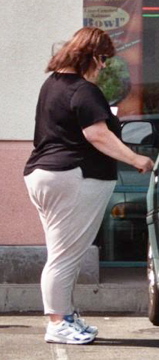
Christin before Kimkins when she weighed 250 pounds
Christin said she did this video so that others would "know exactly where I stand on this." She explained why most people choose to lose weight: to improve their health. Period! When you are 100+ pounds overweight, then you are not living healthy, she noted.
She chose the Kimkins program because she "wanted to lose weight quickly and I thought healthfully" because she "wanted more for my life." She wanted to "be there" for her family in the years to come. I think all of us who have ever gone on a weight loss plan can relate to that.
Christin today after losing 100 pounds
When she first began, the program was working great for her because "I was following the program exactly as written. I thought I was doing perfectly." But after losing 100 pounds in five months, Christin then conspicuously noticed there was not one single doctor who approved the Kimkins diet. That's when she started looking into who Heidi Diaz, aka Kimmer, really was and what she claimed to be.
Diaz had alleged in the marketing of Kimkins that she lost 198 pounds in 11 months on this Kimkins diet and was promoting it that way to anyone who would listen with supposed pictures to prove it. But it was this recent series of articles that included recent photographs of Diaz along with several other sites that made Christin become concerned and realize that those claims by Diaz were simply "not true."
"Heidi did not lose the weight, she did not follow this program that she claims is safe for anybody, even for diabetics," Christin said.
Then Christin turned in her video to the "risks" of being on the Kimkins diet that she discovered first-hand while following the program. She said she has real "concerns for everyone else that has attempted this program or will attempt this program."
That includes first and foremost hair loss. Christin admitted that her hair "started fall out in handfuls" and it "scared" her. She estimates she has lost as much as 60 percent of what used to be "thick, full hair" prior to her Kimkins experience.
"Now it's very thin," she exclaimed.
Another side effect was the loss of her menstrual cycle that she believes happened from "eating so few calories and my body was becoming malnourished." She said the hair loss and lack of periods are both tell-tale signs of anorexia, an eating disorder where victims literally starve themselves to be thin.
"I believe now the Kimkins diet program promotes a form of anorexia that I don't know if science has even attempted touch on this yet," Christin stated. "300 calories a day is not safe weight loss."
Any dietary change this drastic need to be closely monitored by a doctor just like those who undergo gastric bypass surgery do, she added.
When these symptoms began to show up, Christin went on the Kimkins forums to see if anyone else was losing their hair and female cycle like she was. "What's going on?" she pleaded to anyone who would listen to her concerns. And Christin said she "saw it come up multiple times" regarding these symptoms she was having in other people, too.
The excuse provided in response to this happening was that it was "perfectly normal and you're going through a shed. Your body is just losing estrogen." It was just too coincidental that "almost every other person who kept their calories under 1000 calories, probably more under 700 calories, has lost hair."
"I don't want to scare you," Christin said speaking directly to people who are still following Kimkins, "but I want to bring you into the reality that there is a better way to lose weight."
Christin asks "are you really doing this?" and urges people to take their diet plan to their doctor for him to examine it. "Take him your Fitday, take him exactly what you are eating, let him see your calorie counts," she said.
"I'm concerned about you," Christin pleaded.
Christin says she is sorry for supporting the "dangerous" Kimkins diet
When the time came for Christin to step into the spotlight back in June when the Woman's World magazine cover story opportunity came up, she said she was "put on a pedestal as the 'cover girl.' I was the model, I was the way to do it." But now she realizes how she was used as a pawn and seeks the mercy of those who trusted and looked up to her.
"I need to ask your forgiveness," she said. "I'm sorry. I was wrong. Kimkins is not the way to lose weight. Kimkins is dangerous...for your health, it's dangerous for your psyche."
But as much as Kimkins hurt Christin up until this point, none of it was as grave as what was happening to her without even realizing it. She had the symptoms of an eating disorder that she admits made her realize she "had a problem" when she was fearful of even consuming some salad out of fear that she'd stall in her weight loss.
"I did not get fat on salad and on healthy vegetables," Christin explained. "I got fat on sugar and white carbs."
Getting over the fear of eating was a very difficult mental test for Christin as she now obsessed over every little bite of food she was eating and how it would impact her on the scale. She revealed that she hasn't met anyone who has been on the Kimkins program who wasn't "literally scared" to add food back into their diet.
"What kind of a program is it that makes you scared? Weight loss is not about fear, weight loss is about excitement, it's about joy, it's about recapturing your life," Christin shared with a glimmer in her eyes. "It should be a fun journey, not a fearful one."
And yet fear was exactly what gripped Christin and it would not let go of her.
"If I wasn't losing everyday, then I began wondering what was wrong with me," Christin admitted. "Nothing was wrong with me. My body was screaming at me. It was putting the brakes on and telling me you're going about this the wrong way."
As a devout Christian, she knew that "God created us to eat healthy foods; vegetables and fruits, whole grains, and yes, even fat." Christin reiterated that she believes there is "validity to low-carb programs" like Atkins, Protein Power, and the like when they are done the correct way and not the Kimkins way.
"You will provide your body with all of the nutrients that it needs" when you follow low-carb by the book, Christin shared. "God did not create you to starve yourself."
Outlining the "many dangers within the Kimkins program," she said that it goes much deeper than just an eating disorder. She said that "something is going on within my body" and that it has been manifested in the form of "flutters" in her heart for the past month.
"Twinges, cramps, aches, all within my chest cavity right around the area of my heart," Christin expressed, sharing that it all came to a head on Monday when the "severe chest pains...stomach aches, and nausea" were so great she was admitted to the emergency room staying there until late at night.
The doctors examined her with many tests, including an EKG, blood work, chest x-rays, and they kept her at the hospital for several hours to monitor her condition. It's still unknown what caused the tremendous pain to come on Christin like it did on Monday night, but she was prescribed pain medications and was referred to a cardiologist for an immediate follow-up visit.
That visit to the cardiologist took place on Wednesday who shared several concerns for Christin. With a "more and more serious" look on his face after hearing Christin's story about her starvation-mode weight loss method compliments of the Kimkins diet, he told her flat out that "our bodies can suffer damage from eating that little."
After conducting more tests on her, including an EKG, an ECG, blood work, and "lots of listening with the stethoscope," the cardiologist said he was not concerned about what he called a "normal" low pulse rate of 45 (incidentally, mine is in the upper 40's since I lost nearly 200 pounds and Christin has experienced a heart rate in the low-to-mid 40's). Even still, she says she "might get a second opinion on" just to be sure about it.
But there were real concerns that the cardiologist had for Christin, including "possible damage to my heart nodes and valves from malnutrition." Because of that, he wants to have a sonogram of Christin's heart to confirm whether or not there is this damage since it was inconclusive from the initial examination. He's also concerned about some "esophageal spasms" that happen whenever there is a "rapid change in your dietary program and you lose a lot of weight."
"Things can change on your insides," Christin quoted the cardiologist as saying, "that it takes it a while to catch up."
She is now medication for this "distress" with the contractions surrounding her esophagus and trying to rest as her body goes through the healing process.
Speaking passionately and directly to those who still think the Kimkins diet is a safe and effective way to lose weight in a healthy manner, Christin had an extremely clear and articulate message for them.
"If I and my story can stop anyone else from having pain and having the fear that I did that I might have caused even further damage and by attempting to be for my family I hindered my longevity with them--I was scared to death. That ride to the hospital was one of the most fearful ones that I have ever had! My husband was scared at having to face the possibility of losing his wife and his helper and his love," she recalled from her haunting experience earlier this week.
When they got to the hospital, Christin said she and her husband "prayed together" while holding hands hoping for the best in God's hands. And that's something she wants to help others avoid if they will simply listen to what she has to say.
"If I can save any of you from having to go through that, then it is worth it," Christin concluded.
Speaking about her role as the Public Relations head of Kimkins last month and as the cover girl on the Woman's World magazine in June, Christin said she did it because she "thought [she] was helping" others as is her heart's desire.
"It has always been my desire to help people," she said. "And especially those that I feel a connection with, those who have struggled to lose weight their entire lives, those who have issues with obesity--something that I know all too well."
Christin said taking on those responsibilities felt like she was "doing my part to give hope, to give assurance, to sympathize and to empathize" with people who were facing the same struggles that she had trying to lose weight. She still has those feelings for people who want to beat their obesity which is why she is still blogging and participating in a low-carb forum again.
"My heart goes out to you because I know what it's like," Christin stated. "I know the euphoria of losing weight quickly, but I also know the risks and the dangers involved and I am begging with you now to please listen to your body like I've said so many times and do the right thing."
She added: "There is a right way and a wrong way to lose weight. And I am now convinced that starving yourself and utilizing the Kimkins program in that manner is not the right way."
Realizing there is still a need for a community for people who desire weight loss the healthy way, Christin said we should all "stand together and learn together" the "correct way to use a low-carb program to make each other healthy, to live a longer life for our loved ones and our families."
Christin said she'll be back to blogging again soon and appreciates the friendship and love that has been shown to her through this horrific experience.
"I love you and I'm here for you," she concluded.
Visit Christin and learn more about her continuing low-carb weight loss journey at her "The Journey On" blog as well as the "Livin' La Vida Low-Carb Discussion" forum. And if you would like to contact Woman's World magazine to let them know about your concerns regarding the Kimkins program, their direct e-mail address is DearWW@aol.com. Perhaps if enough of us let them know about Christin and others who have suffered serious health consequences from being on Kimkins, then they may print a retraction.
Despite Brouhaha, Kimkins Diet Generates 25-Pound Weight Loss In First Three Weeks
The post that appeared here has been removed for not promoting the low-carb community in the professional manner I have come to expect from myself. THANK YOU!
Bariatric physician Dr. Caroline Cederquist not very kind to low-carb
It has been my pleasure to present a series of captivating interviews with bariatric physicians on Thursdays over the past couple of months. Most of them have been at the very least respectful of the low-carb lifestyle as a healthy option for weight loss.
"The Livin' La Vida Low-Carb Show with Jimmy Moore" Episode 63 [15:29m]: Play in Popup | Download
It's funny how these self-proclaimed health experts like Dr. Cederquist like to talk the talk, but never walk the walk of their own advice. She and others CLAIM they are in favor of helping people "individualize" their diet to their specific needs, but then they discourage people from even trying low-carb living which is being proven more and more by research like this to be a healthy lifestyle change for the obese. I guess she is all for custom diets as long as they are of the high-carb, low-fat, low-calorie, portion-controlled variety.
Get your low-carb groove on with this podcast show by:
Is it just me or does this Dr. Cederquist smack of just a tinge of hypocrisy promoting the idea of finding what works for you, but then needlessly frightening people about healthy low-carb plans like the Atkins diet? If livin' la vida low-carb is an equally effective plan of action as low-fat for weight loss and improved health, then why all the drama and scaremongering?
Talk about it at the podcast site and share your theories about why the Dr. Cederquists of the world feel so compelled to do this sort of thing.
Coming up on Thursday is my 8th and final interview from the American Society of Bariatric Physicians obesity conference I attended in Nashville, TN last month. You'll get to hear from Dr. Scott Rigden discuss his idea of a "caveman diet" for treating people who are obese. I'm sure you will enjoy it!
Basing a diet on the glycemic index sounds good, but is it?
It's interesting to see how many diet books have come out in recent years taking portions of the wildly popular Atkins diet and tried to transform them into nicely packaged "new" diets. Sadly, most of these so-called diets greatly miss the mark of the masterpiece of the original.
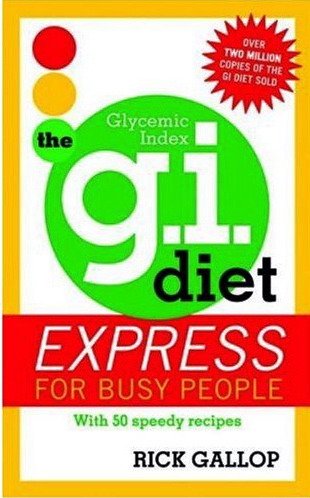
Such is the case with Rick Gallop and his series of books on The G.I.Diet. It's an interesting concept that Gallop has capitalized on selling millions of his little books. But is the information he provides useful to people who are livin' la vida low-carb? Let's examine his latest book to find out.
It's called The G.I. Diet Express: For Busy People and is aimed to reach the active dieter. Isn't that ALL of us who are attempting to lose weight? Yep and Gallop knows that, too!
Looking at the "diet in a nutshell" outlined in this book, Gallop explains what the glycemic index is since most Americans haven't really caught on to it yet. It's all about the impact of foods on blood sugar and to choose foods that will slowly digest to prevent your body from making too much insulin which can lead to diabetes.
Here's a key point to remember: All low-carb foods are also low-G.I. foods, but not all low-G.I. foods are low-carb. This is too important to be overlooked as you delve deeper into this new diet. The ratio of carbohydrates/protein/fat is 50/40/10. Yikes!
Gallop bemoans saturated fat as "positively dangerous to your health and can increase your risk of heart disease, stroke, and some cancers." Um, no it doesn't, Mr. Gallop! You're referring to the MUCH more dangerous and unhealthy trans fats found in many of those high-carb foods you love people to eat on your diet.
Using traffic light colors as symbols throughout the book, Gallop lists his approved "Greenlight" foods that I wouldn't touch with a 10-foot pole on my low-carb diet--bread, cereal, margarine, pasta, potatoes, dairy, oatmeal, and rice. Is he joking? This can't be a seriously "healthy" diet!
Sadly, that's EXACTLY what he's trying to fool people into believing. What really got me was how much emphasis was placed on portion sizes, calories, fat, salt, fiber, protein and sugar...but nary a word about total carbohydrates! Very telling!
In fact, the more I read The G.I. Diet Express: For Busy People, it quickly obvious that this book was nothing more than a wolf in sheep's clothing as a front for the USDA-indoctrinated Food Pyramid. That tried and true failure of diet consisting of high-carb, low-fat, low-calorie, portion-controlled meals we've been forced to accept as "healthy" our entire lives! Not anymore!
Many of these "50 Speedy Recipes" included in the book are quite high in carbs, although most of them could be converted into genuinely healthy low-carb meals by removing the suspiciously high-carb ingredients. I wouldn't buy the book just to have to make all these changes to the recipes, though.
And I just about had to pick my jaw up off the floor when I saw Gallop RECOMMEND fast food restaurants for his diet. He gushed over Subway for their "broad range of low-fat products" and claiming they "deserve a G.I. Diet gold star and warrant your support" for offering such high-carb junk as ham, roast beef, and turkey breast subs. Wanna take a guess how many carbs that bread has in it, Mr. Gallop? Do you care?
McDonald's, Burger King, Wendy's, Taco Bell, Arby's, and even Pizza Hut all get the thumbs up from this brilliant diet book author seeking to help people find a way to lose weight. From the looks of these recommendations, that's probably the last thing he's doing.
Sure, some people will do this diet and think it's great because their body can somehow handle the same high-carb, low-fat diet which Dr. Dean Ornish has been pushing for decades. But not for people like me who react strongly to the presence of carbohydrate in our diet in any form--after all, it turns to sugar in the body just the same.
Finally, in the FAQ section of the book, we get the real agenda of Gallop and his opposition to livin' la vida low-carb when he describes low-carb diet plans such as Atkins as "diuretics" which only work "in the short term." Hmm, that's strange you say that, Mr. Gallop since I lost 180 pounds on that diet in 2004 and have kept it off ever since.
You're just a big fraud and I'm happy to expose you as such! But you don't care since you're laughing all the way to the bank with the millions of dollars you've bilked out of people who have bought your books. Shyster!
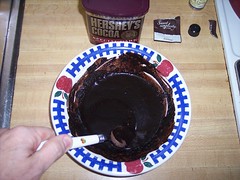
I was playing around in the kitchen yesterday and stumbled upon a low-carb chocolate dessert recipe that should fit within ANYBODY'S low-carb plan. If you need a quick chocolate fix on your low-carb diet, then this will do the trick! ENJOY!
JIMMY'S ONE-MINUTE LOW-CARB CHOCOLATE DELIGHT
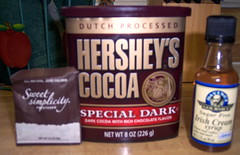
1 50mL bottle of your favorite flavor of DaVinci Syrups (I used Irish Cream!) 1-2 Tablespoons of Hershey's Cocoa (I LOVE Special Dark!) 1-2 packets of your favorite sweetener (You can use Splenda, but I used erythritol in my recipe!)
Gather all of your ingredients and a small bowl and spoon.
Pour the DaVinci Syrup into the bowl.
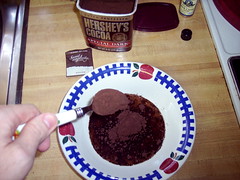
Next scoop out 1-2 Tablespoons of the cocoa. Use more to make it thicker or less for a thinner consistency.
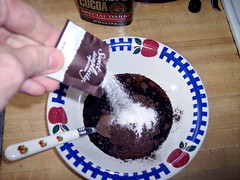
Then add your sweetener. Erythritol worked great for my recipe, but so will Splenda, stevia, or any other artificial sweetener that you love.
Stir this yummy concoction slowly with a spoon. If you do it too fast, the cocoa will spill on the counter.
Be sure to break up any bubbles or pockets of the cocoa so that it all gets thoroughly drenched. Otherwise, you could get some unsweetened cocoa in your mouth which isn't very pleasant! :S
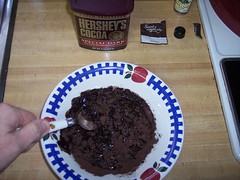
After about 30 seconds of stirring, scraping the sides of the bowl often, you should have a nice smooth, velvety chocolate mixture that resembles melted chocolate. Ooh la la!
Oh, man, just look at that--it'll make you slap your momma silly, I'm telling you. But now it's time for the taste test...
Mmmmmm...did I die and go to chocolate heaven or what?! WOO WEE, that's so good! I even got some dribbling down my bottom lip. Hee hee!
What pray tell is the nutritional lowdown on this decadent chocolate dessert? This is the BEST part:
FAT--.5g CARBS--2-3g (depending on your sweetener) CALORIES--40
If you just have to have something quick that's a little sweet and chocolately to eat when you are livin' la vida low-carb, then this stuff is da BOMB!
For a twist on the dessert eaten at room temperature, try microwaving it for 15-20 seconds for a luscious hot melted chocolate or freezing it for a fudge-like consistency. Play around with it using different DaVinci syrups and sweeteners until you find something that suits your tastes.
I promise you it's good. Let me know what you think about it if you try it! ;)
After blogging about the preliminary findings of a study comparing low-carb weight loss with a low-fat, portion-controlled diet in October 2005, I am pleased to share with you the full findings of this study as reported by Reuters recently.
Lead researcher Dr. Kevin C. Maki, investigator at the Chicago, IL-based Radiant Research, wanted to see if lowering the glycemic load and increasing the protein content of the study participants' diet would provide any advantages when it comes to weight loss (a theory already substantiated by previous research). Also, the researchers were looking at body fat composition and cardiovascular risk among the overweight and obese adults participating.
Observing the 86 study participants over an initial 12-week period and then for an additional 24 weeks thereafter, Dr. Maki split them into one of two dietary groups: A reduced-glycemic load (RGL) diet group and a traditional low-fat, portion-controlled diet group (LFPC).
The RGL group was specifically told to eat until they were satisfied, maintain a low-carb dietary intake for the first two weeks (simulating the Induction phase of the Atkins diet), and then to start adding low-glycemic-index carbohydrate afterwards. They were not required to count a single calorie (something I've never done on my low-carb plan) and were permitted to eat as much as they wanted during the study.
The LFPC group was the control in the study and were told to lower their fat intake and portion sizes aiming for an energy deficit of 500-800 calories/day. The total calories would vary by individual based on their activity level and food intake. But it was basically a low-fat, low-calorie, portion control diet.
At the end of 12 weeks, the RGL group had lost nearly twice as much weight (10.8 pounds) as the LFPC group (5.5 pounds). Additionally, the RGL group lost MORE THAN DOUBLE the amount of fat (4.2 pounds) as the LFPC group (2 pounds).
As signficant as these three-month comparison totals were, they became statistically less important at the end of 36 weeks. Weight loss as well as body fat composition after the six-month study concluded remained virtually the same as it was at the end of week 12.
However, the researchers did note that the positive change in HDL cholesterol (which was recently found in this study to be more a better health marker for cardiovascular risk than LDL cholesterol) among the RGL group was TWICE that of the LFPC group.
Dr. Maki concluded that the low-carb RGL diet is "a reasonable alternative to a low-fat, portion-controlled eating plan for weight management."
At this point, Dr. Maki would like to continue to research why the low-carb RGL diet works so well for short-term weight loss and to figure out ways continue those losses over the long-term so they can "obtain greater insight into strategies that would improve long-term weight-loss maintenance."
That's exactly what livin' la vida low-carb is all about. Lost in the debate between low-fat and low-carb is the fact that both have been found to be at least equally effective at weight loss. That's why I have been pushing for them to be recommended alongside each other by our government and health leaders now that the research has shown them to be no different. Or, as Dr. Maki states in his research, low-carb is now a "reasonable alternative."
As more and more research like this one from Dr. Maki and the Stanford JAMA study keep coming out showing livin' la vida low-carb is a viable option for people to try instead of the failed low-fat, low-calorie, portion control diets, it's gonna get a whole lot more difficult for them to keep ignoring it. They'll do their best to turn a blind eye, but at some point it will become so obvious they'll be left with no choice but acceptance.
That day can't come fast enough if we are going to beat obesity!
Should You Switch To A Low-Calorie/Low-Fat Diet After Low-Carb?
Questions about livin' la vida low-carb abound from so many brand new readers interested in learning more about this remarkable lifestyle change that is quite literally turning everything we've ever known about diet and health on its head! As someone who has personally been eating this way since 2004 and losing close to 200 pounds in the process, I am more than happy to share my experiences with others so they too can radically change their life for the better!
Most of the questions people ask me in my e-mail box have already been addressed in some form or fashion in my archives of 1700 blog posts over these past two years. One of the best ways you can find the answers to your questions about livin' la vida low-carb is to use the fantastic Google or Yahoo search engines. Enter "livin' la vida low-carb" plus some keywords you are looking for.
For example, let's say you want to find the columns I have written about "Induction," then simply do a search on "livin' la vida low-carb" and "Induction" to find the results you are looking for. That's a lot better option than trying to use the search box in the upper left-hand corner of the blog and I very highly recommend using the search engine. If I've written about it, then you'll find it that way. :)
Nevertheless, I'm always glad to hear from anyone who has a question for me, so feel free to send an e-mail to livinlowcarbman@charter.net.
I recently received the following e-mail from a man who wanted to know if at some point he needed to switch from his Atkins low-carb diet to a low-calorie/low-fat diet to "keep the weight off." Read what he has to say and then I'll provide my comments:
Hi Jimmy:
I stumbled upon your web site and read with interest your comments on low-carb diets. My brother-in-law lost 50 pounds on the Atkins diet several years back, but eventually put it back on plus many more pounds to spare. I'm sure some of this was due simply going off the "Atkins Lifestyle" and most was due to actually overeating tremendously, not exercising, and eating a lot of carbs.
I am concerned, however, that almost everyone I know who has done the Atkins diet has eventually regained their original weight. Some even continued to restrict their carbs in a modest fashion, yet still put all their weight back on.
My primary question to you is: Can a person use the Atkins diet to lose the weight that they want to lose and then switch to a moderately low calorie and low fat diet (without a lot of refined carbs) and still expect to keep most of the weight (fat off)?
Other questions if you have time:
1) It's generally thought that overeating by 3500 calories will cause one to gain a pound of fat. Does this equation still apply to a person who has gone off the Atkins diet or is there some kind of "rebound effect" when upping carbs that causes people to put on more than a pound per extra 3500 calories. I ask this because I have seen some people put on weight rapidly after going off the Atkins diet when they weren't overeating grossly.
2) I enjoy weightlifting and working out and would like to avoid losing muscle. Some claim that they have lost a lot of muscle and strength on the Atkins diet. What are your thoughts? Is much of the weight lost muscle?
My own experience with the Atkins diet was about a 9-pound weight loss in about six weeks on the diet. Much, I believe was water. I didn't care for the restrictions much, but would certainly try it again if I thought the results would be better with a longer try. I suspect that I did not eat enough fat.
I sure would appreciate your response--especially to the first question.
Awesome questions and I'm pleased to address each one.
First, let me say THANK YOU for finding my blog and I hope you will find lots of information and encouragement for you as you continue to implement permanent healthy lifestyle changes in your regular routine. Getting on the Atkins diet and staying there has meant the difference between morbid obesity and the best shape of my entire life.
Regarding your brother-in-law who gained back his weight, he's exactly what I was talking about in this blog post. It completely baffles my mind how people who lose weight on the Atkins low-carb diet and then start eating gobs of carbs again claim the diet failed them. No it didn't! YOU failed if you didn't stick with it. And not everyone who tried low-carb failed. I'm living proof of that!
I eat virtually the same way now that I did while I was losing weight, including a high amount of fat and moderate protein with very few carbohydrates. My primary sources for carbs include non-starchy green leafy vegetables, low-glycemic fruits like berries, and healthy fiber (which I subtract from the total carbs for my net carbs).
To answer your question about switching from a low-carb diet like Atkins to a low-calorie, low-fat diet, my question would be WHY? If livin' la vida low-carb helped you lose weight, then why wouldn't you want to dance with the one who brung ya, hmm?
But if someone has found success on a low-carb diet, then that means their body can not just lose weight but also keep it off for good using that nutritional approach. When you start trying to tinker with the basic tenets of low-carb living, you are simply asking for frustration and eventual failure in your efforts. There's a reason why low-calorie, low-fat diets fail and low-carb succeeds. Don't mess up a good thing!
As for your question about calories, you might want to read this blog post about a study debunking the whole "calories in, calories out" theory regarding weight loss. Although I have never counted calories on low-carb, that doesn't mean they don't count. Most successful low-carbers listen to their body and only eat when they are hungry and stop when they are full. There's nothing complicated about doing that. Welcome to how I live my life now. :)
On your question about muscle and strength on a low-carb diet, it's another myth. Noted researcher Dr. Donald K. Layman from the University of Illinois at Urbana-Champaign said in my interview with him last year that as long as you are eating an adequate amount of protein in your low-carb diet so your body can naturally produce the glucose from the amino acids you consume (though a process known as gluconeogenesis, your muscles can and will remain intact.
You might want to read this, this, and this for more information about this important subject. Also, be sure to check out Anthony Colpo's bodybuilders forum to see real people who are livin' la vida low-carb pumping themselves up!
Finally, you stated that you believe your weight loss on the Atkins diet was mostly water, but that's yet another myth about this way of eating that we keep hearing from those so-called health "experts." Read what Atkins expert Jackie Eberstein had to say about this (she worked directly with Dr. Robert C. Atkins for three decades) as well as my own detailed thoughts about it. I'll give you a hint...I don't think I'm drowning in the nearly 200 pounds I have lost!
Your assertion that you "didn't care for the restrictions much" on Atkins clearly tells me you didn't read the book closely enough. People who follow Atkins by the book know there is much more flexibility in what you can eat than just trying to make it up on your own. If I had only one thing to say to people who want to start livin' la vida low-carb, it would be this--BUY THE BOOK and then FOLLOW IT EXACTLY for the REST OF YOUR LIFE! You can't help but succeed if you do that.
THANKS again for the questions and I hope it helps you keep on livin' la vida low-carb for a long, healthy, and happy life!
The post that appeared here has been removed for not promoting the low-carb community in the professional manner I have come to expect from myself. THANK YOU!
An OTC version of the weight loss drug orlistat gets FDA-approval
It wasn't a matter of if, but when.
This Washington Post story details the disappointing news that the United States government regulatory agency over approving medicines that can be sold without a prescription in this country has given its final blessing to an over-the-counter version of a prescription weight loss drug made by pharmaceutical company GlaxoSmithKline, who calls this "the only FDA-approved weight loss product available to consumers without a prescription." Yippee freakin' skippy!
You may recall last January when I blogged about the weight loss drug orlistat following an 11-2 recommendation by a group of medical "experts" who deliberated for all of one whole day about whether the risky prescription medicine Xenical should be made available in an OTC formula.
Today, the Food & Drug Adminstration (FDA) made it official and gave the rubber stamp to sell orlistat using the name "Alli." No, it's not pronounced like Muhammed Ali (AH-LEE), but rather like the word "ally" (AL-EYE) as in someone who is on your side.
The irony in that name is that the FDA is certainly no "Alli" to anyone desiring weight loss with their outlandish and irresponsible approval of this drug. They really ought to be ashamed of themselves for putting a drug like this one out there because obesity pills are just pie in the sky promises that don't deliver without a little effort on the part of the dieter. And the FDA even acknowledges that fact.
While they don't encourage children under the age of 18 take this drug (but who are we kidding? Parents will be buying this drug for their fat kids left and right!), it is absolutely open game for adults willing to combine it with a low-fat, low-calorie, portion control diet and exercise program. That's right, just in case you missed the fine print from the FDA about this latest cure-all for obesity, the dirty little secret is you STILL have to diet!
Don't even think about livin' la vida low-carb while taking the 60 mg capsules of "Alli" right before each of your three daily meals either because it only works well in people who eat little to no fat in their diet. Yep, not only do you get the unique pleasure of having most of the fat you put inside of your body sucked completely dry like a shallow river basin in 110 degree heat, but you also are FORCED to eat a low-fat diet in the process to make it work. Aren't you just so very happy about that?!
But wait, there's more!
In addition to not absorbing dietary fat (which can be dangerous on a number of levels that you don't even want me to get into!), this drug may very well prevent you from absorbing some of the most essential nutrients in the foods you eat. Therefore, they recommend you take a multivitamin before you go nighty-night sucking your thumb while holding a fuzzy wuzzy teddy bear.
Isn't this hilarious? While opponents of livin' la vida low-carb always chastise us for promoting vitamin supplementation on our very natural and healthy way of eating, here's the FDA telling people they need to eat a low-fat diet and take supplements if they decide to start using the "Alli" OTC weight loss pill. And this is the WEAK version of the drug Xenical--can you imagine what the full-strength one is like?
Like most drugs, "Alli" is not without some really nasty side effects. Try this on for size: loose stools, excess gas, fatty stools, possible uncontrollable bowel movements, flatulence with discharge, abdominal pain, and a general sense of poop-poopy-doop 24 hours a day, 7 days a week, non-stop fun between you and the porcelain goddess! Aren't you so glad you chose to lose weight this way? NOT! Sounds about as bad as the weight loss drug for dogs I blogged about last month!
Seriously, though, orlistat is NOT for everyone (I don't think it's for ANYONE, but that's just my take on it!). People who have had an organ transplant shouldn't take it because of drug interactions and neither should people on blood thinners, who are diabetic, have a thyroid problem, binge eating disorder, bulimia nervosa, or malabsorption syndromes. The FDA says people with these conditions should consult with their before using this over-the-counter drug.
Um, maybe I'm thinking too hard about this, but why make a drug OTC if there are very real dangers to a large segment of the population with all those ailments listed above? Has the FDA completely gone out of its mind here (don't answer that question because we already know the answer)?!
I'm telling you, this is a class action lawsuit just waiting to happen. The FDA has no idea what it has gotten itself into approving a drug like orlistat and making it available to anyone and everyone walking through the grocery store, Wal-mart, or drugstore. The end result will be more obesity and a lot more tummy aches.
I've said it before, but I'll say it again and again if I have to. People need to stop looking for the next great diet pill to come prancing in like Prince Charming to swoop them off their feet with promises of weight loss nirvana. Sorry to burst your fantasy everyone but it ain't gonna happen...nor should it!
Weight loss can be achieved safely and naturally without the use of ANY drugs whatsoever. Not once during my nearly 200-pound low-carb weight loss experience over these past few years have I felt compelled to add a drug, prescription or otherwise, to my diet for the purposes of aiding in my weight loss. NEVER! If I didn't trust my low-carb lifestyle to do everything I needed it to to shed the pounds and restore my health, then I'd start looking for another way to eat.
It should be quite disturbing to anyone who is eating a low-fat, low-calorie diet right now that their diet all by itself just isn't good enough to bring about weight loss and improved health. Nope, they have to have something like orlistat to be added to them in order for them to work better (although the jury is still waaaaay out on that claim!). Why put yourself through all of that?!
Come on over to livin' la vida low-carb and enjoy what REAL healthy living is like. No drugs, no forced diet plans, no disgusting foods to put up with--just delicious foods that help produce amazing positive results in your weight and health.
"The Livin' La Vida Low-Carb Show with Jimmy Moore" Episode 20 [12:27m]: Play in Popup | Download
Okay, listen up all you supporters of the low-fat, low-calorie diets that are supposed to save the planet from obesity and disease. It is absolutely MANDATORY that you listen to this podcast show today because I offer you hard scientific evidence backing up my claim that livin' la vida low-carb is indeed a BETTER and HEALTHIER nutritional approach than your failed diets will ever be.
There's no denying the very clear fact that the low-carb lifestyle is a high-quality, proven weight and health management program that could very well be the answer we've been looking for in this great obesity crisis of our day! Share your comments about what you heard today or call the listener comment line for "The Livin' La Vida Low-Carb Show with Jimmy Moore" at (206) 203-4192.
Tune in to the show by using any of the following ways:
Have you been on a low-fat, low-calorie diet in the past because you bought into the lie that it was the ONLY way you could lose weight and get healthy? When it failed to help you keep the weight off over the long-term, did you find the low-carb lifestyle was a better option for you? Leave your comments here and please share your story. We've been graced with the presence of an anti-low-carb zealot over the past few days who wants proof that people can really eat the way that we do and be healthy. Tell her YOUR story!
THANK YOU for listening to "The Livin' La Vida Low-Carb Show with Jimmy Moore." Thousands of people are flocking to my podcast show because it is providing positive, uplifting, encouraging and educational audio episodes much in the same manner that you get here at my blog.
If you are one of the few who has not yet listened, it only lasts about 12 minutes so take a listen for just this one episode. Love it? Hate it? Either way, please let us know what you think and feel free to offer your suggestions for future podcast topics. I'm never short on ideas, but I am always open to what YOU want to hear.
Tell a friend, co-worker, or family member who could benefit from this podcast to give it a listen. It very well could change their life forever! That would be totally awesome, wouldn't it?
So share "The Livin' La Vida Low-Carb Show" with the world by putting it in your signature on your e-mails and when you post comments on your favorite low-carb forums. We have a message to share and it's getting out there! THANKS again for your help!
A nutritionist from Furman University in Greenville, SC named Kelly Frazier unfortunately took my criticisms of her anti-low-carb viewpoints as exhibiting "hostility" towards her and she believed all I did was "bash" her personally. Of course, that's not true since my comments were directed at the substance of the "Healthy Living Guide" worksheets she authored as dietary truth about carbohydrates. None of my comments were about her as a person.
It also led her two sisters--Paula and Julie Anne--to post similar comments that I should not "bash" Kelly and explaining how everyone knows just how unhealthy livin' la vida low-carb is. Yadda yadda yadda! We've heard that so many times before while refuting it point-by-point here at my blog ad nauseam.
Even still, I'm willing to defend what I believe even when the tough questions are asked of me by people like Kelly who wonder how I can support such a paradoxical nutritional approach that is in the minority of support among the so-called health establishment these days. Just because we don't conform doesn't mean we're wrong!
Nevertheless, although Kelly originally expressed to me the "pain" she felt from my original post, she was very open and willing to share her genuine questions about the low-carb lifestyle and was interested in hearing my responses back to each of them. This post today will serve to offer those answers and provide Kelly with feedback to help her understand where we are coming from as low-carb advocates.
I applaud Kelly's willingness to exchange ideas about this subject and I am proud of her for having the courage to do it when so many other nutritionists and dietitians would simply ignore whatever a low-carb supporter would have to say. That says a lot about her character and I'm honored she would at least listen to what I have to say. THANK YOU, Kelly!
I'd like to give a special thanks to my low-carb blogging friend Regina Wilshire from the "Weight Of The Evidence" blog for assisting me with answering some of these questions from Kelly. I will add links to previous posts I have written that are relevant to each question as well to give context to my answers.
Here's what Kelly wrote to me in an e-mail and my responses:
Hi Jimmy,
I am going to try to explain some of my concerns about low-carbohydrate diets below (get ready for the longest email of your life). As I mentioned during my last email, I realize that some people can achieve long term weight loss on low-carb diets.
However, our sponsors (including major universities, hospital systems, and YMCAs statewide) have decided to stick with the guidelines of worldwide nutrition authorities. I welcome your reactions to the comments below. I am glad that we can have a peaceful discussion about our differences.
Yes, I'm glad we can discuss this openly so that everyone can benefit from the curiosity of your questions since these are some of the most oft-repeated "concerns" that continue to get spread about livin' la vida low-carb. I'm anxious to set the record straight for people who believe these are actually true.
1) Nutritional deficiencies
The perception of a low-carb diet varies from person to person and diet to diet. Let's make sure that we are talking about the same thing. The traditional Atkins style low-carb diet consists of large amounts of meat, bacon, pork rinds, butter, etc.
Just as I will acknowledge that an all vegetable diet is not balanced, I hope that we can agree that an all meat diet is also unbalanced. A nutritional analysis of the meal plans recommended during the early stages of Atkins suggests that there are many nutrient deficiencies with this style of eating. We have computer programs that will analyze foods and tell you the overall vitamin and mineral content of the diet. Researchers have also done this and published the findings on Medline.
Anyone who has taken the time to actually read Dr. Atkins New Diet Revolution or Atkins For Life books, they will very likely be shocked to learn that this diet, even during the misunderstood Induction phase, is very clearly NOT an all meat, bacon, pork rinds and butter nutritional approach. Some people do try to go on a zero-carb diet, but that's not the way recommended by Dr. Robert C. Atkins.
In fact, Dr. Atkins WARNED people about eating too much cured and processed meats since they are not as good for your body as whole meats are. The truth of the matter is that green leafy and other non-starchy vegetables are ENCOURAGED even during the most restrictive Induction phase of Atkins which only lasts for two weeks. The same goes for the widely accepted South Beach Diet, too.
Following those 14 days of Induction, even more healthy carbohydrates from such healthy foods as spinach, green beans, cauliflower, blueberries, strawberries, and melons are introduced to the menu of the typical low-carb dieter. This recent survey of active low-carbers found that vegetable consumption actually DOUBLES for people who begin the low-carb lifestyle while their meat and egg consumption remained the same as before or even decreased!
In this poster presentation at the NMS scientific sessions that took place in Brooklyn, New York in January 2006, four popular government "endorsed" dietary plans (AHA No-Fad, ADA, DASH and Food Pyramid) were found to be deficient in a number of essential nutrients at 2,000 calories as published for the public to follow. Men's Health magazine featured the ADA diet deficiency in its November 2006 issue and the ADA response was basically that 2,000 calories isn't enough calories to meet RDA's for all essential nutrients.
It is incumbent upon anyone promoting any diet to publish at least seven days of menus that are nutritionally complete for essential nutrients (vitamins, minerals, trace elements), essential fatty acids and essential amino acids at the normal calorie level being promoted. Can we see such a menu from you, Kelly, because it would certainly allow us the opportunity to see what you believe is healthy?
If the "Shrinkdown" recommendations are sound and nutritionally complete, then such a request should be simple to fulfill and will benefit everyone participating in this weight loss program since such materials provide a real-world example of what is expected for consumption in the real world. Are you open to providing a seven-day menu to verifiably prove that the guidelines you've helped develop are nutritionally complete and not setting up nutritional deficiencies? We'll be waiting to see such a menu.
2) Cancer
I am also concerned about the link between excessive meat consumption and increased risk of cancer. High red meat consumption has been associated with higher rates of breast, prostate, colon, pancreatic, and kidney cancer.
Population and lab studies suggest this link. For example, higher intakes of meat generally correlate with higher incidences of these cancers. Researchers have suggested several possible mechanisms for this link.
One is that certain carcinogens may be formed during the cooking process. Chargrilling, frying, and smoking animal fat and protein can create substances such as heterocyclic amines and polycyclic aromatic hydrocarbons. Some of these substances are known carcinogens. This means that they may cause and accelerate the cancer process.
A high-fat diet has also been associated with cancer. This may be due to excess calories and obesity, but that doesn't seem to explain the whole picture. For example, when fat reaches the small intestine, the gallbladder squirts a little bile into the small intestine to help emulsify the fat (sort of like how Dawn detergent emulsifies grease when you do the dishes). Bile can be converted into secondary bile acids which are also carcinogens that seem to irritate the linings of the intestines and may accelerate the cancer process. Some evidence suggests that a high saturated fat intake increases the conversion of bile to secondary bile acids which compounds this effect.
Researchers have also suggested that excess heme iron in the diet may act as a pro-oxidant and be involved in the cancer process. Since red meat is a high source of bioavailable heme iron, this is another mechanism that may be at work.
Of course, there is an abundance of data suggesting that phytonutrients in plant foods (whole grains, fruits, vegetables, beans, olives, nuts, etc.) reduce the incidence of cancer. Diets that restrict these foods may not provide optimal nutrient intake.
What are your definitions for "high" and "excessive" within the context of this discussion, Kelly? These are merely arbitrary without real numbers attached. We cannot adequately discuss this until these parameters are understood.
The fact that you cite one or two studies to declare proof that the low-carb diet is harmful is a bit ridiculous, especially when you are talking about cancer. I have studies showing that a low-fat, high-carb diet as promoted by you has actually been found to lead to cancer in the pancreas as well as in the esophagus. Can we conclude that these high-carb diets that you promote are highly carcinogenic based on these studies? It certainly appears to be that way according to the latest research!
Kelly is most certainly correct when she notes there is a study that shows what she says it does, but there are other studies that suggest it is the processes involved in oxidative damage that are the culprit. The following was recently published in Medical Hypothesis:
"Oxidative biochemical damage is widespread in diseases. It is apparent that decreasing the amount of dietary red meat will limit the level of oxidative catalysts in the tissues of the body. Increasing consumption of vegetables and fruits elevates the levels of antioxidative components, for example, selenium, vitamin E, vitamin C, lycopene, cysteine-glutathione and various phytochemicals. These detrimental processes of heme catalysis of oxidative damage hypothesized here are not well recognized."
Oxidative damage is harmful to our cells, but it again comes down to what constitutes a nutritionally complete diet. For example, the sulphur amino acids require B6 to be metabolized to antioxidants rather than oxidants (free radicals); deficiencies within the trans-sulfuration pathway induces the generation of reactive species of oxygen and halogens, homocysteine accumulation, and the synthesis of proinflammatory molecules by macrophages, thus contributing to pathologies like atherosclerosis and tumor development.
For example, methionine is a powerful antioxidant to clear free radicals, but can cause oxidative stress if you're not consuming adequate vitamin B-6. Inadequate supply of B6 would produce an oxidative environment in the body. Other cofactors are that are critical in the process too are B12, B-complex, choline, folic acid, and magnesium. So while it's easy to point to the potential of heme iron from meat, there are other equally important factors to consider before jumping the gun and suggesting individuals eliminate meat from an otherwise healthy and nutritionally complete diet!
3) Saturated fats
You mentioned that they were very healthy. I am interested to hear the logic behind that statement. I understand that during active weight loss, all bets are off. Saturated fats do not appear to increase LDL in some people while they are losing weight.
Since weight loss also tends to decrease LDL, the effect of saturated fats on LDL seems to be diminished in some people while they are losing weight. However, if you do a quick search of literature on Medline (what researchers use to evaluate published literature, www.pubmed.org), you will find thousands of articles describing the negative effects of saturated fats on raising LDL, risk for certain cancers, and other ailments.
It appears that the liver has a hard time clearing cholesterol when excess saturated fats are consumed. It may start to package more cholesterol as low-density lipoproteins. LDL, as you probably know, is involved in the process of atherosclerosis. It appears that when oxidized, LDL damages the delicate endothelial cells that line the arteries and starts the process of plaque build-up. LDL may also contribute to atherosclerosis by joining the plaque build-up itself (LDL acts kind of like spackle on walls).
Studies conducted before 2000 categorize trans fatty acids as saturated fats which merely serves to confuse the data. We must keep the proper context when discussing issues like this because it plays an important role in understanding what it all means.
We know from reviewing the literature that insulin is atherogenic and a high intake of carbohydrates stimulates both higher blood sugars and, thus, higher levels of insulin in the blood. This is why a low-carb diet was found in this study to actually LOWER the existence of saturated fat in the body compared with those on a low-fat diet. Hmmm, ironic, isn't it?
We also know, from decades of research that LDL cholesterol is most certainly NOT the whole story--HDL, triglycerides and the levels of the harmful vLDL are critically important to overall health and well-being. A low-carb diet not only has the potential to increase LDL (specifically the large "fluffy" benign type), but it raises HDL levels while significantly lowering triglycerides to below 100--considered VERY healthy! In fact, my HDL is around 72 and my triglycerides are at 43. Will anyone argue with me that this is unhealthy?
It is all too easy to adopt a viewpoint based on findings that are in agreement with your personal views. But a closer look at the actual literature that has been coming out in recent years and continues to pour out in 2007 very clear does not support the lipid hypothesis that so many health "experts" believe and often point to a different direction to consider when it comes to healthy cholesterol levels. Especially for people who are livin' la vida low-carb, the cholesterol concerns are a moot point.
Kelly, if you want to read more scientific data on this subject of cholesterol, then you may want to pick up a copy of the book The Great Cholesterol Con by independent researcher Anthony Colpo from Australia for more information. It's available on Amazon.com.
4) Bone health is my next concern. Meat contains high amounts of protein, especially sulfur containing amino acids. High protein intakes, especially of sulfur containing amino acids, appear to accelerate calcium excretion in the urine. This may contribute to a higher risk of osteoporosis. High protein diets have been associated with a higher rate of bone fracture (e.g., Harvard's Nurses Health study).
Again, I must ask, what is the definition of the word "high" in this context, Kelly? That's such an arbitray term--do you have any hard numbers you can assign to it?
But to directly address your point, I can point you to this study released in December 2006 that found low-CALORIE diets put bones at risk for degeneration, NOT low-carb ones. This was published in the Archives of Internal Medicine, a highly respected medical journal. What is your response to that?
There are many more studies that specifically say protein intake is NOT correlated with bone health, calcium loss leading to fractures, and that nutritional density of the diet is important to properly understand bone health.
5) Kidney and liver health are my next concerns.
Protein differs from fat and carbohydrate in several ways. While carb and fat are made of carbon, hydrogen, and oxygen, protein also has nitrogen. This means that for protein to be metabolized (including for gluconeogenesis), your body must excrete the extra nitrogen. To do this, it kicks of the protein's amine group and excretes it as urea.
High amounts of urea may cause or worsen kidney complications. According to the American Liver Foundation "Certain proteins are converted into ammonia, a toxic metabolic product, by bacteria in the intestine or during the breakdown of body protein. The ammonia must be broken down by the liver and made into urea which is then excreted by the kidneys." They also add "good nutrition - a balanced diet with adequate calories, proteins, fats, and carbohydrates - can actually help the damaged liver to regenerate new liver cells."
In individuals with mild kidney disease, high protein diets can be life threatening (Please see proteinuria) The National Kidney and Urologic Diseases Information Clearinghouse adds "In people with diabetes, excessive consumption of protein may be harmful. Experts recommend that people with kidney disease of diabetes consume the recommended dietary allowance for protein, but avoid high-protein diets. For people with greatly reduced kidney function, a diet containing reduced amounts of protein may help delay the onset of kidney failure. Anyone following a reduced-protein diet should work with a dietitian to ensure adequate nutrition."
To sum all of that up, carbohydrates are clean burning fuel. They do not create excess metabolic waste products like urea that can damage the kidneys. When fats are metabolized without the presence of glucose, ketone bodies are formed. Since fats cannot be used by the brain and nervous system directly, ketones are formed to help the body survive during periods of starvation. Ketones can cause the blood pH to drop to deadly levels (also known as a diabetic coma).
The science behind this is very clear here. Anyone who has normal kidney function is NOT at any higher risk for kidney disease eating a low-carb diet. The issue of protein is a red herring and does not address the critical importance of nutrient-density as I have noted previously about this nutritional approach.
It is advised, across the board, by every medical professional who uses a low-carb nutritional approach on patients that those with advanced kidney disease should NOT follow this diet unless they are under strict medical supervision. Anyone with kidney disease should consult their physician before beginning a low-carb program. Those with normal kidney function are not going to get kidney disease just because they restrict their carbohydrates and eat foods like meat or eggs.
One final observation: Studies in real people with diabetes have found improvement in kidney function in those who follow a low-carb diet as well as a stabilization of their blood sugar levels. How about that?
6) Other interesting info according to Sizer and Whitney's Concepts and Controversies
From my nutrition course that I teach at Furman:
"Scientists have only recently uncovered other roles for sugars in living tissues. For example, sugar molecules dangle from many of the body's fat and protein molecules. Once thought to be mere hitchhikers, these sugars can often have dramatic effects. They can change the shape of a protein, for instance, by altering its function. The protein of mucus, which protects body membranes and the digestive tract with a slippery coating, depends on a sugar molecule for its functional properties. Sugars also bind to cell membranes, affecting cellular interactions that may play roles in disease processes."
Of course, the authors are using the word "sugar" to describe the fragments of carbohydrate containing foods (mono- and disaccharides) and are not suggesting that we eat large amounts of table sugar (sucrose).
Humans have five ways to create increases of glucose in their bodies, but only one to lower it. This suggests that in the evolution of the human body, high blood sugar was not a threat to our ancestors who did not have the instant access to carbohydrates that we have today. Instead, what they dealt with was low blood sugar, so their body was able to create all the glucose it needed for survival.
As we stand today in 2007, there remains NO actual requirement for carbohydrates in the human body to survive, but we do NEED both fatty acids and amino acids from the fats and proteins we consume or we will die. Yes, you heard me correctly--we can all live just fine without consuming another carbohydrate for the rest of our lives (because of that amazing little process known as gluconeogenesis!).
7) Participant adherence is my final concern
The low-carbohydrate lifestyle is very challenging to adhere to. By offering participants a moderate approach to weight management (e.g., enjoy a variety of foods in moderate amounts, include moderate physical activity regularly), we hope that participants will learn a lifestyle that they can maintain long-term. If we suggested a more drastic approach such as low-carb, low-fat, or vegan diet, they may give up when it becomes difficult to adhere to it.
With regards to blood glucose control and insulin fluctuations, the American Diabetes Association actually encourages individuals with diagnosed diabetes to follow a balanced diet of fruits and vegetables (even starchy ones), whole grains, lean meats, and healthy fats. (Please see this article)
I am not sure that I understand the theory that eating more than 100 grams of carbohydrate per day would cause "spikes in blood sugar." By eating moderate amounts of complex carbs, fat, and protein over the course of the day (3-6 evenly spaced meals), the blood sugar should remain steady and little energy will be converted and stored as fat. Complex carbohydrates must be broken down before they are absorbed so they generally do not induce a large glycemic response (with the exception being fast acting starches like those in white potatoes). If you include small portions of healthy fats and lean protein with the meal, they delay the emptying of the stomach contents and also slow the glucose response.
I recall you mentioning that the meat focus is a myth about low-carb diets. This leads me to believe that you don't recommend this style of diet. Perhaps a healthier lower-carb approach would consist of an abundance of vegetables and fruits and moderate amounts of whole grains, lean proteins, and healthy fats. This follows the Mayo Clinic Healthy Weight Pyramid that we recommend during Shrinkdown.
Since we cannot medically supervise our participants and do not know if they have existing health complications (e.g., kidney, bone, liver disease or susceptibility to certain cancers), we feel that it would not be prudent for us to recommend a low-carbohydrate diet when we are aware of the potential risks.
Kelly, the fact is that ALL weight loss endeavors are a challenging venture regardless of the nutritional approach implored. Any effective weight loss plan is going to restrict SOMETHING--low-carb cuts back on the carbs, low-fat lowers the fat, low-calorie reduces caloric intake, and portion control decreases the amount of food consumed.
This deprivation that exists with all weight loss diets is crucial to seeing success. There's no way I could have ever lost over 190 pounds if I didn't cut back on carbs, calories, fat, or portions. But to remain healthy while losing the weight, it is important to choose a plan that will make that happen and provide adequate nutrients for your body. Livin' la vida low-carb was that plan for me and it could very well be the plan that works for many others, too!
My problem with the "Shrinkdown" recommendation is that it is a one-size-fits-all low-fat, low-calorie dietary approach with the exact same risks you expressed about low-carb diets. The participants really have no business blindly following these nutritional guidelines provided by you and the other "Shrinkdown" literature authors without consulting their doctors first to see if it is healthy for them.
The bottom line is the dietary recommendations made in the "Shrinkdown" program seem to be nutritionally deficient and may be leaving you and the organizers of this event open to liability for endorsing a blatantly unbalanced dietary approach that is in fact nutritionally deficient and incomplete when followed.
Of course, you can prove me wrong, Kelly, by providing a week's worth of menus that either meet or exceed the recommended daily nutrient requirements. If you cannot do this, then can you live with promoting a diet that may very well lead to chronic disease and quite possibly even death for the people following such a plan?!
Do you REALLY believe in your own diet enough that you are unashamed to provide just seven days of what a healthy low-fat, low-calorie diet should actually look like? I'm willing to continue the conversation if you are willing to submit what should be an extremely easy request. Are you up to the challenge, Kelly? I'll be waiting...